

Quick answer: The IR distance on a spec sheet is the reach of the infrared illuminator: at that distance a person is visible as a shape, not identifiable. Identification depends on pixel density on the subject, which the lens and the sensor set, not the LEDs. A 2.8 mm camera printed at IR 164 ft (50 m) detects at 164 ft and identifies a face at roughly 14 to 21 ft (4.3 to 6.5 m); a varifocal such as CS-I4US L-2.8-12mm, printed IR 262 ft (80 m), pushes identification out by narrowing the view. Spec the lens for the evidence distance first, then check that the IR reaches it.
Illumination distance vs identification distance
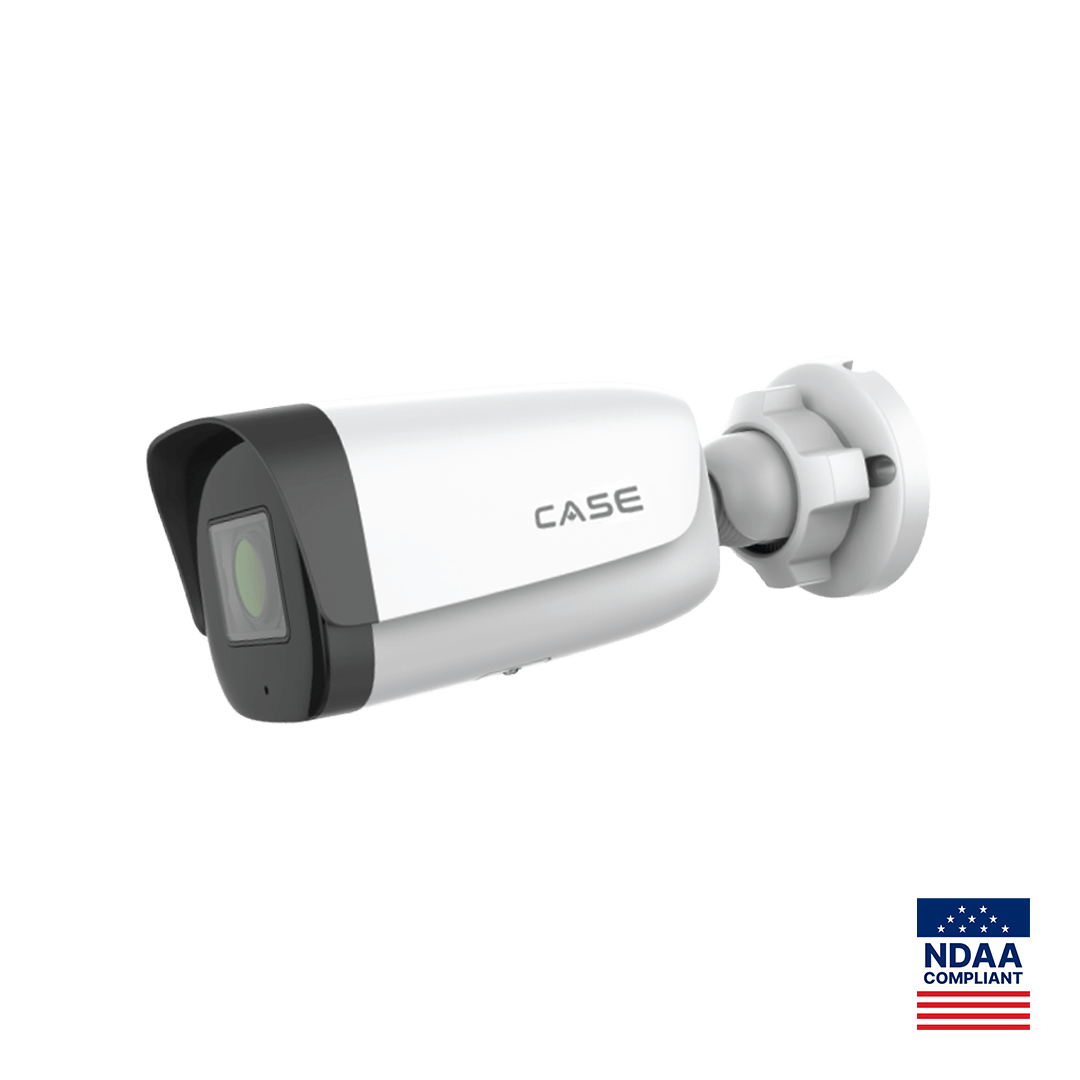
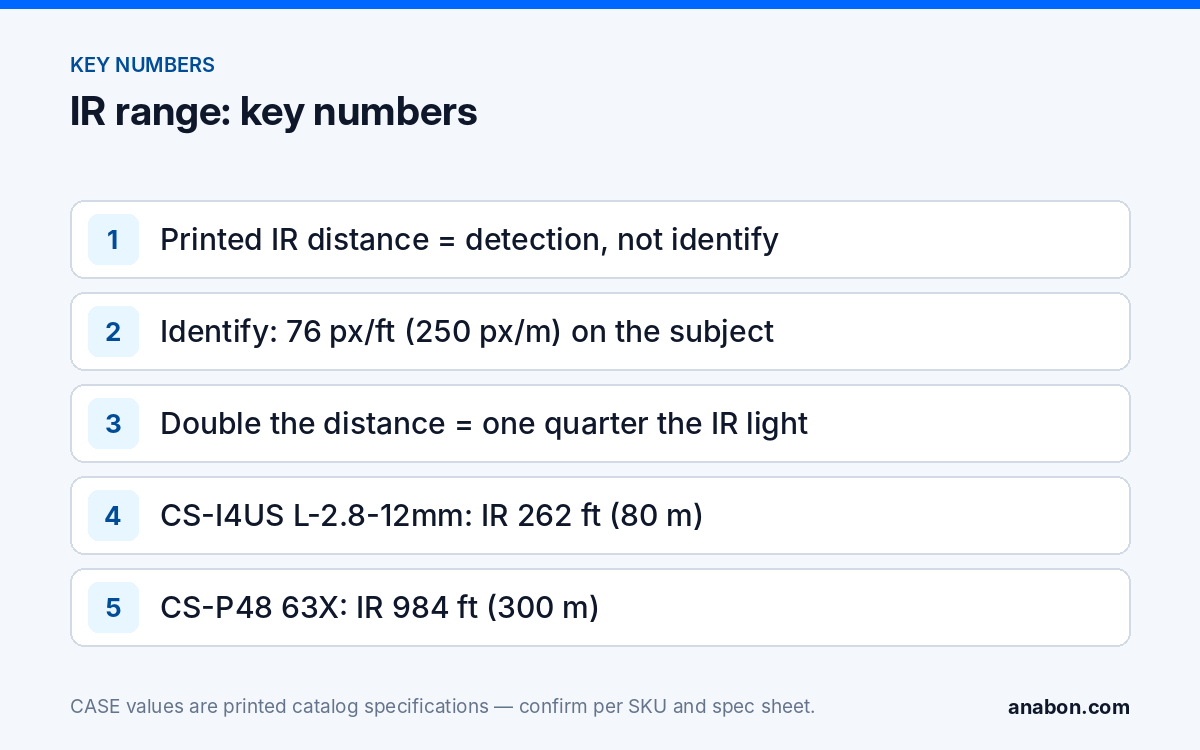
Most CASE camera pages print a Max. IR Distance row: 98 ft (30 m) on CS-I8KS SD-2.8mm, 164 ft (50 m) on CS-I8WS SD-2.8mm, 262 ft (80 m) on CS-I4US L-2.8-12mm, 984 ft (300 m) on CS-P48 63X. The figure answers one question: how far the built-in LEDs throw enough near-infrared light for a usable monochrome image. It is a property of the illuminator, measured by the maker under its own conditions, and says nothing about whether the person at that distance can be recognized.
Two physical facts set the limit. Light from the LEDs falls off with the square of distance, so a subject at 164 ft (50 m) receives one quarter of the light a subject at 82 ft (25 m) receives, and the camera raises gain to compensate, which adds noise. And the subject at that distance occupies a small patch of the sensor. IEC 62676-4 gives the usual yardstick: about 7.6 px/ft (25 px/m) on the subject to detect, 19 px/ft (63 px/m) to observe, 38 px/ft (125 px/m) to recognize a known person, and 76 px/ft (250 px/m) to identify an unknown one. The printed IR distance is normally a detection distance; the identification distance is a lens question, and it is much shorter.
How lens and resolution decide what the IR actually shows
Pixel density is resolution divided by the width of the scene at the subject distance, and the lens sets that width. A worked example with an assumed horizontal view of about 100° for a 2.8 mm lens (the spec sheet gives the exact angle per SKU): an 8MP sensor is 3,840 pixels wide. At 164 ft (50 m) the scene is about 391 ft (119 m) wide, so the subject gets about 9.8 px/ft (32 px/m): detection. At 98 ft (30 m) it is 16 px/ft (54 px/m): still short of observation. Identification at 76 px/ft (250 px/m) arrives at roughly 21 ft (6.5 m). A 4MP sensor at 2,560 pixels wide identifies at about 14 ft (4.3 m). Those numbers are why a wide-angle camera at the far end of its IR range produces a figure walking, not a face.
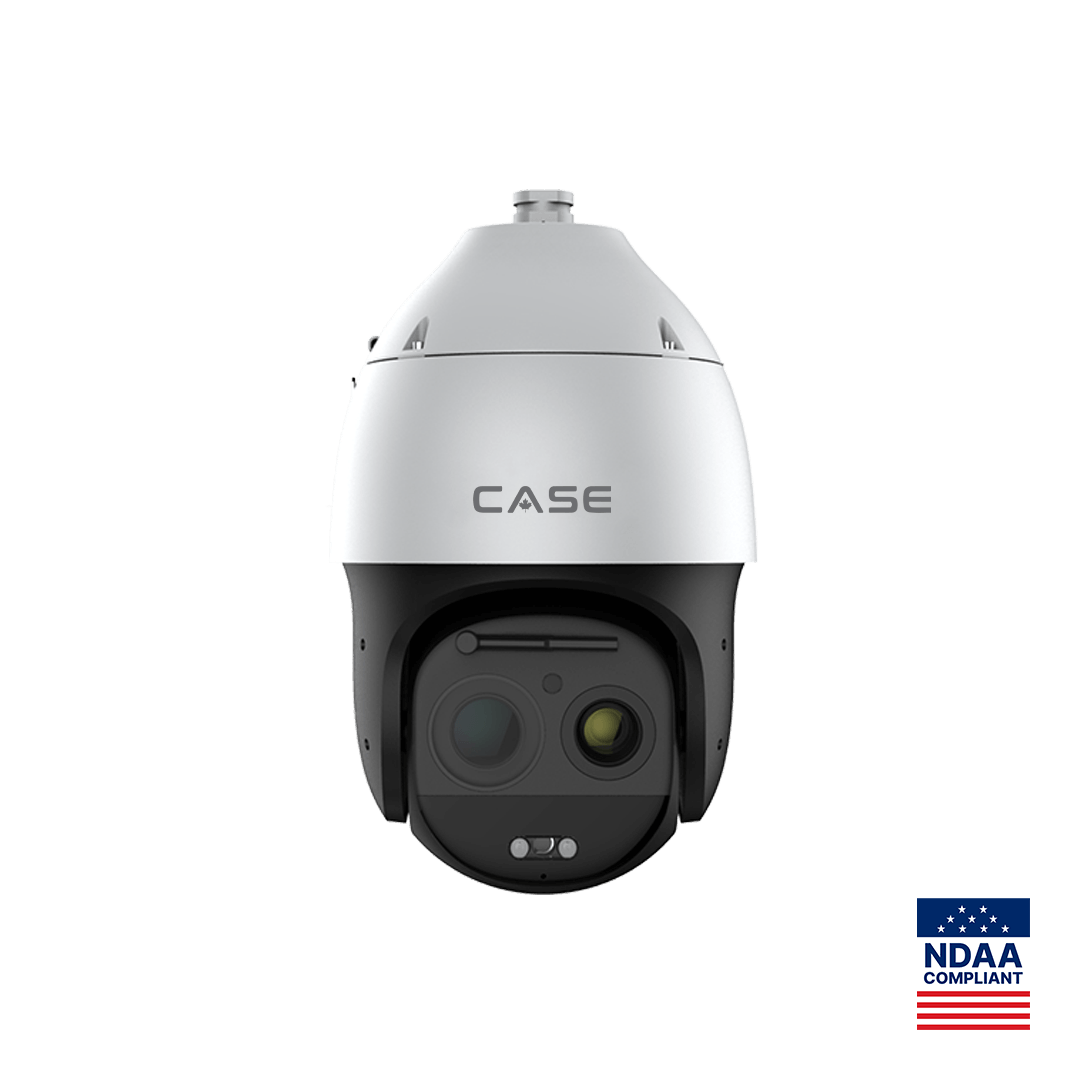
Narrowing the lens changes everything. The same 4MP sensor behind the long end of a 2.8–12 mm varifocal, with an assumed view near 28°, identifies at about 67 ft (20 m), recognizes at about 135 ft (41 m) and observes to the end of the printed 262 ft (80 m) IR on CS-I4US L-2.8-12mm. The IR did not change; the pixels per foot did. On a PTZ such as CS-P48 63X (5.7–359 mm, IR 984 ft (300 m)) the operator zooms into the illuminated scene, the only way 984 ft of IR becomes more than detection. The field of view and lens calculator walks through the math per lens.
| Evidence level (IEC 62676-4) | Pixel density on the subject | What the clip shows |
|---|---|---|
| Detect | 7.6 px/ft (25 px/m) | Something is there; direction of travel |
| Observe | 19 px/ft (63 px/m) | Clothing type, carrying something, vehicle class |
| Recognize | 38 px/ft (125 px/m) | A person the viewer already knows |
| Identify | 76 px/ft (250 px/m) | An unknown person, usable in evidence |
Smart IR and overexposure
The opposite failure happens close in. An illuminator sized for 164 ft (50 m) puts far too much light on a face at 6 ft (2 m), and the result is a white oval with no features: the camera that could not identify anyone at the fence also cannot identify the person at the door. Smart IR is the firmware answer: the camera lowers LED output or shortens the shutter when a bright, near subject appears, then restores it when the subject leaves. The catalog prints Smart IR explicitly on CS-P58 T-44X; on the fixed cameras it is a configuration item, confirmed per model and firmware. Where it is adjustable, set the IR level for the nearest subject you need to identify and let the far field detect.
Placement fixes more than the slider. A camera aimed down a corridor or along a fence sees subjects at a range of distances, which is where smart IR earns its name. A camera aimed at a door from 10 ft (3 m) with its LEDs at full power overexposes every face unless the level is reduced. Door positions are often better served by a white-light or low-light color SKU (see full color night vision explained); long views are where IR belongs.
Four things that shrink the usable IR range
- Weather. Rain, snow and fog scatter IR straight back into the lens; snowfall fills the frame with sparks and the far field disappears. The printed distance assumes clear air.
- Near surfaces. A wall, soffit or branch inside the beam reflects IR into the lens and drives the exposure down for the whole scene. Keep the first 6 ft (2 m) in front of the camera empty, and keep the dome bubble clean; a fingerprint on it glows under IR.
- Heat. LEDs are heat sources. CS-P48 63X prints operating conditions of −40 °F to 158 °F (−40 °C to 70 °C) with IR off and −40 °F to 104 °F (−40 °C to 40 °C) with IR on; on a sun-facing mount the IR limit is the one that counts.
- Insects and webs. IR attracts insects; webs across the lens appear as bright strands and trigger motion events. See night image problems: IR glare, foggy domes, insects and spider webs.
IR range across CASE models (as printed)
The table lists the Max. IR Distance and lens rows as printed in the 2027 Q1 catalog, with the position each reach suits. Confirm the row on the SKU spec sheet before it goes into a schedule.
| SKU | Form | Max. IR Distance (printed) | Lens (printed) | Position it suits |
|---|---|---|---|---|
| CS-I8KS SD-2.8mm | 8MP dome, IP67 and IK10 | 98 ft (30 m) | 2.8mm Fixed | Lobby doors, corridors; white light 33 ft (10 m) |
| CS-I8WS SD-2.8mm | 8MP bullet | 164 ft (50 m) | 2.8mm Fixed | Building faces, medium lots; white light 49 ft (15 m) |
| CS-I8XQ II-2.8mm | 8MP deterrence turret | 164 ft (50 m) | 2.8mm Fixed | Entrances and yards with EW; white light 98 ft (30 m) |
| CS-I4US L-2.8-12mm | 4MP motorized varifocal bullet | 262 ft (80 m) | Motorized 2.8-12mm | Fence lines, driveways, dock faces at distance |
| CS-I8TS I-2.7-13.5mm | 8MP varifocal AI bullet | 262 ft (80 m) | 2.7mm – 13.5mm | The same views with the on-camera AI list |
| CS-P24S 23X | 2MP PTZ | 492 ft (150 m) | 5 – 115mm (23X) | Yards and lots with an operator or presets |
| CS-P48 63X | 4MP laser PTZ | 984 ft (300 m) | Motorized lens 5.7-359mm (63X) | Perimeters, large open sites, tracking |
| CS-I4SV S-2.8mm | 4MP PhotonX turret | N/A (no IR) | 2.8mm Fixed | Color at doors from ambient light, 0.0001 Lux; white light 33 ft (10 m) |
Reading the table: the three 2.8 mm fixed cameras differ in IR reach but share the same wide view, so their identification distance is similar and short; the difference is how far they detect. The two varifocals turn 262 ft (80 m) into recognition distance only at the long end of the lens, set and documented at commissioning. The PTZs reach because they zoom. CS-I4SV S-2.8mm is the other route: no IR, color from ambient light, a different tool for a different position.
How to test IR range on site
- Mount the camera at its final height and angle; a test on a tripod at 5 ft (1.5 m) proves nothing about a soffit at 12 ft (3.7 m).
- After dark, with site lighting in its normal state, mark distances with cones at 25, 50, 100 and 150 ft (7.5, 15, 30 and 45 m), further for varifocals and PTZs.
- Have a colleague walk to each mark, stop, face the camera for five seconds, then turn sideways. Record the whole pass.
- Review on the NVR monitor at full resolution and score each mark: detect, observe, recognize, identify. The mark where the face stops being usable is the identification distance at that lens setting.
- Check the nearest mark for overexposure and adjust the IR level or smart IR setting until the near face is usable too.
- Record the scored distances and the lens setting in the commissioning report; it answers the later question of why the fence camera did not identify someone at 150 ft (45 m).
What to tell your customer
“The IR distance on the data sheet is how far the camera can see that someone is there at night, not how far it can identify them. Identification depends on the lens and how large the person is in the picture, so we place wide cameras to detect across the lot and narrower ones at the gate and the doors for faces. We test each one at night before handover and record the distances.”
FAQ
What does a 50 m IR rating on a security camera actually mean?
It is the distance at which the built-in infrared illuminator still produces a usable monochrome image, measured by the maker under its own conditions, and it is written here as 164 ft (50 m). At that distance a wide-angle camera detects a person; it does not identify one. Identification depends on pixel density on the subject, which the lens and sensor set.
How far can a 2.8 mm camera identify a face at night?
With an assumed horizontal view of about 100°, an 8MP sensor reaches the 76 px/ft (250 px/m) identification density at roughly 21 ft (6.5 m), and a 4MP sensor at about 14 ft (4.3 m), regardless of whether the IR is printed at 98 ft (30 m) or 164 ft (50 m). The spec sheet gives the exact angle per SKU; test the distance on site.
Why are faces washed out close to the camera at night?
An illuminator sized for a long reach puts too much light on a subject at 6 ft (2 m), so the face records as a white oval. Smart IR lowers LED output or shortens the shutter for near subjects; where the IR level is adjustable, set it for the nearest subject you need to identify. At door positions a white-light or low-light color camera is often the better choice.
Does a longer IR range mean a better camera?
No. It means a stronger illuminator, which is useful on long views and a problem at close range. CS-I8KS SD-2.8mm prints 98 ft (30 m) and suits a lobby; CS-I4US L-2.8-12mm prints 262 ft (80 m) and suits a fence line. Match the IR reach to the evidence distance the lens can deliver, and confirm both on the SKU spec sheet.