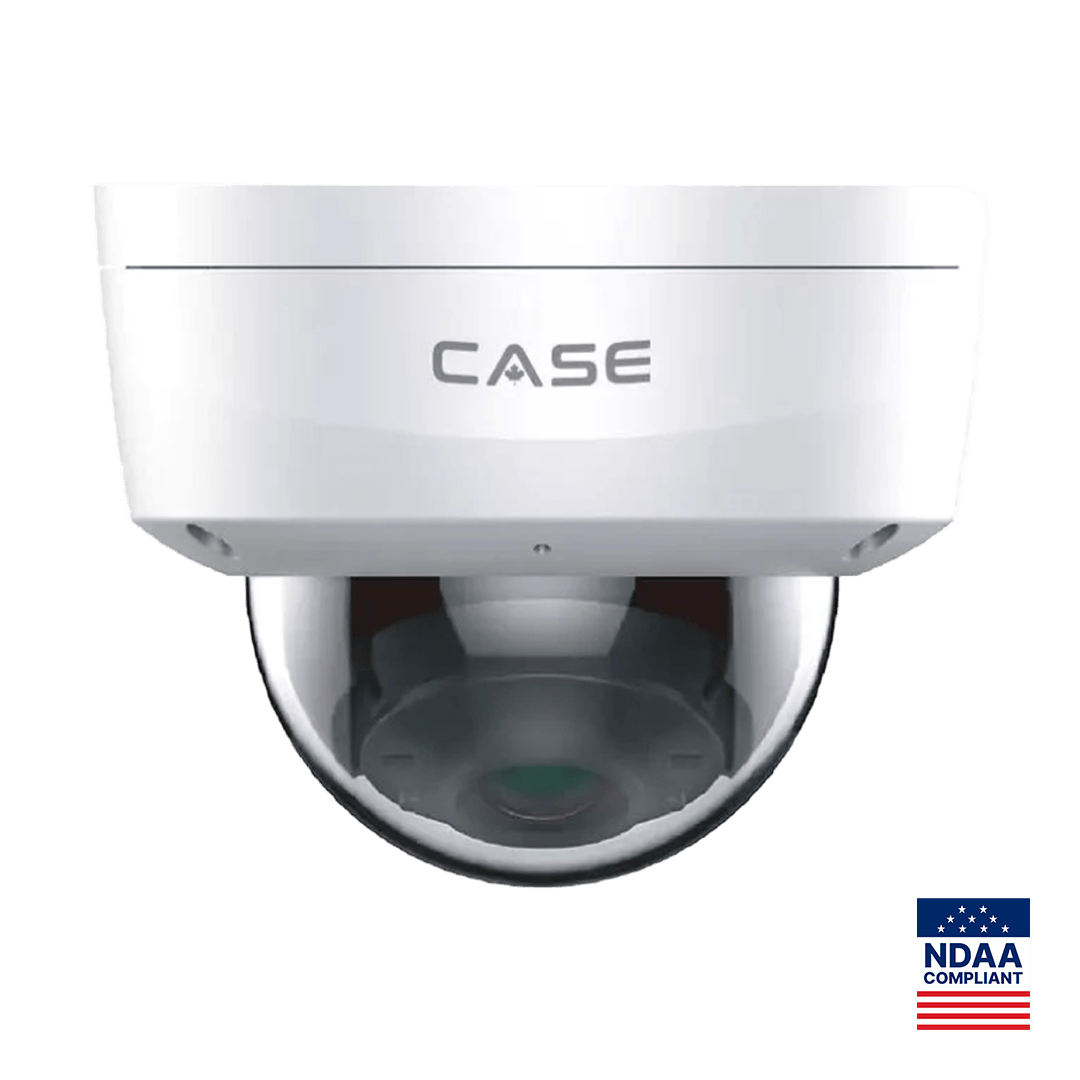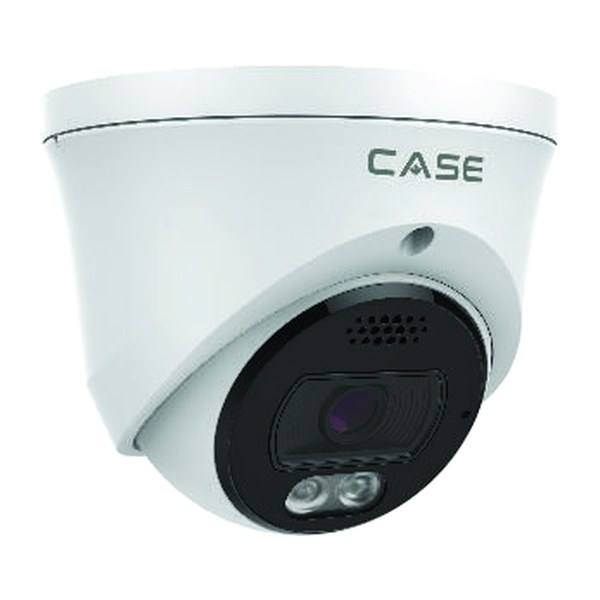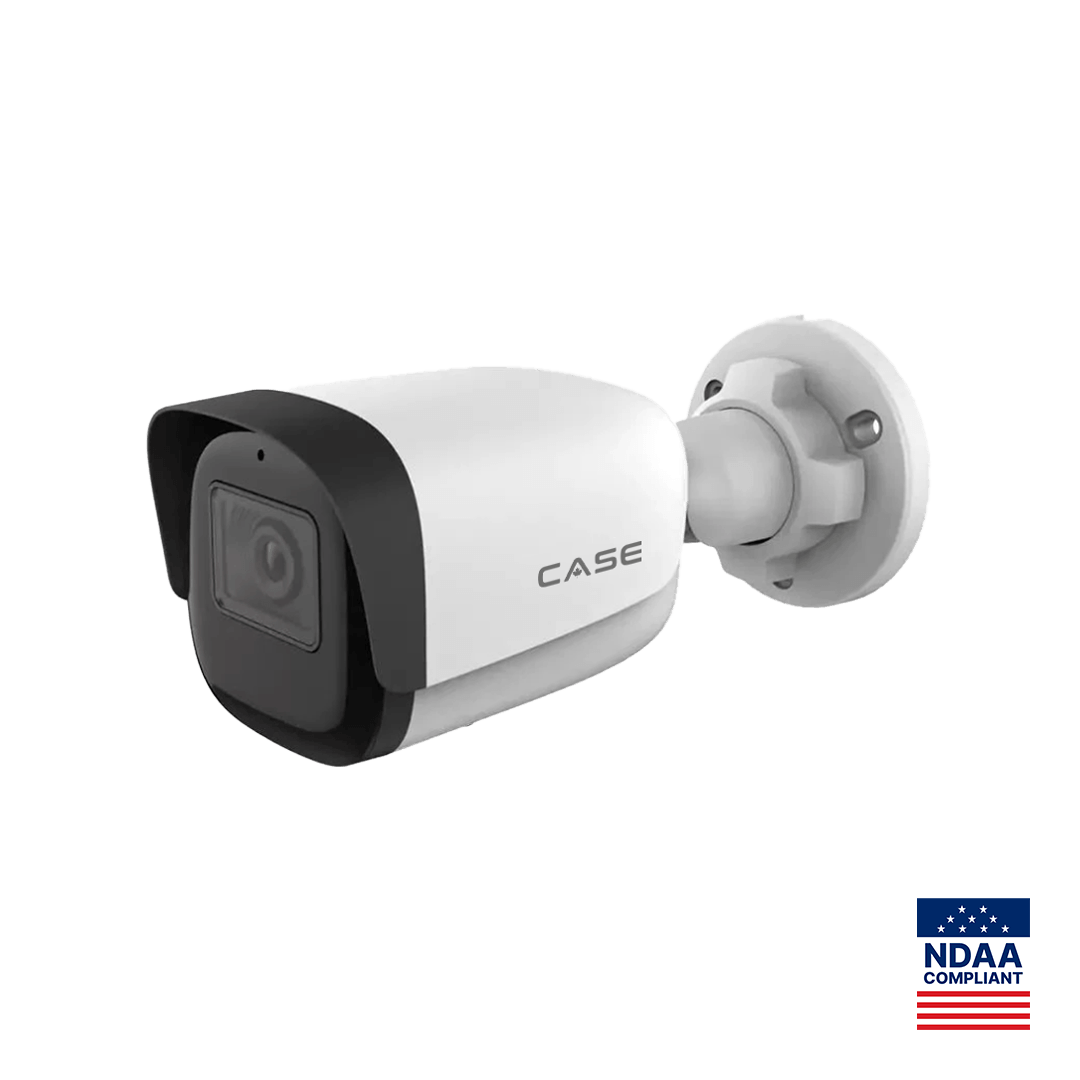


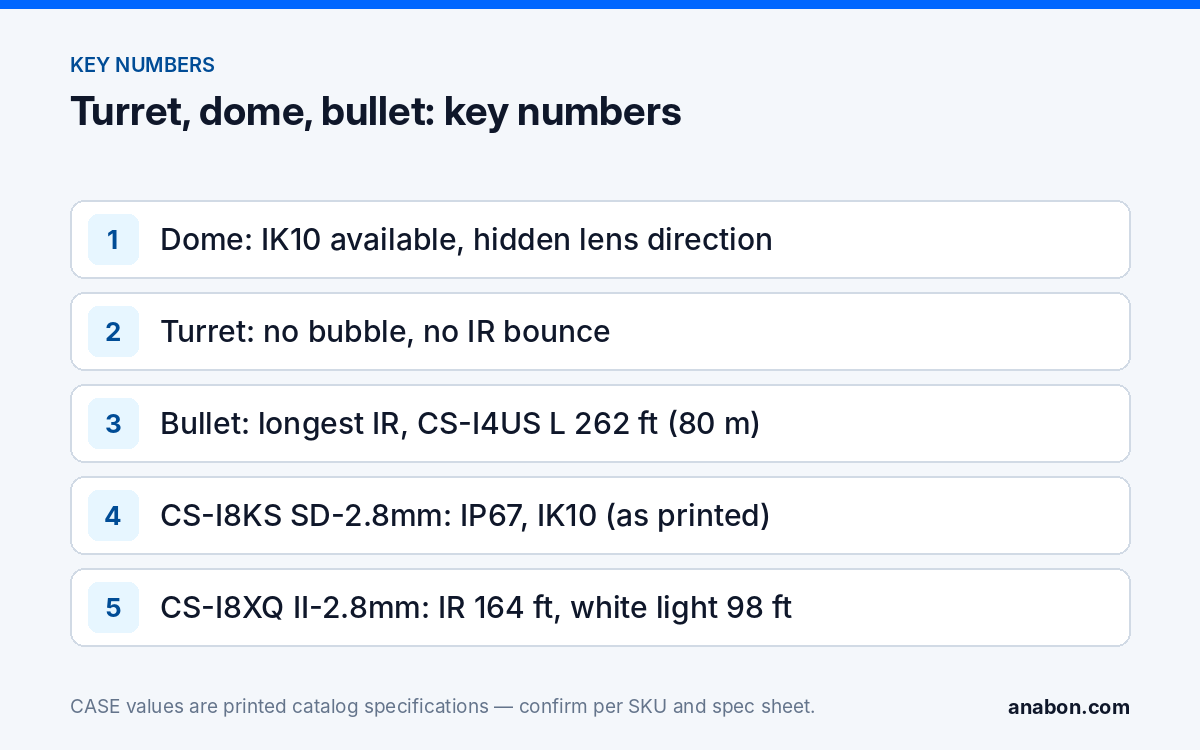
Quick answer: Pick the housing by the mounting position and the threat, not by looks. A dome is the ceiling and reachable-height choice because it hides the lens direction and is the form that prints an IK10 rating among the CASE examples here (CS-I8KS SD-2.8mm prints IP67, IK10). A turret is the soffit and wall choice: no bubble, so no IR bounce, easy to re-aim, and room for a microphone, speaker and white light (CS-I8XQ II-2.8mm). A bullet is the pole and perimeter choice: the longest IR throws, a hood against rain and glare, and a visible presence; the bullet CS-I4US L-2.8-12mm prints IR 262 ft (80 m).
Turret vs dome: what changes when you remove the bubble?
A dome puts the lens, the IR LEDs and the sensor behind one polycarbonate bubble. A turret (often called an eyeball) exposes a ball-shaped module with a flat window; the IR LEDs sit around the window, separated from it by the housing. That one difference drives most of the trade-offs.
IR bounce is the dome’s weak point. IR light leaving the LEDs can reflect off the inside of the bubble and back into the lens, producing a milky haze at night. It happens when the foam gasket between the LED board and the bubble is not seated, when the bubble is scratched, or when the dome is mounted so close to a wall or eave that the beam hits a surface a few feet away. A turret designs the problem out because there is no bubble. For the night-imaging side of this choice, see full-color night vision explained.
The dome wins on two things: the lens direction is hidden, which keeps a corridor camera from telegraphing its blind spots, and the bubble lets the housing carry an impact rating. Of the five examples below, only the dome prints an IK level. A turret can be re-aimed by hand by anyone who can reach it, so a turret below 10 ft (3 m) in a public corridor is the wrong camera even when the image is better.
Bullet vs turret: when does the longer housing earn its place?
A bullet’s cylinder has room: for a larger IR array, for a motorized varifocal lens, and for a sunshade that keeps rain and low sun off the glass. The printed figures show it. CS-I4US L-2.8-12mm, a bullet, prints IR 262 ft (80 m) and a motorized 2.8 to 12 mm lens; CS-I8WS S-2.8mm, a fixed bullet, prints IR 164 ft (50 m). The turret CS-I5XS SD-2.8mm prints IR 98 ft (30 m). Where the subject is 100 ft (30 m) or more away on a pole or fence line, the bullet is the form that reaches.
The turret answers back on the building itself. Under a soffit or on a wall at 10 to 12 ft (3 to 3.7 m), nothing needs 262 ft of IR, and the turret’s compact housing, flat window and hidden cabling are tidier. The second-generation CS-I8XQ II-2.8mm shows how much fits inside a turret today: 8MP at 3840×2160@30fps, IR 164 ft (50 m), white light 98 ft (30 m), a built-in microphone and speaker, red and blue light, and a 1 TB memory slot, as printed. A bullet on a wall is also easier to knock off aim with a ladder or a delivery truck mirror, and it gives spiders a sheltered hood to anchor a web in front of the lens.
Bullet vs dome: the two ends of the visibility scale
The bullet is the most visible form, the dome the least, and both facts are useful. In a parking lot, a yard or a fence line, the customer usually wants the camera seen; a bullet on a pole at 12 to 15 ft (3.7 to 4.6 m) reads as “this site is covered” from the street. In a retail floor, lobby or office, the customer wants coverage without a visual statement; a dome on the ceiling does that and, with IK10, survives contact. For “bullet vs dome” searches the honest answer is that they rarely compete for the same position: one is a pole camera, the other is a ceiling camera. The question is which of the two meets the turret in the middle, and the table below is how to decide.
Comparison table: IR, vandal resistance, adjustment, aesthetics, snow
| Criterion | Dome | Turret | Bullet |
|---|---|---|---|
| IR bounce risk | Highest: LEDs and lens behind one bubble | Lowest: no bubble, LEDs separated from the window | Low; glare if aimed at a nearby surface |
| Impact rating | IK10 available (CS-I8KS SD-2.8mm prints IP67, IK10) | None printed on the CASE examples here | None printed on the CASE examples here |
| Field adjustment | Pan, tilt and rotate inside; remove the bubble to re-aim | Rotate and tilt the ball; re-aim without opening | Pan, tilt and rotate on the bracket; re-aim without opening |
| Lens direction visible | Hidden | Visible | Obvious |
| Visual profile | Lowest | Moderate | Highest; deterrent by presence |
| Ceiling or wall | Ceiling first; wall with a tilted bubble | Either | Wall and pole |
| Spiders and insects | Webs show as glowing arcs under IR | Flat window, easiest to wipe | Hood shelters webs in front of the lens |
| Snow and ice | Fine flat under a soffit; collects snow on a wall | Lens stays clear unless aimed upward | Hood sheds icicles in front of the lens; needs an overhang or downward tilt |
| Typical IR reach (printed examples) | 98 ft (30 m) | 98 to 164 ft (30 to 50 m) | 164 to 262 ft (50 to 80 m) |
| Audio hardware | Mic on the examples; no speaker | Mic and speaker on CS-I8XQ II-2.8mm | Mic on the examples; speaker on some SKUs |
Where the rows say “none printed”, that is the instruction: do not add an IK value to a proposal that the spec sheet does not print. For what the IP and IK figures mean on site, see IP66 vs IP67 vs IK10.
CASE examples by form factor (as printed in the CASE Catalog 2027 Q1)
| SKU | Form | Resolution | IR / white light | Protection | Housing | Operating conditions |
|---|---|---|---|---|---|---|
| CS-I8KS SD-2.8mm | Dome, 2.8 mm fixed | 8MP, 3840×2160@20fps | 98 ft (30 m) / 33 ft (10 m) | IP67, IK10 | Metal+Plastic | −31 °F to 149 °F (−35 °C to 65 °C) |
| CS-I5XS SD-2.8mm | Turret, 2.8 mm fixed | 5MP, 3072×1728@30fps | 98 ft (30 m) / 49 ft (15 m) | IP67 | Metal+Plastic | −31 °F to 149 °F (−35 °C to 65 °C) |
| CS-I8XQ II-2.8mm | Turret, 2.8 mm fixed, mic and speaker | 8MP, 3840×2160@30fps | 164 ft (50 m) / 98 ft (30 m) | IP66 | Metal | Not printed; confirm per spec sheet |
| CS-I8WS S-2.8mm | Bullet, 2.8 mm fixed | 8MP, 3840×2160@20fps | 164 ft (50 m) / none | IP67 | Metal | −40 °F to 149 °F (−40 °C to 65 °C) |
| CS-I4US L-2.8-12mm | Bullet, motorized 2.8 to 12 mm | 4MP, 2560×1440@30fps | 262 ft (80 m) / none | IP67 | Metal + Plastic | −22 °F to 140 °F (−30 °C to 60 °C) |
Two reading rules. Housing is quoted as printed: “Metal” and “Metal+Plastic” are different lines on the sheet, and one letter in the SKU can change them. Body color is not printed as a row in the catalog, so confirm the orderable color per SKU with Anabon before it goes into a quote. All five are CASE cameras: CASE cameras carry a 6-year warranty, handled through the installer or dealer. On CS-I8XQ II-2.8mm, EW (Early Warning) is printed as a deterrence feature; availability and behavior are confirmed per SKU, firmware and project configuration.
Quick picks by site type
- Retail floor, office, lobby, corridor at 9 to 10 ft (2.7 to 3 m): dome. Where the public can reach it, an IK10 dome such as CS-I8KS SD-2.8mm.
- Parking structure, stairwell, school, transit shelter: IK10 dome, mounted as high as the structure allows; varifocal where distances differ between positions.
- Building perimeter under soffits, entrances, loading-dock doors: turret. CS-I5XS SD-2.8mm for a standard entrance; CS-I8XQ II-2.8mm where the customer wants the camera to light up and speak.
- Parking lot, yard, fence line, gate approach on a pole: bullet. CS-I8WS S-2.8mm for a fixed 2.8 mm view; CS-I4US L-2.8-12mm where the lens must be set on site and the subject is far.
- Cold sites: check the printed operating range per SKU; of the five, CS-I8WS S-2.8mm prints −40 °F (−40 °C). See security cameras for cold weather.
- Mixed estate: standardize on one dome, one turret and one bullet SKU so the truck carries three housings, not nine.
Beyond these three fixed forms, a camera schedule can also list PTZ and speed-dome cameras, dual-lens 180° panoramic units (CASE offers a turret, CS-I86V I-180, and a bullet, CS-I82V I-180), covert pinhole cameras and thermal cameras; each is a different conversation. When a customer cannot picture the difference between a turret and a dome at their own entrance, the approved route is a demo: for approved demo products we provide a 90-day test period under the approved demo return process. This is not a general return policy.
What to tell your customer
“We chose each housing for its position: domes on the ceilings where the camera must survive contact and keep its view direction private, turrets under the eaves where they stay clear and are easy to service, and bullets on the poles where the distance calls for longer infrared reach and a visible presence. Every unit is rated on the manufacturer’s specification sheet, and warranty and service run through us as your installer.”
FAQ
Is a turret or a dome better for an outdoor entrance?
Above reach, under a soffit, a turret: no bubble, no IR bounce, re-aimed without opening, and room for white light and audio on SKUs such as CS-I8XQ II-2.8mm. Within reach of the public, a dome with a printed IK10 rating such as CS-I8KS SD-2.8mm, because the listed turrets print no impact level.
Why does my dome camera look foggy at night but fine in daylight?
That is IR bounce: infrared from the LEDs reflecting off the inside of the bubble into the lens. Check that the foam gasket around the lens is seated against the bubble, that the bubble is clean and unscratched, and that the dome is not aimed at a wall or eave a few feet away. If the position cannot change, a turret removes the problem.
Do bullet cameras see farther than dome cameras?
In the CASE examples, yes, because the housing has room for a larger IR array: CS-I4US L-2.8-12mm prints IR 262 ft (80 m) and CS-I8WS S-2.8mm 164 ft (50 m), against 98 ft (30 m) on CS-I8KS SD-2.8mm. IR reach is the illuminator’s rated throw; identification distance still depends on lens, resolution and pixel density.
Which housing is the most vandal-resistant?
The one that prints an IK level, mounted above reach. In this set only the dome CS-I8KS SD-2.8mm prints IK10; the turrets and bullets print none, so quote none. Pair the rating with mounting height, tamper-resistant screws and concealed cabling; no housing is “vandal proof”, and the proposal should say “vandal-resistant”.
Can the same SKU come in black or white?
The CASE Catalog 2027 Q1 prints no color row, so treat the color in a photo as illustrative. Confirm the orderable color for the exact SKU with Anabon before writing it into a quote or a camera schedule; housing material, by contrast, is printed (“Metal”, “Metal+Plastic”, “Plastic”) and should be quoted exactly as the sheet shows it.