


Quick answer: Some CASE catalog rows list operation down to −40 °C (−40 °F), while others list −35 °C (−31 °F) or a different range. Check the complete SKU and revision, actual site exposure, startup after an outage, power, mounting and every other component. An operating-temperature row alone does not establish cold-start performance, built-in heaters or a complete winter-ready installation.
On this page
Operating temperature vs storage temperature: which figure do you spec against?
Use the exact operating-conditions row for the actual powered device and obtain any missing startup, storage, humidity or installation requirements. Do not transfer one product’s −40 °C to 65 °C (−40 °F to 149 °F) range to all cameras. If storage or cold-start performance is required, request the actual revision’s written documentation; absence from a catalog is not a tested capability.
Use actual ambient and equipment conditions, not the human wind-chill value, when comparing ratings. Wind can increase cooling toward ambient, and exposure also affects moisture, snow and ice. Agree appropriate project design conditions, outage/restart requirements and margins with the responsible designer. Do not substitute one weather statistic or assume uninterrupted power proves cold-start capability. Solar exposure and high ambient temperature matter too.
Which CASE cameras are rated to −40 °F (−40 °C) and which to −31 °F (−35 °C)?
The examples below retain the exact catalog SKU rows, not a complete list or a project approval. Use the IP cameras for installers collection for your shortlist, then confirm the exact revision’s documents. Each listed fixed model shows 0–95% RH; humidity alone does not establish condensing operation. Confirm current revision documents, permitted orientation, installation and power before committing to a schedule. Resolve discrepancies with Anabon in writing rather than silently choosing whichever source has the stronger number.
| SKU | Form | Operating temperature | Protection |
|---|---|---|---|
| CS-I5PS S-2.8mm | 5MP dome, IR 98 ft (30 m) | −40 °F to 149 °F (−40 °C to 65 °C) | IP66, IK08 |
| CS-I4SV S-2.8mm | 4MP PhotonX turret, no IR, white light 33 ft (10 m) | −40 °F to 149 °F (−40 °C to 65 °C) | IP67 |
| CS-I8SS I-2.7-13.5mm | 8MP varifocal turret, IR 164 ft (50 m) | −40 °F to 149 °F (−40 °C to 65 °C) | IP66 |
| CS-I8WS S-2.8mm | 8MP bullet, IR 164 ft (50 m) | −40 °F to 149 °F (−40 °C to 65 °C) | IP67 |
| CS-I8WQ I-2.8mm | 8MP bullet, IR 164 ft (50 m), white light 49 ft (15 m) | −40 °F to 149 °F (−40 °C to 65 °C) | IP67 |
| CS-I82V I-180 | 8MP (4+4) stitched 180° bullet, PhotonX | −40 °F to 149 °F (−40 °C to 65 °C) | IP67 |
| CS-I5VN S-1.4mm | 5MP indoor camera, 1.4 mm lens | −40 °F to 149 °F (−40 °C to 65 °C) | Indoor Usage |
| CS-P48 63X | 4MP 63x PTZ, IR 984 ft (300 m) | −40 °F to 158 °F (−40 °C to 70 °C) IR off; −40 °F to 104 °F (−40 °C to 40 °C) IR on | IP66 |
| CS-P88 44X | 8MP 44x PTZ | Same two ranges as CS-P48 63X | IP66 |
| CS-P58 T-44X | Thermal 384×288 + optical 44x PTZ | Same two ranges as CS-P48 63X | IP66 |
| CS-I5KS SD-2.8mm | 5MP dome, white light 33 ft (10 m) | −31 °F to 149 °F (−35 °C to 65 °C) | IP67, IK10 |
| CS-I8KS SD-2.8mm | 8MP dome, white light 33 ft (10 m) | −31 °F to 149 °F (−35 °C to 65 °C) | IP67, IK10 |
CS-I5VN S-1.4mm says Indoor Usage; its temperature row does not authorize an outdoor wall or a condensing cold room. CS-I8WS S-2.8mm and CS-I8WS SD-2.8mm have different listed lower limits, −40 °C and −35 °C respectively. CS-I8XQ II-2.8mm has no operating-temperature row on its catalog comparison page; obtain the exact current specification instead of borrowing the I variant’s range. General category policies are a starting point, not a warranty for every SKU. Confirm the term, exclusions and claim process for the exact model and revision in writing. Project Series items, intercoms, powered accessories and model-specific exceptions need their own confirmation; hard-drive claims follow the applicable drive-manufacturer terms.
PTZ in winter: why do the sheets print two ranges?
These three exact PTZ catalog rows distinguish IR off (−40 °C to 70 °C / −40 °F to 158 °F) from IR on (−40 °C to 40 °C / −40 °F to 104 °F). Do not invent the internal thermal design or treat the upper limits as universal solar-exposure approval. Confirm the exact configuration, installation and startup conditions and the complete power system. Use Anabon’s current exact-model documents to verify the separate IR-on and IR-off conditions before specification.
CS-P88 44X lists DC36V±25% / IEEE802.3bt PoE++. CS-P48 63X lists DC36V±25% and a PoE++ line with an incomplete IEEE designation; obtain its exact power specification rather than silently correcting the catalog or assuming a bt source fits. CS-P58 T-44X has no power row on its catalog page. A 30 W af/at port is not proof of compatibility. Confirm startup/peak demand, source class, voltage, cabling and temperature for the full system. Do not diagnose every winter PTZ stall as a motor-lubricant issue. CASE PTZ general policy is three years, subject to exact written terms.
Winter installation practices: condensation, cable, PoE and mounting
Condensation
Moisture or frost can come from several faults, including humid air, an entry/seal issue, contamination or changing environmental conditions. Inspect safely and follow the exact product’s approved cleaning, opening and resealing procedure. Use only specified parts/desiccant and preserve required vents or drains. Repeated fog needs diagnosis and support; opening a housing, adding sealant or a desiccant pack is not a generic repair.
Cable
Choose cable and entries approved for the actual route: exposure, wet locations, UV, burial, temperature and applicable project/local requirements. Follow the cable’s installation-temperature and bend limits; 0 °C is not a universal pull threshold. Have the responsible qualified trade verify code, bonding and surge provisions rather than rely on a generic NEC/CEC section. PoE max distance and extenders explains channel length and the separately specified CS-H1108PLS extend mode.
PoE and the switch
Check the rated source, available power, load and temperature at every component. Cold does not make PoE universally safe or guarantee unchanged delivered power. CS-H1108PLS lists −20 °C to 55 °C (−4 °F to 131 °F) and IP30, so protect it from incompatible weather, condensation and ambient conditions using an appropriately designed location/assembly. A heated enclosure still needs its own thermal and power design. Protect camera connectors with approved compatible entries and boxes.
Mounting
- Assess drifting snow, plows, ice shedding, access and the actual required view. Use approved structurally suitable supports and safe working methods.
- Match the full installed assembly to the actual water, temperature and impact risks. Use the IP and IK ratings guide when reviewing enclosure protection. IP67 alone does not approve a water-trapping soffit or a flood-prone installation.
- Record exact product limits, outage/restart requirements and any missing confirmations in the camera schedule. Test the required recordings and permitted alarms under representative conditions.
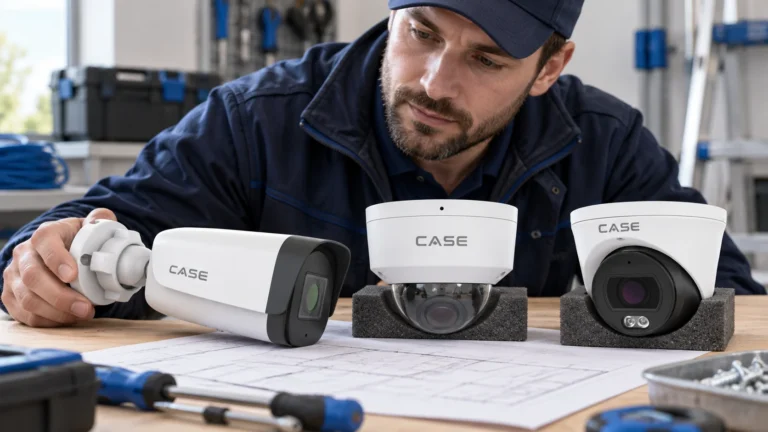
Dome vs turret vs bullet in snow: which housing stays clear?
No dome, turret or bullet automatically stays clear in snow. The exact window/hood, mounting, orientation, wind, light and ice conditions matter; an overhang can also cause reflections or hazardous icicles. Use approved mounting and assess the recorded task, safe access and maintenance. Compare form-factor trade-offs without assuming one shape solves winter exposure.
Snow near an illuminator can cause bright moving artifacts and unwanted events. Supported analytics may help, but do not promise they eliminate weather alarms or share identical behavior across models. Confirm the exact SKU, firmware, software and event integration; test the required detection and recording alongside the image. Preserve the agreed evidence coverage rather than disable broad areas or events blindly. Axis’s general image-quality troubleshooting guide is a reference for environmental checks, not CASE-specific fault codes or repair procedures.
What to tell your customer
We will document the exact camera and power-system limits, installation conditions and restart requirements for this site, then verify the required recordings and alarms. The published temperature row is one part of that design. Any missing cold-start, moisture or mounting requirement needs written confirmation before we promise performance or service terms.
FAQ
Do CASE cameras have built-in heaters for cold weather?
Do not infer a heater from an operating-temperature number. Obtain a written exact-model heater/startup statement if the project requires it, and compare the whole system’s requirements. Some catalog rows omit conditions; omission does not establish a capability or justify borrowing another variant’s rating.
Why does the camera fog on the inside after a cold night?
Condensation is one possibility, not a remote diagnosis. Check the actual exposure and recorded symptoms with the installer and Anabon, then follow the approved inspection/service procedure. Do not assume adding desiccant or opening/resealing the housing repairs every cause or preserves all conditions automatically. The IP and IK ratings guide explains the marking’s scope; it does not replace the model’s service procedure.
Does PoE work at −31 °F (−35 °C)?
Only when the actual source, powered device, cable, connectors and installation are approved for those conditions and the load. CS-H1108PLS is listed only down to −20 °C; it needs a suitable protected environment on a −35 °C site. Confirm startup/peak loads and representative operation rather than promise the same delivered power at every temperature.
Can a PTZ run its IR illuminator at −40 °F (−40 °C)?
The three named PTZ catalog rows have −40 °C as the lower operating limit in both IR states. That is not a separate cold-start or full-installation guarantee. Obtain exact power, startup, humidity and installation requirements; CS-P48 63X’s incomplete PoE designation and CS-P58 T-44X’s absent power row need confirmation.
References
- Anabon: current exact-model documents
- NOAA/NWS: wind chill and actual ambient temperature
- Axis: general image-quality and environmental troubleshooting