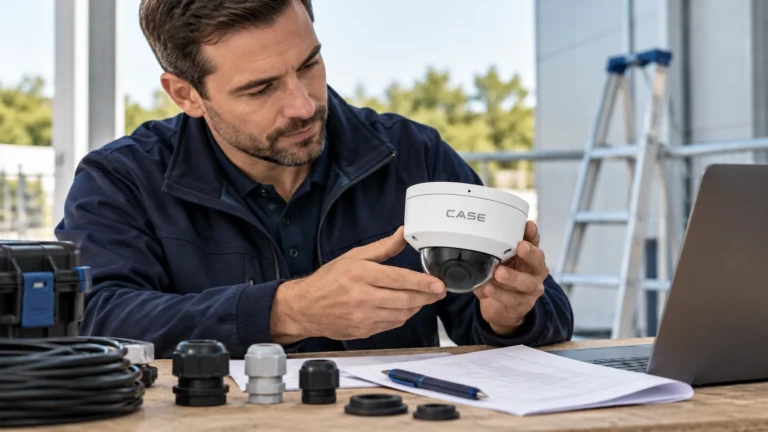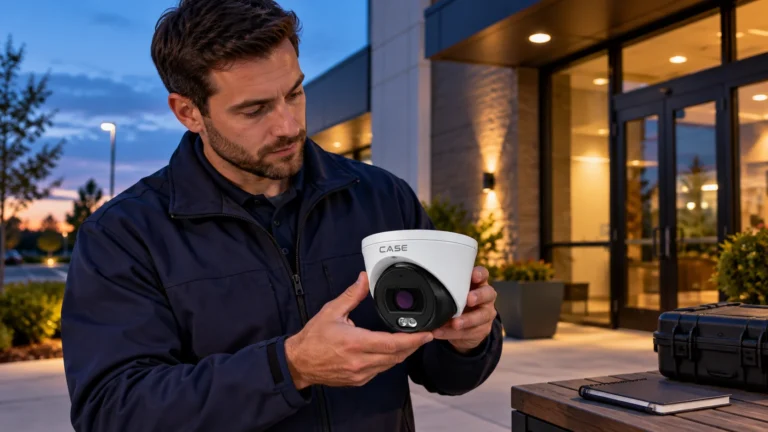



Quick answer: Choose a housing after defining the required view, mounting, access, environment and tampering risk. Dome, turret and bullet forms have useful differences, but no shape guarantees impact resistance, hidden aim, no IR reflections or longer identification range. Compare exact model/lens, IP/IK, lighting, power and compatible assembly, then test the actual recorded task and service access.
On this page
Turret vs dome: what changes when you remove the bubble?
Domes commonly have an outer optical cover; turrets and bullets use other window/housing arrangements, but construction and service procedures vary. Do not infer cover material, light isolation, tool-free adjustment or seal behavior from the shape alone. Check the exact revision and approved assembly instructions.
A shared dome cover can create reflection/contamination issues, but night haze has several possible causes. A turret can avoid some shared-cover problems and still suffer external reflections, moisture, glare, focus or exposure faults. Use approved inspection/service rather than generic foam/gasket adjustment. The night-image troubleshooting guide covers recorded tests.
A dome may obscure aim in some conditions, but does not guarantee hidden direction, coverage or impact resistance. The exact CS-I8KS SD-2.8mm row lists IK10; do not transfer that rating to all domes or declare every reachable turret unsuitable. Assess actual threats, approved tamper/mount provisions, recorded target angle and safe access; one universal 10 ft height is not the design.
Bullet vs turret: when does the longer housing earn its place?
The actual optics and illumination matter more than housing length. CS-I4US L-2.8-12mm lists motorized2.8–12 mm and IR80 m; CS-I8WS S-2.8mm lists 2.8 mm fixed and IR50 m; CS-I5XS SD-2.8mm lists IR30 m. Those rows do not prove every bullet sees farther or identifies a target at a particular distance. Confirm output, field of view, exposure and real recorded detail.
A compact turret can suit some wall/soffit tasks, but the actual mount, view, exposure, impact requirement and service route decide. CS-I8XQ II-2.8mm lists 3840×2160 at 30fps, IR50 m, white light30 m, a microphone/speaker, red/blue light and1 TB memory. These are exactII product rows, not universal turret features or an automatic deterrence/backup guarantee. Bullets and turrets can both suffer webs or tampering depending on the site. Use Anabon’s exact product/revision documents to confirm these complete-model details before selection.
Bullet vs dome: the two ends of the visibility scale
A visible bullet or more discreet dome may fit an architectural preference, but neither guarantees deterrence, hidden coverage or survival of contact. Domes can be appropriate outdoors and bullets on buildings; do not force one shape to a ceiling and another to a pole. Agree actual view, target angle, light, environment, threat and approved support/assembly before deciding.
Comparison table: IR, vandal resistance, adjustment, aesthetics, snow
| Criterion | Compare the exact product and installation |
|---|---|
| Night reflection/contamination | Optical window/cover, nearby surfaces, illumination, approved cleaning and recorded result; no form eliminates every problem |
| Impact/tampering | Printed IK level where present, actual test scope, compatible mount/fasteners, access and local risk; no vandal-proof guarantee |
| Adjustment/service | Exact supported procedure, tools, locking and safe access; do not assume re-aiming never requires opening |
| Appearance/aim | Actual visibility and architectural preference; no guarantee a dome conceals direction |
| Environment | Printed device limits plus entry/mount/power/route/startup requirements; shape alone does not clear snow or ice |
| View/range | Actual lens/output, field of view, light/exposure, target and recorded task; not the length of the body |
| Audio/light/analytics | Exact SKU/firmware hardware and supported integration; not every turret has a speaker or every bullet a long-range lamp |
If the exact required rating is not documented, obtain the current specification/approval rather than invent it. An omitted row is not proof that every product in that shape lacks the property. IP66 vs IP67 vs IK10 explains the distinction between ingress and impact tests; the installed assembly and task still need verification.
CASE examples by form factor (as printed in the CASE Catalog 2027 Q1)
Use the IP cameras for installers collection to build a shortlist, then compare the exact SKU and installation requirements.
| SKU | Form | Resolution | IR / white light | Protection | Housing | Operating conditions |
|---|---|---|---|---|---|---|
| CS-I8KS SD-2.8mm | Dome, 2.8 mm fixed | 8MP, 3840×2160@20fps | 98 ft (30 m) / 33 ft (10 m) | IP67, IK10 | Metal+Plastic | −31 °F to 149 °F (−35 °C to 65 °C) |
| CS-I5XS SD-2.8mm | Turret, 2.8 mm fixed | 5MP, 3072×1728@30fps | 98 ft (30 m) / 49 ft (15 m) | IP67 | Metal+Plastic | −31 °F to 149 °F (−35 °C to 65 °C) |
| CS-I8XQ II-2.8mm | Turret, 2.8 mm fixed, mic and speaker | 8MP, 3840×2160@30fps | 164 ft (50 m) / 98 ft (30 m) | IP66 | Metal | Not printed; confirm per spec sheet |
| CS-I8WS S-2.8mm | Bullet, 2.8 mm fixed | 8MP, 3840×2160@20fps | 164 ft (50 m) / none | IP67 | Metal | −40 °F to 149 °F (−40 °C to 65 °C) |
| CS-I4US L-2.8-12mm | Bullet, motorized 2.8 to 12 mm | 4MP, 2560×1440@30fps | 262 ft (80 m) / none | IP67 | Metal + Plastic | −22 °F to 140 °F (−30 °C to 60 °C) |
Record housing material separately from body color and use the exact SKU/revision:Metal, Metal+Plastic and Plastic are different rows. Under Anabon’s naming rule, a photographed white or gray body is recorded as White, and a black body as Black; record both when both are actually shown. Confirm the orderable finish and availability separately and do not invent a color order code. General category policies are a starting point, not a warranty for every SKU. Confirm the term, exclusions and claim process for the exact model and revision in writing. Project Series items, intercoms, powered accessories and model-specific exceptions need their own confirmation; hard-drive claims follow the applicable drive-manufacturer terms. Lighting, speaker, EW and other functions require exact-model/firmware and project confirmation.
Quick picks by site type
- Public/reachable areas: assess the actual impact/tampering requirement and compatible installation, not a universal dome/height rule. CS-I8KS SD-2.8mm is one catalog example with IK10.
- Entrances/soffits: compare the exact view, lighting, reflection, access and mounting conditions; CS-I5XS SD-2.8mm or CS-I8XQ II-2.8mm may be candidates if their actual requirements fit.
- Poles/perimeters: compare optics, target detail, exposure, illumination, power/route and structural/environmental design; CS-I8WS S-2.8mm or CS-I4US L-2.8-12mm are different candidates, not automatic range solutions.
- Cold sites: use the exact operating and startup/environment requirements for all components; see the cold-weather installation guide.
- Standardization: reduce unnecessary variants only after confirming tasks and support needs; three housings are not automatically enough for every site.
Other designs include PTZ, panoramic, pinhole and thermal products, each with its own task, full identity and supported workflow. A shared form or nominal angle does not make them substitutes. Approved demo purchases may have a 90-day test period under the approved demo return process/conditions; this is not a general return policy or permission to skip a site design.
What to tell your customer
We will choose the exact view, housing and compatible mounting from the site’s task, environment and risk, then verify the required recordings and service access. A shape or rating alone does not guarantee hidden aim, no reflections, long-distance identification or resistance to every attack. We will document actual product and service terms separately. On winter projects, include the cold-weather installation guide in that site review.
FAQ
Is a turret or a dome better for an outdoor entrance?
Either may fit after comparing the actual view, mount, impact/tamper requirement, lighting, environment and service access. A turret is not immune to IR reflections, and a dome is not automatically impact-rated. Use exact product/assembly documents and a representative recorded day/night test rather than one height rule.
Why does my dome camera look foggy at night but fine in daylight?
IR reflection is one possibility, but moisture, contamination, focus/exposure or another fault can produce night haze. Compare recordings and actual light/optical paths, then follow exact-model approved inspection/cleaning/service instructions. Do not reseat a foam ring or replace the camera from a generic diagnosis; another housing does not guarantee the problem disappears. Axis’s general image-quality guide can help structure those checks; follow CASE’s exact service instructions for the actual product.
Do bullet cameras see farther than dome cameras?
Some listed bullets have longer published IR-distance rows than some domes, but form alone does not establish range or identification. Compare exact optics, output, task, exposure and scene light and test the actual recording. The end of an illumination row is not a universal identification limit.
Which housing is the most vandal-resistant?
Compare the exact documented impact test/rating, actual threat and approved full assembly. CS-I8KS SD-2.8mm lists IK10, but no shape or mounting height makes a camera vandal-proof or guarantees survival of every strike. Confirm specified compatible protection and safe target/service geometry rather than inventing a rating for another model. Use the IP66 vs IP67 vs IK10 guide to keep ingress and impact requirements separate.
Can the same SKU come in black or white?
Record the appearance actually shown for the complete SKU under Anabon’s rule:white or gray photographed body is White; black is Black; record both if both finishes are shown. Keep the printed housing material separate. Confirm what can be ordered for the exact revision and do not invent a separate color code because the catalog lacks a color-order row.
References
- Anabon: exact product/revision documents
- Axis: general image/reflection diagnostics,not CASE service instructions