

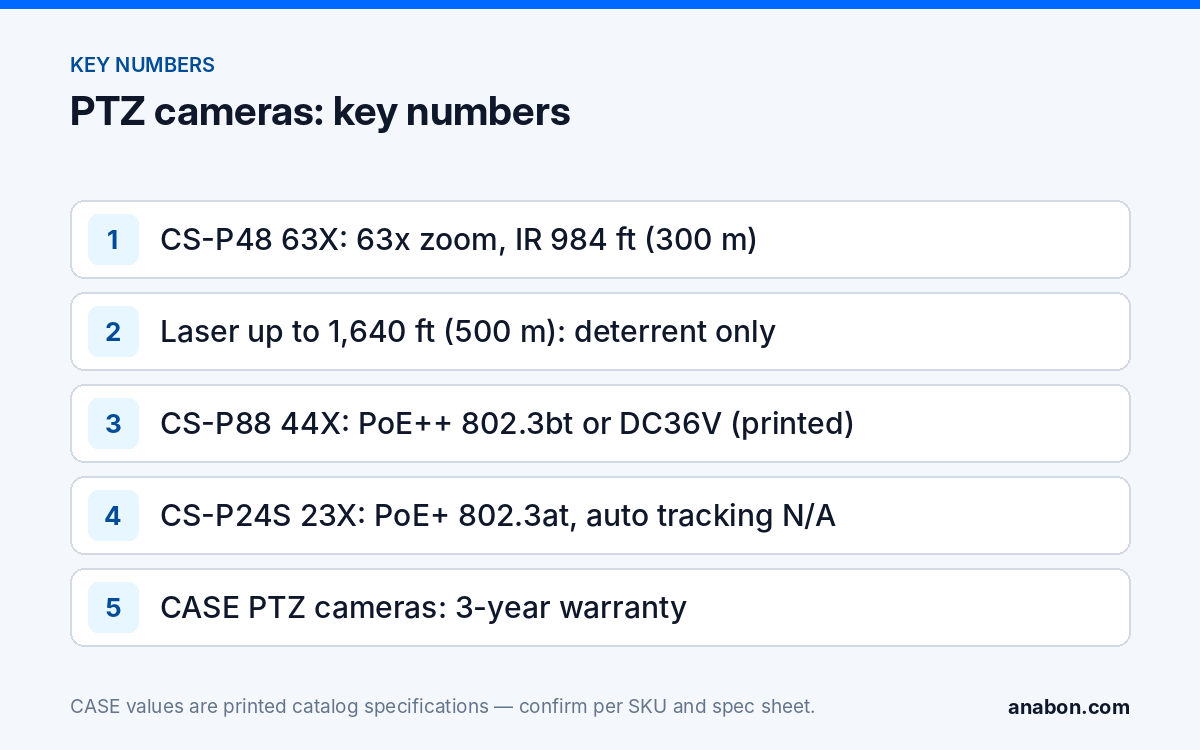
Quick answer: A PTZ camera earns its place when something steers it: a live operator, an alarm that calls a preset, a tour, or auto tracking that follows a person across a yard. Without one of those, a PTZ records only where it happens to point, and fixed or 180° cameras cover more. The CASE line runs from CS-P24S 23X (auto tracking printed N/A) through CS-P44S 25XA and CS-P66V 25XA-180 to the laser units CS-P48 63X and CS-P88 44X (IR 984 ft (300 m), laser up to 1,640 ft (500 m) as a deterrent) and the thermal CS-P58 T-44X. Power is per spec sheet (PoE+ or PoE++ 802.3bt), and CASE PTZ cameras carry a 3-year warranty.
When does a PTZ earn its place, and when are fixed cameras enough?
A fixed camera records everything in its view all the time. A PTZ investigates one thing at a time, with a lens that reaches across a site. A PTZ is the right call when the site is large and open (a laydown yard, a truck lot, a fence line, a solar field), when someone will steer it (a guard desk, a monitoring station, a manager who checks the yard at night), when an alarm needs verification at distance (a fence sensor calls a preset and the operator sees the gate at 20x), and when a moving subject should be followed rather than handed between cameras.
A PTZ is the wrong call when nobody will watch it, when the customer needs a continuous record of a specific area (a door, a cash point, a dock), and when the pitch is “one PTZ instead of four fixed cameras”, which produces four gaps and one camera parked on its home position. The sound design puts fixed or 180° cameras on the record and a PTZ on the detail. CS-P66V 25XA-180 is the one-housing version of that pairing: a 6MP 180° panorama channel (2.8 mm, 3840×1568@30fps, 0.0001 Lux as printed) and a 4MP 25x PTZ channel (4.8–120 mm) with auto tracking.
| Site condition | Fixed or 180° camera | PTZ |
|---|---|---|
| Continuous record of a defined area | Yes | No: records only where it points |
| Someone watches live or responds to alarms | Supporting view | Yes |
| Open site more than 300 ft (90 m) across | Many cameras or 180° units | One or two with presets |
| Follow a moving person or vehicle | Hand-off between cameras | Auto tracking where printed |
| Talk-down and visible deterrence at range | EW on selected fixed models, short range | Built-in speaker where printed (not on CS-P24S 23X or CS-P44S 25XA), plus laser on CS-P48 63X and CS-P88 44X |
What runs without an operator: presets, tours, alarm calls and auto tracking
Four functions let a PTZ work unattended, set up in this order at commissioning.
- Presets. Saved pan, tilt and zoom positions: gate, dock apron, fuel island, far fence corner. Name them in plain language; operators and alarm rules call them by name.
- Home position and park time. The preset the camera returns to after an operator or a tracking event releases it. Without it the camera stays wherever the last person left it, the most common PTZ complaint on a service call.
- Tours. A timed sequence of presets; weak as evidence, because the camera is elsewhere most of the time.
- Alarm-to-preset. An alarm input or an analytics rule calls a preset. CS-P44S 25XA prints alarm I/O 1/1; CS-P48 63X and CS-P88 44X print 8/2, enough for several fence zones on one unit.
Auto tracking is the fifth function. The camera detects a target with its own rule (a tripwire, a perimeter, Human & Vehicle Classification where printed), then pans, tilts and zooms to keep that target in frame until it leaves the scene or a timeout returns the camera home. It tracks one target at a time, needs a defined detection zone and a clean home view, and while it tracks it watches nothing else, so the fixed cameras keep the record. The catalog prints Auto Tracking: Yes on CS-P44S 25XA, CS-P66V 25XA-180, CS-P48 63X and CS-P88 44X, N/A on CS-P24S 23X, and lists Auto-Tracking among the optical-lens analytics of CS-P58 T-44X. AEW (Auto-tracking Early Warning) adds the EW light and audio deterrent to tracking. EW and AEW are deterrence features; availability is confirmed per SKU, and tracking behavior (zone, sensitivity, return time) per firmware and project configuration.
Laser deterrence on CS-P48 63X and CS-P88 44X
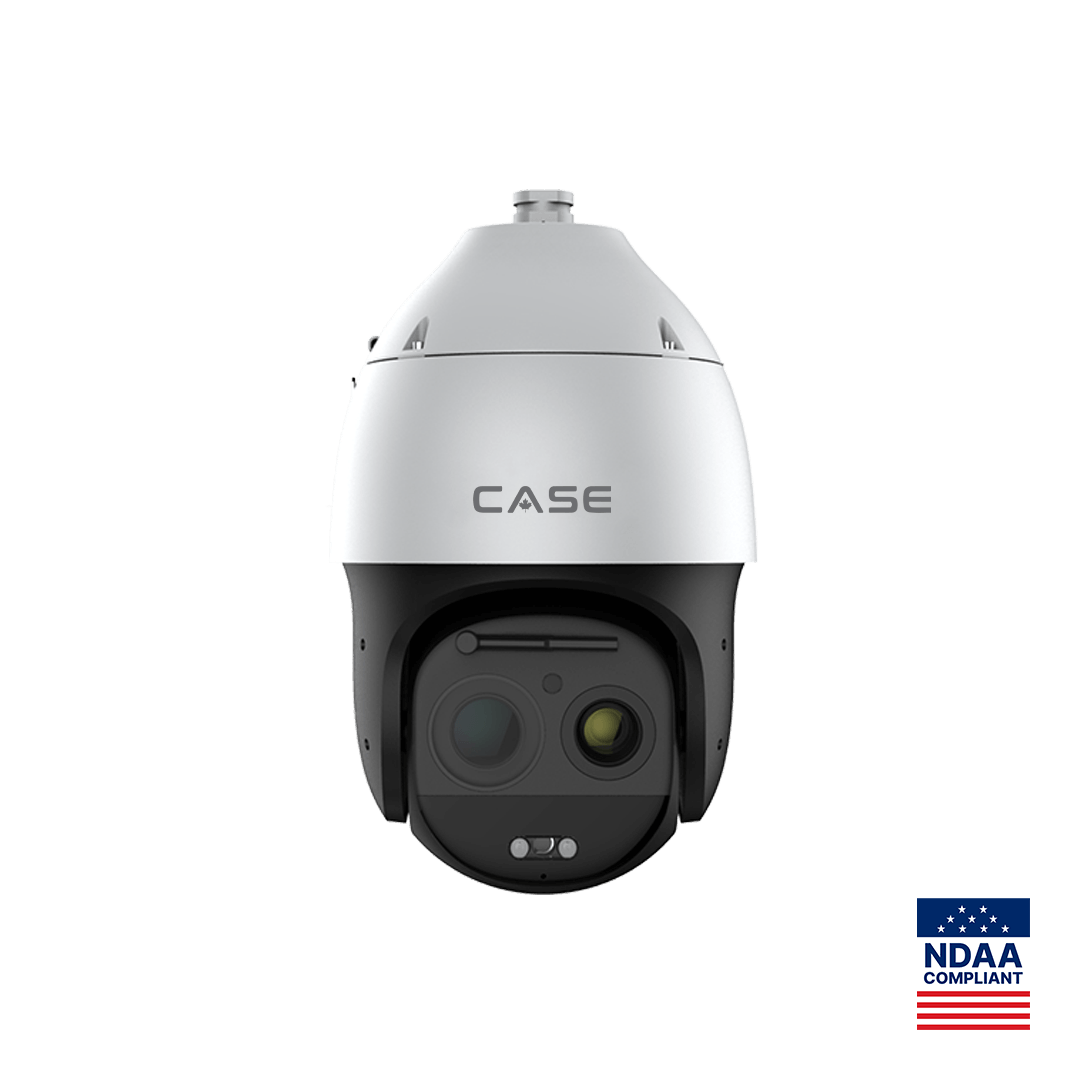
Both laser PTZs print IR 984 ft (300 m), a built-in speaker, audio I/O 1/1, alarm I/O 8/2, a 512 GB memory slot and a laser row of “Up to 500m”, which is 1,640 ft. The catalog describes the laser as an optional, visible beam designed to be eye-safe. The wording for every proposal: the laser is a deterrent, not an illuminator, and is offered on selected models only. It puts a visible spot on the person at the fence while the speaker talks; the printed 1,640 ft (500 m) is the beam’s reach, not an evidence distance.
What separates the two units is the imager and the lens. CS-P48 63X is 4MP (2560×1440@30fps) with a 5.7–359 mm lens, 63x, and prints TVS 6000V lightning, surge and voltage transient protection. CS-P88 44X is 8MP (3840×2160@30fps) with a 5.7–250 mm lens, 44x. Pick CS-P48 63X when reach matters most; pick CS-P88 44X when the operator needs detail on a wider view at moderate range. Both print operating conditions of −40 °F to 158 °F (−40 °C to 70 °C) with IR off and −40 °F to 104 °F (−40 °C to 40 °C) with IR on. One printed difference: CS-P88 44X prints Human & Vehicle Classification in its AI row; CS-P48 63X does not, so do not claim it there. Row-by-row comparison: the CS-P48 63X and CS-P88 44X product guide.
Thermal PTZ: what CS-P58 T-44X adds
CS-P58 T-44X carries two imagers in one PTZ: a 384×288 thermal channel (vanadium oxide uncooled focal plane array, 17 µm pixel interval, NETD ≤40mK@f/1.0) and an optical channel up to 3072×1728@30fps behind a 6–264 mm lens, with IR 984 ft (300 m). The thermal field of view is printed at 7.5° horizontal by 5.6° vertical on a fixed 50 mm lens, a narrow slice: a verification and fire-watch tool, not a wide-area recorder. Built-in parts as printed: microphone, speaker, automatic wiper, electronic compass and GPS/BDS. The thermal analytics row prints tripwire, double tripwire, perimeter, temperature alarm and fire/smoke detection; the fire detection distance is printed as a 6.6 ft × 6.6 ft (2 m × 2 m) fire at 9,843 ft (3,000 m), quoted with the target size, never as a bare distance. No Power row is printed, so power and PoE class come from the spec sheet. See also thermal vs infrared cameras.
Power (PoE+, PoE++ or a power supply) and mounting
PTZ power is the item most often wrong on a bill of materials; the catalog prints a Power row per unit, and the two ends of the line are not the same class.
| SKU | Power row as printed | On the switch side |
|---|---|---|
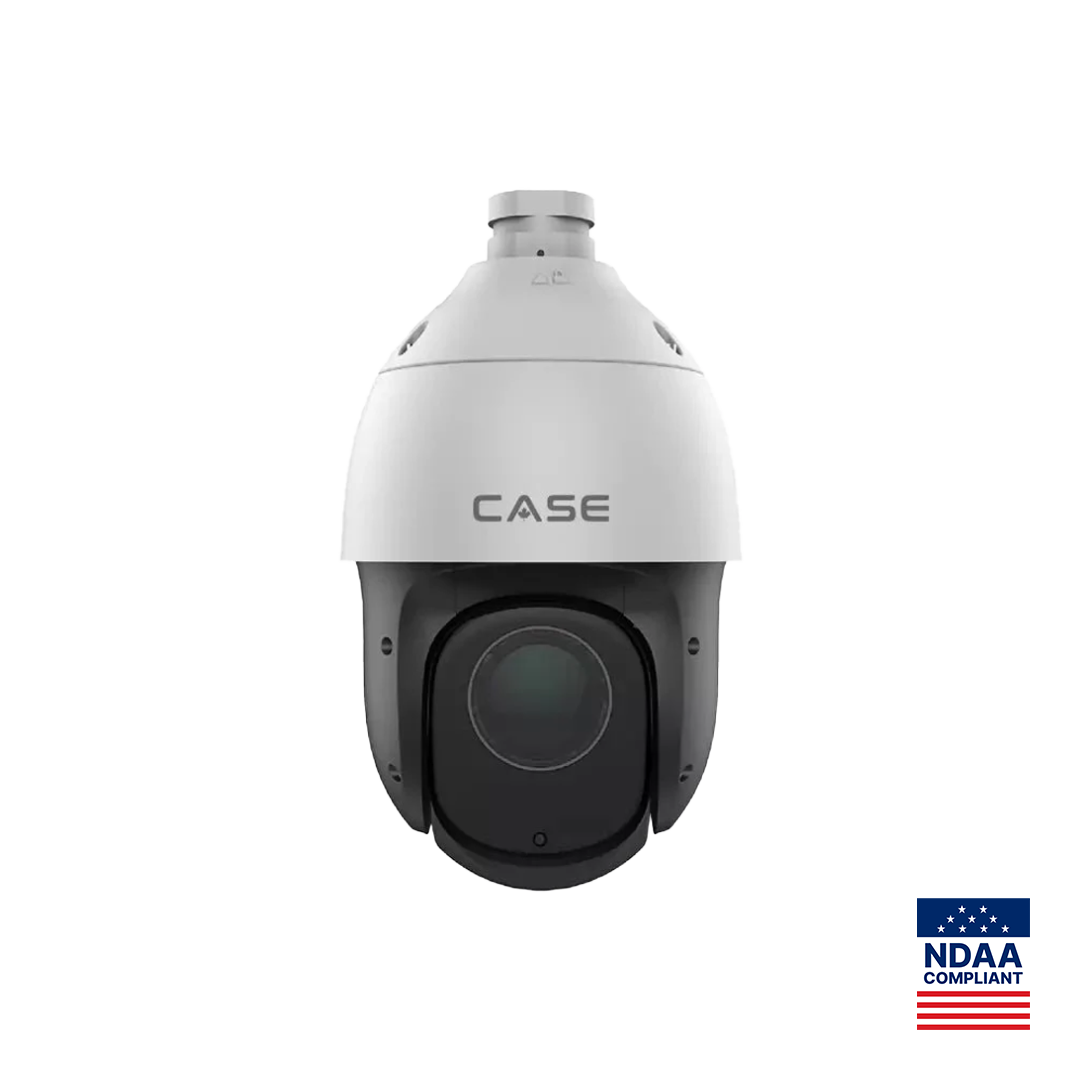
| CS-P24S 23X | DC12V±10% / PoE+ (IEEE802.3at) | An 802.3at port on a CASE switch is enough |
| CS-P44S 25XA | DC12V±10% / POE+ (IEEE802.3at) | An 802.3at port is enough |
| CS-P66V 25XA-180 | AC24V±25%; DC24V±10%; POE 802.3bt | bt injector or a 24 V supply; not an af/at port |
| CS-P48 63X | DC36V±25%, POE++ (IEEE802.3bt) | bt injector or the DC36V supply |
| CS-P88 44X | DC36V±25% / PoE++ (IEEE802.3bt) | bt injector or the DC36V supply |
| CS-P58 T-44X | No Power row printed | Confirm on the spec sheet before quoting |
The CASE PoE switches in the catalog, CS-POE33024PF, CS-POE33108PF and CS-H1108PLS, print IEEE 802.3af/at with 30W per port, and the CS-PSE3301AC injector prints 15.4W (af) / 30W (at). They power the cameras; none of them powers a bt-class PTZ. Put a bt injector or the unit’s own power supply on the BOM for CS-P66V 25XA-180, CS-P48 63X and CS-P88 44X, and keep the switch budget for the fixed cameras (see the PoE budget calculator). Heaters and wipers peak in winter, when an undersized supply shows up.
Mounting follows weight and vibration. CASE prints wall mounts CS-A25, CS-A28 and CS-A29, corner mount CS-A35, pole mount CS-A36 and pendant CS-DF21Y; compatibility is per the individual spec sheet. At 63x a pole that sways 1 in (25 mm) at the top moves the image across the whole frame, so a PTZ goes on a stiff pole or a building corner. CS-P48 63X prints TVS 6000V protection, and every pole-mounted PTZ still needs an external surge device on the data and power lines, bonded per NEC (CEC in Canada), as laid out in lightning and surge protection for outdoor and PTZ cameras.
Warranty: 3-year on PTZ, stated exactly
The PTZ term is the most frequently miswritten line in a camera proposal. The exact wording: CASE cameras and CASE NVRs carry a 6-year warranty. CASE PTZ cameras carry a 3-year warranty. CASE accessories carry unlimited warranty. Hard drives are supported through back-to-back manufacturer warranty. Warranty and RMA run through the installer, dealer or approved business account, never from the end user to Anabon. Write “3-year” next to every PTZ line on the schedule and the submittal; 6-year on a PTZ is wrong and is corrected at review.
What to tell your customer
“A PTZ is for looking closely at one thing; the fixed cameras are for recording everything. We place fixed cameras where you need a continuous record and a PTZ where someone will use it: to follow a person across the yard, to check an alarm at the fence, and on the laser models to put a visible spot and a voice on an intruder at distance. The PTZ carries a 3-year warranty, the fixed cameras and the recorder 6-year, all handled through us.”
FAQ
Can one PTZ replace several fixed cameras?
Not for recording. A PTZ captures only the direction it points at, so a yard covered by one PTZ has a record of one view at a time and gaps everywhere else. Use fixed or 180° cameras for the continuous record and a PTZ for detail, tracking and alarm verification. CS-P66V 25XA-180 combines a 180° panorama channel and a 25x PTZ in one unit.
What does ptz camera auto tracking actually do?
The camera detects a target with its own rule, then pans, tilts and zooms to keep that one target in frame until it leaves or a timeout returns the camera to its home preset. It is printed Yes on CS-P44S 25XA, CS-P66V 25XA-180, CS-P48 63X and CS-P88 44X and N/A on CS-P24S 23X. Zone, sensitivity and return time are confirmed per firmware and project configuration.
Is the laser on CS-P48 63X and CS-P88 44X an illuminator?
No. The catalog describes it as an optional, visible beam designed to be eye-safe, printed at up to 1,640 ft (500 m). The laser is a deterrent, not an illuminator, and is offered on selected models only. Night imaging on these units comes from the IR, printed at 984 ft (300 m); identification distance depends on lens, zoom and pixel density.
Can I power a CS-P88 44X from a CASE PoE switch?
Not from the af/at ports printed on CS-POE33024PF, CS-POE33108PF or CS-H1108PLS. CS-P88 44X prints DC36V±25% / PoE++ (IEEE802.3bt), so it needs a bt injector or its own DC36V supply; the same applies to CS-P48 63X and CS-P66V 25XA-180. CS-P24S 23X and CS-P44S 25XA print PoE+ 802.3at and run from the switch.