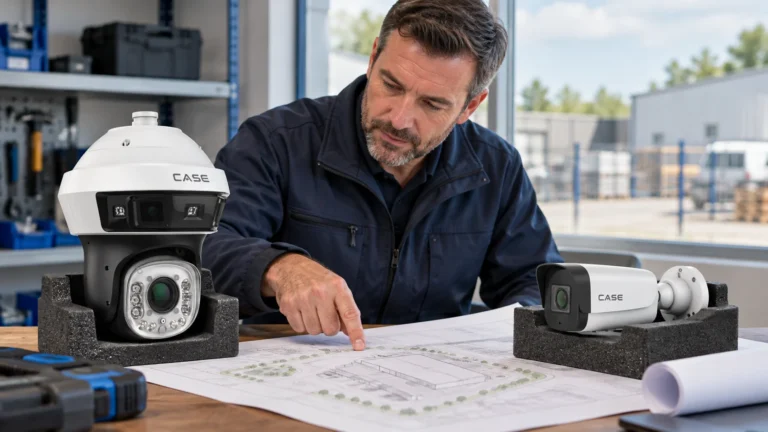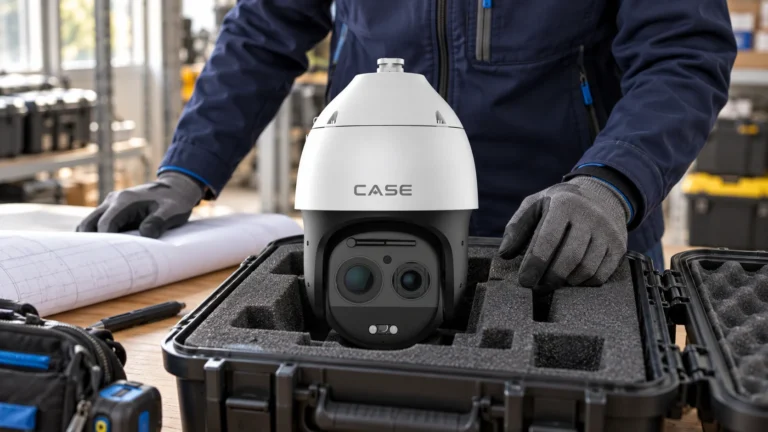



Quick answer: The CS-P66V 25XA-180 combines a 6MP fixed panorama and a 4MP 25× PTZ module. Its printed power choices are AC24V, DC24V or PoE 802.3bt. The CS-P58 T-44X combines a 384×288 thermal channel and an optical channel with a 6–264mm lens. Its catalog fire-distance figure is for a specified 2m × 2m target at 3000m; it is not a promise for any fire or a substitute for a required fire alarm. Choose by the viewing task, verified recording workflow and actual site test, not by the longest distance in a table.
On this page
What does a panoramic PTZ camera do that two cameras do not?
When a conventional PTZ zooms in or turns away, it no longer shows the whole area. A separate fixed overview camera is one solution. The CS-P66V 25XA-180 combines a fixed panorama and a PTZ module in one housing. Plan the panorama and detail as separate streams and verify how the actual NVR records and displays both; one physical camera does not establish the channel count or supported modes on every recorder.
| Design question | Separate overview + PTZ | CS-P66V 25XA-180 |
|---|---|---|
| Overview while the PTZ is zoomed | Yes, from the second camera | Separate panorama module; verify concurrent recording and display |
| Mounts and cable runs | Design mounts and cables for the two actual devices | Verify combined-unit mount, supply and cabling requirements |
| Recorder channels | Confirm each device’s actual streams and NVR channel use | Plan both streams; confirm actual NVR channel use and recording modes |
| Power | Two budgets to plan | Verify complete-unit supply and load: AC24V, DC24V or PoE 802.3bt as printed |
| Alignment of overview and detail | Set by hand on site | Shared housing; verify actual alignment and permitted pan/tilt views |
Use the PTZ camera planning guide to decide whether a fixed overview plus detail task is needed at the actual parking lot, campus or yard. Define the required view, target detail, mount and operator response first. A combined housing or the 180 model suffix does not establish coverage around every building corner, a camera replacement ratio or every client’s tracking/recording workflow. Survey the actual scene before committing the layout.
How do the panorama and PTZ channels split the work on the CS-P66V 25XA-180?
Plan the panorama and PTZ modules from their different printed optics, image-format and analytics rows. Verify both intended views without assuming two independently interchangeable cameras or a fixed NVR-channel count. The table preserves the actual page 33 rows; no PTZ pixel dimensions or frame rate are inferred from its 4MP label.
| Printed row | Panorama channel | PTZ channel |
|---|---|---|
| Megapixel | 6MP | 4MP |
| Lens | 2.8mm | 4.8-120mm (25X) |
| Max. resolution | 3840×1568@30fps | Not printed in this row; confirm on the spec sheet |
| Min. illumination | 0.0001 Lux | 0.001 Lux |
| AI | Tripwire, Double Tripwire, Heatmap, Human & Vehicle Classification | Tripwire, Double Tripwire, Perimeter, Object Abandon, Object Lost, Loitering, Running, Parking, Crowd Detection, People Counting, On Duty Detection, Video Abnormal, Audio Abnormal, Human & Vehicle Classification, Face Capture |
Use the camera/NVR analytics guide to separate the printed camera functions from recorder search and client behavior. Panorama minimum illumination is 0.0001 Lux and PTZ is 0.001 Lux; neither establishes moving-detail performance. Auto Tracking, built-in speaker, audio I/O 1/1 and alarm I/O 2/1 are listed, but obtain actual trigger, electrical ratings, audio permissions and firmware/client support before proposing an automatic warning or talk-down sequence. The 150 m IR and 512 GB memory entries are not identification-range, included-card or usable-retention guarantees.
Commissioning the tracking
- Set the permitted panorama view and PTZ limits using the actual supported controls. Confirm the documented home-position method before drawing rules; agree which private or neighboring areas must remain outside the view.
- Use only documented tracking/zone controls for the actual model and firmware. Verify the approved target-selection behavior and permitted view with representative movement; do not assume every exclusion control exists.
- If the actual firmware supports the required return/home behavior, agree and test it. Do not promise a particular timer, return position or recovery workflow from the Auto Tracking label alone.
- Agree a safe recorded day/night demonstration of the required target, tracking and return behavior. Verify limitations with multiple representative targets without implying simultaneous tracking of every target. Record the selected settings and acceptance result before handover.
What is the CS-P58 T-44X for, and how far does fire detection reach as printed?
The CS-P58 T-44X is a bi-spectrum PTZ: a thermal channel built on a vanadium oxide uncooled focal plane array (384×288, 17µm pixel interval, 8µm~14µm response waveband, NETD ≤40mK@f/1.0) and an optical channel of up to 3072×1728@30fps on a 6mm~264mm lens with 120dB WDR and 984 ft (300 m) Smart IR. The thermal lens is a fixed 50mm with a field of view of 7.5° horizontal and 5.6° vertical, so the thermal channel is a long, narrow view that the PTZ points where it is needed.
The fire-distance row prints Fire(2mx2m) 3000m; retain both the 2 m × 2 m target and 3000 m distance when quoting that catalog reference. It is not a universal distance for smaller fires, every atmosphere or an automatic identification range. Confirm the current supplied revision’s actual thermal modes, thresholds, calibration/range requirements and permitted response procedure. NETD ≤40mK is not a stated calibrated temperature-accuracy specification. No live-fire, camera calibration or site acceptance test was performed for this article; keep any required fire-system design separate.
- Possible project discussion: outdoor yards, storage and perimeters with a permitted thermal/optical observation task. Verify the actual target, atmosphere, line of sight and operator response; a thermal label does not guarantee detection through smoke, weather, obstructions or internal material piles.
- Required fire protection: the catalog does not establish this camera as an approved replacement for a code-required fire detection/alarm system. Have the responsible qualified designer determine the actual required system and approval; do not infer a listed fire role or a complete fire-code design from the analytics label.
- Built-in parts as printed: microphone, speaker, automatic wiper, electronic compass and GPS/BDS, useful for orienting the camera on large sites and for keeping the optical window clear.
How do you power and mount these PTZs?
Use the IP camera user manual and the exact PTZ revision’s instructions to resolve supply, maximum draw, electrical interfaces, cable route and mount ratings before quoting. The P58 page does not print a power row. The P66V page lists AC24V±25%, DC24V±10% and PoE 802.3bt, without every class/load detail. Its printed options do not make every nominal 24 V or bt source suitable. The P58 protection text quotes EN 55035:2017; that catalog statement is not an independently checked test report or a complete site surge/bonding design.
- CS-P66V 25XA-180: verify the actual approved AC24V±25%, DC24V±10% or 802.3bt supply, polarity where relevant, available load, maximum mode-dependent draw and wiring. A catalog af/at 30 W port such as CS-POE33024PF does not establish the required bt service. Do not select the injector or supply solely from the standards label.
- CS-P58 T-44X: no power row is printed in the catalog. Do not size the power supply or the cable until you have the spec sheet.
- Cable route: follow the actual interface, cabling and link-budget limits. Where the route needs fiber, an extender or remote power, verify every active device, environmental limit and permitted power arrangement; do not assume an extender preserves all data and power functions.
- Surge and bonding: use the applicable manufacturer instructions and a qualified project electrical design for the exposed data/power route and mounting structure. A printed protection statement does not establish immunity for every surge, substitute for site bonding or authorize an improvised grounding connection.
- Mounting: both print IP66. Housing material is not printed for either unit. Choose a wall, corner or pole bracket rated for the camera weight from its spec sheet; mount and junction box compatibility is confirmed per individual spec sheet.
- Temperature: the CS-P66V 25XA-180 prints −22 °F to 149 °F (−30 °C to 65 °C). The CS-P58 T-44X prints −40 °F to 158 °F (−40 °C to 70 °C) with IR off and −40 °F to 104 °F (−40 °C to 40 °C) with IR on.
Spec tables: CS-P66V 25XA-180 and CS-P58 T-44X as printed
| CS-P66V 25XA-180 | As printed |
|---|---|
| Megapixel | Panorama: 6MP; PTZ: 4MP |
| Lens / zoom | Panorama: 2.8mm; PTZ: 4.8-120mm (25X) |
| Max. IR distance | 492 ft (150 m) |
| Auto tracking | Yes |
| Max. resolution and frame rate | Panorama: 3840×1568@30fps |
| Built-in speaker / audio I/O / alarm I/O | Yes / 1/1 / 2/1 |
| Min. illumination | Panorama: 0.0001 Lux; PTZ: 0.001 Lux |
| Protection | IP66 |
| Memory slot | 512 GB |
| Power | AC24V±25%; DC24V±10%; PoE 802.3bt |
| Operating conditions | −22 °F to 149 °F (−30 °C to 65 °C), 0–95% RH |
| CS-P58 T-44X | As printed |
|---|---|
| Thermal sensor / resolution | Vanadium Oxide Uncooled Focal Plane Arrays, 384×288 |
| Optical resolution | Up to 3072×1728@30fps |
| Focal length (optical) | 6mm~264mm |
| Thermal FOV | H 7.5°, V 5.6° (fixed 50mm) |
| Pixel interval / waveband / NETD | 17µm / 8µm~14µm / ≤40mK@f/1.0 |
| Smart IR range | 984 ft (300 m) |
| Min. illumination / WDR | 0.001Lux / 120dB |
| Fire detection distance | 6.6 ft × 6.6 ft (2 m × 2 m) fire at 9,843 ft (3000 m) |
| Built-in parts | Mic, speaker, automatic wiper, electronic compass, GPS/BDS |
| Protection | IP66; lightning, surge and voltage transient protection meets EN 55035:2017 |
| Operating conditions | −40 °F to 158 °F (−40 °C to 70 °C) IR off; −40 °F to 104 °F (−40 °C to 40 °C) IR on |
Compare a network video recorder against both required streams, configured bitrates, decoding, retained detail and supported event/search path. Current physical page 59 lists CS-N880 H-AI as 80CH with 400Mbps/400Mbps and AI-on 320Mbps/200Mbps, including a Thermographic Retrieval search label. Those rows do not establish that either PTZ’s complete thermal/event data is indexed or that all maximum functions run together. Obtain the exact camera/NVR firmware and client compatibility, and demonstrate the required recording, retrieval and export result.
What warranty applies to CASE PTZ cameras?
The catalog marks these two PTZ models with a 3-year warranty badge. Confirm the written term, start date, exclusions and claim route for the exact supplied item before putting it in a proposal. Do not apply the general fixed-camera or powered-accessory term to a PTZ. Service normally starts with the installer or dealer that supplied the system; agree any distributor participation for the case.
What to tell your customer
Suggested proposal wording, subject to the agreed design: We will verify the panorama and PTZ detail views and demonstrate their actual recorded and client behavior. For the thermal PTZ we will define the target and operator response, confirm the supported modes and use a safe acceptance procedure. Required fire protection remains a separately approved design. The proposal will identify the complete models, supply/mount details, tested integration and written warranty and service obligations, without promising every target at the catalog distance.
FAQ
Can I power the CS-P66V 25XA-180 from a CASE PoE switch?
Use the PoE budget calculator to plan verified loads and reserve, not to establish device compatibility. P66V prints 802.3bt or the specified AC24V/DC24V options; the catalog CASE switch rows cited here are af/at 30 W per port. Obtain the actual required bt type/class, maximum draw in the intended modes, supported supply and available allocation. A generic bt label or adequate total wattage does not prove every port or wiring arrangement is suitable.
What resolution does the PTZ channel of the CS-P66V 25XA-180 record?
The resolution row prints only the panorama: 3840×1568@30fps. The PTZ module is printed as 4MP with a 4.8-120mm (25X) lens, but its resolution and frame rate are not in that row. Confirm both on the spec sheet before you size recorder bandwidth or storage for the PTZ channel.
Does the CS-P58 T-44X detect every fire at 9,843 ft (3000 m)?
No. The catalog figure is explicitly for a 2m × 2m fire target at 3000m. It provides no universal distance for another target size or site. Specify the target and conditions, verify suitability with the manufacturer’s current documentation and agree a safe acceptance test. This is operator-assistance monitoring, not a replacement for a required fire system.
Can the CS-P58 T-44X measure body temperature?
Use the thermal vs infrared camera guide to distinguish imaging tasks, then request the actual permitted model-specific function. P58 prints industrial thermal analytics and a 7.5° by 5.6° thermal view, not documentation establishing approved human body-temperature screening, calibrated accuracy or a medical use. Do not offer that application from these rows. No medical-device approval or human screening procedure was evaluated here.
What warranty do I write on the proposal for these two SKUs?
Use the warranty-by-category guide as context. Physical catalog pages 33 and 36 each show a three-year PTZ badge, subject to the supplied complete SKU/revision, actual order eligibility, start date, exclusions, authorization and written service obligations. Do not extend that badge to accessories, drives, a different camera family or arbitrary onsite labor. Start through the supplying installer/dealer and obtain the applicable claim route.
References
- Current CASE catalog and revision-specific manuals
- Confirm a model, configuration or integration