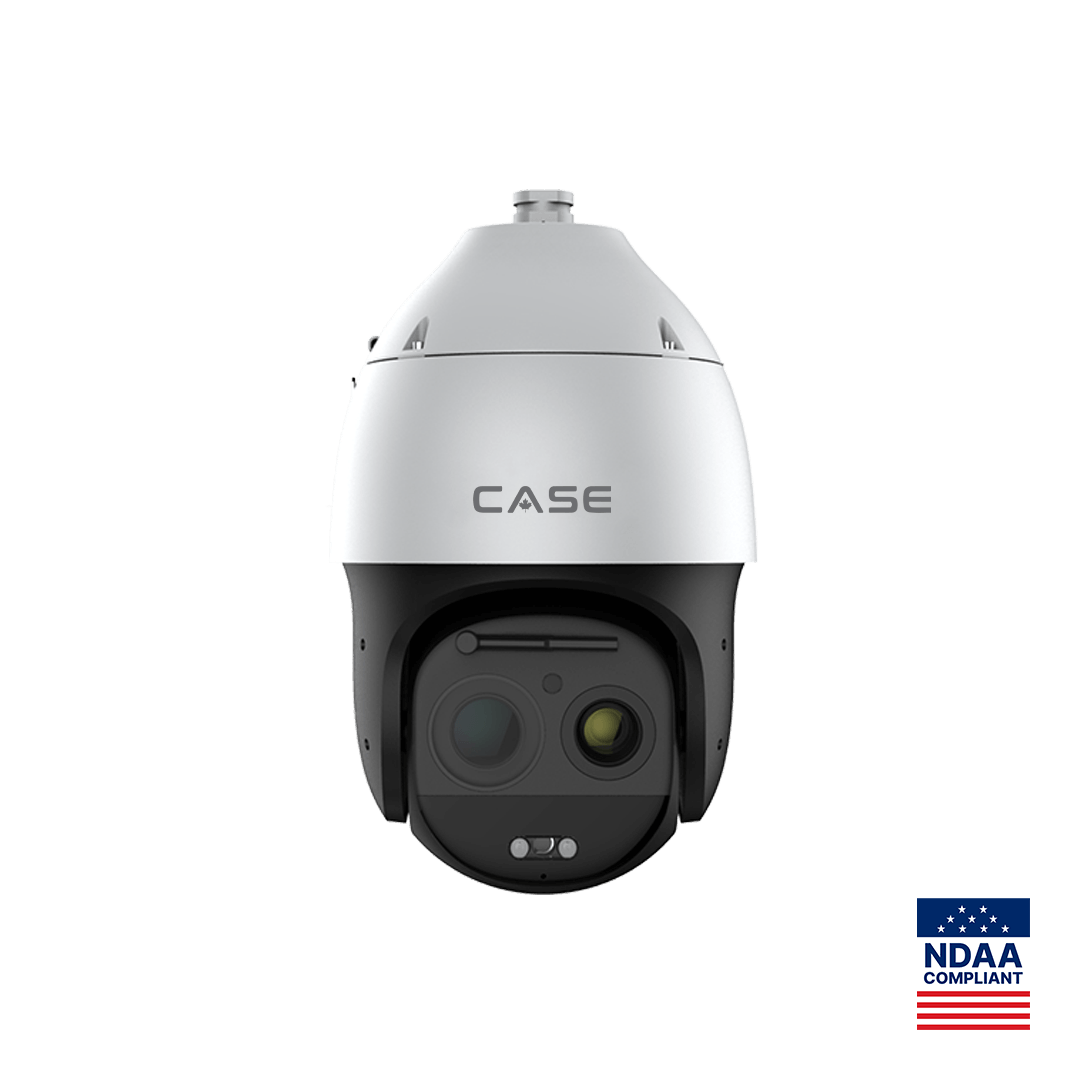


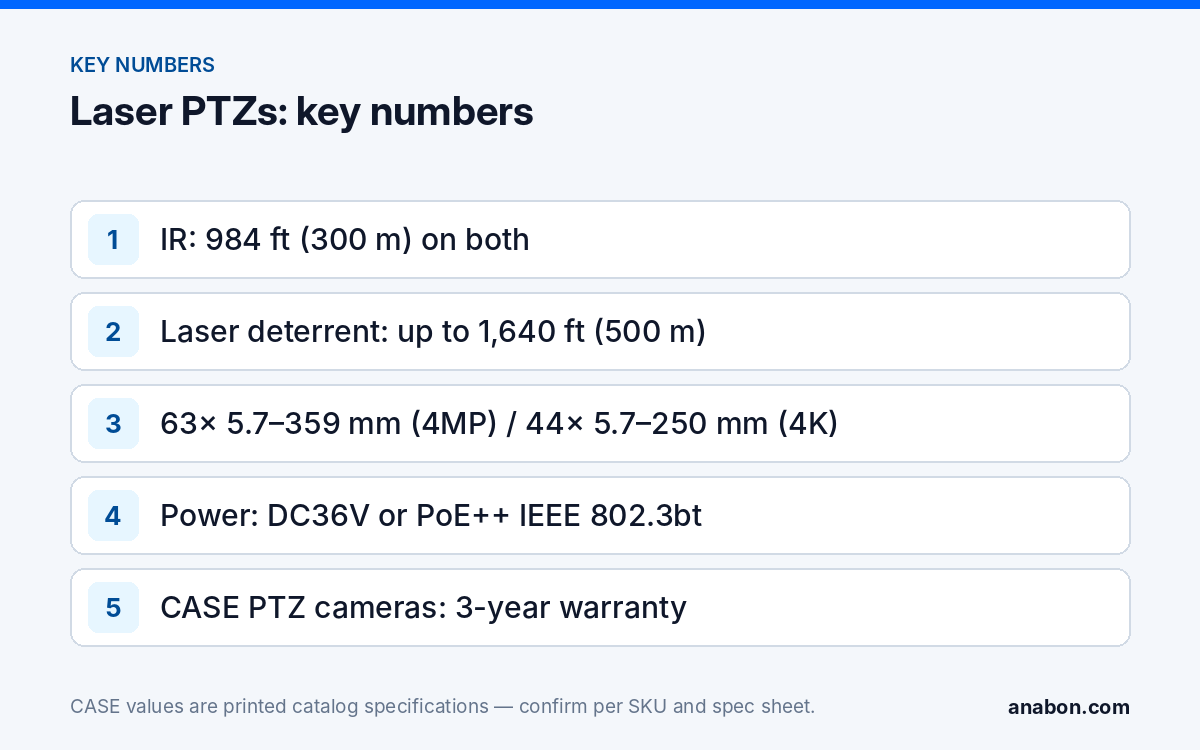
Quick answer: The CS-P48 63X and CS-P88 44X are CASE laser PTZ camera models for yards, lots, perimeters and other large sites: both print 984 ft (300 m) IR, a laser up to 1,640 ft (500 m), auto tracking, a built-in speaker, alarm I/O 8/2 and power by DC36V or PoE++ (IEEE 802.3bt). Pick the CS-P48 63X for reach (5.7–359 mm, 63x, 4MP) and the CS-P88 44X for 4K detail (5.7–250 mm, 44x, 3840×2160). The laser is a deterrent, not an illuminator. CASE PTZ cameras carry a 3-year warranty.
Which one: 63x at 4MP or 44x at 4K?
Both share the IR range, the laser, auto tracking, the speaker, the memory slot, I/O and operating range. The decision is optical reach against resolution. Compare only rows both pages print:
| Row (as printed) | CS-P48 63X | CS-P88 44X |
|---|---|---|
| Megapixel | 4MP | 8MP |
| Lens / zoom | Motorized lens 5.7-359mm (63X) | Motorized lens 5.7-250mm (44X) |
| Max. resolution and frame rate | 2560×1440@30fps | 3840×2160@30fps |
| Protection | IP66, TVS 6000V Lightning Protection, Surge Protection and Voltage Transient Protection | IP66 |
| Human & Vehicle Classification in the AI row | Not printed | Printed |
| Video Abnormal, Audio Abnormal in the AI row | Printed | Not printed |
- Quote the CS-P48 63X when the job is distance: a long fence line, a rail or truck yard, a waterfront, an approach road where the operator must zoom on a vehicle far from the pole. The 359 mm long end is the reason to choose it.
- Quote the CS-P88 44X when the scene is wide and busy at mid range: a large parking area, a distribution yard, a campus quad. More pixels at 3840×2160 help the operator read detail after the event, and its AI row prints Human & Vehicle Classification.
- Do not mix up the AI lists. The CS-P48 63X row does not print Human & Vehicle Classification; its tracking and analytics behavior is confirmed per firmware before you write it into a proposal.
Shared AI functions printed on both: Tripwire, Double Tripwire, Perimeter, Object Abandon, Object Lost, Loitering, Running, Parking, Heatmap, Crowd Detection, People Counting, On Duty Detection, Safety Helmet Detection and Face Capture. For the wider question of when a PTZ is needed at all, see PTZ cameras: auto tracking, laser deterrence and when fixed cameras are enough.
What does the laser actually do?
The catalog describes the laser as an optional, visible beam designed to be eye-safe, printed as up to 1,640 ft (500 m) on both SKUs. EW and AEW are deterrence features. Availability is confirmed per SKU. The laser is a deterrent, not an illuminator, and is offered on selected models only.
In practice, the PTZ detects a target in an armed zone, auto tracking follows it, and the visible beam plus a warning through the built-in speaker tells the intruder that the site is watched and responding. The night image itself comes from the 984 ft (300 m) IR and the 0.001 Lux low-light rating, not from the laser. Set expectations accordingly:
- Write deterrence into the proposal as a feature that can interrupt an incident, not as a promise that every intrusion stops.
- Arm the laser and audio only in zones that should be empty, and on a schedule agreed with the customer.
- Keep the beam off public roads, neighboring property and flight paths. Aiming a laser at aircraft is prohibited in both the US and Canada; check state, provincial and local rules before enabling the laser at an airport-adjacent site.
- No built-in microphone is printed (N/A); the speaker and Audio I/O 1/1 are. If the project needs listen-in, an external mic is a separate design and legal decision.
How do you power and protect a bt-class PTZ?
The power row reads DC36V±25% and PoE++ (IEEE 802.3bt) on both SKUs. That has three consequences for the bill of materials:
- Not every PoE switch will do. The CASE catalog switches print IEEE 802.3af/at; the CS-POE33024PF, for example, prints 30W maximum PoE power per port. These PTZs need an 802.3bt source or the DC36V supply, so plan a bt injector, a bt switch port or a local power supply.
- Take power consumption from the spec sheet. No consumption figure is printed on the catalog page. Budget the source from the spec sheet value with IR on, which is the worst case.
- Respect the Ethernet distance. PoE runs are limited to 328 ft (100 m) of copper. A pole at the far end of a yard usually needs fiber to the pole and DC36V or a bt injector locally; the PoE max distance guide covers the options.
Surge is the other half. The CS-P48 63X prints TVS 6000V lightning protection, surge protection and voltage transient protection; the CS-P88 44X prints IP66 only, so take its surge rating from the spec sheet. On either unit, a tall metal pole is the most exposed point on site: bond the pole and the camera mount per NEC / CEC (verify the local code), add surge protectors on the data and power lines at both the pole and the head end, and keep the ground path short. The surge protection guide for outdoor and PTZ cameras has the full checklist.
How should you mount a long-zoom PTZ on a pole?
At 359 mm or 250 mm, a small movement at the camera becomes a large movement in the image. Pole choice decides whether the long end of the zoom is usable.
| Check | Why it matters | What to do |
|---|---|---|
| Pole stiffness | Wind sway is magnified at long focal lengths | Use a pole rated for the camera weight and wind load; weight is not printed in the catalog row, so take it from the spec sheet |
| Height | Too low limits line of sight; too high adds sway and blocks close-range views | Set height from the scene survey and the zones the PTZ must reach; avoid trees that grow into the view |
| Clear 360° path | Auto tracking needs an unobstructed pan path | Keep the head clear of the pole top, signs and lights; place it where the main zones are not behind the pole |
| Cold and heat | The operating range differs with IR on and off | Printed: −40 °F to 158 °F (−40 °C to 70 °C) with IR off, −40 °F to 104 °F (−40 °C to 40 °C) with IR on; check the site extremes |
| Service access | PTZs need periodic cleaning and checks | Plan lift access and a service loop at the pole base |
Commissioning checklist:
- Set presets and a patrol for the zones the customer cares about, then test auto tracking at night with a person walking the fence line.
- Confirm that IR, laser and speaker behave as configured in each zone, and record the settings.
- Use the printed alarm I/O 8/2 for gate contacts, perimeter sensors or a siren where the design calls for it.
- Record the 512 GB card status and the firmware version in the handover file.
Spec table: CS-P48 63X and CS-P88 44X as printed
| Row | CS-P48 63X | CS-P88 44X |
|---|---|---|
| Megapixel | 4MP | 8MP |
| Lens / zoom | 5.7-359mm (63X) | 5.7-250mm (44X) |
| Max. resolution and frame rate | 2560×1440@30fps | 3840×2160@30fps |
| Max. IR distance | 984 ft (300 m) | 984 ft (300 m) |
| Laser | Up to 1,640 ft (500 m) | Up to 1,640 ft (500 m) |
| Auto tracking | Yes | Yes |
| Built-in mic / speaker | N/A / Yes | N/A / Yes |
| Audio I/O / alarm I/O | 1/1 / 8/2 | 1/1 / 8/2 |
| Min. illumination | 0.001 Lux | 0.001 Lux |
| Memory slot | 512 GB | 512 GB |
| Power | DC36V±25%, PoE++ (IEEE 802.3bt) | DC36V±25% / PoE++ (IEEE 802.3bt) |
| Operating conditions | −40 °F to 158 °F (−40 °C to 70 °C) IR off; −40 °F to 104 °F (−40 °C to 40 °C) IR on; 0–95% RH | −40 °F to 158 °F (−40 °C to 70 °C) IR off; −40 °F to 104 °F (−40 °C to 40 °C) IR on; below 95% RH |
| Protection | IP66, TVS 6000V lightning, surge and voltage transient protection | IP66 |
What warranty applies, and how is service handled?
CASE cameras and CASE NVRs carry a 6-year warranty. CASE PTZ cameras carry a 3-year warranty. CASE accessories carry unlimited warranty. Hard drives are supported through back-to-back manufacturer warranty. Both laser PTZs are CASE PTZ cameras, so the term is 3 years; write it that way in the proposal and the warranty statement, and keep it separate from the 6-year term of the fixed cameras and the NVR on the same job. Warranty service runs through the installer or dealer, and Anabon supports it through your business account. If the project is larger than you would usually take on, bring us the opportunity before you say no: Anabon reviews PTZ layouts, power and surge design before you quote.
What to tell your customer
“This camera watches the whole yard and zooms in on anything that moves in the areas we set up. At night it sees by infrared, and when someone enters a protected zone it can follow them, sweep a visible warning beam toward them and play a warning through its speaker. It is there to interrupt an incident, not just record it. The PTZ carries a 3-year warranty, and service goes through us.”
FAQ
Is the laser on these PTZs used to light the scene at night?
No. The laser is a deterrent, not an illuminator. The catalog describes it as an optional, visible beam designed to be eye-safe, printed up to 1,640 ft (500 m). The night image comes from the 984 ft (300 m) IR and the 0.001 Lux low-light rating. Arm the laser only in zones that should be empty.
Can I power the CS-P88 44X from a standard PoE+ switch?
Plan for no. The power row prints DC36V±25% or PoE++ to IEEE 802.3bt, while 802.3at ports such as those on the CASE catalog switches print 30W per port. Use a bt injector, a bt switch port or the DC36V supply, and size it from the spec sheet consumption with IR on.
Which model has lightning protection printed?
The CS-P48 63X prints TVS 6000V lightning protection, surge protection and voltage transient protection alongside IP66. The CS-P88 44X prints IP66 only, so take its surge rating from the spec sheet. On both, bond the pole and add surge protectors on data and power lines at both ends, per NEC / CEC.
Do these PTZs work in a Canadian winter?
Both print −40 °F to 158 °F (−40 °C to 70 °C) with IR off and −40 °F to 104 °F (−40 °C to 40 °C) with IR on. The low end is the same either way, which suits northern US and Canadian sites; check the summer high against the IR-on limit for hot, sunny locations.
What warranty do the CS-P48 63X and CS-P88 44X carry?
CASE PTZ cameras carry a 3-year warranty, and both laser PTZs are CASE PTZ cameras. Do not quote them with the 6-year term of CASE fixed cameras and NVRs. Warranty service runs through the installer or dealer; an end user should contact the installer or company that supplied their system.