


Quick answer: Spec construction site security cameras as two layers: deterrence and overwatch (a long-range PTZ with Auto Tracking on a pole or mast, deterrence turrets with EW at the gate and laydown yard) and power and network (an always-on circuit from the temporary service, or a solar tower or trailer where there is none, plus a 4G/LTE router and a small NVR). The CASE Project Series solar trailers are quoted per project, and the installer who owns the kit and rents it by the month earns from every phase of the job.
What makes a construction site different: power, network and the theft pattern?
Power. Temporary site power in the US falls under NEC Article 590 (in Canada, CEC Section 76; verify the local code with the site electrician). It is built for tools, not for a recorder that must run at 3 a.m.: generators go off at shift end and GFCI circuits trip in the rain. Either get a dedicated, always-on, surge-protected circuit confirmed in writing, or take power off the table with a solar unit.
Network. There is no customer network. A 4G/LTE router, sourced per project, carries alerts and live view on the sub-stream; recording stays local on the NVR or the camera’s memory slot.
Theft pattern. Losses cluster after hours, on weekends and over holiday closures: copper wire, tools, fuel, attachments, small equipment and the contents of job-site trailers. Many incidents follow a daytime look around, which is why a camera that answers a person with light and voice behaves differently than one that records quietly. Write two or three relocations into the agreement from day one.
Option A: a pole-mounted PTZ with 4G where temporary power exists
With an always-on circuit in hand, a PTZ on a 20–25 ft (6–7.6 m) pole at the gate corner is the fastest deployment and the one that moves least often.
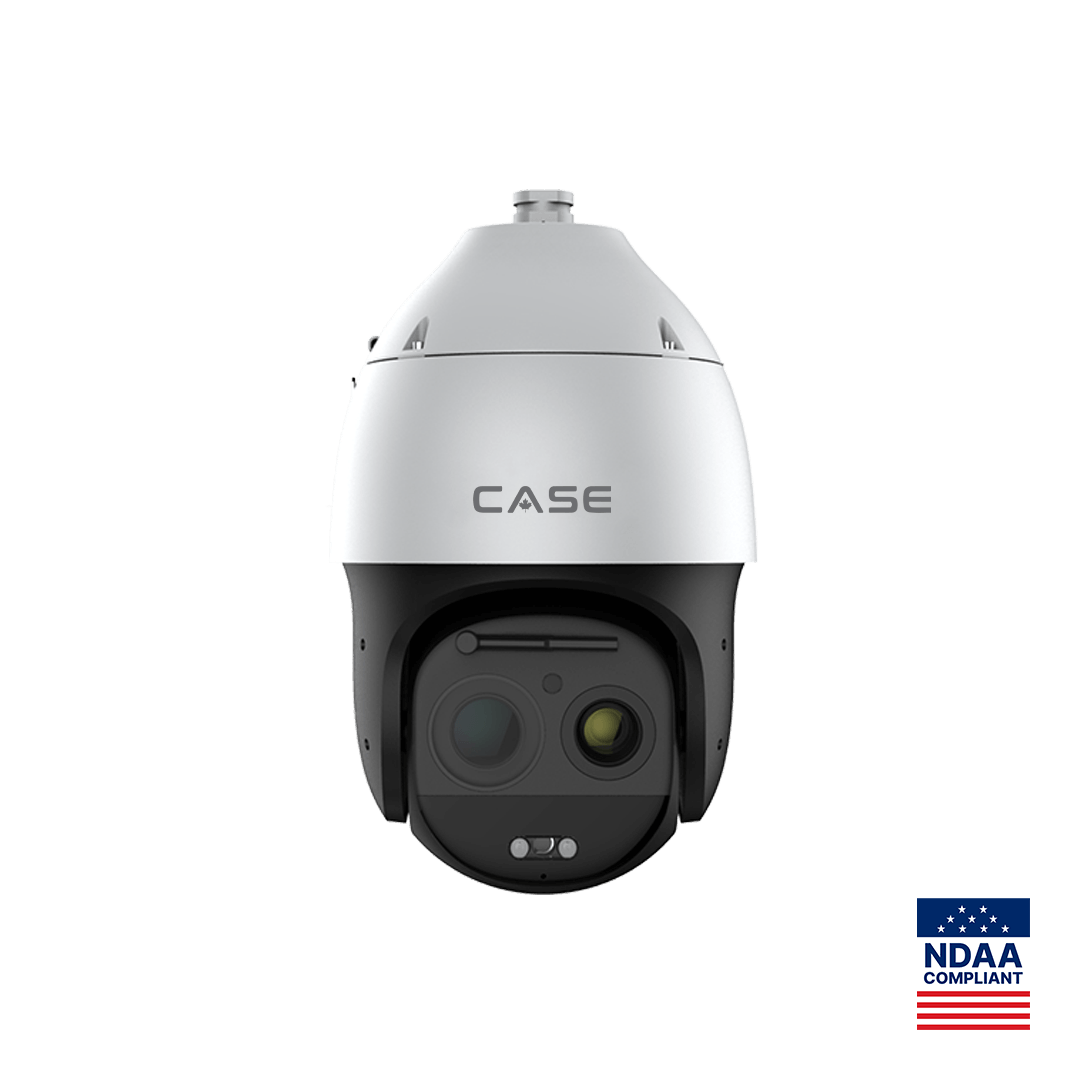
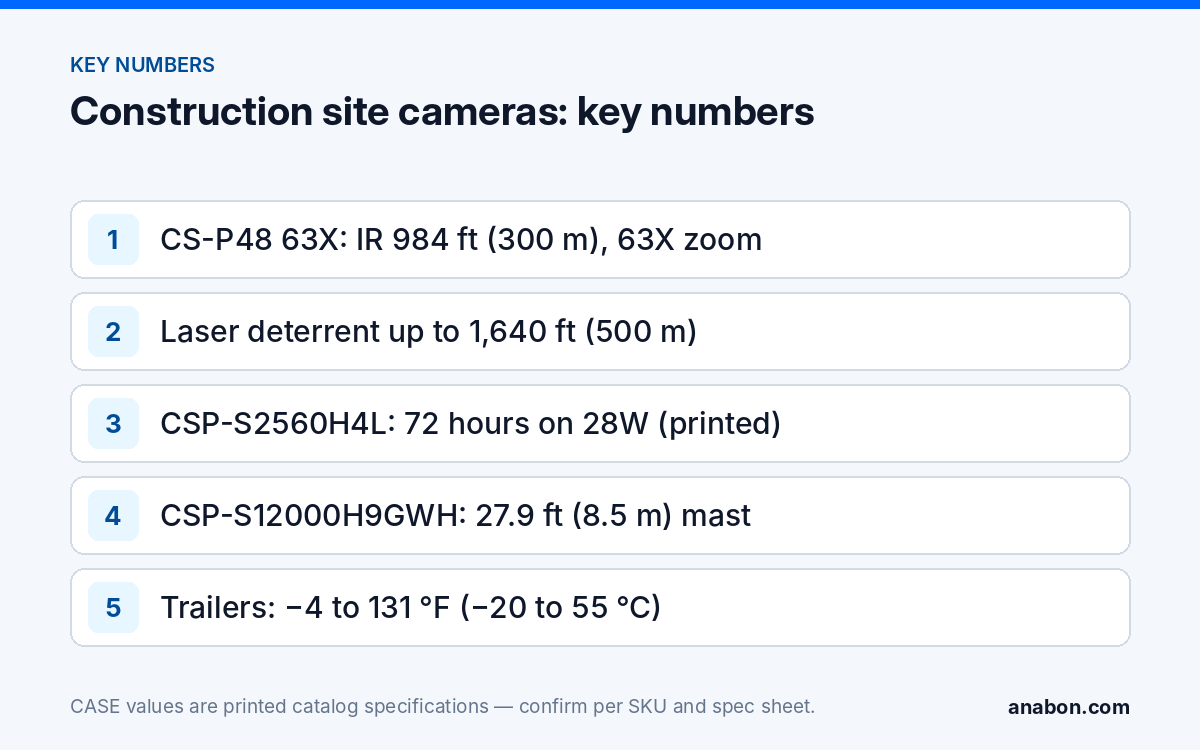
For a large or long site the reference unit is the CS-P48 63X: 4MP, motorized 5.7–359 mm lens (63X), IR to 984 ft (300 m), Auto Tracking, a built-in speaker, alarm I/O 8/2, and a laser the catalog describes as an optional, visible beam designed to be eye-safe, reaching up to 1,640 ft (500 m). Protection is printed as IP66 with TVS 6000V lightning, surge and voltage-transient protection; the operating range is −40 to 158 °F (−40 to 70 °C) with IR off and −40 to 104 °F (−40 to 40 °C) with IR on. Power is DC36V or PoE++ (IEEE 802.3bt): the CASE PoE switches in the catalog are 802.3af/at with 30 W per port, so this PTZ needs its own power supply or a bt-class injector, confirmed against the spec sheet before the pole goes up.
For a smaller footprint the CS-P44S 25XA is a 4MP PTZ with a 4.8–120 mm lens (25X), IR to 492 ft (150 m), Auto Tracking, PoE+ (IEEE 802.3at) or DC12V, IP66 and −22 to 149 °F (−30 to 65 °C). It prints no built-in speaker and EW is not listed for it: sell it as overwatch and tracking, not as a deterrent.
Recording goes to an NVR in a lockable enclosure. The CS-N110 P8H-AI prints 10 channels, 8 PoE ports and 100 Mbps incoming / 80 Mbps outgoing bandwidth, and its VCA Search list includes Early-warning Search and Safety Helmet Search. Remote access runs through CASE Connect; app features and remote access options are confirmed by model, software version and project configuration. On P2P versus port forwarding over a cellular router, see Port Forwarding Risk: P2P vs VPN.
Option B: solar towers and trailers, quoted per project
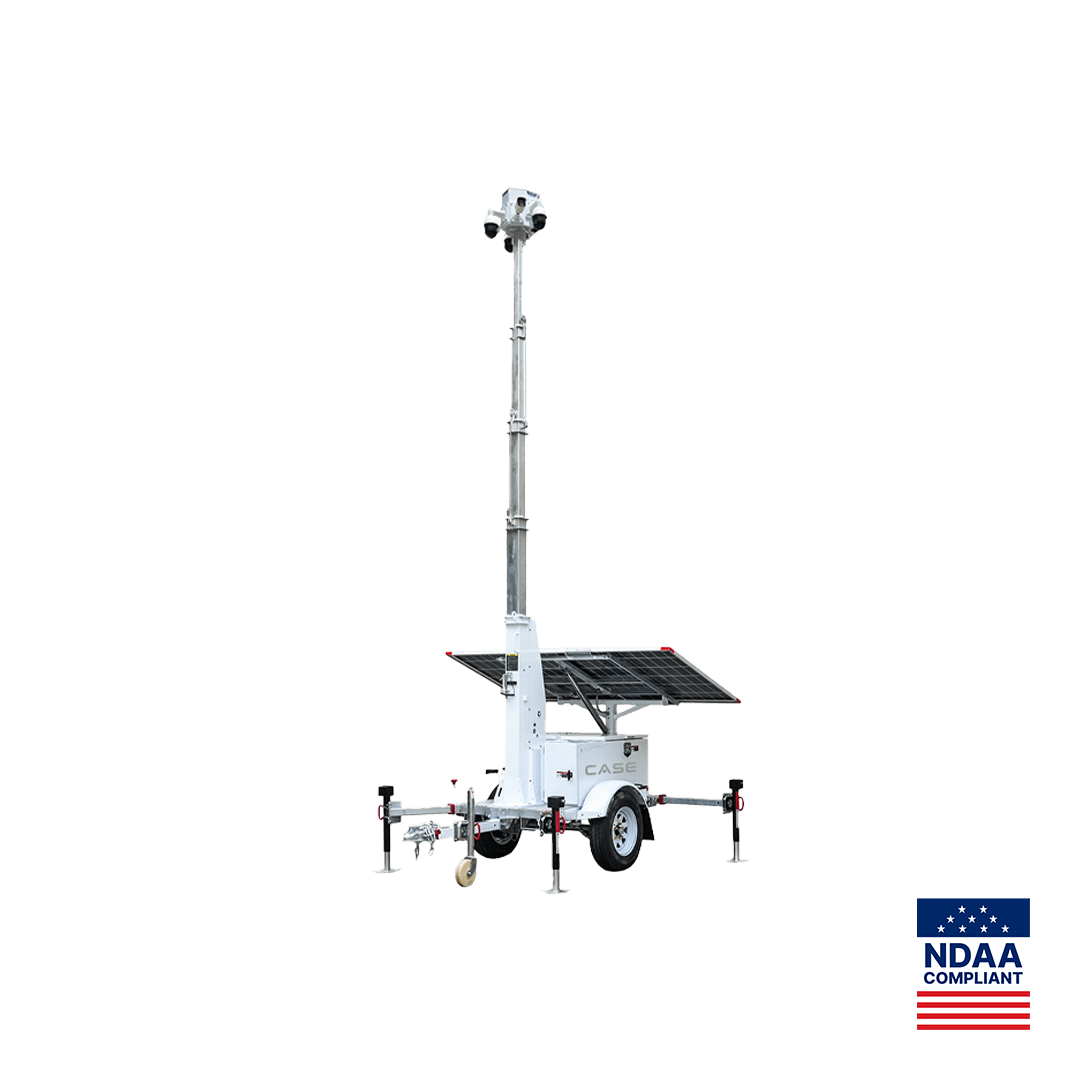
When there is no power at all, the CASE Project Series offers three off-grid units. They are project-quoted: availability, lead time, certificates and the warranty term are confirmed in writing per project before any of them is promised, even though the catalog pages carry badges. The rows below are as printed.
| As printed | CSP-S2560H4L | CSP-S6000H7GW | CSP-S12000H9GWH |
|---|---|---|---|
| Solar panel | 1×450W bifacial | 1×720W bifacial | 2×600W bifacial |
| Battery | LFP, 2560Wh | GEL, 6000Wh | GEL, 12000Wh |
| Running time | 72 hours on 28W | 72 hours under 66W load | 72 hours under 133W load |
| Mast | 11.5 ft (3.5 m), manual winch | 21.3 ft (6.5 m), manual winch | 27.9 ft (8.5 m), electric winch |
| AC charger | No | 1.5kW, AC110V/230V | 1.5kW, AC110V/230V |
| PoE switch | No (PoE listed as optional) | Not printed | 8-port PoE switch included |
| Working temperature | Not printed | −4 to 131 °F (−20 to 55 °C) | −4 to 131 °F (−20 to 55 °C) |
Read the running-time row as a load budget: add up the nameplate draw of every device from its own spec sheet and compare the sum with the printed load. The compact tower’s 28 W is a small budget, sized from the spec-sheet draw of each fixed camera and the router, not one for a PTZ with IR running all night, and it prints no AC charger, so it cannot be topped up from a generator; the two trailers can. The trailers also print a working range that stops at −4 °F (−20 °C), while the CS-P48 63X prints −40 °F (−40 °C): on a northern winter site the trailer, not the camera, sets the limit, and that is a line to confirm in writing on the quote. Panels face south and must not end up shaded as the structure rises; extended heights reach 30.7 ft (9.35 m), so check overhead lines before raising a mast. Quoting steps are in the CASE Project Series overview.
Deterrence at night: EW and AEW on the gate, the yard and the mast
EW and AEW are deterrence features. Availability is confirmed per SKU. The laser is a deterrent, not an illuminator, and is offered on selected models only.
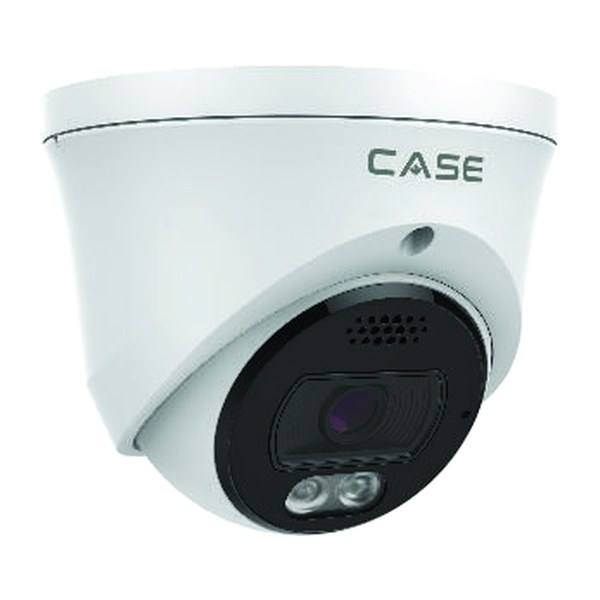
At the gate and the laydown yard the fixed deterrence unit is the CS-I8XQ II-2.8mm: 8MP, IR to 164 ft (50 m), white light to 98 ft (30 m), red and blue light, built-in mic and speaker, a 1 TB memory slot, IP66, metal housing and 120 dB True WDR. Its AI row prints Helmet Detection, People Counting and Human / Vehicle / Non-motor Vehicle / Pet Classification (Dog, Cat), which lets you set the EW response to trigger on people and vehicles rather than on any motion; confirm the trigger behavior per firmware and test it on site. No operating temperature row is printed for this SKU, so check the spec sheet before quoting it for a winter site. When the cellular link drops, recording continues on the local NVR, and a microSD card in the camera’s slot (up to 1 TB as printed) can keep an edge copy where edge recording is configured. On the mast, the CS-P48 63X pairs Auto Tracking with EW so the camera follows the person while light and audio respond.
Deterrence fails through fatigue, not hardware, so commission it like this:
- Draw EW zones on the laydown yard, the gate and the fuel tank, never on the public sidewalk or the neighbor’s lot.
- Arm EW only on the closed-site schedule; the superintendent confirms the calendar and holidays in writing.
- Trigger on human and vehicle classification where the SKU prints it (the CS-P48 63X AI row does not), not plain motion, and test with a walk at dusk and at full dark.
- Record a site-specific voice message and write down who receives alerts in CASE Connect.
Background: Active Deterrence Cameras: EW/AEW.
Recurring revenue: how do installers run a monthly service model?
General contractors rarely want to own a camera trailer; they want it gone when the fence comes down. That is the opening for a monthly service agreement: you own the equipment, deploy it, keep it running and move it, and the contractor pays a monthly fee per unit for the life of the job. Build the fee from your own labor, data, depreciation and relocation costs.
| Included in the monthly service | Billed separately or excluded |
|---|---|
| Delivery, positioning and commissioning | Relocations beyond the number in the agreement |
| 4G/LTE data plan and router management | Civil work: footings, trenching, temporary poles |
| Remote view for named site staff through CASE Connect | Damage, vandalism or theft of the unit (insured by the contractor) |
| Monthly health check and removal with wipe at project end | Clip exports beyond an agreed quota; third-party monitoring |
Warranty supports the economics of a fleet you keep for years. CASE cameras and CASE NVRs carry a 6-year warranty. CASE PTZ cameras carry a 3-year warranty. CASE accessories carry unlimited warranty. Hard drives are supported through back-to-back manufacturer warranty. The CSP- solar trailers carry no stated term until Anabon confirms it in writing for the project. Warranty runs through you, the installer, which is where a service agreement wants it; see Service Agreements and Recurring Revenue.
How do you move the system between phases and sites?
Treat every relocation as a mini-commissioning with a written record.
- Before: export clips the superintendent still needs, note PTZ presets and EW zones, photograph every camera’s aim.
- Power-down: stop recording cleanly, lower the mast fully, secure the panel for travel, disconnect camera cables at the box.
- New position: check overhead lines and the crane swing, level the base, confirm the panel is unshaded, raise the mast.
- Power-up: verify 4G signal and the P2P connection, re-aim from the photographs, re-draw EW zones, test the voice message at dusk, confirm remote view.
- Record: date, position, serials, sign-off and the next scheduled relocation.
At project end the unit returns to your yard: reset passwords, wipe recordings according to the retention line in the agreement, and hand the contractor a short closing report, which is also the opening of the next sale.
What to tell your customer
“We supply, run and move the camera system for the life of the job on a monthly agreement. After hours it detects people and vehicles and answers them with light and a voice message; it is designed to interrupt an incident, not only to record it. Where there is no site power, we quote a solar unit for your project and confirm availability and lead time in writing. You get live view and alerts through CASE Connect, with the exact features confirmed for your configuration.”
FAQ
Do I need a solar trailer, or can I use temporary site power?
If the electrician will give you a dedicated, always-on, surge-protected circuit from the temporary service in writing, a pole-mounted PTZ and a small NVR are the faster deployment and need no battery management. If the generator goes off at night or the panels keep moving, quote a solar tower or trailer per project.
How long does a CASE solar trailer run without sun?
The catalog prints running time as 72 hours on 28W for the CSP-S2560H4L, 72 hours under 66W load for the CSP-S6000H7GW and 72 hours under 133W load for the CSP-S12000H9GWH. Those are load figures, not camera counts: add up the draw of every device from its spec sheet and confirm the result per project.
Can the CS-P48 63X run from the trailer’s PoE switch?
The CS-P48 63X prints DC36V or PoE++ (IEEE 802.3bt) as its power input. The CASE PoE switches in the catalog are 802.3af/at with 30 W per port, and the 8-port switch included with the CSP-S12000H9GWH prints no class. Plan a dedicated power supply or a bt-class injector and confirm the power path per project.
What warranty applies to a construction site camera system?
CASE cameras and CASE NVRs carry a 6-year warranty. CASE PTZ cameras carry a 3-year warranty. CASE accessories carry unlimited warranty. Hard drives are supported through back-to-back manufacturer warranty. The CSP- solar trailers and towers carry no stated warranty term until Anabon confirms it in writing for the project. Warranty is handled through you, the installer.