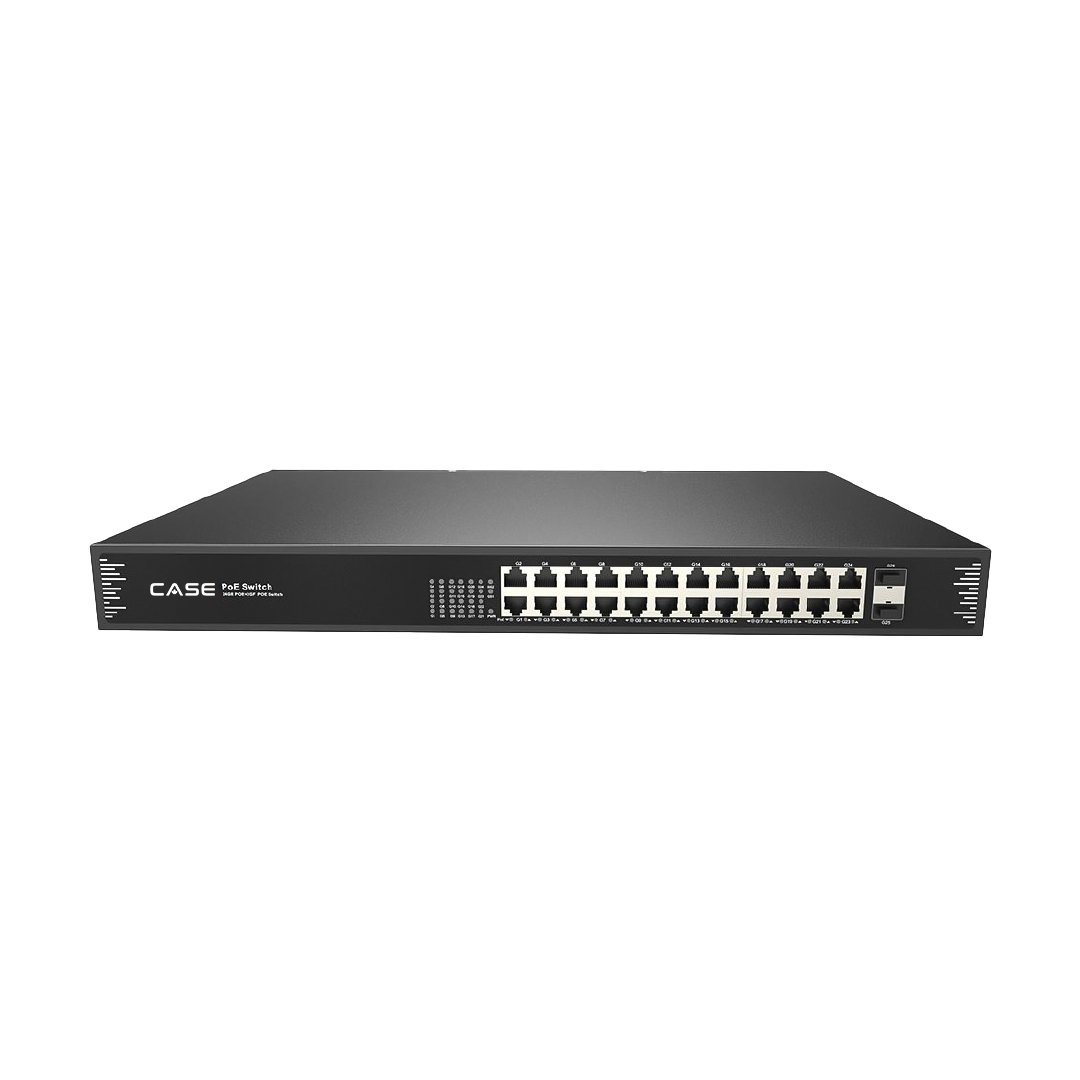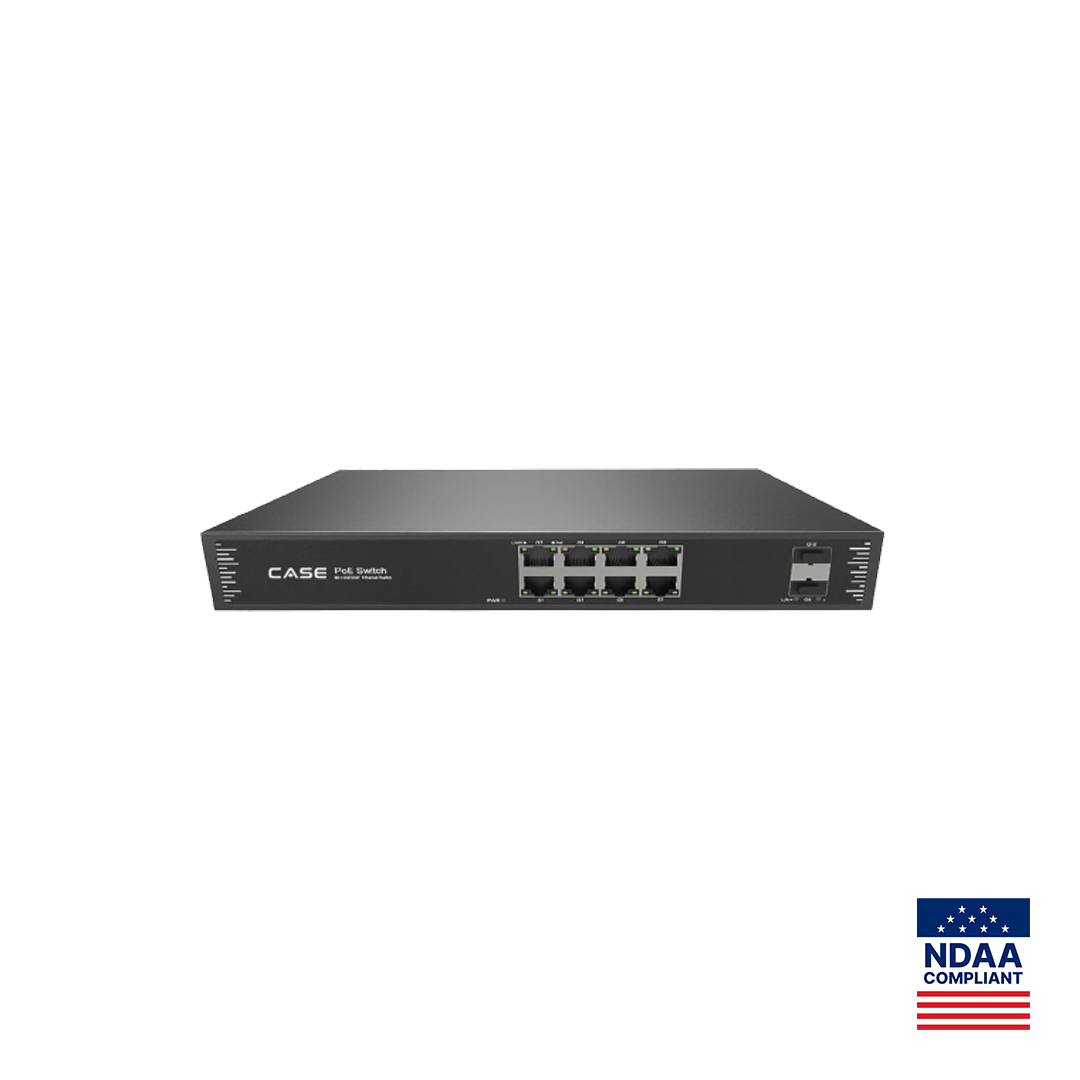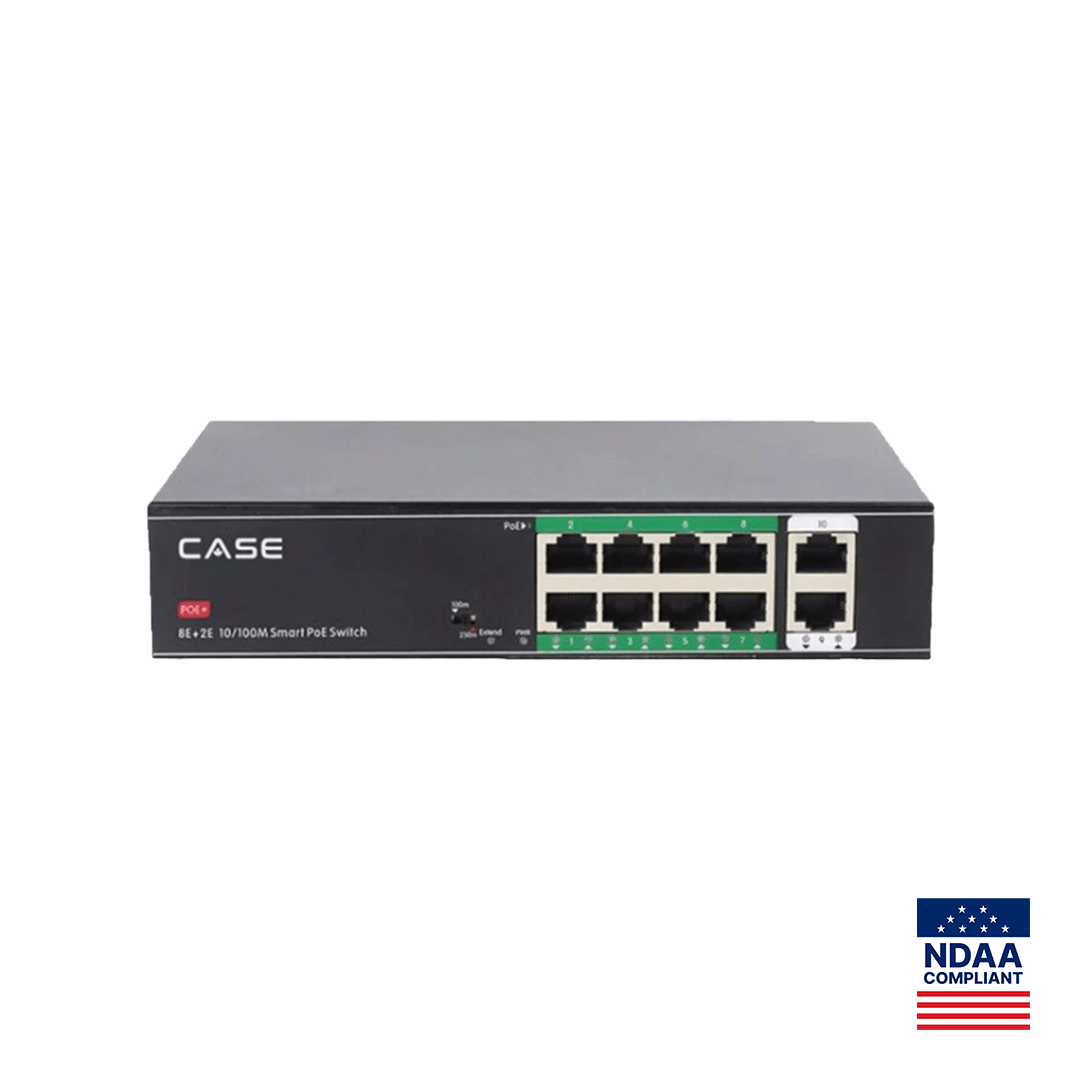


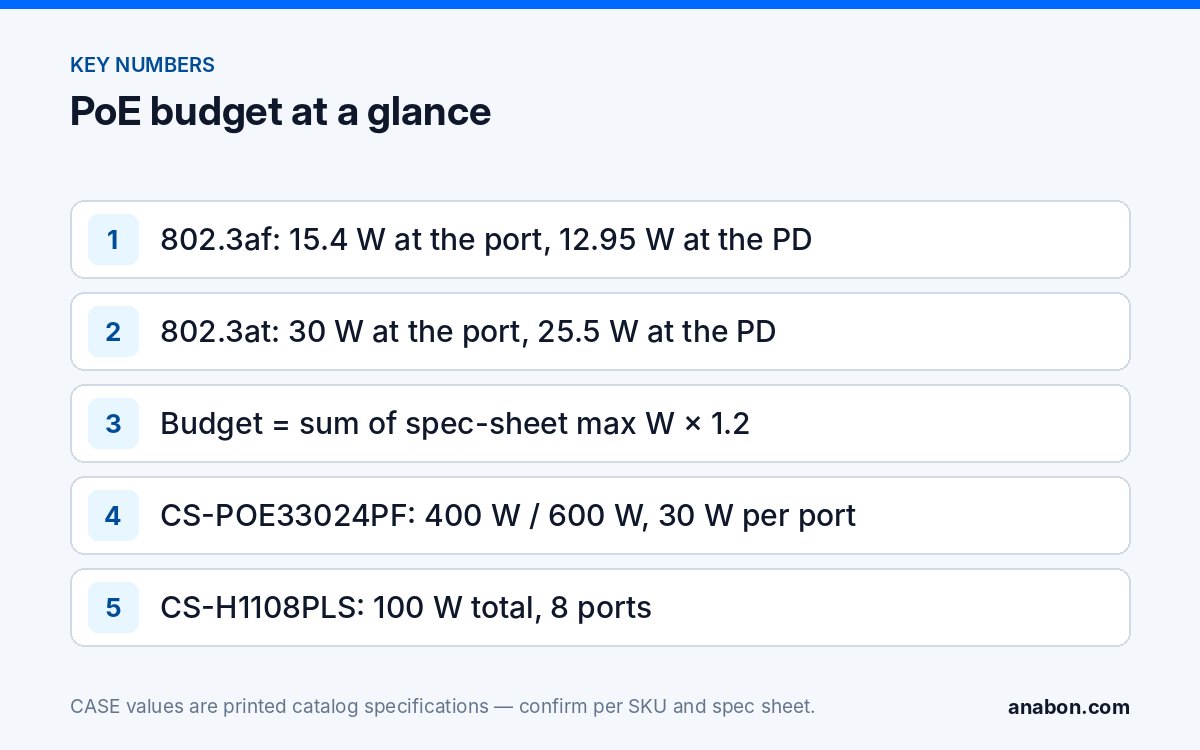
Quick answer: PoE budget = Σ spec-sheet maximum watts of every powered device × 1.2 headroom, compared with the switch’s printed total PoE budget, with no device above the printed per-port maximum. A 16-port switch does not power 16 cameras by default: many switches reserve power by announced class, so class-3 cameras reserve 15.4 W each and a 180 W budget is gone after eleven. The CASE switches print IEEE 802.3af/at, 30 W per port and totals of 100 W (CS-H1108PLS), 130 W / 250 W (CS-POE33108PF) and 400 W / 600 W (CS-POE33024PF); bt-class PTZs such as CS-P48 63X and CS-P88 44X need a bt injector or their DC supply.
PoE classes: what the port offers and what the camera actually draws
IEEE 802.3 defines Power over Ethernet in three generations that matter on camera jobs. Each states two numbers: what the switch or injector (the PSE) must deliver at the port, and what the powered device (the PD) can rely on after cable loss over a full 328 ft (100 m) channel. A camera spec sheet quotes the PD side; the switch budget is spent on the PSE side.
| Standard | Common name | At the port (PSE) | At the device (PD) | Classes |
|---|---|---|---|---|
| IEEE 802.3af (Type 1) | PoE | 15.4 W | 12.95 W | 0–3 |
| IEEE 802.3at (Type 2) | PoE+ | 30 W | 25.5 W | 4 |
| IEEE 802.3bt (Type 3) | PoE++ / 4PPoE | 60 W | 51 W | 5–6 |
| IEEE 802.3bt (Type 4) | PoE++ / 4PPoE | 90 W | 71.3 W | 7–8 |
Two numbers on a camera spec sheet decide the budget: the PoE class, which sets what the port must supply, and the maximum power consumption in watts, which is what you add up. The CASE catalog prints the PoE class for PTZs (PoE+ IEEE 802.3at on CS-P44S 25XA, PoE++ IEEE 802.3bt on CS-P48 63X and CS-P88 44X) and no wattage for any camera, so the figure you enter always comes from the SKU spec sheet.
Why does the budget run out at night?
A camera that draws 5 W at noon can draw 9 W at dusk. IR LEDs, white-light illuminators, heaters and PTZ motors switch on when the scene changes, which is when the switch is asked for the most power. The spec-sheet maximum includes the illuminator at full output, which is why the calculator never uses the typical figure. Three behaviors to design for:
- IR and white light. A turret printing 98 ft (30 m) IR plus 49 ft (15 m) white light, such as CS-I5XS SD-2.8mm, carries two illuminators; size on its spec-sheet maximum.
- Cold starts. Below 14 °F (−10 °C) heaters and motors draw their peak at power-up; a switch recovering from a 3 a.m. outage in January sees every device at maximum together.
- Class reservation. Many switches reserve the full class allowance (15.4 W or 30 W) per port at link-up regardless of real draw; the switch documentation says which method applies.
A camera that works all day and drops at dusk is diagnosed in PoE camera not working.
Calculator: class, spec-sheet maximum, headroom → which switch
Required budget (W) = Σ spec-sheet maximum watts of every powered device × 1.2
Check 1: required budget ≤ printed total PoE budget. Check 2: no device above the printed per-port maximum. Check 3: every run ≤ 328 ft (100 m), or on an extend-mode port.
Worked example: a 14-camera distribution yard
Twelve fixed cameras whose spec sheets state 7 W maximum (84 W), one white-light bullet at a spec-sheet maximum of 12 W, and one CS-P44S 25XA, which prints PoE+ (IEEE 802.3at): until its spec-sheet maximum is in hand, reserve the full 30 W class allowance. Total 84 + 12 + 30 = 126 W; with 20% headroom, 151 W. A CS-H1108PLS (100 W) is out before headroom, and both it and the CS-POE33108PF (130 W / 250 W) have only eight PoE ports for fourteen devices. A CS-POE33024PF at 400 W fits on budget and on ports, with ten ports spare. The longest run, 262 ft (80 m) to the gate, sits inside the 328 ft (100 m) channel.
- List every PoE device: cameras, intercom panel, access readers, wireless bridges, any PoE-powered switch.
- Write the PoE class and the spec-sheet maximum watts next to each. No spec sheet, no number.
- Add the maxima and multiply by 1.2.
- Compare with the printed total PoE budget, then check each device against the printed per-port maximum.
- Check run lengths; beyond 328 ft (100 m) see PoE max distance and extenders.
- Record the table and night-time PoE tester readings in the handover pack.
CASE PoE switch budgets as printed (2027 Q1)
All three CASE switches and the injector print IEEE 802.3af/at with a 30 W per-port maximum; none is a bt device. The last column is arithmetic (budget divided by ports), not a printed figure.
| SKU | Ports as printed | PoE standard | Max per port | Total PoE budget | Average per port, all used |
|---|---|---|---|---|---|
| CS-H1108PLS | 8×10/100M PoE + 2×10/100M uplink; 328 ft (100 m) standard / 820 ft (250 m) Extend Mode | IEEE802.3af/at | 30 W | 100 W | 12.5 W |
| CS-POE33108PF | 8×10/100/1000M RJ45 PoE + 2×1000M SFP | IEEE 802.3af/at | 30 W | 130 W / 250 W | 16.25 W / 31.25 W |
| CS-POE33024PF | 24×10/100/1000M RJ45 PoE + 2×1000M SFP | IEEE 802.3af/at | 30 W | 400 W / 600 W | 16.7 W / 25 W |
| CS-PSE3301AC | 2×10/100/1000M RJ45 (Ethernet IN + PoE OUT) | IEEE802.3af / IEEE802.3at | 15.4 W (af) / 30 W (at) | 18 W (af) / 35 W (at) | one device |
| CS-PD5202 | Inline splitter: PoE in, data + 12VDC out | IEEE802.3af/at | 13 W (12VDC ± 0.5V) | — | one non-PoE device |
Read the averages as design limits. On the 400 W CS-POE33024PF, 24 ports at the 30 W maximum would be 720 W: it is a switch for fixed cameras with a handful of at-class devices, not for 24 PTZs. The 250 W CS-POE33108PF is the one small CASE switch that runs all eight ports at the full 30 W allowance (240 W). All three print −4 °F to 131 °F (−20 °C to +55 °C) and IP30: indoor rack, cabinet or wall mount, not outdoors. CASE accessories carry unlimited warranty. The full write-up is the CASE PoE layer; the units are listed under network switches for business-account login.
Why a 16-port switch runs out at camera 12
Take a 16-port switch with a 180 W budget that reserves power by class. Fixed IR cameras announce class 3 and reserve 15.4 W each. Eleven cameras reserve 169.4 W; the twelfth asks for 15.4 W more, the switch has 10.6 W left, and camera 12 never powers, even though eleven cameras are really drawing about 70 W. Add an at-class PTZ reserving 30 W and the count drops to nine. The failing camera changes after every power cycle because the switch allocates in link-up order.
On a metered switch that budgets by real draw, sixteen 6 W cameras total 96 W and fit easily, which is why the calculator needs the spec-sheet maximum and the switch documentation together. A PoE NVR’s built-in ports follow the same logic with their own budget: the 16 ports of a CS-N220 P16H-AI share a budget the catalog table does not print; confirm it on the spec sheet.
bt-class PTZs: bt injector or DC supply, never the af/at switch
CS-P48 63X prints DC36V±25%, POE++(IEEE802. bt) and CS-P88 44X prints DC36V±25%/PoE++(IEEE802.3 bt). Both print 984 ft (300 m) IR and −40 °F to 158 °F (−40 °C to 70 °C) with IR off and −40 °F to 104 °F (−40 °C to 40 °C) with IR on, so take the spec-sheet maximum draw for the worst night of the year. No CASE switch, and not the CS-PSE3301AC injector (30 W at-class maximum), can power them. The options, in order of preference:
- A single-port IEEE 802.3bt injector rated for the PTZ’s spec-sheet maximum, within 328 ft (100 m) of the camera. CASE prints no bt injector in the catalog; the model is specified and confirmed per project.
- The camera’s own DC36V±25% supply at the pole, with data back to the switch; the PTZ leaves the PoE budget entirely.
- A bt-capable switch for the PTZ ports only, with the fixed cameras on the CASE af/at switch.
Compact PTZs differ: CS-P44S 25XA prints DC12V±10%/POE+(IEEE802.3 at), so it fits a 30 W CASE port, budgeted at its spec-sheet maximum or, until you have it, at the full 30 W. CASE PTZ cameras carry a 3-year warranty.
Headroom rule and the PoE table for handover
Keep 20% of the printed budget unallocated after the spec-sheet maxima are added; that margin pays for illuminators, cold starts and the camera added at handover. Then write it down: copy the table below into the job folder, one row per powered port, and attach the night-time PoE tester readings.
| Port | Device (full SKU) | PoE class | Spec-sheet max (W) | Reserved by switch (W) | Run ft (m) | Tester at night (V / W) |
|---|---|---|---|---|---|---|
| 1 | CS-I5XS SD-2.8mm | from spec sheet | from spec sheet | per class or metered | 180 (55) | filled on site |
| 2 | CS-P44S 25XA | at (class 4) | from spec sheet | 30 | 262 (80) | filled on site |
| Totals | — | — | Σ max × 1.2 | Σ reserved | longest run | vs. printed budget |
Add the switch’s printed budget, per-port maximum, firmware version and allocation method, so the next technician knows whether a camera can be added.
What to tell your customer
“Your switch has a fixed amount of power to share across all cameras, and that number, not the number of ports, decides how many cameras it runs. We added up the maximum each camera can draw on the coldest night with its lights on, kept 20% in reserve, and documented it so any camera added later is checked against the same figure.” Keep the PoE table in the handover pack.
FAQ
How do I calculate the PoE budget for a camera system?
Write down the spec-sheet maximum power of every PoE device, add them up and multiply by 1.2 for headroom. Compare the result with the switch’s printed total PoE budget, confirm no device exceeds the printed per-port maximum, and check every run is within 328 ft (100 m). If the switch reserves by class, use 15.4 W or 30 W per device instead.
How many cameras can a 24-port PoE switch power?
Divide the printed budget by the real reservation per camera. CS-POE33024PF prints 400 W or 600 W with 30 W per port: at 15.4 W class-3 reservations that is 25 or 38 cameras, so all 24 ports fit; at 30 W class-4 reservations it is 13 or 20. Mixed sites usually run out of budget on the at-class devices first.
Can a CASE PoE switch power a CS-P48 63X or CS-P88 44X?
No. Both PTZs print PoE++ (IEEE 802.3bt) with a DC36V±25% alternative, and every CASE switch and the CS-PSE3301AC injector print IEEE 802.3af/at with a 30 W per-port maximum. Use a bt injector rated for the PTZ’s spec-sheet maximum, specified per project, or the camera’s DC supply at the pole, and keep the fixed cameras on the CASE switch.
Why does the dead camera change after every power cycle?
Because the switch allocates its budget in the order devices link up. When the total reservation exceeds the printed budget, the last device to negotiate stays dark, and the boot order varies with cable length and camera firmware. A different camera failing each time is the signature of an exhausted budget, not a bad camera; unplug two working cameras and watch the dead one boot.