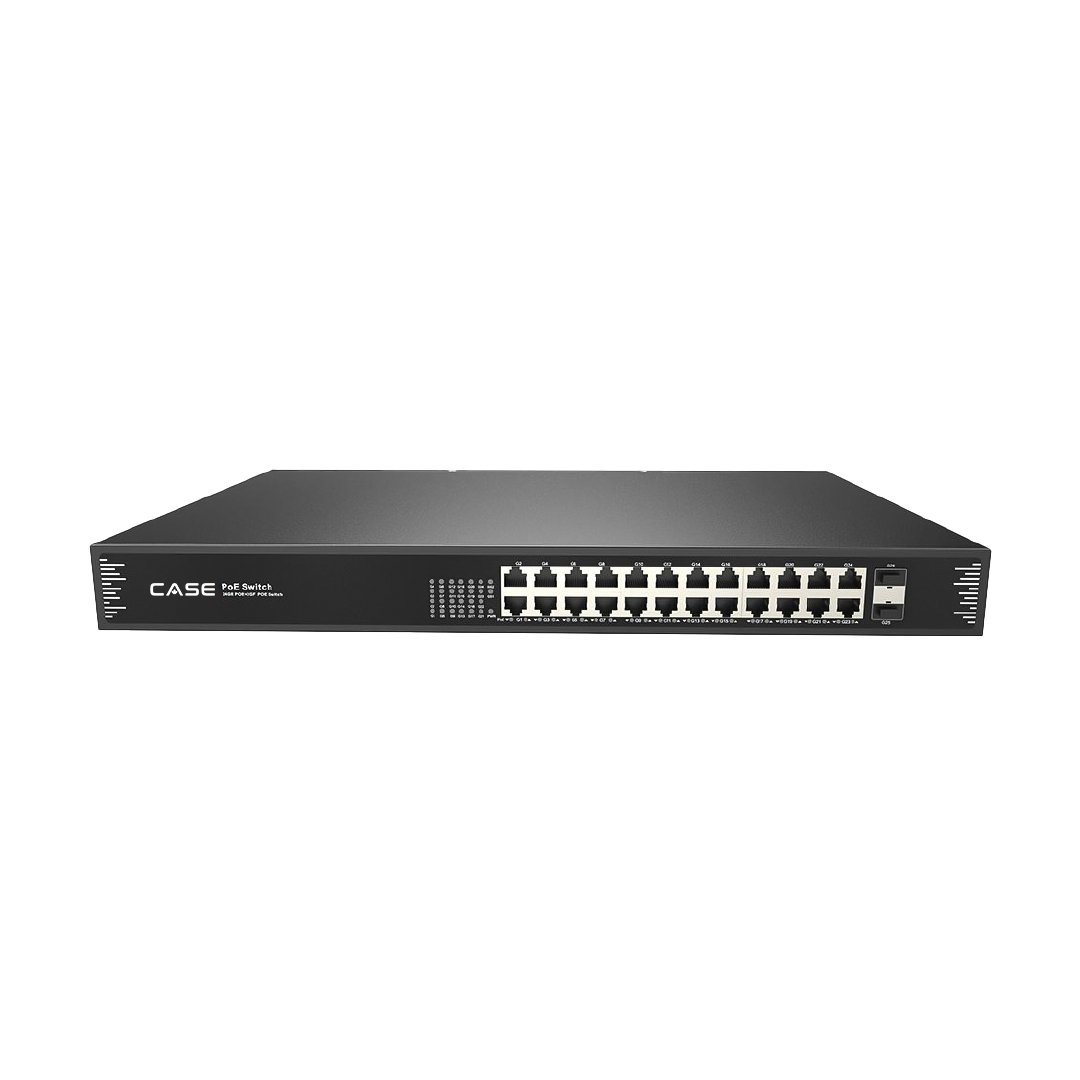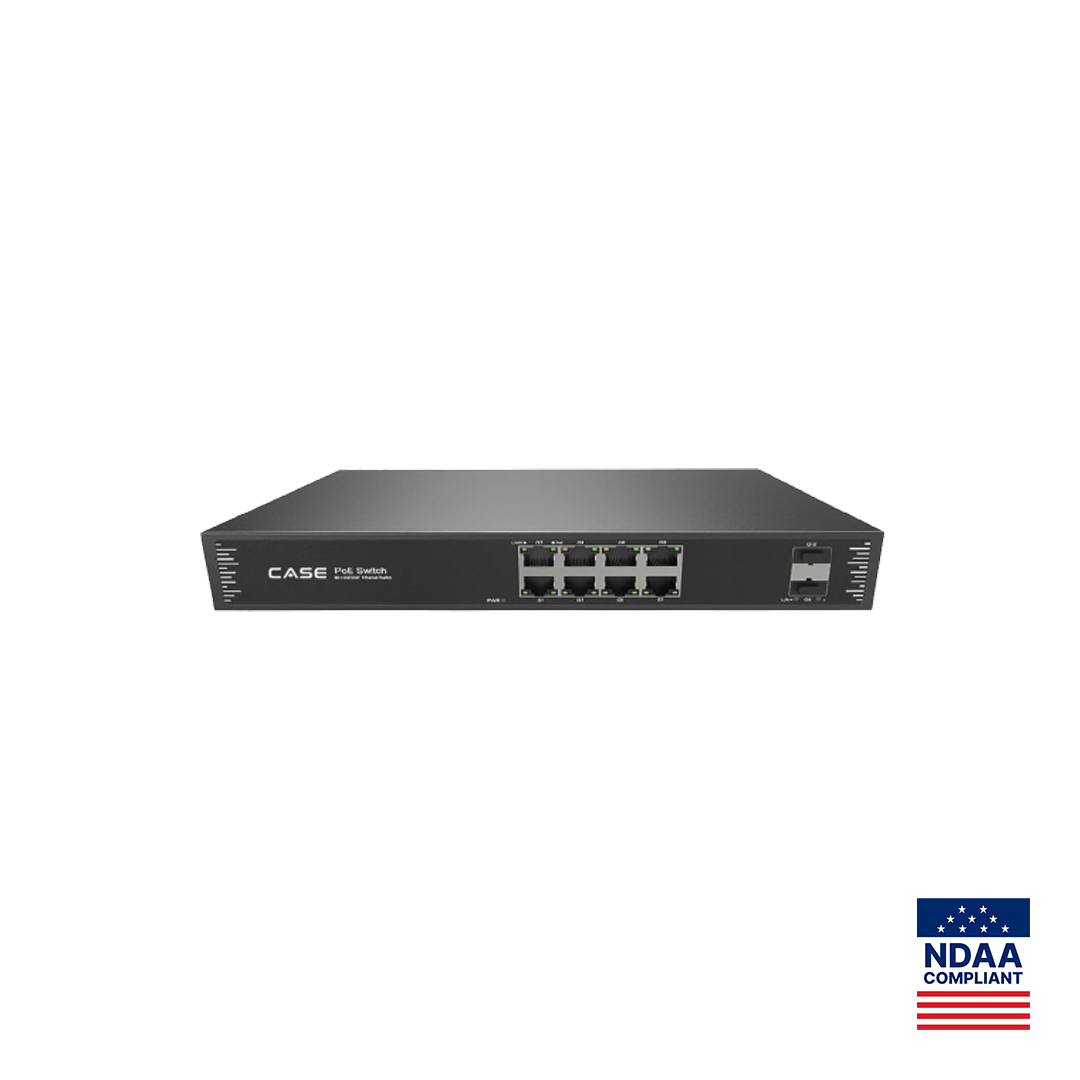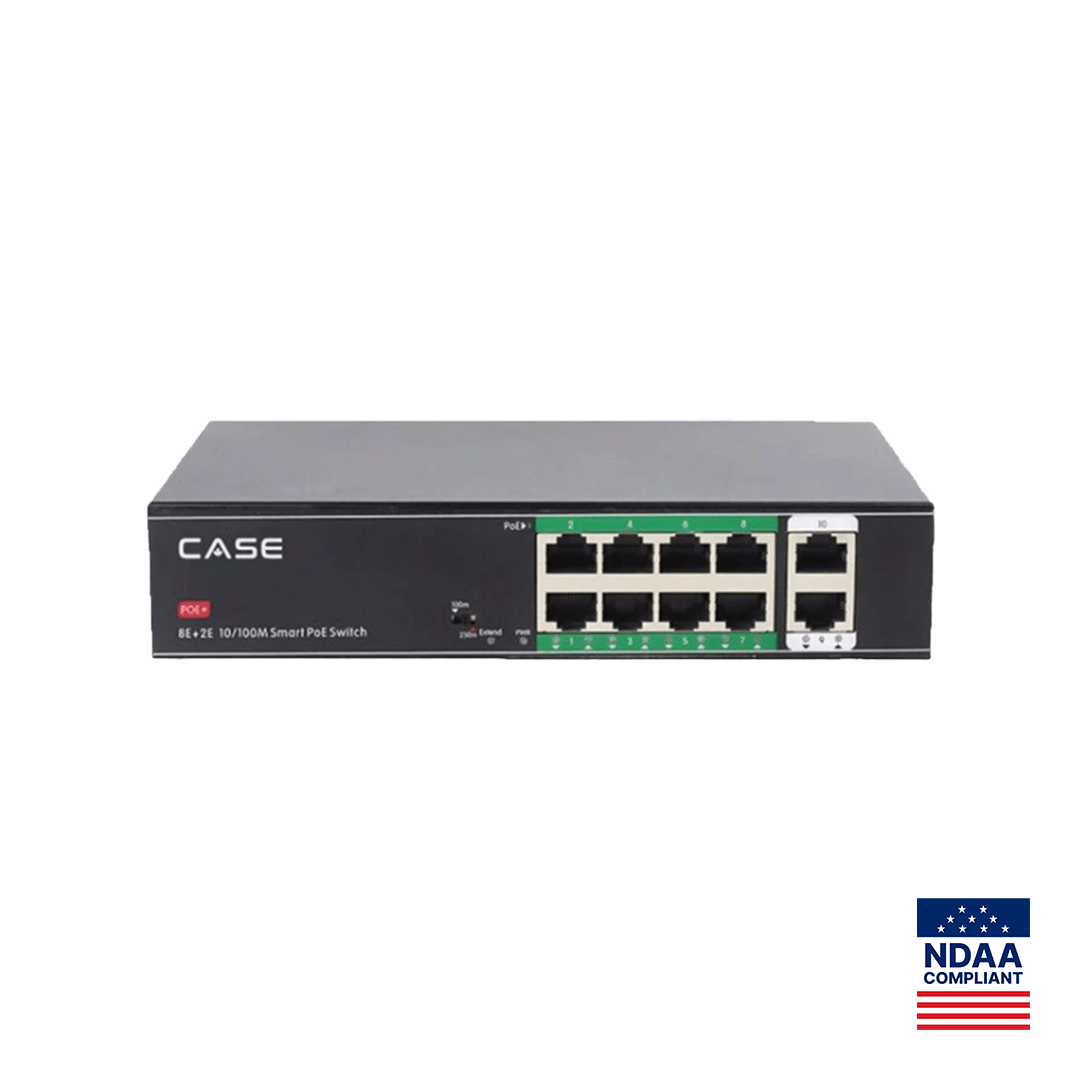


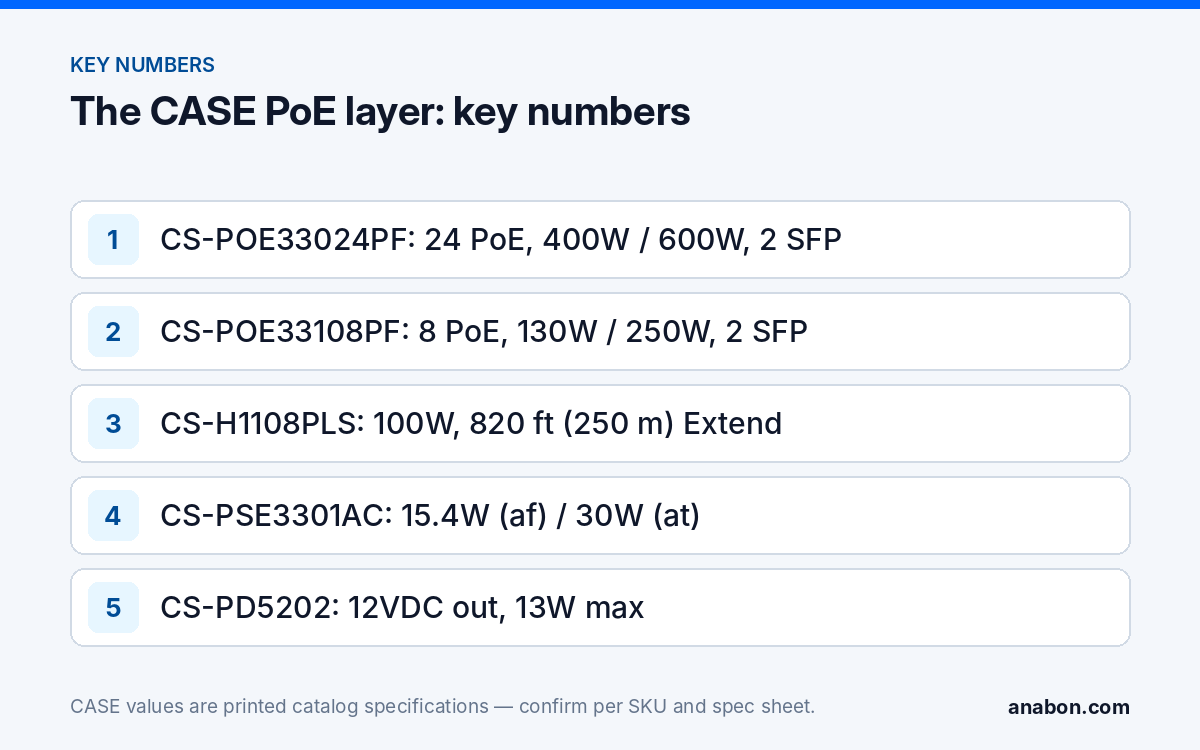
Quick answer: A PoE switch for IP cameras is chosen on three printed numbers: ports, total PoE budget and uplinks. The CASE line covers 24 Gigabit PoE ports with 2 SFP uplinks (CS-POE33024PF, 400W or 600W), 8 Gigabit PoE ports with 2 SFP uplinks (CS-POE33108PF, 130W or 250W) and 8 Fast Ethernet PoE ports with an 820 ft (250 m) Extend Mode (CS-H1108PLS, 100W). A Gigabit PoE injector (CS-PSE3301AC) and a 12VDC PoE splitter (CS-PD5202) close the gaps. CASE accessories carry unlimited warranty.
Which CASE switch fits which job? Ports, budget and uplinks
All three switches print IEEE 802.3af/at and a maximum of 30W per port. What separates them is port speed, total budget and the uplink type.
| Printed row | CS-POE33024PF | CS-POE33108PF | CS-H1108PLS |
|---|---|---|---|
| PoE ports | 24×10/100/1000M RJ45 | 8×10/100/1000M RJ45 | 8×10/100M |
| PoE standard | IEEE 802.3af/at | IEEE 802.3af/at | IEEE802.3af/at |
| Max PoE power per port | 30W | 30W | 30W |
| Total PoE budget | 400W / 600W | 130W / 250W | 100W |
| Uplinks | 2×1000M SFP fiber | 2×1000M SFP fiber | 2×10/100M RJ45 |
| Transmission distance | Not printed | Not printed | 328 ft (100 m) Standard / 820 ft (250 m) Extend Mode |
| Installation | Desktop, wall mount, 1U/19 in rack | Desktop, wall mount, 1U/19 in rack | Desktop or wall-mount |
| Protection | 4KV lightning protection, IP30 | 4KV lightning protection, IP30 | 4KV lightning / IP30 |
| Operating temperature | −4 °F to 131 °F (−20 °C to +55 °C) | −4 °F to 131 °F (−20 °C to +55 °C) | −4 °F to 131 °F (−20 °C to +55 °C) |
The two budgets on the Gigabit switches are two versions of the same model, as printed; write the budget you need on the order line so the right one ships. Three practical readings of the table:
- CS-POE33024PF is the rack switch for a camera closet or main data room: 24 cameras, fiber uplinks to the core or to a second building.
- CS-POE33108PF is the intermediate distribution frame (IDF) switch: a cluster of 8 cameras at the far end of a fiber run, or a small rack.
- CS-H1108PLS is the field switch for a remote cluster where copper is the only option and a run is longer than 328 ft (100 m). Its ports and uplinks are 10/100M, which suits camera streams but not a backbone.
IP30 and a low limit of −4 °F (−20 °C) mean all three belong indoors or in a conditioned enclosure. On a northern US or Canadian site, an outdoor cabinet needs heating and a thermostat; take the cabinet rating from its own documentation.
How much PoE budget is really there?
The per-port maximum and the total budget are different limits, and the total is the one that runs out first. IEEE 802.3af allows 15.4 W at the switch port and 802.3at allows 30 W; the device at the end of the cable receives less because the cable loses some on the way.
Planning formula: sum of each camera’s maximum power (from its spec sheet, with heater, white light and IR at full output) × a planning margin you choose, compared with the printed total budget.
| Switch (printed budget) | Ports | Average per port if all ports are used | Planning note |
|---|---|---|---|
| CS-POE33024PF, 400W | 24 | About 16.7 W | Fine for most fixed cameras; check white-light and heated units |
| CS-POE33024PF, 600W | 24 | 25 W | Room for a mix with several 802.3at cameras |
| CS-POE33108PF, 130W | 8 | About 16.3 W | Fixed cameras at a remote cluster |
| CS-POE33108PF, 250W | 8 | About 31 W | All 8 ports at 30W fit within the total |
| CS-H1108PLS, 100W | 8 | 12.5 W | Count carefully when long runs and IR are combined |
Worked example (illustrative camera values, not CASE specs): 20 cameras at 9 W maximum each plus 4 at 22 W each is 180 W + 88 W = 268 W. With a 25% margin that is 335 W, inside the 400W version of the CS-POE33024PF. Swap four more of the 9 W cameras for 22 W units (16 at 9 W plus 8 at 22 W is 320 W, or 400 W with the margin) and the 600W version is the safer line. The full method is in the PoE budget calculator.
None of these switches prints 802.3bt, so they are not the power source for a bt-class device. The CS-P88 44X, for example, prints DC36V±25%/PoE++(IEEE802.3 bt), so it needs its own DC36V supply or a bt-class source chosen from its spec sheet, with the switch carrying data only.
When does the CS-H1108PLS Extend Mode make sense?
The printed row is Transmission Distance: 100m (Standard) / 250m (Extend Mode), which is 328 ft (100 m) and 820 ft (250 m). The standard Ethernet channel limit is 328 ft (100 m); Extend Mode is the switch’s own option for longer copper runs to a camera.
- Use it for a gatehouse, a far corner of a parking lot or a fence-line camera where trenching fiber is not justified.
- Link speed in Extend Mode and how the mode is enabled are not in the catalog row; read them from the spec sheet and bench-test the actual camera, bitrate and cable before site day.
- Use solid-copper Cat6 or Cat5e, not copper-clad aluminum, and record the measured length in the as-built.
- Keep the run inside the building’s grounding and surge plan; outdoor runs follow the NEC in the US (CEC in Canada), and the local code governs.
When the run is past 820 ft (250 m), or the cluster has several cameras, a fiber link to a CS-POE33108PF is usually the cleaner design. More options are in PoE max distance and PoE extenders.
Where do the PoE injector and the splitter fit?
CS-PSE3301AC Gigabit PoE injector
As printed: 2×10/100/1000M RJ45 (Ethernet IN + PoE OUT), IEEE802.3af / IEEE802.3at, 15.4W (af) / 30W (at) per port, total power 18W (af) / 35W (at), Cat5e or higher up to 328 ft (100 m), thermal protection above 212 °F (100 °C), a PoE status LED, −4 °F to 131 °F (−20 °C to +55 °C), desktop or wall mount.
- One camera on a non-PoE switch port in the customer’s IT closet.
- A camera added after the switch budget is used up.
- Bench testing and service calls: keep one in the truck.
CS-PD5202 PoE splitter (12VDC output)
As printed: one 10/100Base-TX RJ45 data input, one 8P male data output and a DC5521 power port; IEEE802.3af/at; 13W maximum; input 44–57VDC via PoE; output 12VDC ± 0.5V; inline cable installation; 4KV lightning / IP40. The catalog’s budget row prints ≤100m (Cat5 or higher), that is ≤328 ft (100 m), which is a cable distance, not a power figure.
- A 12VDC device with an Ethernet port, such as a wireless bridge or a network device without PoE, at the end of a PoE cable.
- Replacing a separate 12VDC supply at a location with no outlet, within the 13W limit.
- Check the device’s barrel connector and polarity against DC5521 before site day.
What warranty covers the PoE layer?
CASE cameras and CASE NVRs carry a 6-year warranty. CASE PTZ cameras carry a 3-year warranty. CASE accessories carry unlimited warranty. Hard drives are supported through back-to-back manufacturer warranty.
The switches, injector and splitter are CASE accessories, so the accessory term applies. Warranty claims run through the installer or dealer and their business account; when an end user calls, the answer is: “For warranty and service, please contact the installer or company that supplied your system.” For the claim steps, see the warranty and RMA process article in the partner section.
The bundle rule: what goes on every camera order?
Many callbacks on a camera job are power and network problems, not camera problems. A short rule for every quote:
- Every camera that is not on an NVR PoE port gets a switch port, and every switch gets a budget line in the quote file.
- Recorders with built-in PoE still get an external switch when the camera count, a remote cluster or the budget needs it.
- Every remote cluster past 328 ft (100 m) gets either the CS-H1108PLS in Extend Mode or a fiber link to a CS-POE33108PF; SFP transceivers are chosen per run and fiber type and confirmed on the spec sheet.
- One CS-PSE3301AC injector per job as a service spare, and a CS-PD5202 splitter wherever a 12VDC network device has no outlet.
- Switch IP addresses, port maps and budgets go into the as-built; separate the camera network from business traffic as described in separating camera traffic from the customer’s business network.
Browse the switch range on the network switches collection and order through your approved business account.
What to tell your customer
“Each camera gets its power and network from one cable, through a switch we sized for every camera on the site plus a margin. Long runs are handled with a switch mode built for that distance or with fiber. The switch and the small power adapters are CASE accessories with unlimited warranty, and all service goes through us.”
FAQ
Can I put a camera on every port of the 24-port switch at 30W?
No. Each port can deliver up to 30W, but the printed total budget is 400W or 600W depending on the version, and 24 ports at 30W would need 720W. Add up each camera’s maximum power from its spec sheet, apply a margin, and pick the version whose total covers it. State the budget version on the order line.
Does Extend Mode keep full camera bandwidth at 820 ft (250 m)?
The catalog prints the distance only: 328 ft (100 m) Standard and 820 ft (250 m) Extend Mode on the CS-H1108PLS. Link speed in Extend Mode is on the spec sheet, not in the catalog row. Bench-test the real camera at the bitrate you plan, on a spool of the cable you will install, before committing a design to it.
Can the CASE switches power a laser PTZ?
No. The switches print IEEE 802.3af/at with 30W per port. The CS-P88 44X prints DC36V±25%/PoE++(IEEE802.3 bt), which is a higher class. Power that PTZ from its own DC36V supply or a bt-class source chosen from its spec sheet, and use the switch port for data only, inside a surge-protected design.
When should I use the injector instead of a switch?
Use the CS-PSE3301AC when only one camera needs power on an existing non-PoE network port, when a switch budget is full, or for bench work and service calls. It prints 15.4W (af) / 30W (at) on a Gigabit port, up to 328 ft (100 m) of Cat5e or higher. More than two or three cameras in one place usually justify a switch.
What warranty applies to a PoE switch or a splitter?
The switches, the injector and the splitter are CASE accessories, and CASE accessories carry unlimited warranty. CASE cameras and CASE NVRs carry a 6-year warranty and CASE PTZ cameras a 3-year warranty. Claims run through the installer or dealer and their business account; an end user should contact the company that supplied the system.