


Quick answer: Spec a parking lot as five zones, not as a camera count: the entry and exit lane, the drive aisles, the perimeter and corners, the pedestrian doors and pay points, and, on large lots, a PTZ overwatch position. Use a stitched 180° camera for overview, deterrence turrets with EW along the aisles, a PhotonX turret at the doors, and treat license plate capture as a per-project item with its own camera, lane and lighting review.
Which zones does a parking lot break into, and what does each one need?
Managers ask for “cameras on the parking lot”. What you quote is five zones, each with its own goal, lens and mounting height.
| Zone | Goal of the image | Camera type and example CASE SKU | Lens and mounting height |
|---|---|---|---|
| Entry and exit lane | Vehicle type, color, direction, driver-side context | Deterrence turret: CS-I8XQ II-2.8mm | 2.8 mm fixed; 10–12 ft (3–3.7 m), looking along the lane |
| Drive aisles | Row overview, after-hours deterrence | Deterrence turret: CS-I8XQ II-2.8mm with EW facing the aisle | 2.8 mm fixed; 12–14 ft (3.7–4.3 m) on light poles |
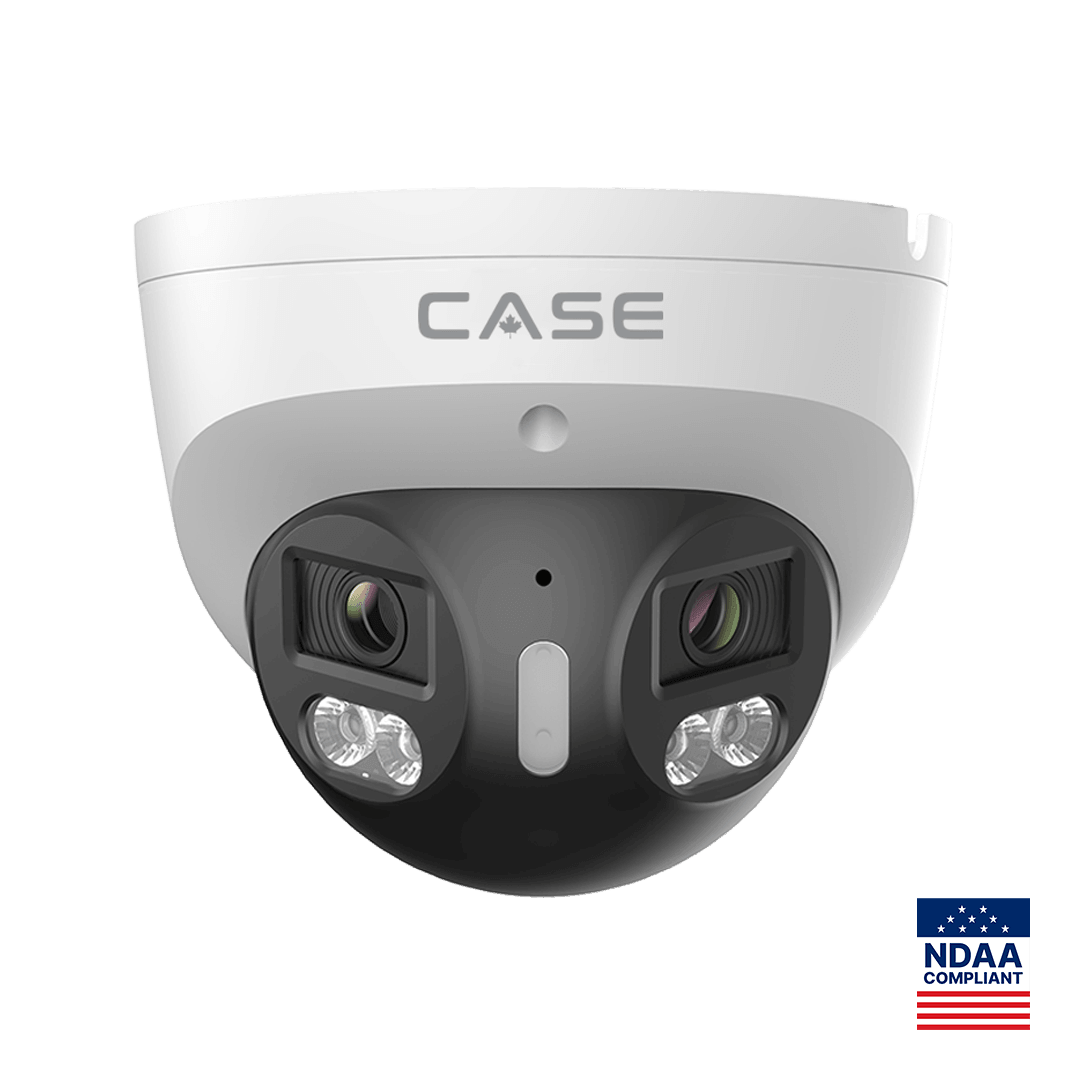
| Perimeter and building corners | Whole-lot overview with few cameras | Stitched 180° turret: CS-I86V I-180 | 2.8 mm fixed, two lenses; 14–16 ft (4.3–4.9 m) at the corner |
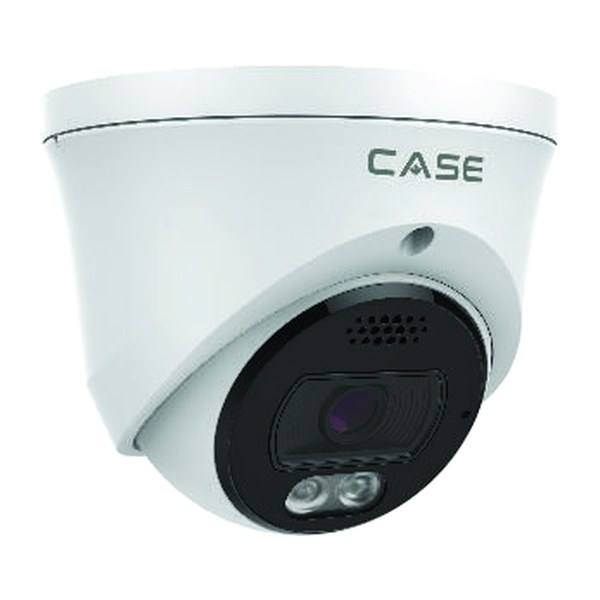
| Pedestrian doors, pay station, elevator lobby | Person detail in color at night | PhotonX turret: CS-I4SV S-2.8mm | 2.8 mm fixed; 8–10 ft (2.4–3 m), facing the approach |
| Overwatch on large lots | Follow an incident across rows | AI PTZ: CS-P44S 25XA (Auto Tracking) | 20–25 ft (6–7.6 m) pole or roof edge |
| Plates at the gate | Readable plate per lane | LPR camera: CSP-I4LQ I-LPR-8-32mm (Project Series) | Dedicated plate view, one camera per lane, low angle |
Site walk and discovery questions
Ask the manager on the first visit:
- What happened that made you call: break-ins, hit-and-run damage, dumping, loitering, a claim dispute?
- Which light poles have power and stay on all night, and are they yours or the utility’s?
- Where is the head end, how far is the farthest pole in cable feet, and how long must video be kept?
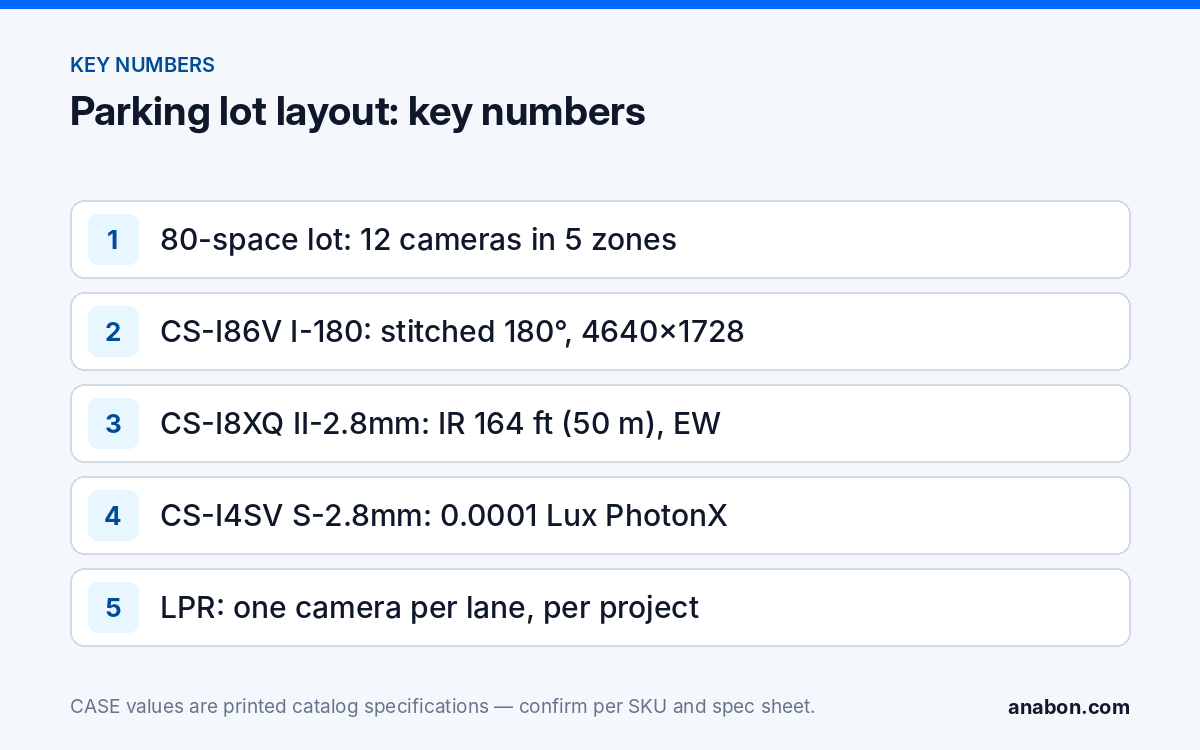
Sample layout: how do you cover an 80-space lot with 12 cameras?
A single-entrance 80-space lot is about 200 ft × 130 ft (61 m × 40 m): three double-loaded rows, an entry and exit lane on the street side, the building along the north edge with a pay station by the main door, and six light poles on the row ends.
| ID | Zone | CASE SKU | Mount and height | What it must show |
|---|---|---|---|---|
| C01 | Entry lane, inbound | CS-I8XQ II-2.8mm | Lane-side pole, 10 ft (3 m) | Vehicle front, color, time in |
| C02 | Exit lane, outbound | CS-I8XQ II-2.8mm | Lane-side pole, 10 ft (3 m) | Vehicle rear, color, time out |
| C03 | Entry lane, plates | CSP-I4LQ I-LPR-8-32mm (per project) | Dedicated post, 4–6 ft (1.2–1.8 m) | Plate only, one lane |
| C04 | North-west building corner | CS-I86V I-180 | Wall, 15 ft (4.6 m) | Rows 1–2 and the west perimeter |
| C05 | North-east building corner | CS-I86V I-180 | Wall, 15 ft (4.6 m) | Rows 2–3 and the east perimeter |
| C06–C09 | Drive aisles, row ends | CS-I8XQ II-2.8mm | Light poles, 13 ft (4 m) | Each aisle end to end, EW zone on the aisle |
| C10 | Main door and pay station | CS-I4SV S-2.8mm | Soffit, 9 ft (2.7 m) | Person detail in color at the door |
| C11 | Dumpster enclosure and rear path | CS-I8XQ II-2.8mm | Wall, 12 ft (3.7 m) | Dumping, rear approach |
| C12 | Optional overwatch | CS-P44S 25XA | Roof edge or 22 ft (6.7 m) pole | Follow an incident across the lot |
One CS-I86V I-180 per building corner replaces two or three narrow cameras with no seam between them. Keep the PTZ optional at this size; add it when the same manager asks about a larger lot or a garage level. For the housing choice per position, see Turret vs Dome vs Bullet Cameras.
Where does LPR fit at the entrance, and why is it a per-project item?
Plate capture fails for geometric reasons. A plate camera needs a lane where every vehicle passes at a predictable distance and speed, a small horizontal and vertical angle to the plate (as a rule of thumb, under about 30°), a lens set so the plate fills enough pixels, and light on the plate rather than the scene. The overview camera does none of that, which is why C01 and C03 are two cameras.
The CASE LPR camera, CSP-I4LQ I-LPR-8-32mm (4MP, 8–32 mm lens as titled on its spec sheet), is a Project Series item: availability, lead time, certificates and the warranty term are confirmed in writing per project before you promise any of them, and plate performance is stated only after the spec sheet is checked against speed, angle, distance, lighting and the plate formats in your region.
Keep two things straight in writing. License Plate Search Support printed on the CS-N440 P16H-AI is an NVR search function, not a statement that any camera reads plates. And plate data is personal information: retention and access fall under state laws (provincial laws and PIPEDA in Canada), and the property manager decides who may pull records.
What decides night performance in a lot: the camera or the lighting?
Both, and lighting usually decides first. A minimum illumination rating is measured with the camera’s illuminators off; it says nothing about headlights, pole glare or the corner behind the dumpster. Walk the lot after dark, then match the illuminator to the zone:
- IR for aisles and perimeters. The CS-I8XQ II-2.8mm prints IR 164 ft (50 m) and white light 98 ft (30 m); IR covers the aisle without lighting the neighbors’ windows.
- PhotonX where color matters. The CS-I4SV S-2.8mm prints 0.0001 Lux with white light 33 ft (10 m) and no IR; the CS-I86V I-180 prints 0.0009 Lux with IR and white light at 98 ft (30 m); the CS-I82V I-180 bullet (0.0001 Lux, white light 49 ft (15 m), no IR) is the bullet-housing option for a corner. Low-light and full-color behavior is stated per SKU on the specification sheet and should be confirmed for the site.
- WDR at the gate. The CS-I8XQ II-2.8mm prints 120dB True WDR (TWDR); the CS-I86V I-180 and CS-I4SV S-2.8mm print 120dB. Aim gate cameras off-axis so headlights cross the frame instead of filling it.
- Cold nights. Printed operating conditions: −31 °F to 149 °F (−35 °C to 65 °C) on the CS-I86V I-180; −40 °F to 149 °F (−40 °C to 65 °C) on the CS-I4SV S-2.8mm. No operating temperature row is printed for the CS-I8XQ II-2.8mm, so check its spec sheet for northern sites. More in Full-Color Night Vision Explained.
If the lighting is poor, say so in the proposal and put the upgrade on the owner’s side of the scope; the Illuminating Engineering Society publishes a recommended practice for parking facilities that the owner’s lighting designer will recognize.
How do you put deterrence on the perimeter without annoying the neighbors?
EW and AEW are deterrence features. Availability is confirmed per SKU. The laser is a deterrent, not an illuminator, and is offered on selected models only. On a lot the useful version is EW on the aisle turrets: the CS-I8XQ II-2.8mm prints a built-in mic and speaker, white light, a red and blue light, and Human / Vehicle / Non-motor Vehicle / Pet Classification, so a cat crossing the row does not trigger it. Set it up so it stays a feature:
- Draw the EW zone on the aisle and the parked rows, not on the sidewalk or the street.
- Arm light and audio only on the after-hours schedule the manager signs off; daytime stays record-only.
- Test the warning from the far end of the aisle at night and set the volume to cover the aisle and no more.
- Write zones, schedule and volume into the handover sheet.
Verify local bylaws on light trespass and noise before you arm audio and strobe near residences.
Which NVR and how much retention does a lot need?
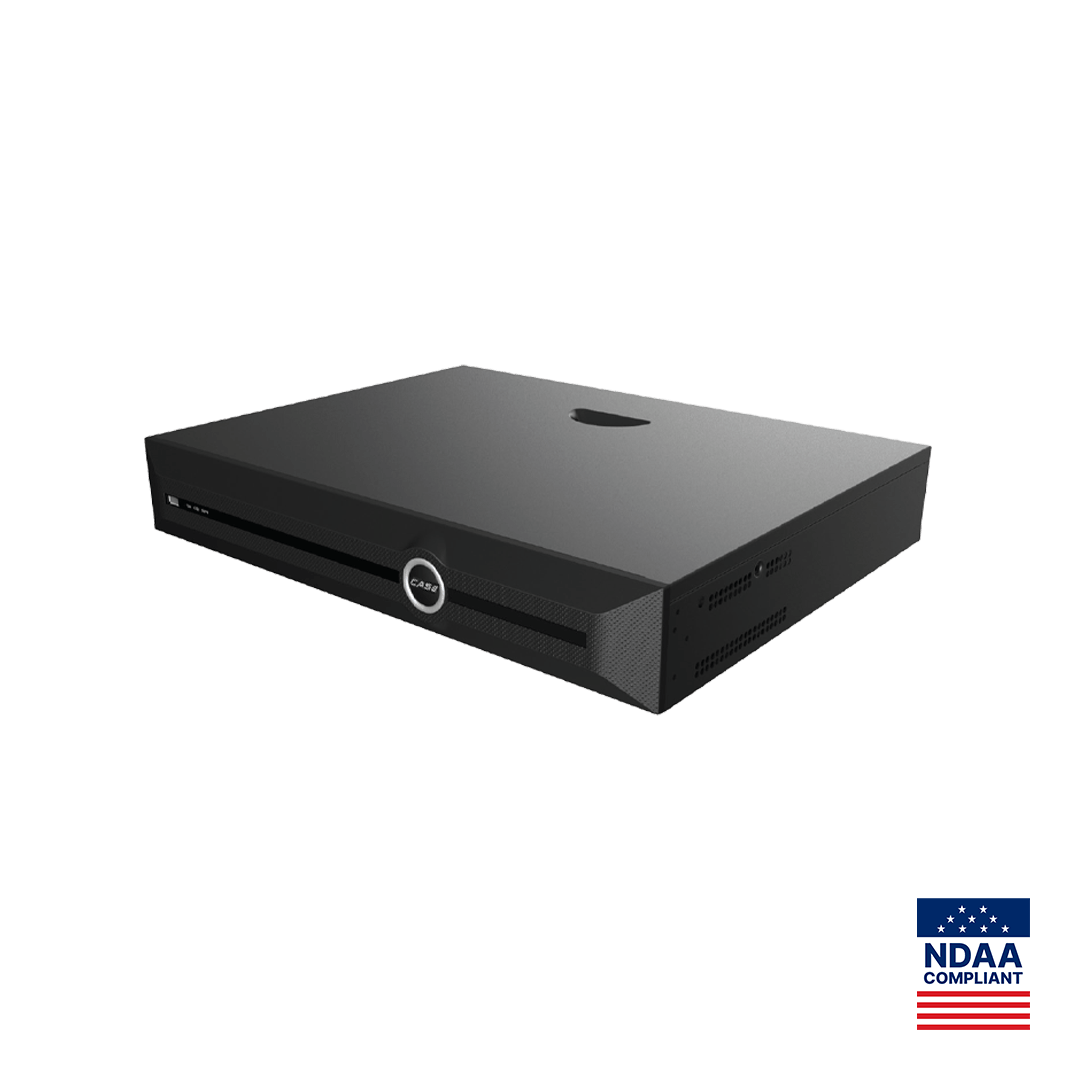
Twelve cameras fit a CS-N220 P16H-AI (20 channels, 16 PoE ports, 160Mbps in, AI on 120Mbps, up to 10 TB per HDD) with room for a second phase. Choose the CS-N440 P16H-AI (40 channels, 16 PoE ports, 400Mbps / 400Mbps, AI on 200Mbps / 200Mbps, 4×10TB HDD, 16 alarm inputs / 4 outputs) when the lot joins a building system or a garage level. See Choosing the Right CASE NVR for the full comparison.
Retention
Managers hear about a dented bumper days later, so 30 days is the practical floor and 60 to 90 days is common where claim disputes drove the purchase. Size the drives with the NVR storage calculator; treat S+265 savings as margin, not as the plan.
Cable runs and power on poles
Pole cameras break the 328 ft (100 m) Ethernet rule more than any other vertical. In order of preference: fiber to a pole enclosure using the 2×1000M SFP ports on a CS-POE33024PF; an 8-port CS-H1108PLS in the enclosure, which prints 820 ft (250 m) in Extend Mode on 10/100M ports; or a direct run where the pole is within distance. The CS-P44S 25XA prints PoE+ (IEEE802.3 at), so budget 30W at its port. Pole equipment needs surge protection and bonding per NEC (CEC in Canada); verify the local code and the utility’s rules on poles the owner does not own.
What to tell your customer
“We cover the lot as zones: the lane, the aisles, the corners and the doors, so every space is seen by an overview camera and every aisle has a camera that can warn someone off after hours. Plate reading is a separate camera on the lane that we confirm for your gate after a site review, so it is quoted as its own item. CASE cameras and CASE NVRs carry a 6-year warranty and CASE PTZ cameras carry a 3-year warranty; support comes through us.”
FAQ
How many cameras does an 80-space parking lot need?
Count zones, not spaces. A single-entrance 80-space lot usually works out to 10 to 12 cameras: two on the entry and exit lane, two 180° units on the building corners, four to six deterrence turrets along the aisles, one or two at doors, and an LPR camera per lane only where plates are a project requirement.
Can one camera do the overview and read license plates?
Not reliably. An overview camera is set wide and high to see the whole aisle; a plate camera is set narrow, low and almost level with the lane so the plate fills enough pixels. Treat LPR as its own camera, lane and lighting review, confirmed per project against the spec sheet and the site conditions.
What warranty applies to the cameras and recorder in this layout?
CASE cameras and CASE NVRs carry a 6-year warranty. CASE PTZ cameras carry a 3-year warranty. CASE accessories carry unlimited warranty. Hard drives are supported through back-to-back manufacturer warranty. A CSP- Project Series LPR camera carries no stated term until Anabon confirms it in writing for the project. Warranty flows through you, the installer.
Can the NVR search recordings by license plate?
The CS-N440 P16H-AI prints License Plate Search Support in its VCA Search list. That is an NVR search function, not a statement that any camera on the system reads plates. Plate capture depends on the LPR camera, lane geometry, firmware and project configuration, so confirm the whole chain per project.