

Quick answer: An infrared (IR) camera is a normal image sensor with its own invisible light source: it shows what reflects that light, in monochrome, out to the illuminator’s printed range. A thermal security camera has no light source; its sensor reads the long-wave infrared every object emits because of its temperature, so it shows heat, works in total darkness and light fog, and on measuring models reports a temperature. It does not identify faces or read plates, and it is not a fire alarm. Specify IR for evidence at the door, thermal for perimeters, heat and early fire warning on large sites.
IR illumination vs thermal imaging: what is the sensor actually seeing?
Both are called infrared, which is where the confusion starts. An IR camera uses the same silicon sensor as a daytime camera; at night it opens its IR-cut filter and switches on near-infrared LEDs, and the sensor records that light bouncing off the scene. Range is the illuminator’s printed throw, and a person in dark clothing against a dark wall is hard to pick out. A thermal camera uses a different detector: most CASE thermal SKUs print a Vanadium Oxide uncooled focal plane array, elements that change resistance as the long-wave infrared they absorb warms them (CS-P58 T-44X prints the response waveband as 8µm to 14µm). Nothing is emitted. A warm body against a cold yard is a bright shape.
| Question | IR-illuminated camera | Thermal camera |
|---|---|---|
| What it records | Near-infrared light reflected off the scene | Long-wave infrared emitted by the scene |
| Range limit | Illuminator throw, printed per SKU | Lens and sensor resolution; printed as detection distance per lens |
| Faces, plates, color | Faces and plates within the lit zone | No: shapes and heat only |
| Fog, smoke, dust | Light scatters back; image washes out | Sees through light fog and smoke; dense fog and heavy rain still attenuate |
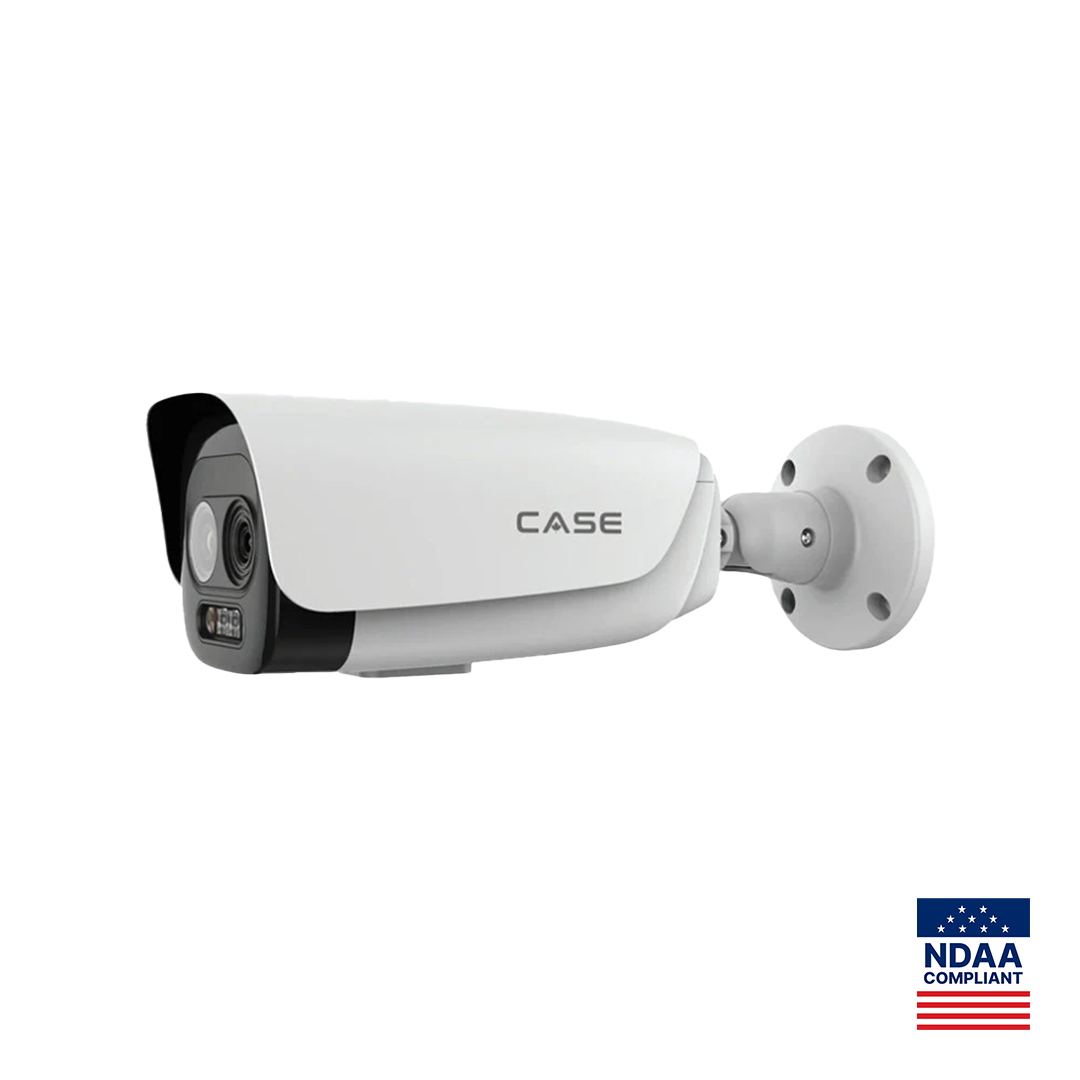
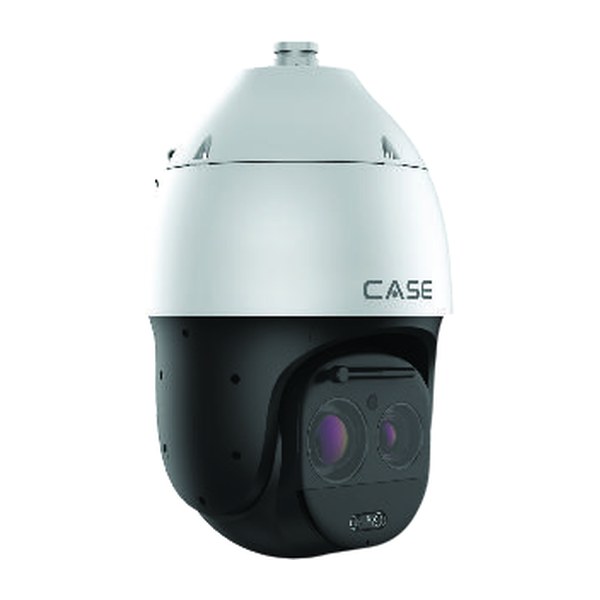
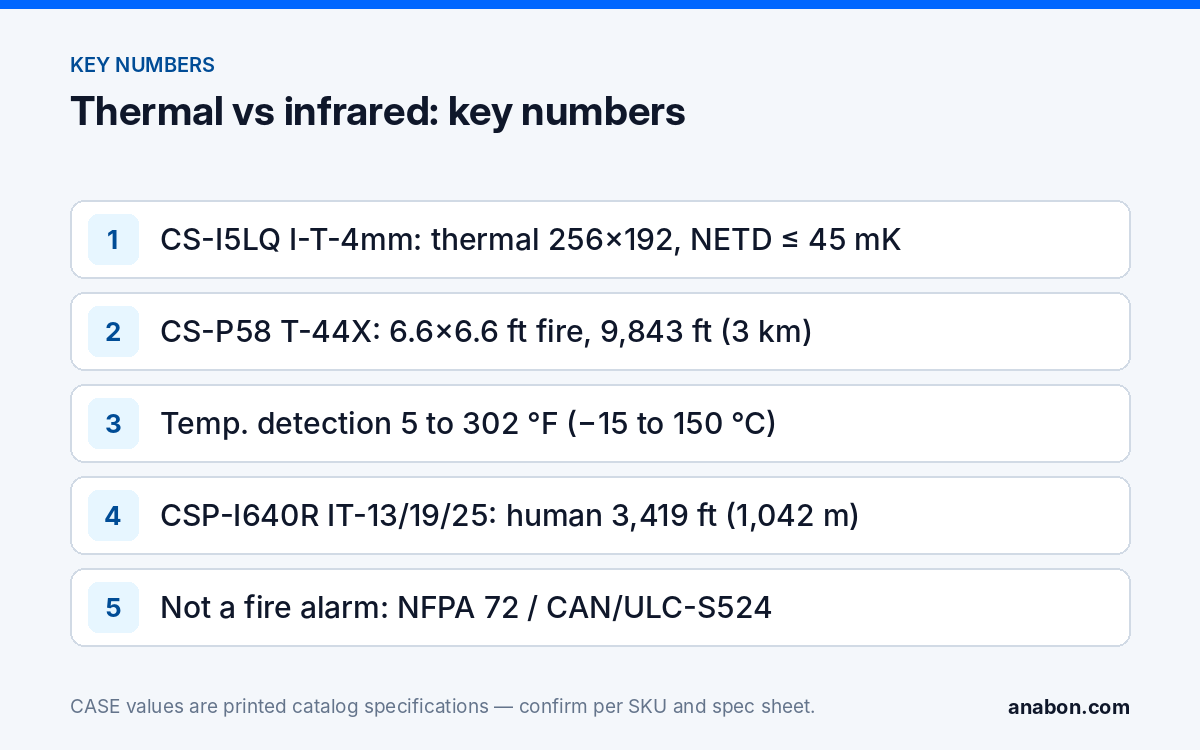
Bi-spectrum units carry both. CS-I5LQ I-T-4mm prints an optical channel at 2880×1620@30fps and a thermal channel at 256×192@25fps in one bullet: the thermal side detects, the optical side shows who. CS-P58 T-44X does the same on a PTZ with a 6mm to 264mm zoom and IR 984 ft (300 m). The IR side is covered in IR range explained.
Detection range and NETD: how do you read a thermal spec sheet?
Resolution is the detector grid: 256×192 on CS-I5LQ I-T-4mm, 384×288 on CS-P58 T-44X and CSP-I384 EXT I-7/13/25mm, 640×512 on CSP-I640R IT-13/19/25, 1280×1024 on CSP-I1280R IU-75mm. More elements put more pixels on a distant person, but the counts are far below visible cameras, which is why a thermal image never resolves a face.
Detection distance on a thermal sheet is conventionally a Johnson-criteria detection figure: enough pixels to tell that a human-sized or vehicle-sized target is present, not to recognize who or what it is. CSP-I640R IT-13/19/25 prints human detection at 1,243 ft (379 m) with the 9.1 mm lens and 3,419 ft (1,042 m) with the 25 mm lens, vehicle detection from 3,816 ft (1,163 m) to 10,479 ft (3,194 m); CSP-I1280R IU-75mm prints human 1.9 mi (3 km) and vehicle 5.9 mi (9.5 km). Draw the alarm line well inside those figures; the 25 mm lens reaches farther with a narrower field (printed 17.5°×14.0°) than the 9.1 mm lens (48°×38°).
NETD, noise-equivalent temperature difference, is the smallest temperature difference the detector distinguishes from its own noise; lower is better. CS-I5LQ I-T-4mm prints ≤ 45 mK at 77 °F (25 °C) and F# = 1.0, CS-P58 T-44X and CSP-I384 EXT I-7/13/25mm print ≤40mK, CSP-I1280R IU-75mm ≤35mK. Forty-five millikelvin is about 0.08 °F (0.045 °C): a person against a wall differs by far more, so any of these detects people; the lower figures matter when the target is close to background temperature, such as a vehicle parked for hours in the sun.
Temperature measurement: which jobs is it for?
A measuring thermal camera reports temperature per drawn region and alarms when a threshold is crossed. CS-I5LQ I-T-4mm prints two ranges, 5 to 302 °F (−15.0 to 150.0 °C) and 122 to 1,022 °F (50.0 to 550.0 °C) with an Auto mode, and an accuracy of ±3.6 °F (±2 °C) or ±2%. CSP-I384 EXT I-7/13/25mm prints −4 to 302 °F (−20 to +150 °C) and 32 to 1,022 °F (0 to +550 °C). These are screening-grade figures: emissivity, distance and ambient temperature move the reading, so the use case is trend and threshold, not certified measurement.
- Electrical rooms, switchgear and transformer yards: a connection running hotter than its neighbors, alarmed before it fails.
- Motors, bearings and compressors: heat rise as a maintenance trigger.
- Waste, recycling, wood chip and coal piles: self-heating that shows at the surface before smoke.
- Battery storage and charging areas: a cell or charger above threshold after hours.
- Hazardous-area process equipment: the explosion-proof CSP-I384 EXT I-7/13/25mm, printed with Gas Zone 1 & 2 and Dust Zone 21 & 22, is quoted per project.
Commissioning for measurement: set the emissivity for the surface that matters, draw the region on the equipment, set the threshold with the customer’s engineer, and prove the alarm path end to end, including the notification in CASE Connect, confirmed per model and configuration.
Fire and smoke detection: what can a thermal camera do, and what is it not?
A thermal camera detects a fire as a region above a temperature threshold, often before smoke reaches a conventional detector, outdoors and over large areas where detectors cannot be installed. CS-P58 T-44X prints Fire / Smoke Detection and Temperature Alarm on its thermal channel and a fire detection distance of 9,843 ft (3,000 m) for a 6.6 ft × 6.6 ft (2 m × 2 m) fire; the target size is part of the figure. CSP-I640R IT-13/19/25 prints Fire Detection and Smart Temperature Measurement. CS-I5LQ I-T-4mm prints temperature detection but no fire-detection function or distance, so none is claimed for it without the spec sheet. Visible-light smoke and fire detection, printed on Generation II turrets such as CS-I8XQ II-2.8mm, is an AI function on an ordinary camera, confirmed per use case, firmware and region.
What thermal is not: a fire alarm system. In the US, fire alarm initiating devices are governed by NFPA 72 and the local code; in Canada by CAN/ULC-S524 and the building code as adopted locally. A thermal camera is not a listed initiating device under either, and the authority having jurisdiction decides what satisfies the code. Sell thermal fire detection as a supplementary early-warning layer alongside, never instead of, the required fire alarm system, and have the fire protection contractor confirm any interface to it.
- State in writing that the thermal camera supplements and does not replace the fire alarm system required by NFPA 72 (US) or CAN/ULC-S524 (Canada); verify the local code.
- Set and document the threshold and region; route the alert to a monitored input, CASE Connect and the NVR, and test all three.
- Quote the printed fire detection distance only with its target size, and only for the SKU that prints it.
CASE thermal options as printed in Catalog 2027 Q1
| SKU | Type | Thermal resolution | NETD | Temperature / fire rows | Operating range · Protection | Sales model |
|---|---|---|---|---|---|---|
| CS-I5LQ I-T-4mm | Bi-spectrum bullet, optical 2880×1620@30fps | 256×192@25fps | ≤ 45 mK | 5 to 302 °F (−15 to 150 °C), 122 to 1,022 °F (50 to 550 °C); no fire distance printed | −31 to 149 °F (−35 to 65 °C) · IP67 | Catalog; CASE cameras carry a 6-year warranty |
| CS-P58 T-44X | Bi-spectrum PTZ, 6mm to 264mm, IR 984 ft (300 m) | 384×288 | ≤40mK | Temperature Alarm, Fire / Smoke Detection; 6.6 ft × 6.6 ft (2 m × 2 m) fire at 9,843 ft (3,000 m) | −40 to 158 °F (−40 to 70 °C) IR off · IP66 | Catalog; CASE PTZ cameras carry a 3-year warranty |
| CSP-I640R IT-13/19/25 | Fixed thermal, 9.1 / 13 / 19 / 25 mm athermal lenses | 640×512 | Not printed | Fire Detection, Smart Temperature Measurement; human to 3,419 ft (1,042 m) | −40 to 158 °F (−40 to +70 °C) · IP66 | Project-quoted |
| CSP-I1280R IU-75mm | Fixed thermal, 75mm lens | 1280×1024 | ≤35mK | Tripwire, Regional Intrusion; human 1.9 mi (3 km), vehicle 5.9 mi (9.5 km) | −40 to 140 °F (−40 to +60 °C) · IP66 | Project-quoted |
| CSP-I384 EXT I-7/13/25mm | Explosion-proof thermal, 7 / 13 / 25 mm | 384×288 | ≤40mK | −4 to 302 °F (−20 to +150 °C), 32 to 1,022 °F (0 to +550 °C) | −40 to 140 °F (−40 to +60 °C) · IP66 / IP68 / IP69 | Project-quoted |
Two sales models sit in that table. CS-I5LQ I-T-4mm and CS-P58 T-44X are catalog-line products with the warranty stated above, handled through the installer or dealer. The three CSP- units are CASE Project Series: availability, certificates, lead time and warranty term are confirmed in writing per project before any is promised; the ATEX and IECEx wording printed on CSP-I384 EXT I-7/13/25mm rests on certificate documents supplied per SKU, not on the catalog page. Bring us the opportunity before you say no. CASE offers NDAA-compliant options for compliance-sensitive projects. Anabon confirms the exact products and provides the official compliance documentation for each project. In detail: CS-I5LQ I-T-4mm; and explosion-proof cameras.
What to tell your customer
“The infrared cameras at your doors light the scene with invisible light and record faces and plates. The thermal camera on the yard reads heat: it sees a person or a running engine in total darkness and light fog at distances the other cameras cannot reach, and alarms when something exceeds the temperature we set. It supplements your fire alarm system; it does not replace it. We tested the alarm path with you before handover.”
FAQ
What is the difference between a thermal security camera and an infrared camera?
An infrared camera is a normal sensor with invisible near-infrared LEDs; it records reflected light and shows faces and plates within the illuminator’s printed range. A thermal camera has no light source and reads the long-wave infrared the scene emits, so it shows heat and presence in total darkness and light fog, at long range, without faces or plates. Bi-spectrum units do both.
How do thermal cameras work?
The detector is an array of elements, Vanadium Oxide on most CASE thermal units (as printed per SKU), that warm slightly as they absorb long-wave infrared from the scene and change resistance; the electronics turn those differences into an image where hotter is brighter. Nothing is emitted. Resolution (256×192 to 1280×1024 on the CASE line) and lens focal length set the detection distance; NETD sets the smallest temperature difference shown.
Can a fire detection camera replace smoke detectors?
No. A thermal camera detects a heat source above a threshold and can alert before smoke reaches a detector, especially outdoors and over large areas, but it is not a listed fire alarm initiating device under NFPA 72 (US) or CAN/ULC-S524 (Canada). Sell it as a supplementary early-warning layer alongside the required fire alarm system; the authority having jurisdiction decides what the code requires.
What does NETD mean on a thermal camera spec sheet?
Noise-equivalent temperature difference: the smallest temperature difference the detector distinguishes from its own noise under test conditions, usually at 77 °F (25 °C) and F# = 1.0. Lower is better. CS-I5LQ I-T-4mm prints ≤ 45 mK, about 0.08 °F (0.045 °C); CS-P58 T-44X prints ≤40mK and CSP-I1280R IU-75mm ≤35mK. People are easy at any of these; the lower figures help with targets close to background temperature.