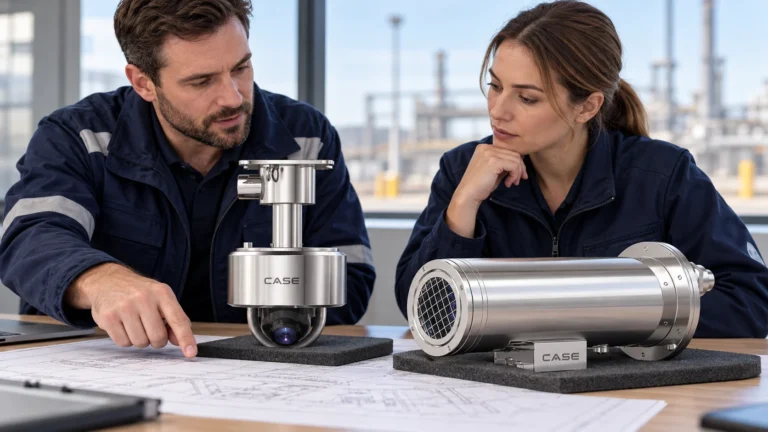



Quick answer: An explosion-proof camera proposal starts with the site’s approved hazardous-area classification and the required certification basis. Match the complete model/configuration, certificate, marking, conditions of use and installation method; a catalog icon or another country’s scheme is not site approval. CASE CSP- Project Series availability, documents, lead time and warranty terms require written project confirmation before a commitment.
On this page
Hazardous-area basics: Class/Division vs Zone
A hazardous (classified) area is assessed for the flammable gas, vapor, combustible dust or ignitable fibers that may be present and the likelihood of an ignitable quantity. Electrical equipment can introduce heat or sparking; the approved classification and protection requirements govern the proposed equipment and installation.
Class/Division and Zone are distinct classification systems used under applicable national rules. The project’s competent designer must identify the actual class/division or zone, substance group, temperature limits, ambient conditions and required approval basis for each position. Verify the adopted code edition and authority requirements; do not choose the classification from a camera brochure. For the applicable US workplace scope, OSHA 1910.307 addresses hazardous locations; it does not establish Canadian or universal project approval.
ATEX and IECEx are different conformity frameworks; neither name alone approves a complete North American installation. Read the full equipment marking and certificate for the exact configuration, including protection concept, gas/dust group, temperature limits, equipment protection level and conditions of use. An enclosure described as dust-tight or stainless is not automatically suitable for combustible dust.
| Input to obtain | Who confirms it | What to compare |
|---|---|---|
| Area classification and substance | Responsible competent designer/owner | Actual class/division or zone and gas/dust group at each position |
| Equipment approval basis | Applicable authority and responsible designer | Required national mark, certificate scheme and accepted standards |
| Exact configuration | Supplier documentation and certificate | Full model, options, ambient/temperature limits and specific conditions |
| Installation system | Qualified hazardous-area designer/installer | Approved entry, glands, wiring, bonding, accessories and inspection |
This is an input checklist, not a conversion between Division and Zone ratings. Obtain the approved classification and installation requirements; one system’s label does not automatically establish equivalence or acceptance in another.
What a certificate actually covers (and what it does not)
Obtain the certificate and schedule for the exact model/configuration. Check its controlled current version, product scope, marking, standards and specific conditions of use. An X suffix identifies conditions that must be read and met; do not infer them from a generic example. Marking terms such as Ex db, Ex tb, T6 or an optical-protection suffix are part of a combined assessment, not independent permission to install. The IECEx equipment-certification FAQs explain the controlled online record and national acceptance limits. Record the actual issue and status; a certificate is not proved current by its age or a catalog number alone.
Determine which supplied items, options and accessories the certificate actually covers. An unapproved gland, cable, entry adapter, modification or opening procedure can invalidate the intended protection. IECEx documentation does not automatically provide every national approval. Resolve the actual acceptance basis with the competent designer and authority before quoting; a catalog graphic is not the controlled certificate.
Stainless housings, enclosures and glands
The six catalog pages list stainless 304 or 316L variants. Confirm the actual ordered housing material, finish, environmental exposure and chemical compatibility. A stainless grade alone does not establish suitability for every process, marine or chloride exposure.
Select enclosures, glands, adapters and mounts as part of the approved installation. For example, CSP-110 EX lists alternative entry and voltage rows, but that does not mean every unit supplies every thread, conversion or voltage simultaneously. Confirm the actual variant, certificate scope, cable construction, sealing and bonding instructions. Do not drill, substitute or mix accessories without the required approval. Check the available IP camera user manual, then request any missing model-specific accessory and installation documents; a download listing does not approve a configuration.
The CASE Project Series explosion-proof line (project-quoted)
Six cameras are printed, all Intelligent series, all stainless steel. Rows are as printed in the 2027 Q1 catalog; the spec sheet governs, and nothing here commits to availability, certificate, lead time or warranty term.
| SKU | Imager and lens (printed) | Protection | Certification rows (printed) |
|---|---|---|---|
| CSP-I8PS EX-I-2.7-13.5mm | 8MP AI bullet (3840×2160@20fps), 2.7–13.5 mm, IR 262 ft (80 m) | IP66, IP68 (6.6 ft (2 m), 2 h), IP69 | DNV 22 ATEX 51565X, IECEx DNV 22.0097X; Ex db IIC T6 Gb / Ex tb IIIC T80°C Db |
| CSP-I8MS EX I-2.7-13.5mm | 8MP AI camera (3840×2160), motorized 2.7–13.5 mm | IP66, IP68 (6.6 ft (2 m), 2 h) | DNV 21 ATEX 24764X, IECEx DNV 21.0047X; markings with and without optical fiber |
| CSP-P49S EX-63X | 4MP 63x PTZ (2560×1440@30fps), 5.7–359 mm, IR 984 ft (300 m) | IP68 (6.6 ft (2 m), 2 h) | Presafe 17 ATEX 11328X, IECEx PRE 18.0030X; II 2G Ex db op is IIC T6 Gb / II 2D Ex tb op is IIIC T80°C Db (printed markings; verify actual certificate) |
| CSP-P49S EXT-63X | 4MP 63x PTZ plus 640×480 thermal (17 µm), IR 984 ft (300 m) | IP68 (3.9 ft (1.2 m), 45 min) | IEC/EN60079; gas and dust markings are printed. Obtain the full actual marking and clarify its temperature notation; no certificate number printed |
| CSP-P47S EX-63X | 4MP 63x PTZ (2560×1440@30fps), 5.7–359 mm, IR 984 ft (300 m) | IP68 | Catalog shows gas/dust marking alternatives, including II 2G Ex db IIC T6 Gb and Ex tb / Ex tb op pr dust variants. EN/IEC 60079-0, -1, -31; no certificate number printed. Match the actual supplied variant |
| CSP-I384 EXT I-7/13/25mm | 384×288 VOx fixed thermal, 7 / 13 / 25 mm, NETD ≤40mK, temperature −4 °F to 302 °F (−20 to +150 °C) / 32 °F to 1,022 °F (0 to +550 °C) | IP66 / IP68 (6.6 ft (2 m), 2 h) / IP69; defroster and wiper | ATEX and IECEx certified; Gas Zone 1 and 2 / Dust Zone 21 and 22; power 12VDC / 24V AC/DC / 100–240VAC / PoE++ |
Where a catalog page omits a certificate number or operating condition, mark the item as requiring evidence. Where it prints one, verify the actual controlled certificate and its scope rather than assuming it is current for the offered configuration. The CASE Project Series overview describes the project-specific quotation process; no listing here commits supply or acceptance.
How quoting works: documents first, then the number
Start the request with the actual hazardous-area classification, required approval basis and permitted project documents. Anabon can confirm which product records and commercial terms are available; a request does not guarantee a certificate, accepted configuration or delivery date.
- Area classification drawing from the owner’s engineer: Class/Division or Zone, gas or dust group, temperature class, per camera position.
- Acceptance basis: does the site accept ATEX/IECEx certificates, or does it require a North American certification mark? Ask in the pre-bid RFI (see how to read a video surveillance RFP).
- Ambient range and mounting: sun load and process heat at each position (which decide whether a cooled housing is needed), height, structure, hot-work permit rules, who may open an Ex housing on site.
- Cable entry and wiring method: NPT or metric threads, armored cable or conduit, gland type, fiber or copper, and where the switch sits (outside the classified area, or in a certified enclosure such as CSP-110 EX).
- Power available: PoE++, 24 V or 100–240 VAC, matched to the printed power rows.
- Documentation required at submittal: certificates, spec sheets, conditions of use and compliance letters; the per-SKU documentation pack is assembled per project.
- Schedule: the required delivery date, so lead time is confirmed against it.
Request a written per-SKU response identifying the available certificate records and versions, outstanding evidence, availability, lead time and project warranty terms. Until the necessary records and acceptance are resolved, keep the proposal conditional; a catalog badge does not fill the gaps. The per-SKU documentation service describes the evidence-request process; request the records that actually exist for your offered configuration.
What to tell your customer
“We match the exact camera and options to the approved position requirements and controlled product records. We also confirm the installation requirements, permitted accessories and written project terms. Your responsible designer and authority resolve acceptance before a supply or installation commitment.”
FAQ
Is an ATEX or IECEx explosion proof camera accepted on a US or Canadian site?
Confirm the applicable national requirements and required approval route with the competent designer and authority. IECEx notes that many member countries still require processing for national certification or approval. A buyer preference alone cannot waive governing requirements. Obtain both the actual product records and the site’s required acceptance before relying on the equipment.
What is the difference between Class 1 Division 2 and Zone 2?
They belong to different classification systems. Do not use a short Division-to-Zone comparison as an equipment-selection or approval rule. Obtain the actual site drawing, substance group, temperature/ambient requirements and accepted certification basis, then have the complete proposed configuration reviewed.
What does Ex db IIC T6 Gb mean on a camera?
Those symbols describe parts of the protection marking, including flameproof protection, gas group, temperature class and equipment protection level. Their combined meaning and permitted use must be checked against the actual certificate, configuration, ambient limits and site classification. The CSP-I8PS EX-I-2.7-13.5mm catalog row is a starting reference, not the controlled certificate or installation approval.
Do CASE explosion proof cameras carry a warranty term?
Not one stated in advance. Every CASE Project Series CSP- SKU is project-quoted: availability, documents, lead time and warranty terms require written confirmation for the actual project. Warranty badges elsewhere and standard-product terms do not override that response.
References
- Anabon current model documents and manuals
- ONVIF model and firmware conformance database
- IECEx: controlled certificate status and national acceptance
- OSHA 1910.307: hazardous classified locations