

Quick answer: Read a video surveillance RFP in this order: the procurement rules in Division 00 (deadlines, addenda, bid form), the general requirements in Division 01 (substitutions, submittals, closeout, training), then the Division 28 section at 28 20 00 Video Surveillance, where Part 2 names the basis of design and the “or equal” language, and Part 1 carries the compliance, warranty and documentation clauses that disqualify bids. Decide go or no-go on those clauses before you count cameras.
What does a Division 28 RFP package actually contain?
A video surveillance RFP is a set of documents that reference each other, written to the CSI MasterFormat numbering North American specifiers use. In Canada the same numbering applies, because MasterFormat is published jointly by CSI and Construction Specifications Canada (CSC); only the procurement portals differ. Open these, in reading order:
| Document | What it decides | What you check first |
|---|---|---|
| Division 00, Procurement and Contracting Requirements | Who may bid, how, by when; bid form; bonding and insurance; addenda | Due date and time, mandatory pre-bid meeting, question deadline, bid security |
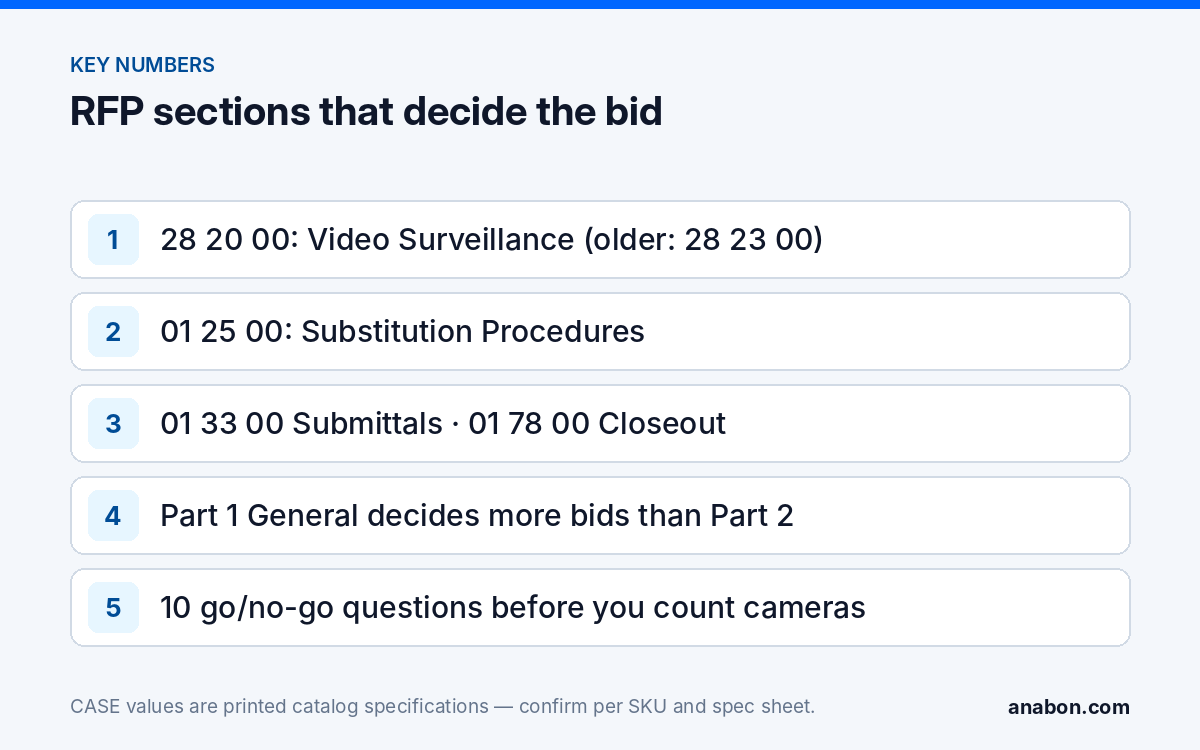
| Division 01, General Requirements | Rules for every trade: 01 25 00 Substitution Procedures, 01 33 00 Submittal Procedures, 01 78 00 Closeout Submittals, 01 79 00 Demonstration and Training | Substitution deadline, submittal format, record documents, training hours |
| Division 26 and 27, Electrical and Communications | Power, raceway, grounding, structured cabling | Whether cabling and conduit are in your scope or the electrical contractor’s |
| Division 28, Electronic Safety and Security: 28 20 00 Video Surveillance (older documents: 28 23 00), often with 28 05 00 Common Work Results | The cameras, recorder or VMS, performance, compliance, warranty, testing | Part 1 General (compliance, submittals, warranty), Part 2 Products (basis of design, “or equal”), Part 3 Execution (install, test, train) |
| Drawings and the camera schedule | Where every device goes and how it is fed | Device count versus the schedule, mounting heights, riser, head-end location |
| Addenda | Changes issued after release; they override the original text | Every addendum acknowledged on the bid form, every change carried into your count |
Every Division 28 section follows the three-part SectionFormat: Part 1 General, Part 2 Products, Part 3 Execution. Bidders lose on Part 1 more often than on Part 2, because the disqualifying clauses (compliance, warranty, submittals, qualifications) sit there while estimators skip to the product list.
How do you read the basis of design and the “or equal” language?
Part 2 usually opens with a named brand and model as the basis of design, followed by one of several phrases. The phrase decides whether you can bid CASE at all and when you must act:
- “or approved equal” / “or equal approved prior to bid”: a substitution request must be approved, in writing, by the deadline in 01 25 00 (often 7 to 10 days before bid). After that, the named product is the only compliant bid.
- “or equal as determined by the Engineer” / “or equal”: the reviewer judges equality, usually at submittal review after award. Lower risk at bid time, higher after it; state the proposed product in your bid so it is never a hidden substitution.
- “no substitutions” / “sole source” / a pre-approved brand list: bid the named product or do not bid.
- Performance specification with no manufacturer named: the best case for a CASE bid; compliance is proven line by line against the spec sheet.
What a substitution request must contain
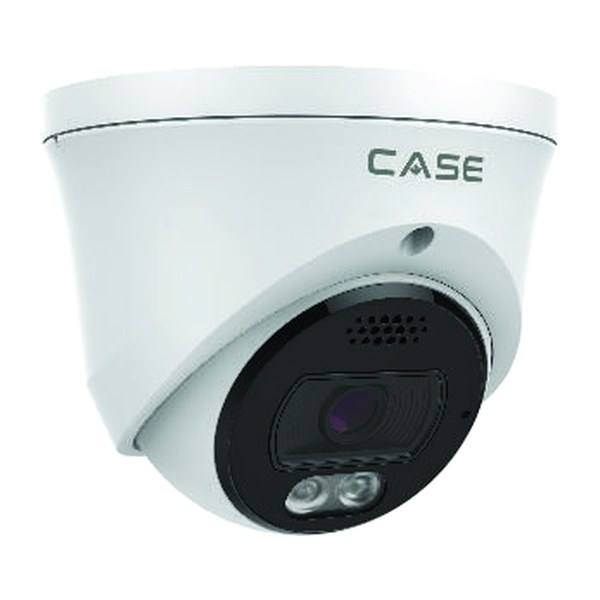
Reviewers approve substitutions that are easy to verify. Submit, on the owner’s form where one exists: the spec section and paragraph; the proposed full SKU (CS-I8XQ II-2.8mm, not “8MP turret”); a compliance matrix listing every numbered requirement next to the printed spec-sheet value with a comply, exceed or deviate mark; the spec sheets; and a plain statement of every deviation, including effects on other trades (power, mounting, network). Anabon supplies the per-SKU documentation for the matrix; it cannot promise acceptance, and neither can you. Bring us the opportunity before you say no, and before you write “equal” on anything.
Which compliance and documentation clauses can disqualify a bid?
These clauses are pass or fail. Read each against the documents you can produce before the deadline, not against what you believe about the brand.
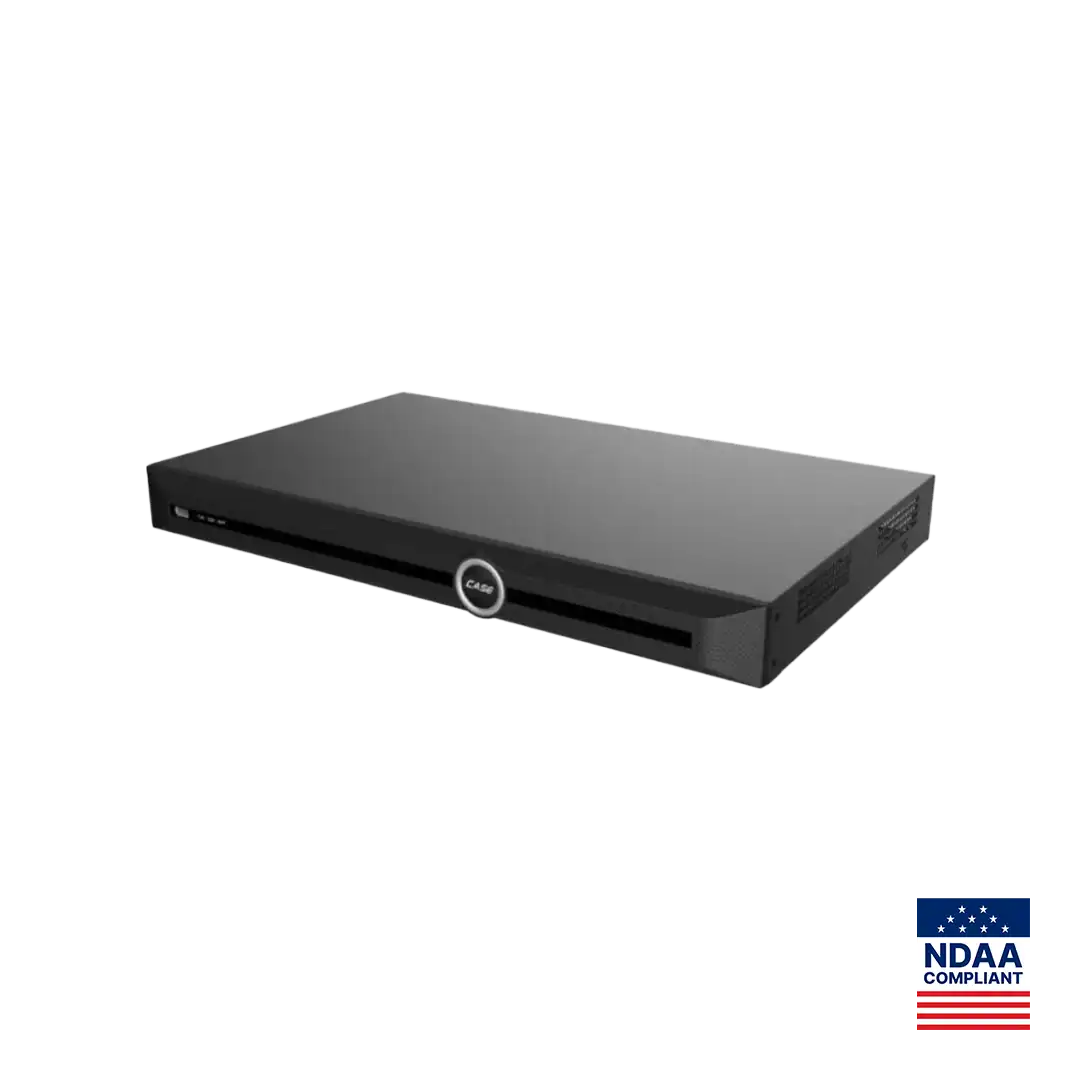
- NDAA Section 889 and the FCC Covered List (US). Required in US federal work and adopted by reference in many state, municipal, school and utility RFPs; in Canada, public buyers set requirements case by case. CASE offers NDAA-compliant options for compliance-sensitive projects. Anabon confirms the exact products and provides the official compliance documentation for each project. Never write “all products are NDAA compliant” in a bid; attach the per-SKU documentation. Background in What Is NDAA Compliance for Security Cameras?.
- TAA and domestic-preference clauses. US federal and some state work; confirmed per SKU and project with documentation, never assumed.
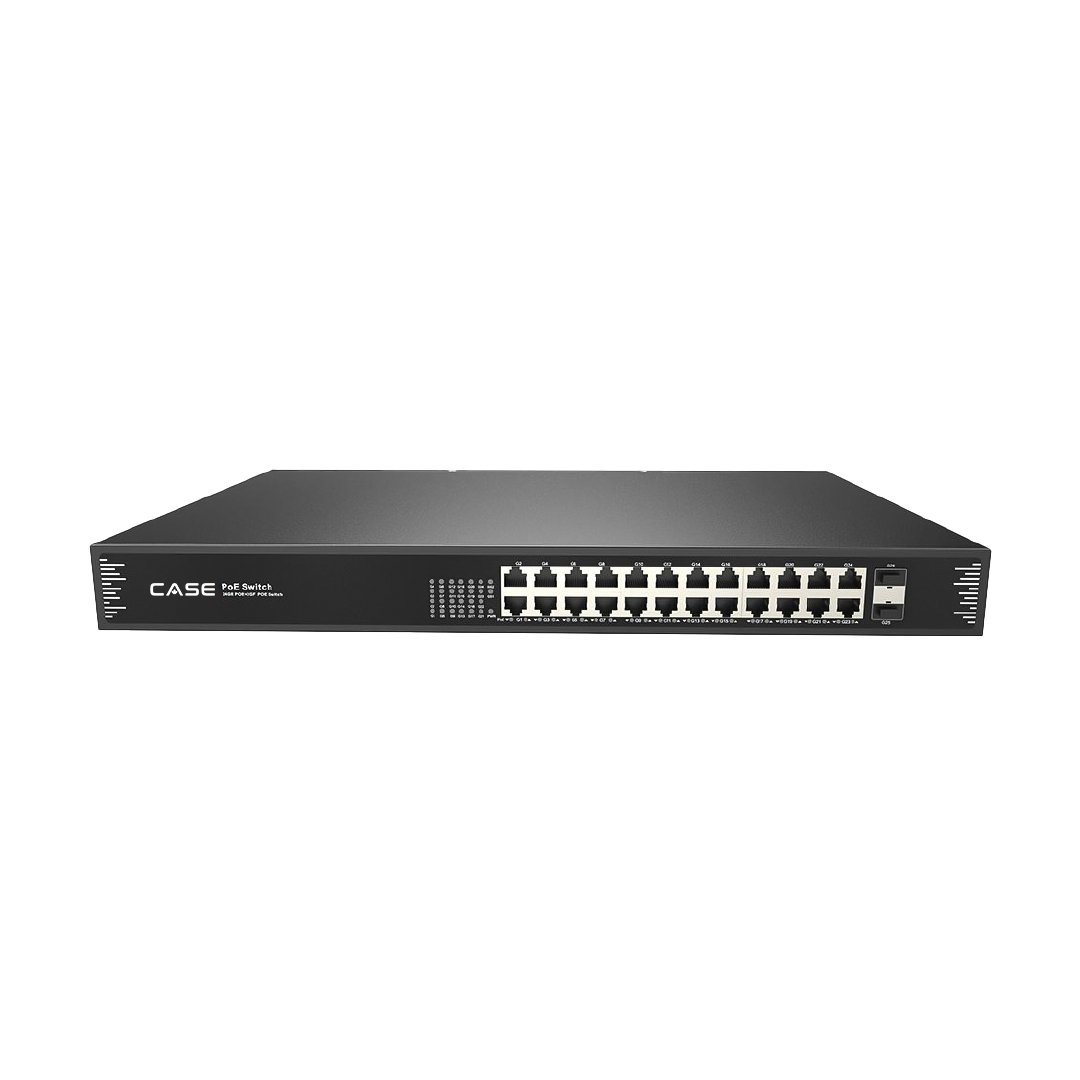
- Listings and emissions. UL (ULC in Canada) listings for power supplies, enclosures and plenum cable; FCC Part 15 for emissions. A cut sheet answers these: the CS-POE33024PF prints “CCC, CE, FCC Part 15 Class B, RoHS, CE/LVD EN62368-1” in its certifications row. A listing the sheet does not print is a deviation to state, not a gap to hope past.
- Interoperability. ONVIF profiles supported are S, T, and G, with M on pinhole models. Third-party behavior is confirmed per platform and project. For integration with an existing VMS, get a test or written confirmation before bid; see ONVIF Profiles S, T, G and M Explained.
- Cybersecurity. Unique credentials, password complexity, disabled unused services, firmware updates, network segmentation: configuration commitments you make in Part 3; Hardening a CASE NVR covers the steps.
- Privacy and signage. State laws (provincial laws and PIPEDA in Canada) on notice, audio and retention; the owner controls the data, but signage and retention settings may be your deliverable.
- Qualifications. Years in business, references, product training certificates, state low-voltage license (provincial trade certification in Canada; verify the local requirement), bonding capacity.
What do the warranty, training and as-built clauses commit you to?
Part 1 of 28 20 00 and the Division 01 closeout sections carry obligations that cost labor after the last camera is aimed. Estimate them on bid day.
| Clause | Typical requirement | What it means for your bid |
|---|---|---|
| Manufacturer warranty | “Not less than X years from Substantial Completion” | Match each category: CASE cameras and CASE NVRs carry a 6-year warranty. CASE PTZ cameras carry a 3-year warranty. CASE accessories carry unlimited warranty. Hard drives are supported through back-to-back manufacturer warranty. A CSP- Project Series item carries no stated term until Anabon confirms it in writing for the project. State any shortfall as a deviation. |
| Contractor warranty | One or two years labor, response time in hours | Service calls, truck rolls and loaners in your estimate; response time in your service plan |
| Submittals (01 33 00) | Product data, shop drawings, samples, before ordering | Engineering hours up front; order nothing until the reviewed set comes back |
| Testing and commissioning | Witnessed acceptance test of every camera and function | A test script per device, a day on site with the owner’s representative, punch-list time |
| Demonstration and training (01 79 00) | Stated hours, sessions and attendees; sometimes recorded | Trainer time, printed quick guides, a second session for night staff |
| Closeout (01 78 00) | Record drawings, camera schedule with addresses and lens settings, O&M manuals, credentials handover, spare parts | Documentation hours; the camera schedule becomes the as-built |
For the schedule format that carries from bid to as-built, see Writing a Camera Schedule and Bill of Materials.
Go or no-go: the ten questions to answer before you bid
- Can I meet the substitution procedure by its deadline with documents in hand, or is the spec closed?
- Can I produce every compliance document the spec names, per SKU, before the bid is due?
- Does the warranty clause match the CASE category terms, or do I have a deviation to state or a contractor warranty to carry?
- Have I read every addendum and carried each change into the count and the bid form?
- Is cabling, conduit and power in my scope or another trade’s, and does the drawing set agree with the spec?
- Does the schedule count match the drawings, and have I walked the site or attended the pre-bid?
- Do the integration, VMS and analytics requirements have written confirmation?
- Can I meet the qualification clauses: license, references, bonding, insurance, trained staff?
- Have I estimated submittals, commissioning, training and closeout as labor?
- Do I know the award criteria (lowest responsive bid, best value, points) and who evaluates?
Two or more “no” answers on questions 1 to 3 is a no-go, however good the camera count looks. One “no” is a written question for the owner’s question period before the deadline.
Where do you find open video surveillance bids?
Public solicitations are posted on the issuing agency’s portal and on state and provincial procurement sites; federal work in each country appears on its federal tender system. Anabon’s bid opportunities page collects public solicitations with a video surveillance scope across the US and Canada so you can scan them in one place, then go to the agency’s documents for the full package. Anabon supports the bidding partner behind the scenes with per-SKU documentation, the compliance package and design assistance; the bid, the contract and the end-user relationship stay with you.
What to tell your customer
“We have read the full package, including the addenda, and we are bidding to the specification as written. Where we propose an alternative product we will submit it through your substitution procedure with a point-by-point compliance matrix and the documentation for each model, and we will state any deviation in writing. Warranty is stated by product category, and compliance documentation is supplied per model for your file.”
FAQ
What is Division 28 in a video surveillance RFP?
Division 28 is the Electronic Safety and Security division of CSI MasterFormat, the numbering most North American construction specifications follow. Video surveillance sits at 28 20 00 in current editions (older documents use 28 23 00). In Canada the same numbering applies because MasterFormat is published jointly by CSI and Construction Specifications Canada.
What does “or equal” mean in a camera specification?
It means the named basis-of-design product sets the performance bar and the owner will consider another product that meets it, through the substitution procedure in Division 01. Read the exact phrase: “or approved equal” needs written approval before bid, “equal as determined by the Engineer” gives the reviewer the final say, and “no substitutions” closes the door.
Does NDAA Section 889 apply to Canadian bids?
Not as a Canadian law. Section 889 and the FCC Covered List are US federal requirements that many US state and municipal RFPs adopt by reference. Canadian public buyers set compliance requirements case by case in their own documents. Either way, the answer is per-SKU documentation: CASE offers NDAA-compliant options, and Anabon confirms the exact products and provides the official documentation for each project.
The RFP demands a five-year warranty on every device. What do I do?
Match the clause to the real terms. CASE cameras and CASE NVRs carry a 6-year warranty, CASE PTZ cameras carry a 3-year warranty, CASE accessories carry unlimited warranty, and hard drives are supported through back-to-back manufacturer warranty. Where a category falls short, submit it as a stated deviation or cover the gap with your own contractor warranty line; never write “6-year on everything”.