

Quick answer: In the US, public-sector security camera bids are posted on SAM.gov for federal work and on state, county, city and school-district portals below that. In Canada, federal tenders are on CanadaBuys, and provinces, municipalities and school boards post on provincial portals or platforms such as MERX. The two systems differ in registration, language, units, compliance clauses and bonding. Anabon’s Bid Opportunities pages collect a curated list of solicitations with a camera scope, and we support the partner behind the scenes: the bid and the customer stay yours.
Where are public-sector security camera bids published?
There is no single list. Public buyers post where their own rules tell them to, so the same camera project can appear as a federal notice, a state portal entry, a county web page or a line inside a general contractor’s construction package. Start from the level of government that owns the building.
| Level | United States | Canada | Typical notice types |
|---|---|---|---|
| Federal | SAM.gov; an active registration with a Unique Entity ID, by the point the solicitation requires (offer or award) | CanadaBuys; supplier account and Procurement Business Number (PBN) | US: RFP, IFB/ITB, RFQ, RFI, Sources Sought. Canada: RFP, ITT, RFQ, RFSO, RFSA, ACAN, RFI |
| State / Province | Each state’s procurement portal, plus agency and university pages | BC Bid, Alberta Purchasing Connection, SaskTenders, the Ontario Tenders Portal, SEAO in Quebec; several provinces and Crown corporations use MERX | RFP, ITT/IFB, RFQ, standing offers |
| County, city, transit, utility | Own procurement pages, third-party bid-notification platforms | Municipal procurement pages, MERX, Biddingo and similar platforms | RFP, ITT, RFQ, pre-qualification |
| School districts and boards, colleges | District procurement pages, state portals, cooperative purchasing contracts | School board pages, provincial portals, group-purchasing bodies | RFP, RFQ, vendor-of-record contracts |
Two places hide more camera work than any portal. First, construction packages: a new school or transit depot carries its cameras in Division 28 of the specification, posted as a construction bid that you reach as a subcontractor to the general contractor. Second, existing contract vehicles (cooperative contracts, standing offers, vendor-of-record arrangements), where the buyer orders against a contract already competed. How to Read a Video Surveillance RFP explains where the camera scope sits once you open the package.
Which search terms and codes catch camera scope?
- Keyword alerts: “video surveillance”, “CCTV”, “security camera”, “electronic security”, “physical security” and “access control”, because the two scopes are often bundled.
- Classification codes: NAICS 561621 (Security Systems Services) and 238210 (Electrical Contractors) in the US; UNSPSC family 4617 (security surveillance and detection) on portals that filter by UNSPSC, including CanadaBuys. Confirm the exact code on each portal.
- Specification numbers: MasterFormat 28 20 00 Video Surveillance (older documents: 28 23 00) in construction packages, both countries.
How do Anabon’s Bid Opportunities pages fit into your search?
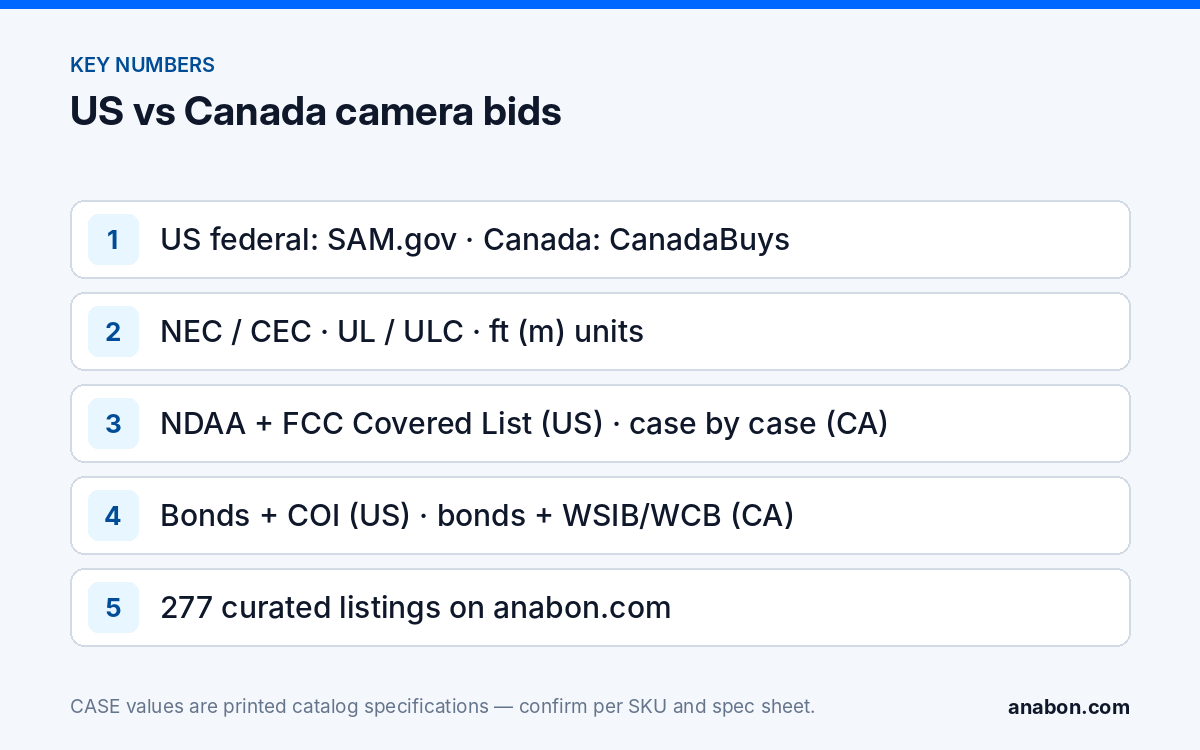
Anabon’s Bid Opportunities pages are a curated list of public solicitations in the US and Canada that include a video surveillance or security camera scope: 317 listings on October 21, 2026, updated as new solicitations are published. Each listing names the buyer, the location and the closing date and points back to the official portal where the documents, addenda and the question deadline live. The list is a filter, not a replacement for the portal: only the official posting tells you whether you must register, attend a mandatory pre-bid meeting or submit on a specific form.
Use the list as a weekly routine:
- Scan new listings for your states or provinces.
- Open the official link and record the closing date and time with its time zone.
- Register on that portal early, download the full package including addenda, and note the question deadline and any mandatory site visit.
- Decide go or no-go on the Part 1 clauses (compliance, warranty, bonding) before you count cameras.
- Send the camera schedule to Anabon for a design review before you quote.
Anabon Security Inc. is a North American B2B distributor of CASE and other professional security brands; we do not bid on these opportunities or contact the owner. We support the partner behind the scenes, and the end-user relationship stays with you.
How do US and Canadian public bids differ?
The documents look alike, but the rules under them differ. Verify each line in the solicitation itself; agencies and provinces set their own terms.
| Item | United States | Canada |
|---|---|---|
| Federal registration | SAM.gov and a Unique Entity ID; many opportunities arrive through existing contract vehicles or as subcontracts under a prime | CanadaBuys with a supplier account and PBN; provinces and municipalities post above-threshold work on electronic tendering systems under the Canadian Free Trade Agreement (CFTA) |
| Language | English | English or French; federal solicitations are bilingual; in Quebec expect French documents and check whether the submission must be in French |
| Units | Feet and inches | Metric; CASE specs are printed metric, so write both, for example IR 164 ft (50 m) |
| Electrical and listings | NEC; UL listings | CEC; ULC or cULus listings; a clause may ask for the Canadian mark specifically |
| Supply-chain compliance | NDAA Section 889 and the FCC Covered List on federal work, adopted by reference by many state, municipal and school buyers | No single federal equivalent of Section 889; public buyers add supply-chain and security requirements case by case (verify each solicitation) |
| Bonding and insurance | Bid, performance and payment bonds on public construction (federal Miller Act, state “Little Miller Acts”); certificate of insurance naming the owner | Bid security and performance bonds; certificate of insurance; a workers’ compensation clearance certificate (WSIB in Ontario, WCB in most other provinces) |
| Privacy law behind the scope | State laws, including recording-consent and biometric statutes | Public bodies: the federal Privacy Act and provincial public-sector acts (FIPPA, FOIP, MFIPPA); PIPEDA covers private-sector handling; Quebec Law 25 adds duties |
Three of these decide more bids than the rest. Registration: a federal registration started the week of the deadline may not be complete in time, in either country. Bonding: if your surety capacity does not cover the bond, settle that before you read the spec. Compliance: a US buyer that adopts Section 889 wants documentation per product; a Canadian buyer that writes its own security clause wants the same thing under a different heading. None of this is legal advice; have counsel read the bonding, insurance and privacy clauses on your first bid in a new jurisdiction.
Which documentation requirements differ between the two countries?
Build the documentation pack per SKU, not per brand, and build it before the question deadline so you can ask the buyer what they will accept.
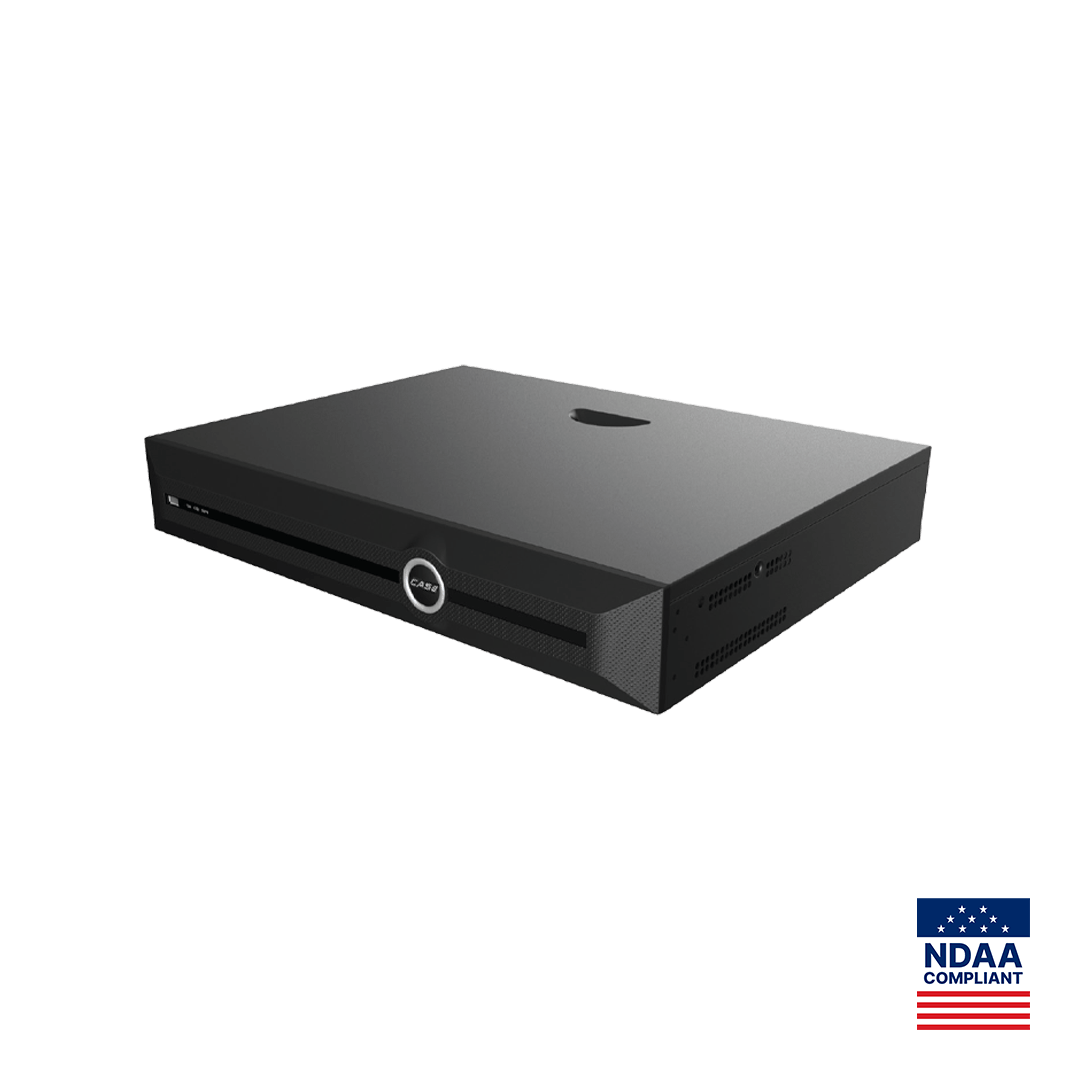
- Supply-chain compliance. NDAA and FCC Covered List (US) / Canadian procurement requirements (case by case). CASE offers NDAA-compliant options for compliance-sensitive projects. Anabon confirms the exact products and provides the official compliance documentation for each project. Never write a blanket sentence into a bid; attach the per-SKU documents. Background: What Is NDAA Compliance for Security Cameras?
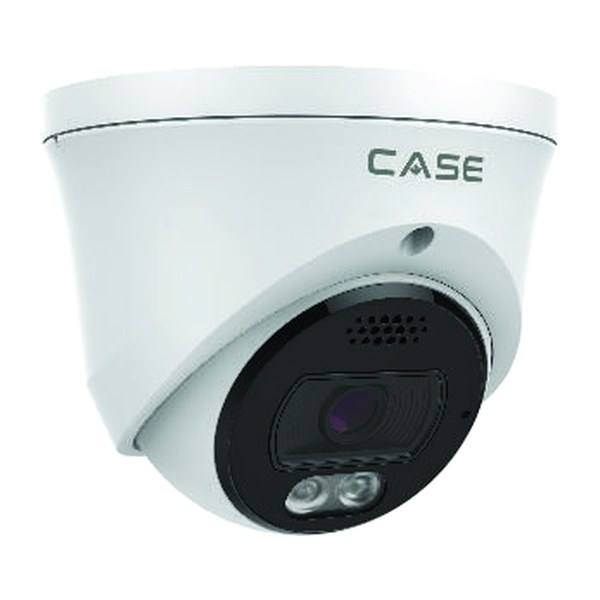
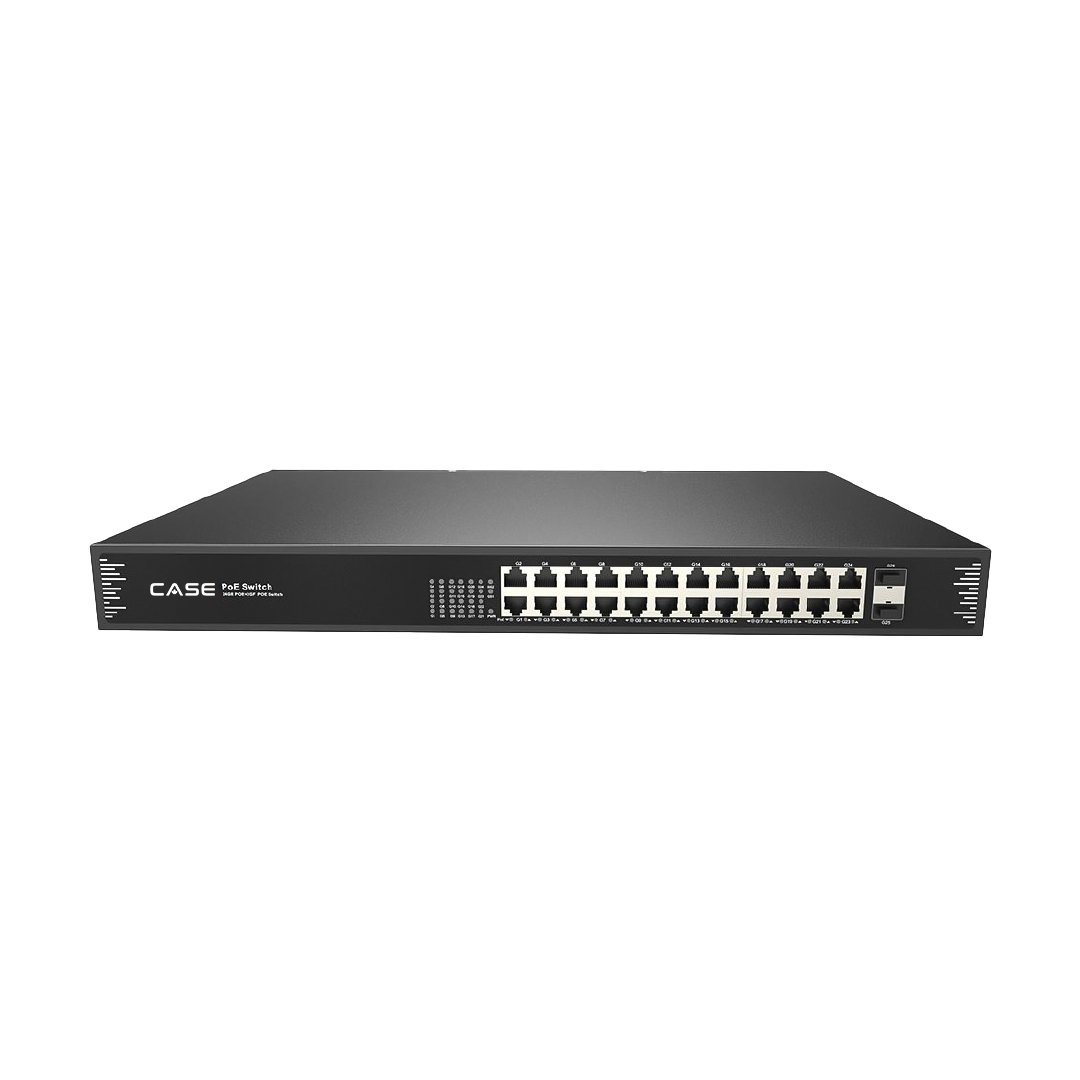
- Spec sheets. One per full SKU as the schedule names them: CS-I8XQ II-2.8mm (8MP, IR 164 ft (50 m), IP66 as printed), CS-N440 P16H-AI (40-channel AI NVR with 16 PoE ports) and CS-POE33024PF (24-port Gigabit PoE switch, 400W / 600W total PoE budget as printed).
- Listings and emissions. Where a clause asks for a UL / ULC listing or FCC Part 15 / ICES-003 emissions compliance, answer from the printed certifications row. The CS-POE33024PF, for example, prints FCC Part 15 Class B and CE/LVD EN62368-1 among its certifications and prints no UL or ULC listing; if a required mark is not printed, raise it as a bid question.
- Warranty statement. By category, exactly: CASE cameras and CASE NVRs carry a 6-year warranty. CASE PTZ cameras carry a 3-year warranty. CASE accessories carry unlimited warranty. Hard drives are supported through back-to-back manufacturer warranty. Warranty service flows through you, the installer.
- Privacy. US buyers may ask for a retention and signage policy under state laws; Canadian public bodies often require a privacy impact assessment under their public-sector act. See Video Surveillance Privacy in Canada.
- ONVIF. Where the spec requires integration with an existing platform: ONVIF profiles supported are S, T, and G, with M on pinhole models. Third-party behavior is confirmed per platform and project.
What is different about school security bids?
In the US, districts post on their own procurement pages and state portals, buy through cooperative purchasing contracts, and tie camera projects to bond measures and grant cycles, so solicitations cluster in spring for a summer installation window. In Canada, school boards post on provincial portals or platforms such as MERX and Biddingo, and capital funding runs through the province, so a refresh is often split into yearly phases. In both countries the scope is usually bundled with access control and intercom, and the privacy section is longer.
How do you team with a distributor behind the scenes?
Public bids reward preparation a small company rarely has time for: compliance matrices, spec sheets per SKU, written lead-time confirmation, a demo the evaluator can touch. A distributor can carry that work while the bid stays in your name. Bring us the opportunity before you say no, and bring it early: the useful window closes at the question deadline.
- Design review: send the camera schedule and drawings with the owner’s name redacted; Anabon checks SKU fit, bandwidth headroom (the CS-N440 P16H-AI prints 400Mbps incoming, 200Mbps with AI on), PoE budget and mounting accessories.
- Documentation per SKU: spec sheets, project compliance documentation, the warranty statement by category.
- Lead time: confirmed per SKU in writing for the project, never assumed from a catalog.
- Demo: for approved demo products we provide a 90-day test period under the approved demo return process. This is not a general return policy.
- What Anabon does not do: contact the owner, submit a bid, or sell to the end user. CASE pricing does not appear publicly online, so your customer only sees the number you quote.
What to tell your customer
“We are bidding to the specification as posted, including the addenda, with documentation supplied per product for compliance, listings and warranty. Warranty service on the system runs through our company, and our distribution partner supports us behind the scenes with design review and documentation.”
FAQ
Where are US federal security camera bids posted?
On SAM.gov, the single federal site for contract opportunities. You need an active registration with a Unique Entity ID by the point the solicitation requires (offer or award), and registration takes time, so complete it early. Many federal camera projects never appear as stand-alone notices: they are released through existing contract vehicles or reach installers as subcontracts under a prime contractor.
Does NDAA Section 889 apply to Canadian public bids?
Not as Canadian law. Section 889 and the FCC Covered List are US federal requirements that many US state, municipal and school buyers adopt by reference. Canadian public buyers write supply-chain and security requirements case by case in their own documents. In both countries the answer is per-SKU documentation, which Anabon confirms and supplies for each project.
Do I have to bid in French in Quebec?
Expect the solicitation documents to be in French and check the submission language clause in each package; many Quebec public bodies require the bid itself in French, while federal solicitations are published in both languages. Budget time for translation and confirm with the buyer, through the question process, which language the attached spec sheets may be in.
Does Anabon bid on public camera projects directly?
No. Anabon Security Inc. is a North American B2B distributor of CASE and other professional security brands and does not sell to end users or submit bids to owners. Anabon supports the installer or integrator behind the scenes with design review, per-SKU documentation, written lead-time confirmation and approved demo products; the end-user relationship stays with the partner.