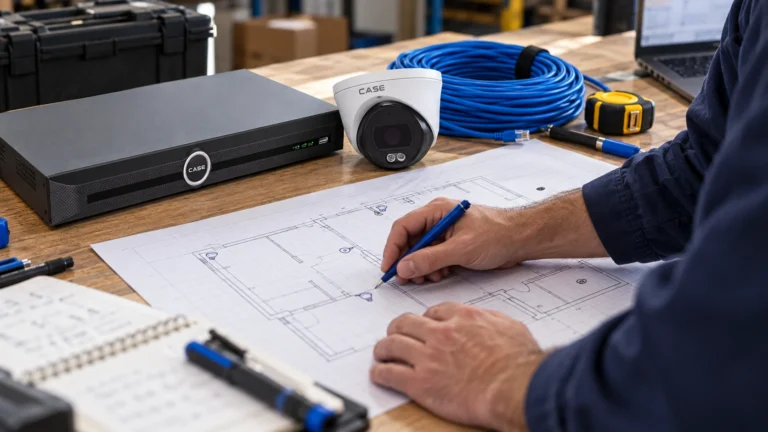



Quick answer: Send a permitted drawing, site notes, draft camera schedule and the owner’s requirements before quoting. Agree the scope, expected outputs and timing of Anabon’s review. Candidate equipment, sizing assumptions and open questions support your proposal; they are not licensed engineering approval, buyer acceptance or a performance guarantee. Your company remains responsible for the contract and final design decisions.
On this page
What is a project design review, and who is it for?
A project design review can identify equipment and sizing questions before you quote: channel headroom, device power, usable recording capacity, required evidence and current model identity. Agree which checks Anabon will perform and which need measurements, tests or another responsible specialist. Resolve open assumptions before relying on a number in your proposal; a distributor review does not eliminate every site or contractual risk.
The review is for professional installers, integrators, low-voltage contractors, alarm companies, dealers and approved business accounts in the US and Canada. Anabon Security Inc. is a North American B2B security camera distributor of CASE and other professional brands. Your company leads the design, proposal, contract and customer relationship. Bring the actual requirement and constraints, including a small job with a difficult cable route or a larger multi-building opportunity; agree the support scope before relying on an output.
What do you send us?
Send the available drawing, site notes, draft schedule and requirements, and identify what is missing. These can start a discussion, but the information needed for a meaningful review depends on the project. Agree confidentiality, permitted sharing, scope, outputs and timing before relying on a deliverable.
| Item | Minimum that works | Why it matters |
|---|---|---|
| Drawing or plan | Floor plan, site plan or an aerial image with one known dimension for scale | Coverage and distances cannot be checked without scale |
| Site notes and photos | Mounting positions, telecom room locations, wall and ceiling types, existing network and power | Sets mounts, boxes, cable routes and PoE layout; see Site Survey for Security Cameras |
| Draft camera schedule | Tag, location, purpose (overview, identification, plate), preferred form factor | Provides the equipment index for the agreed review; confirm the return format, fields and deliverables |
| Owner requirements | Retention days, users and viewing locations, remote viewing yes/no, areas to exclude | Drives storage, user roles and software scope |
| Specification section, if a bid | Division 28 section, addenda, substitution deadline | Compliance clauses, warranty clause and the approval route; see How to Read a Video Surveillance RFP |
| Constraints | Deadline, phasing, cold or hazardous areas, long runs, existing VMS | Decides which SKUs are candidates |
What do we check: coverage, PoE, storage, compliance?
Use the exact model/revision and current documentation for each check, supplemented by the actual site data, calculations and tests the requirement needs. A catalog row alone does not prove coverage, compatibility, code acceptance or usable retention. Mark every assumption, missing input and item requiring the responsible designer or buyer’s review.
| Check | What we look at | What it prevents |
|---|---|---|
| Coverage | Lens and resolution against the identification distance per tag; IR and white-light rows against the darkest position; IP and IK rating and operating temperature against the site | Overview footage where identification was promised; a dome at −40 °F (−40 °C) that prints −31 °F (−35 °C) |
| PoE and network | Exact-device power requirements, compatible PSE/supply, per-port and confirmed total budget; actual cable/application and channel test model including cords; uplinks and recorder ports | A switch that runs out of watts at camera 12; a PTZ that never powers up |
| Storage and bandwidth | Retention days, frame rate and bitrate against drive bays; total incoming bitrate against the recorder’s AI-on bandwidth row | Overwrite before the retention target; a recorder that drops streams with analytics on |
| Channels and headroom | Actual recorded-channel presentation, including the supported multi-sensor configuration and phase two, against channel capacity | No room for the next four cameras |
| Compliance | Clauses the spec names, per-SKU documentation for each line, listings on power supplies and enclosures (UL / ULC), NEC / CEC items for the electrical contractor | A blanket compliance sentence in a bid; a listing the sheet does not print |
| Software scope | What the owner expects from app, desktop and remote access against what is supported today for the model and version | A promised feature that does not exist |
| Accessories and spelling | A mount and junction box per camera; every SKU in current catalog spelling, no legacy models | A technician waiting for a bracket; a quote for a model no longer offered |
Keep three evidence sets separate: written warranty terms for each supplied item; procurement/compliance documents required by the actual clause; and verified interoperability for the actual model, firmware and client. Do not substitute a family-wide guarantee for any of them. For a required ONVIF conformance claim, verify the full model and firmware in the official ONVIF database. Then test the required streams, recording, playback and events with the actual client/version. A profile list or brand name is not a complete integration statement.
What do you get back?
Agree which outputs are included before relying on the review. The camera schedule template can organize equipment and evidence; the following list is a menu to confirm, not a guaranteed deliverable set for every request.
- Camera schedule: your table returned with full SKUs (series letter included), lens, mount, junction box, PoE class, port assignment and the printed rows that justify each choice.
- PoE and network sizing: watts per switch against its printed budget, runs over 328 ft (100 m) flagged with the extender or fiber option, uplink and recorder bandwidth check.
- Storage sizing: drive count and size per recorder for the stated retention, with the assumptions written down.
- SKU list for the bill of materials: cameras, recorder, switches, injectors, mounts, boxes, drives, in current catalog spelling, with accessories attached.
- Documentation list: which spec sheets, compliance documents and statements your proposal or submittal needs per SKU, and how to request them; format in Security Camera Bid Documentation Checklist.
- Open questions: what the owner or consultant still has to answer, worded for forwarding.
A distributor review does not grant consultant acceptance, a licensed-engineering or life-safety approval, guaranteed stock/delivery or a Project Series warranty/certificate. Obtain the actual written confirmations and the buyer’s required review. Agree any authorized customer/consultant participation; protect private pricing and share project information only as permitted.
An illustrative example
Hypothetical planning example, not a documented customer result: consider a two-building yard with 14 fixed cameras at one building and eight fixed cameras plus two PTZs at the gate, a stated 30-day retention target and procurement-document requirements. The following checks illustrate questions to resolve; they do not approve a bill of materials.
If each of the 24 example devices presents one recorded channel, that is already more than a 20-channel recorder can accept. Other configurations may present more channels. Catalog p.57 lists 40 channels, 4×10TB and 200Mbps AI-on input under CS-N440 P16-H-AI, while the index uses P16H-AI; resolve the identifier/revision before a submittal. The large-site AI NVR guide records that issue. For CS-P88 44X, p.35 prints DC36V±25%/PoE++(IEEE802.3bt); confirm the compatible supply/PSE and actual power limits, not an assumed af/at 30W port. Its temperature row also differs with IR on/off. A 140m route needs a verified alternative to a conventional 100m channel, including cords. An illustrative constant 96 Mbps writes 31.104 decimal TB in 30 days before allowances. Compare it with verified usable capacity, supported operating modes, scene variation and reserve rather than simply 40 TB raw. These are checks to resolve, not availability, retention or design approval.
How do you request a review?
- Open or log in to your Anabon business account, or use the contact page if you are not yet set up; say that you want a project design review.
- Attach the drawing, site notes, draft schedule and owner requirements; for a bid add the spec section, addenda and deadline.
- We confirm receipt, list anything missing and tell you when to expect the review for that file set; timing depends on project size and completeness, and we say so at the start rather than promising a figure in advance.
- You receive the outputs agreed for that review, with assumptions and unresolved items identified. Ask for a walkthrough if needed; do not treat an illustrative list in this guide as a guaranteed deliverable for every request.
- Build the proposal from confirmed pricing, supported functions and approved scope. If a physical demo is useful, ask about the approved demo process and confirm availability, approval and actual terms. An online demonstration page does not promise a physical test unit.
How to use this with your customers
Describe only the checks actually performed and documents actually supplied. Separate measured or tested results from calculations, assumptions and unresolved questions; do not call every catalog comparison an accepted site result. Present the agreed schedule, sizing and evidence in your company’s proposal, subject to the actual design and buyer review. Anabon supports the professional partner behind the scenes; the customer’s warranty/service route remains the supplying installer or company.
FAQ
What does a security camera project design review include?
It is the agreed technical review of the draft equipment and assumptions against current exact-model documents and actual project requirements. Depending on scope, checks can include coverage, power/network paths, recording channels, usable storage, AI-on bandwidth, software and evidence gaps. Confirm which schedule, sizing or documentation outputs are included. A catalog row or distributor review alone does not certify site performance, compliance or buyer acceptance.
Does Anabon talk to my customer during the review?
Your company leads the customer relationship and the distributor review. Agree whether any technical discussion or document clarification needs authorized customer/consultant participation and what may be shared. Use a permitted redacted package to start; do not rely on a blanket promise that no contact or additional project identity will ever be needed.
How fast does the review come back?
Agree expected timing when Anabon confirms the scope and the available file set. Missing drawings, measurements or buyer-controlled requirements may need another clarification cycle; do not assume a fixed response time. For a tender, the bid documentation checklist helps identify the requested records, but it does not guarantee their availability or extend the buyer’s deadline.
Can the review include Project Series items such as thermal, explosion-proof or radar?
Yes, as a project conversation. CASE Project Series items with the CSP- prefix are project-quoted; the review identifies candidates, but availability, certificates, lead time and warranty term are stated only after Anabon confirms them in writing for that project. Nothing about those items goes into your proposal before that written confirmation arrives.
References
- Anabon current documents and manuals
- Discuss the project and required documents
- Anabon project-design support scope