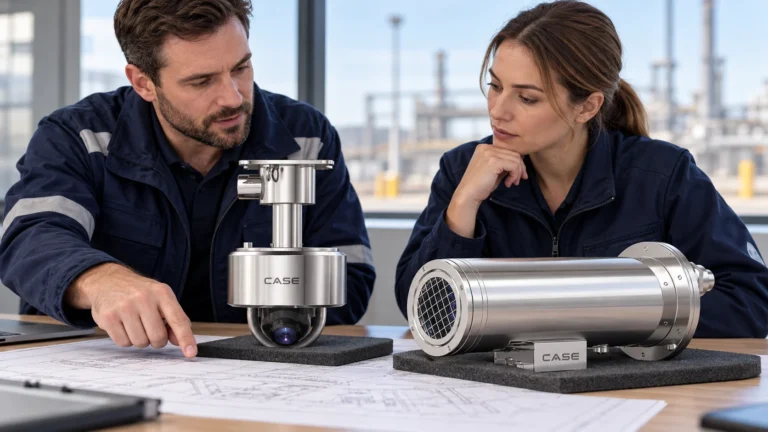



Quick answer: Bring Anabon the drawing, site notes and requirements before you rule out a larger or unfamiliar security project. A review can help identify product candidates, sizing assumptions, supporting documents and open questions. Agree the review scope and timing first. You remain responsible for the proposal; distributor guidance is not licensed engineering approval, a site survey or the buyer’s acceptance.
On this page
Which opportunities should you bring before you say no?
Large or unfamiliar jobs can be worth a closer look before you decline: more cameras than usual, a specialist technology, an unfamiliar procurement clause or a short bid window. Anabon is a North American B2B security camera distributor supporting installers, integrators and dealers. Ask which product-selection, sizing and documentation assistance is available for the actual request, and agree the scope and timing. The goal is a better informed bid decision, not acceptance of a job before the open questions are resolved.
| Opportunity type | Signal you see | Why a review helps |
|---|---|---|
| Larger than your usual job | More cameras than your standard recorder, two buildings, a phase two | Review channel, stream, bandwidth, PoE, cable and storage assumptions; confirm site measurements and the final configuration before quoting. |
| Specialty technology | Thermal, explosion-proof, long-range or laser PTZ, radar perimeter, off-grid solar | Identify candidates and request the project-specific configuration, available evidence, availability, lead time and warranty terms before committing. |
| Compliance-sensitive | Section 889, FCC Covered List or TAA clauses (US); supply-chain clauses in Canadian public tenders | List the exact procurement clauses and request available SKU/configuration evidence; the buyer determines acceptance. |
| Integration-dependent | An existing VMS, a gate or access control system, an ONVIF clause | Check the actual model, firmware and conformance record, then test required functions with the actual platform and version. |
| Analytics requests | Facial recognition, plate search, people counting, safety-helmet detection | Define the required result, model, firmware, licence and site limits; confirm supported functions and applicable privacy requirements before promising them. |
| Short bid window | An “or equal” clause, a substitution deadline, a pre-bid walk next week | Send the file before the question/substitution deadline and agree the available review scope and timing. |
Small jobs qualify too. A five-camera site with one awkward 400 ft (about 120 m) run or a gate camera at the edge of the network is a fair reason to ask.
What should you send with the request?
Start with the file you have and clearly mark what is missing. A scaled plan, site notes, draft camera schedule and owner requirements make the first discussion useful; ask what else is needed for the agreed review.
- A drawing, site plan or aerial image with one known dimension for scale.
- Site notes and photos: mounting positions, wall and ceiling types, telecom rooms, existing network and power.
- A draft camera schedule: tag, location, purpose (overview, identification, plate), preferred form factor.
- Owner requirements: retention days, users and viewing locations, remote viewing, areas to exclude for privacy.
- The specification section and addenda if it is a bid, with the question and substitution deadlines.
- Constraints: phasing, cold or hazardous areas, long runs, existing equipment that must stay.
Use the project design review intake guide to check what to send and why each item matters. Include the actual deadlines and any unknown dimensions or requirements rather than presenting assumptions as measured facts.
What does the review check?
Start with the complete SKU, lens and actual revision for each proposed item. Read the matching specification table and documents rather than borrowing a value from a similar name or series. A catalogue row is a starting point for a candidate; confirm the actual configuration, required performance and any conflicting documents before a customer commitment.
- Coverage: lens and resolution against the purpose of each position; IR and white-light rows against the darkest position; IP and IK ratings and the operating temperature against the site.
- PoE and network: check the device power requirement, supported PoE standard, per-port limit and verified total switch budget. Document each copper channel, uplink and proposed long-reach or fibre route against the equipment and cabling limits. Confirm the actual power arrangement for high-load PTZs; do not assign one solely from its camera count.
- Storage and bandwidth: calculate retention from the proposed streams, recording mode and bitrate, then check supported drives, capacity, incoming bandwidth and the limits with the required AI task enabled. Drive-bay count and headline bandwidth alone are not a completed retention design.
- Channel headroom: today’s device count plus the next phase against the channel count.
- Compliance: which clauses the specification names and which per-SKU documents answer them.
- Software scope: what the owner expects from mobile, desktop and remote access against what is supported today for that model and version.
- Accessories and spelling: confirm compatible mounts, boxes, injectors, switches and other required parts for the actual camera and installation. Resolve retired or unlisted identifiers and revision differences before ordering; do not invent a like-for-like replacement.
- Project Series flags: any item with the CSP- prefix is marked as project-quoted until availability, certificates, lead time and warranty term are confirmed in writing.
Keep product capability, project evidence and commercial terms separate. Use security camera technical support to clarify the exact model, firmware, configuration and required functions; test interoperability with the actual platform and version. Request the applicable written warranty and claim process, including model, accessory and drive exceptions. The outputs below are examples to agree for the request, not a guarantee that every review includes a finished design, a certificate or a complete submittal package.
What outputs can you agree for the review?
| Deliverable | What it contains | How you use it |
|---|---|---|
| Corrected camera schedule | Your tags and positions with full SKUs, lens, mount and box per line | A candidate schedule for your proposal; confirm quantities, positions, specifications and required engineering decisions. |
| Sizing summary | Channels, incoming bandwidth, PoE budget per switch, storage against retention | Shows the assumptions and calculations for review; confirm actual site measurements. |
| SKU and accessory list | Every line in catalog spelling, including switches, injectors, mounts and boxes | Check the accessories, compatibility and actual availability before ordering. |
| Documentation list | Available exact SKU/revision documents, clause-specific evidence, written warranty/service terms and unresolved gaps | A checklist for the buyer’s actual submittal requirements; not product or project approval. |
| Open questions | Items only the owner or engineer can decide, written so you can forward them | Your next call with the customer |
| Project Series notes | Which candidates merit a project quotation and which configuration, evidence, availability, lead time and warranty items remain open | Keeps unconfirmed items out of the proposal |
Agree the review scope, required information and expected timing for this request rather than assuming a fixed turnaround. Use the private pricing guide when preparing the commercial proposal, and obtain the actual account pricing or direct quote through the approved route. Keep private account prices and customer information within the agreed business process.
Illustrative example: a yard worth reviewing before declining
The scenario below is illustrative. It combines requirements that come up often; it is not one customer’s project, and no site or partner is described.
A regional installer who usually quotes 8 to 16-camera retail jobs is invited to bid a public-works yard: about 30 cameras across a vehicle garage, an office and a fenced yard, after-hours deterrence on the fence line, coverage near a fuel dispensing area, 30-day retention, and a grant condition that asks for Section 889 documentation. The fuel area, the compliance clause and the size each looked like a reason to decline. The installer sent the site plan, photos and the specification section instead.
- Recorder: reserve headroom for the proposed cameras and next phase, then compare the actual streams, incoming bandwidth with the intended AI task, recording and supported storage. Select the complete model and revision only after those checks; a larger channel number alone does not size the job.
- Second building: measure the complete cable route and document the local PoE and inter-building link design. A local switch and fibre uplink may be candidates. For CS-POE33024PF, confirm the actual 400W or 600W variant, 30W per-port limit, compatible SFPs and full-load allocation from the unit’s matching documents; do not assume the larger figure applies to every unit.
- Fence-line deterrence: define the recorded detail and detection or deterrence task before choosing a PTZ and mount. If CS-P88 44X is proposed, verify the model’s actual power arrangement and operating limits. The catalogue’s laser-distance row does not establish its purpose, class or eye-safety procedure. Obtain the matching instructions and qualified site assessment before enabling laser hardware; do not describe it as an approved deterrent or illuminator from distance alone.
- Fuel area: have the qualified project team and relevant authority determine the actual hazardous-location requirements. A standard camera positioned outside a classified area or a project-quoted candidate such as CSP-I8PS EX-I-2.7-13.5mm needs assessment for the real location and configuration. Obtain the applicable current certificates, conditions, installation requirements and written supply terms before treating it as a proposal-ready solution.
- Documents: list the available exact model/revision documents, the evidence required by each procurement clause, the applicable warranty and service terms, and software functions confirmed for the proposed version. Record missing evidence and the person responsible for resolving it; the list itself is not acceptance.
In this illustrative scenario, the useful result is a candidate schedule, documented sizing assumptions and questions for the owner or engineer before deciding whether to bid. It is not a completed customer project or a promised award. The municipal yards guide gives more site-planning questions for this type of opportunity.
How to use this with your customers
Describe the work your company is actually qualified and contracted to deliver, and distinguish it from the distributor’s agreed product and documentation assistance. Agree who communicates with the customer and who makes each design or procurement decision. Keep unresolved items visible in the proposal and confirm the actual warranty and service arrangement rather than promising a blanket support entitlement.
FAQ
How fast does a project review come back?
Ask for the expected timing when the request and available review scope are agreed. Supply a scaled drawing, site photos, draft schedule and the owner’s retention and user requirements, with missing items marked. Neither this guide nor sending a file creates a guaranteed response or completion deadline; use the actual agreed timing in the bid plan.
Does Anabon contact my customer during the review?
Your company leads the customer relationship and proposal. Agree who communicates with the owner or engineer and what may be shared. Anabon can help you prepare product questions and supporting documents within the agreed review scope; do not assume a contact restriction or an approval role that has not been agreed.
Is my project too small to ask for a review?
A small job can still have an unfamiliar requirement. A long copper route, a remote gate or a first PTZ is a good reason to discuss the available review scope. Read the cable-length planning guide when preparing route measurements and link options, then confirm the actual equipment limits. A small camera count does not remove the need to resolve power, coverage or site requirements.
Can the review include thermal, explosion-proof or radar items?
They can be discussed as project candidates. Confirm the exact configuration, available evidence, availability, lead time, warranty and service terms in writing before offering a CASE Project Series item. A catalogue example or review conversation is not confirmation of hazardous-location suitability, a safety function, integration or delivery for the actual project.
What if the review says the job should not be bid as written?
A review can still be useful if it identifies a gap, an unsuitable requirement or a need to decline. Consider a scoped question to the buyer, a documented alternative or an agreed later phase; do not promise approval of a substitution. The or-equal substitution guide explains how to record comparisons and open items for the buyer’s actual decision.
References
- Anabon project contact
- Anabon product documents
- ONVIF conformance verification