

Quick answer: Bring your distributor in as soon as the opportunity exists, not after the estimate is built: at the RFI or pre-qualification stage for specialty requirements, and at posting for a standard camera bid, so the design review, per-SKU documentation, demo and written lead-time confirmation are done before the question deadline. Anabon supports the partner behind the scenes; you never have to name the end customer to get that support, and the bid, the customer and the number you quote stay yours.
What can a security distributor do before the bid?
Most installers call a distributor at the end of a bid, to confirm a part number. The useful work happens earlier, when the specification can still be questioned and the design can still change. Anabon Security Inc. is a North American B2B distributor of CASE and other professional security brands; the table is what we do for installers, integrators, dealers and approved business accounts from the first read of the package to the day you submit.
| Bid stage | What Anabon does | What you bring |
|---|---|---|
| RFI, Sources Sought, pre-qualification | Reads the requirement for fit; for specialty items (explosion-proof, thermal, radar, solar trailers) opens a Project Series conversation, quoted per project | The notice text and your go/no-go questions |
| Specification review | Checks Division 28 Part 2 against printed spec sheets, flags “or equal” language, compliance clauses and warranty clauses that need a stated deviation | The spec section, the camera schedule, the addenda |
| Design review | Checks channel count, bandwidth, PoE budget, coverage choices, mounting accessories and storage against printed figures | Drawings with the owner’s name redacted, counts, distances, mounting heights |
| Documentation | Supplies spec sheets per SKU, the compliance documentation for the project and the warranty statement by category | The list of clauses that demand a document |
| Demo | Approved demo products under the approved demo return process for an evaluation the owner can touch | The evaluation date and what the evaluator wants to see |
| Lead time and alternates | Confirms availability and lead time per SKU in writing for the project; identifies an alternate within the line | Your schedule and the owner’s substitution procedure |
None of this replaces your estimate or your relationship with the owner. It removes what small companies lose bids on: documents not ready, figures assumed, a product promised before anyone checked it.
When is the right moment to bring the distributor in?
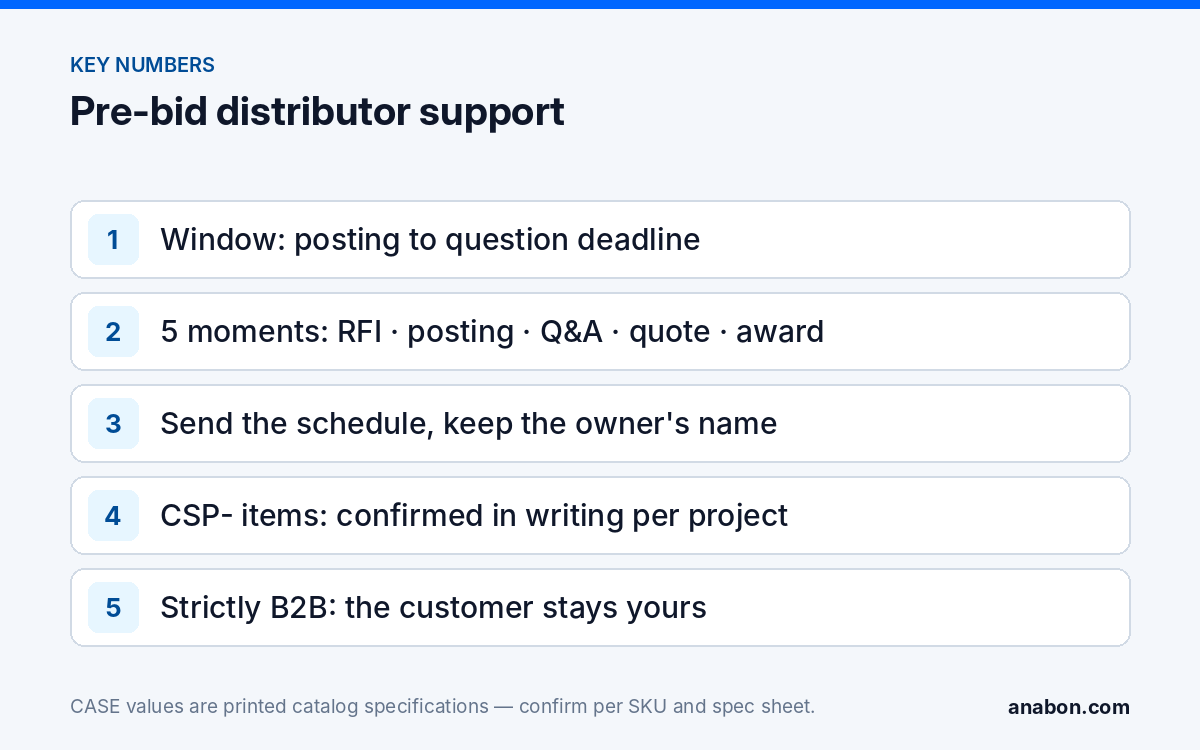
There are five moments in a bid when distributor input changes the outcome, and two when it is too late.
- At the RFI or Sources Sought notice. If the requirement names explosion-proof housings, thermal detection, radar or an off-grid trailer, this is the moment to ask whether it can be done at all. CASE Project Series items (CSP- prefix) are project-quoted; availability, certificates and lead time are confirmed in writing per project, and nothing is promised before that confirmation. Bring us the opportunity before you say no.
- At posting. Read Part 1 and Part 2 of the Division 28 section together with us: the basis of design, the “or equal” phrase, the compliance and warranty clauses. Project Design Review: What Anabon Checks Before You Quote lists the checks.
- Before the question deadline. This is the only window in which you can ask the owner to clarify a listing clause, accept a documentation format or confirm whether a substitution request is due pre-bid. Questions we help you phrase here are worth more than any work after the deadline.
- Before you quote. Design review of the final camera schedule and bill of materials, written lead-time confirmation per SKU, and a named alternate for the high-quantity cameras. Security Camera Lead Times 2026 explains how those confirmations become quote terms.
- After award. Submittals, samples, the training plan for the owner’s staff and the as-built documentation, all of which reuse the pre-bid file.
Too late: the night before submission, when the only possible help is a part number, and after you have promised the owner a product or feature that nobody confirmed. A feature promised in a written proposal is a deviation you now own.
What does a pre-bid design review check?
A design review is a comparison of the schedule against printed figures, not an opinion about brands. These are the checks that most often change a bid:
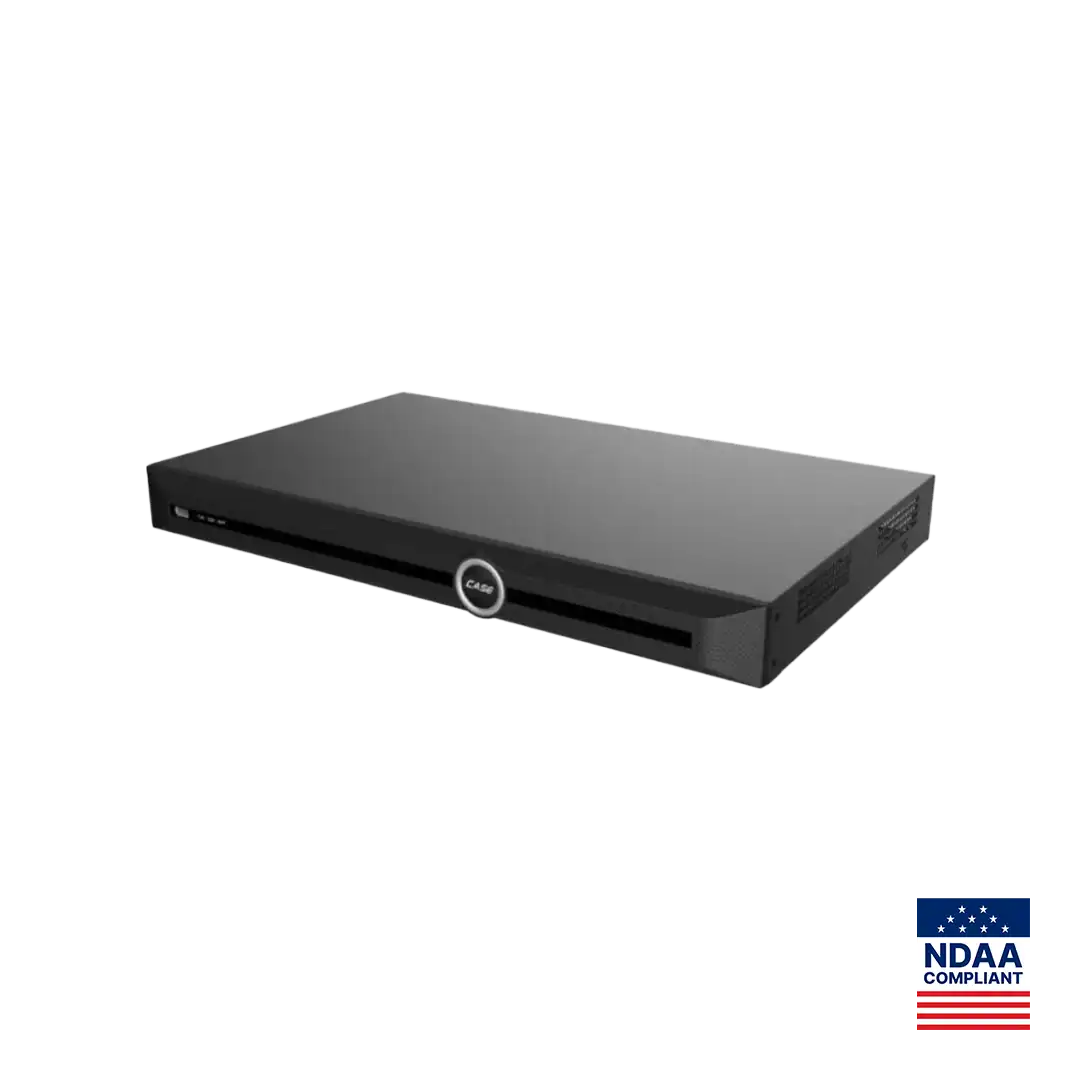
- Channels versus cameras versus bandwidth. A 16-camera schedule on a 20-channel recorder looks fine until the streams are added up. The CS-N220 P16H-AI prints 160Mbps incoming (120Mbps with AI on) and 80Mbps outgoing, with 16 PoE ports; the review checks the main-stream total against that figure, not against the channel count.
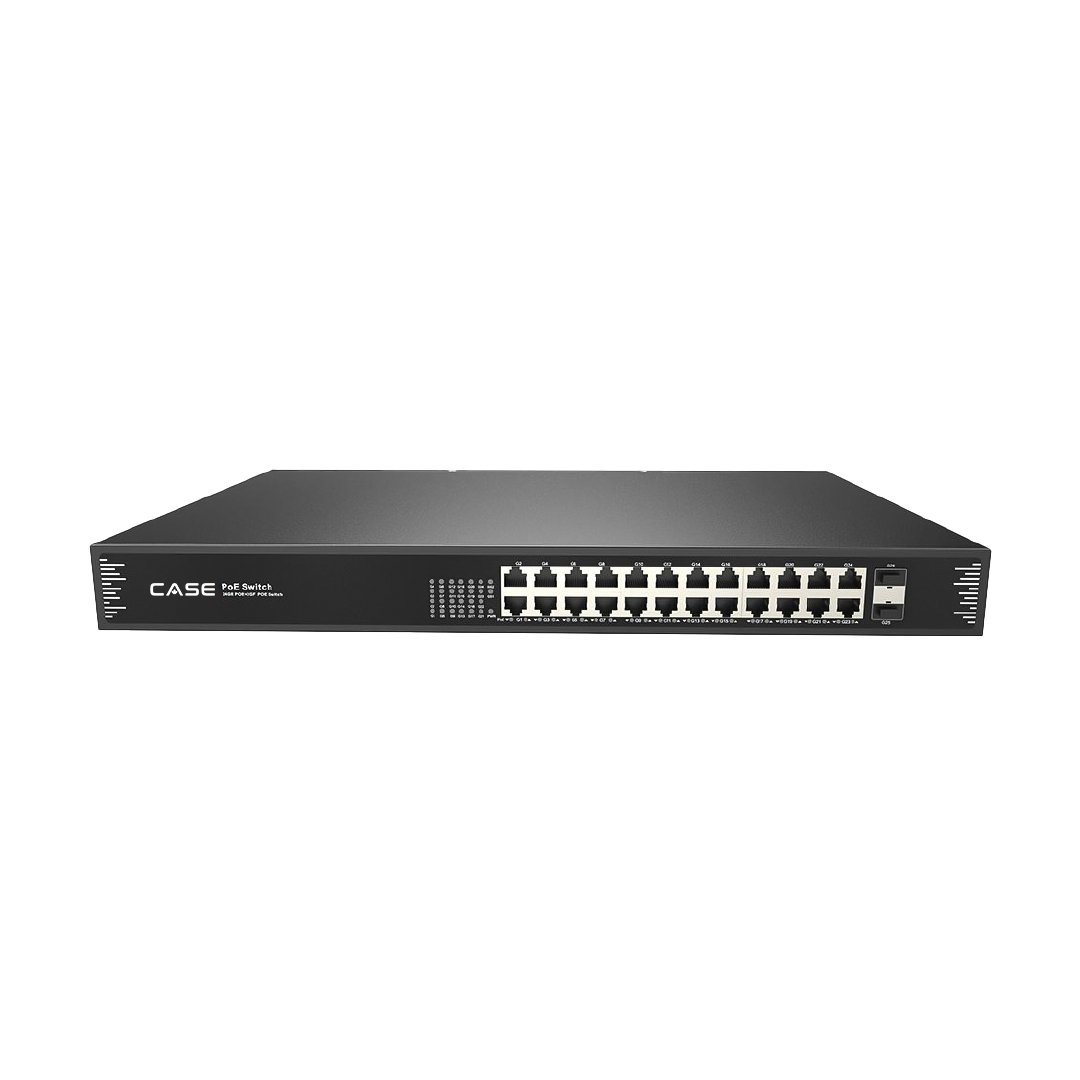
- PoE budget and port count. The CS-POE33024PF prints 24 Gigabit PoE ports, IEEE 802.3af/at, 30W per port and a 400W / 600W total PoE budget; the review adds up the class of every camera on the switch and leaves headroom.
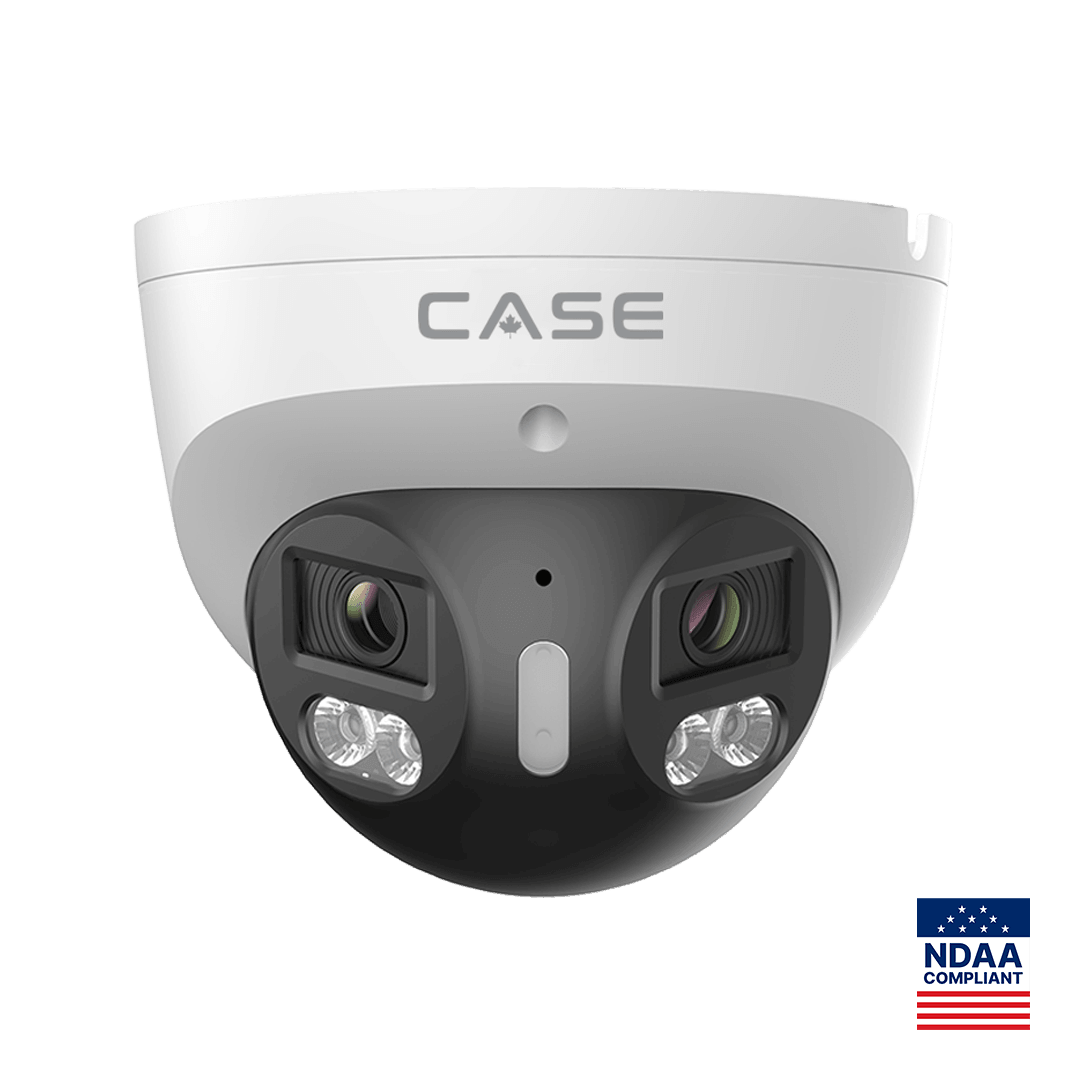
- Coverage choices. Where the drawing shows two cameras back to back on one corner, one CS-I86V I-180 covers 180° as a single stitched 4640×1728 image with 98 ft (30 m) white light as printed, which changes the camera count, cabling and mount; confirm the channel count on the spec sheet.
- Mounting accessories. Junction boxes, pole and corner mounts matched per camera spec sheet.
- Storage. Retention days, frame rate and compression against drive count; hard drives are supported through back-to-back manufacturer warranty, and their supply is confirmed separately from the recorder.
- Compliance clauses. CASE offers NDAA-compliant options for compliance-sensitive projects. Anabon confirms the exact products and provides the official compliance documentation for each project; the review marks which clauses need which document.
- Software scope. CASE Connect is the official app experience for CASE systems. App features and remote access options should be confirmed by model, software version, and project configuration before they appear in your proposal.
- Integration clauses. ONVIF profiles supported are S, T, and G, with M on pinhole models. Third-party behavior is confirmed per platform and project; a review flags any clause that assumes more.
How do you share a project without exposing the end customer?
You do not need to name the owner to get a design review, a documentation pack or a lead-time confirmation. Anabon never contacts the end user and never sells to them, but the simplest protection is that the file we receive does not identify them. Send what the review needs and nothing more:
| Send | Keep |
|---|---|
| Site type and sector (school, warehouse, parking structure, municipal yard) | Owner name, address and contact |
| Camera schedule with counts, locations by zone, mounting heights in ft (m) and distances to target | Your bid amount and your margin |
| Drawings with the title block redacted | The owner’s internal reference numbers |
| The specification text, addenda and the clauses that demand a document | Correspondence with the consultant |
| The deadline, the question deadline and the evaluation date | Anything the solicitation marks confidential |
On public bids much of this is public anyway; the habit matters on private work, where the owner’s name is the asset. Where the solicitation restricts distribution of its documents, send only the relevant excerpts and tell us the restriction.
How does the end-user relationship stay yours?
The hesitation behind “should I involve the distributor” is whether the distributor will one day sell around you. The answer is structural, not a promise: four things, all documented. Anabon is strictly B2B and never sells to your customer. CASE pricing never appears publicly, so your customer cannot find a number to beat you with. You receive private pricing through login, your approved business account and direct quotes, so your customer only ever sees the number you decide to quote. And support, warranty and project help flow through you, so the relationship stays yours.
- Warranty: CASE cameras and CASE NVRs carry a 6-year warranty. CASE PTZ cameras carry a 3-year warranty. CASE accessories carry unlimited warranty. Hard drives are supported through back-to-back manufacturer warranty. Your customer contacts you, and Anabon supports you behind the scenes through the approved warranty process.
- End users who reach us anyway: they hear one sentence. For warranty and service, please contact the installer or company that supplied your system. Anabon supports warranty and technical service through our installer, dealer, and business-account network.
- Demo: for approved demo products we provide a 90-day test period under the approved demo return process. This is not a general return policy. The demo is yours to present; we do not present it to your customer.
How do you start?
- Apply for an approved business account at account.anabon.com; it is the login for private pricing.
- Send the opportunity through Contact Us with the anonymized package from the table above and the three dates: question deadline, submission, evaluation.
- Ask for the documents before you ask for a quote: spec sheets per SKU, the compliance documentation the clauses demand, the warranty statement by category.
- Book the demo early enough that the approved demo product is on site before the evaluation, under the approved demo return process.
- Get availability and lead time per SKU in writing, dated, and write your quote validity from that date.
- Keep the same thread after award; the submittal package starts from the pre-bid file.
Specialty requirements follow the same path with one extra rule: any CSP- Project Series item stays out of your proposal until availability, certificate and lead time are confirmed in writing for that project.
What to tell your customer
“We work with a North American distribution partner that reviews our design against the printed specifications, supplies the documentation for each model and confirms availability and lead time in writing before we quote. They support us behind the scenes; your contract, your service calls and your warranty requests come to our company.”
FAQ
Will Anabon contact my customer or quote them directly?
No. Anabon is strictly B2B and supports you as the installer, integrator, dealer or business account. Anabon does not sell to end users, does not submit bids to owners and does not present demos to your customer. An end user who reaches Anabon is directed back to the installer or company that supplied the system, and the relationship stays with you.
Do I have to name the end customer to get a design review?
No. A design review works from the site type, the camera schedule with counts and mounting heights, the drawings with the title block redacted, the specification text and the deadlines. The owner’s name, address and your bid amount are not needed. On public bids the buyer is public anyway; on private work the anonymized package is the normal way to send a project.
What does Anabon check in a pre-bid design review?
Printed figures against the schedule: channel count, incoming and outgoing bandwidth, PoE port count and budget, coverage choices such as a stitched 180° camera replacing two fixed cameras, mounting accessories per spec sheet, storage and drive supply, compliance clauses that need a document, and software or integration clauses that assume more than is confirmed per model and project.
Can a distributor help with a bid I would otherwise decline?
That is the point of bringing the opportunity before you say no. Specialty requirements such as explosion-proof, thermal, radar or solar-trailer scope are CASE Project Series conversations, quoted per project, with availability, certificates and lead time confirmed in writing before anything is offered. Anabon reviews the requirement with you first; the decision to bid remains yours.