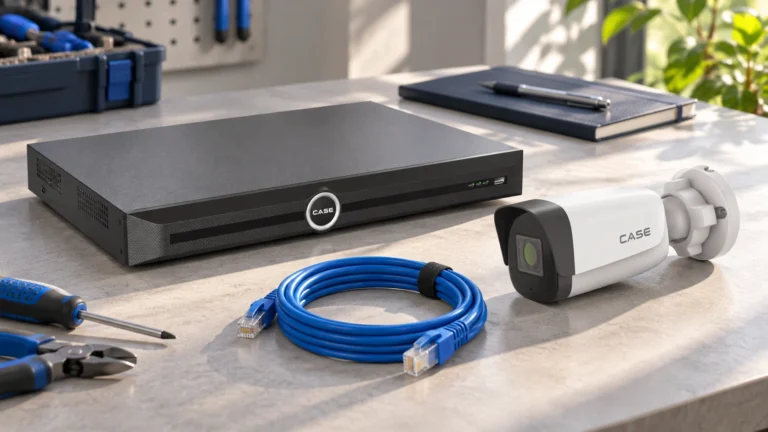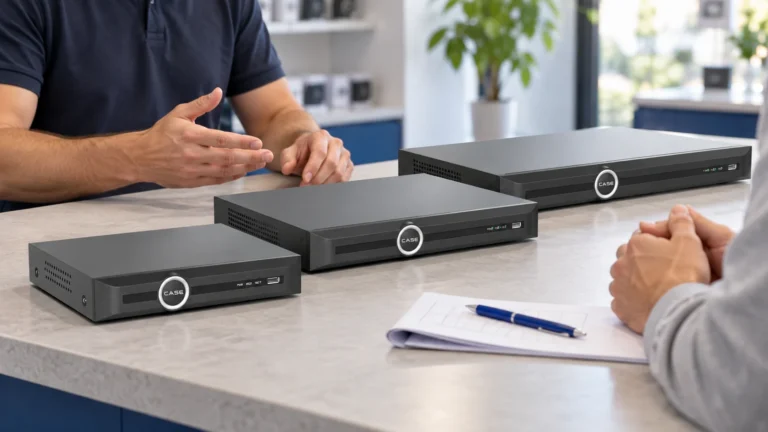



Quick answer: The current catalog lists CS-N880 H-AI at 80 channels with 8×24TB HDD capacity, two independent HDMI+VGA output pairs and no PoE ports. Its detailed CS-N440 P16-H-AI page lists 40 channels, 16 PoE ports and 4×10TB HDD capacity; confirm the ordering identifier against the different index/storefront spelling noted below. Both pages list NVR-side AI, VCA/plate-search entries, 16/4 alarm I/O and lower bandwidth with AI enabled. These figures do not establish concurrent analytics, usable retention or compatibility with every camera. Six-year warranty badges remain subject to actual written order terms.
On this page
SKU check: this guide and the storefront use CS-N440 P16H-AI; the current catalog’s heading on physical PDF page 57 prints CS-N440 P16-H-AI. Confirm that identifier and the actual supplied revision on the order and model sheet. Do not assume a punctuation difference proves a separate or interchangeable product.
Who needs 40 channels, and who needs 80?
Start from the camera schedule when selecting a network video recorder. Count the actual recording inputs/streams and intended expansion; record physical housings and views separately and verify the target NVR’s channel mapping. Check power, incoming/outgoing traffic, decoding/layout, required concurrent analytics and usable storage together. The table gives candidate layouts for verification, not automatic approval of a full-load design:
| Illustrative input/power layout (verify channel mapping) | Candidate to verify | Why |
|---|---|---|
| 20 to 40 cameras, up to 16 near the rack | CS-N440 P16-H-AI (catalog p.57; confirm order identifier) | 16 PoE ports are printed; verify per-port/total power, camera requirements and network/workload before assigning ports |
| 20 to 40 cameras, all on network switches | CS-N440 M-AI | Same 40 channels, AI by NVR and storage, no PoE ports, two Gigabit Ethernet ports |
| 40 to 80 cameras on one recorder | CS-N880 H-AI | 80 channels, 8 drive bays, two independent output pairs, two Gigabit ports |
| Two buildings or more than 80 cameras | A verified multi-recorder/client design | Split by building or by risk; see the two-building design guide |
Current catalog page 56 lists CS-N440 M-AI at 40 channels, 400/400Mbps (AI on 200/200), 4×10TB and the same printed NVR-side AI list. It shows no PoE, Alarm I/O N/A and two Gigabit ports, and its VCA list omits License Plate Search. Page 57’s P16-H-AI configuration lists 16 PoE and 16/4 alarm I/O with plate-search support. Confirm the actual order identifier, power budgets, concurrent functions and integration before choosing; do not transfer another model’s electrical or workload limits.
What does the full AI by NVR set include?
The three referenced pages print Face Detection, Face Recognition, Video Structuralization (excludes vehicle detection), Tripwire, Double Tripwire, Perimeter, Object Abandon, Object Missing, Running, Parking, Heatmap, Sleeping on Duty Detection, On Duty Detection, Smart Motion Detection and Loitering under AI by NVR. The AI NVR explainer compares recorder-side processing with camera analytics. The list is not a simultaneous-channel capacity or universal input-compatibility statement; confirm actual codec/resolution, firmware, concurrent functions and approved privacy tasks.
Four points before you promise any of it:
- How many channels run AI at once is not printed in the catalog row. Take it from the spec sheet and design around it.
- Video Structuralization is printed with the note excludes vehicle detection; do not sell it as vehicle attribute search.
- A printed face feature does not establish permission to use it. Obtain a site-specific privacy/legal review and confirm the exact camera, recorder, firmware and approved workflow before enabling biometric functions. Choose the required non-biometric analytics where they meet the task.
- Which cameras’ events appear in which rule is confirmed per model, firmware, software version and project configuration in a bench test, not assumed from the row.
What can VCA Search find, and what is License Plate Search?
VCA Search lists search functions rather than a guarantee that every event or attribute is indexed. The required camera metadata, event generation, recording, retention and client/version must support the chosen workflow. The printed model lists are:
- CS-N880 H-AI: Heatmap, Early-warning Search, Behavior Search, License Plate Search, Safety Helmet Search, Thermographic Retrieval, Duty Search, Electric Bicycle Retrieval, Face Search.
- CS-N440 P16H-AI: Heatmap, Early-warning Search, Behavior Search, Thermographic Retrieval, Duty Search, Electric Bicycle Retrieval, Face Search, Safety Helmet Search, License Plate Search Support.
- CS-N440 M-AI: the same list without License Plate Search.
Plate Search does not turn an overview camera into a proven plate-reading system. Agree the plate task, camera position, exposure, angle, metadata source and exact NVR/client integration, then test recorded results and search. The parking lot guide helps plan a dedicated entry-lane view. Apply the same care to Thermographic Retrieval: its label does not prove compatibility with a particular thermal camera, calibrated temperature data or an approved fire-alarm workflow.
Use the VCA search workflow to define the required event, search, playback and export checks. Demonstrate them with the actual camera, recorder, firmware and approved client; the published function name alone does not establish a successful evidence or metadata export.
How do bandwidth, storage and outputs compare?
The bandwidth rows are incoming/outgoing totals, with lower AI-on values. Use the appropriate actual operating mode and a measured peak workload with reserve; do not approve an edge-of-limit design merely because average bitrates fit. A 16MP resolution row does not establish decoding every channel at a given frame rate, support for every stitched wide format, or simultaneous live/playback/export performance. Confirm those limits separately.
| Row (as printed) | CS-N880 H-AI | Catalog p.57: CS-N440 P16-H-AI (order ID pending) |
|---|---|---|
| Bandwidth I/O | 400Mbps / 400Mbps | 400Mbps / 400Mbps |
| Bandwidth with AI on | 320Mbps / 200Mbps | 200Mbps / 200Mbps |
| Storage | 8x24TB HDD | 4x10TB HDD |
| Display ports | HDMI1 and VGA1 – HDMI2 and VGA2 Independent Outputs | 1xHDMI and 1xVGA (independent) |
| Ethernet | 2×RJ-45 10/100/1000 Mbps | 1×RJ45 10/100/1000 Mbps, plus 16 PoE ports |
Worked example (illustrative stream settings, not printed specs)
Illustrative arithmetic, not a retention commitment: 80 streams at a constant 4Mbps total 320Mbps, exactly the CS-N880 H-AI’s stated AI-on incoming limit, with no reserve. That writes about 3.46TB/day. Eight 24TB drives total 192TB raw, giving an upper arithmetic bound of about 55 days before formatting, system use, reserve or any supported redundancy. Forty streams at 5Mbps equal the CS-N440 P16H-AI’s 200Mbps AI-on limit and about 2.16TB/day; 40TB raw is roughly 18.5 days before deductions. Do not approve either edge-of-limit design without reserve and a measured workload test. Codec, motion/event recording and actual activity change the result; they do not guarantee a fixed saving. Use the NVR storage calculator with verified usable capacity and measured bitrates.
Outputs and alarm I/O
- Independent outputs let the guard desk and a manager’s office show different layouts. The CS-N880 H-AI prints two HDMI+VGA pairs; the CS-N440 P16H-AI prints one HDMI and one VGA, independent.
- The printed 16/4 alarm I/O is a count, not an electrical load rating. Confirm actual input/output types, voltage/current limits, isolation and any interface module before connecting another system; do not assume an output can power a siren directly.
- Two Gigabit ports are printed for CS-N880 H-AI. Confirm the actual supported network mode, addressing/routing and approved design before using them. Two connectors alone do not establish a firewall, traffic separation, link aggregation or security isolation.
- Confirm the required CASE Connect functions for the exact device and software version. Android is available; iOS is forthcoming. Do not promise the same functions on every client or publish an unverified web-access URL.
- A printed ONVIF profile is not a blanket compatibility promise. Where conformance is required, check the exact model and firmware in the official ONVIF database, then test the required live view, recording, playback and event functions with the actual client/version.
Spec table: CS-N880 H-AI and CS-N440 P16H-AI as printed
| Row | CS-N880 H-AI | Catalog p.57: CS-N440 P16-H-AI (order ID pending) |
|---|---|---|
| IP video channels | 80CH | 40CH |
| PoE ports | N/A | 16 |
| Bandwidth I/O | 400Mbps / 400Mbps (AI on: 320Mbps / 200Mbps) | 400Mbps / 400Mbps (AI on: 200Mbps / 200Mbps) |
| Resolution | 16MP | 16MP |
| Display ports | HDMI1+VGA1, HDMI2+VGA2, independent | 1xHDMI, 1xVGA, independent |
| Storage | 8x24TB HDD | 4x10TB HDD |
| Alarm I/O | 16 inputs / 4 outputs | 16 inputs / 4 outputs |
| Ethernet | 2×RJ-45 10/100/1000 Mbps | 1×RJ45 10/100/1000 Mbps |
| AI by NVR | Full set (listed above) | Full set (listed above) |
| VCA Search | Includes License Plate Search | Includes License Plate Search Support |
| Warranty reference | 6-year catalog badge; confirm written SKU/revision and order terms | 6-year catalog badge; confirm written SKU/revision and order terms |
Drive coverage follows the applicable manufacturer’s written terms and is separate from recorder coverage. Verify actual supported drive models/revisions, raw versus usable capacity, required recording behavior and any supported redundancy before committing retention. Record installed drive serials and handover details; a bay/capacity row is not proof that drives are included or that every drive revision is supported.
What to tell your customer
Suggested customer wording, subject to the agreed scope: We will confirm the supplied recorder identifier/revision, actual stream load, usable storage and required concurrent analytics. We will test the agreed search, playback and export workflow with a verified metadata source and client. The proposal will identify the exact recorder and separate written recorder, drive and service terms; catalog maxima are not guaranteed full-system results.
FAQ
Is License Plate Search the same as an LPR camera?
No. License Plate Search is a VCA Search function of the CS-N880 H-AI and CS-N440 P16H-AI recorders for finding recorded events by plate. Reliable plate reading still needs a camera positioned and configured for plates at the entry lane. What the search returns is confirmed per model, firmware, software version and project configuration in a bench test.
Why does bandwidth drop when AI is on?
The recorder spends part of its processing on analytics, so the camera bandwidth it accepts is lower. The CS-N880 H-AI prints 400Mbps in, 320Mbps with AI on; the CS-N440 P16H-AI prints 400Mbps in, 200Mbps with AI on. Design the sum of camera main streams against the AI-on figure unless analytics are ruled out in writing.
Should I choose the CS-N440 P16H-AI or the CS-N440 M-AI?
Compare catalog pages 56/57 for CS-N440 M-AI and the detailed CS-N440 P16-H-AI configuration, while resolving the index/storefront order identifier. Their printed channel/bandwidth/storage/AI rows match, but PoE, Ethernet, alarm I/O and plate-search entries differ. If an update is actually needed, obtain the approved nvr firmware download for the exact supplied hardware/revision through the documented process; do not select a package from a similar-looking name or assume an upgrade fixes an untested feature.
Can I use these NVRs on an NDAA-sensitive bid?
Ask for the exact recorder and camera documentation required by the actual solicitation clauses, including the full identifier and revision. A brand-level statement is not bid acceptance. Keep the evidence, qualifications and open items with the submittal and obtain the buyer’s required review before committing.
What warranty applies to the recorder and the drives?
Both detailed pages show six-year recorder badges. Use the warranty-by-category guide for context and confirm the actual supplied SKU/revision, written term, start date, exclusions and service route. Drive-manufacturer coverage is separate. Start through the supplying installer/dealer and obtain the actual return authorization before shipment; a recorder badge does not establish included onsite service or drive coverage.
References
- Current CASE catalog and revision-specific manuals
- Confirm a model, configuration or integration
- ONVIF Conformant Products database