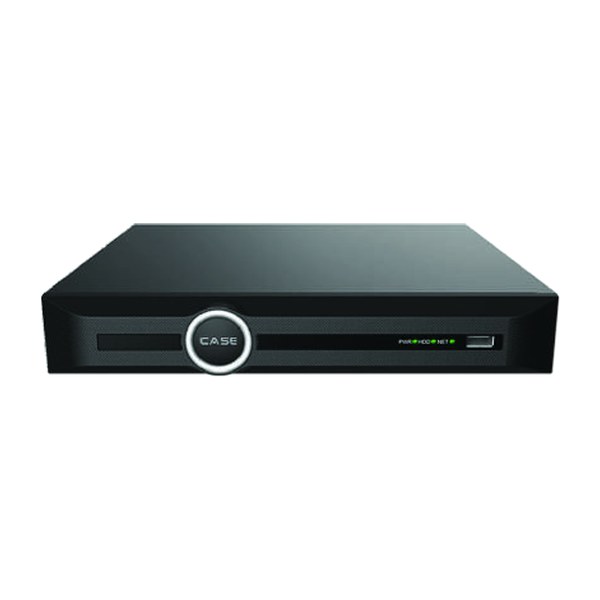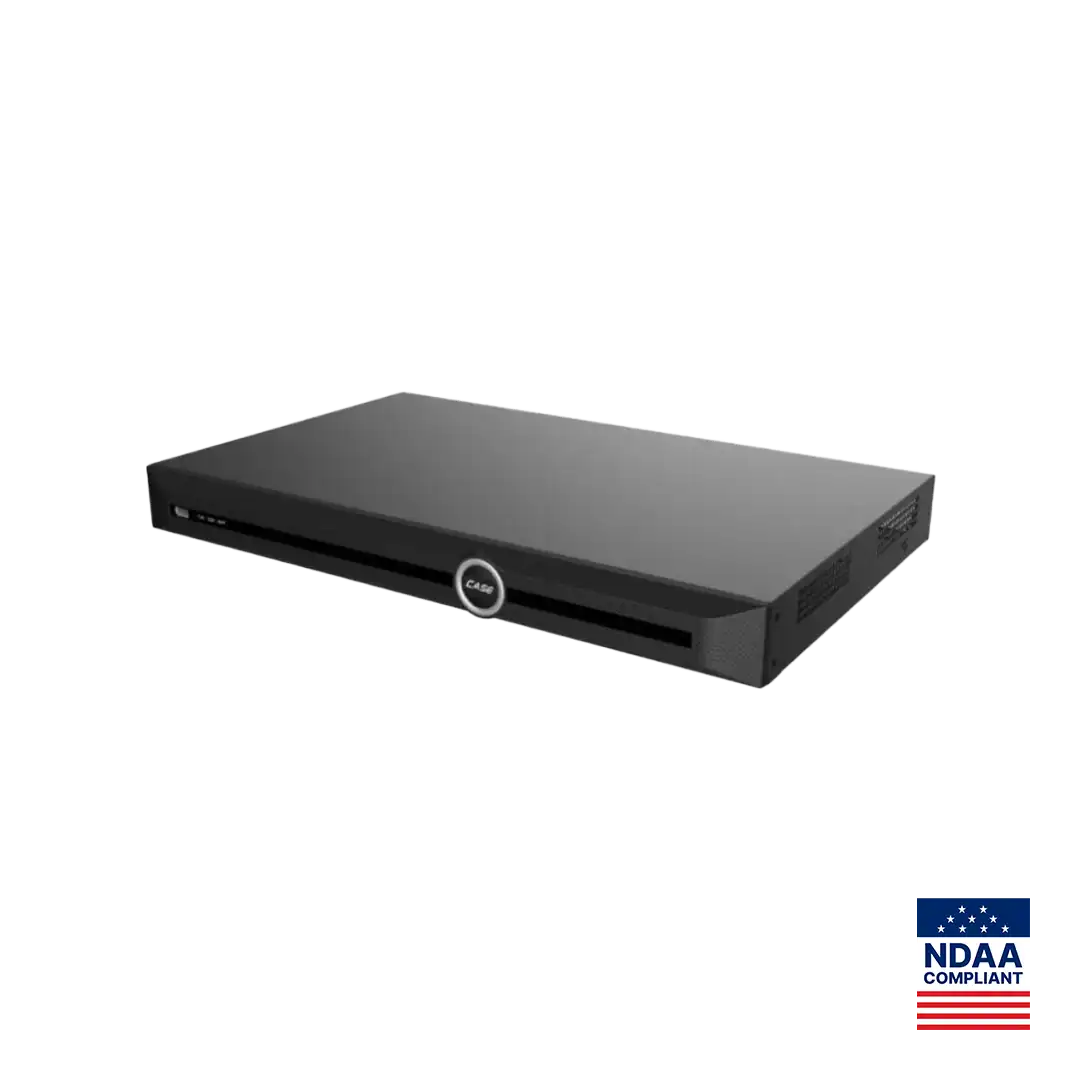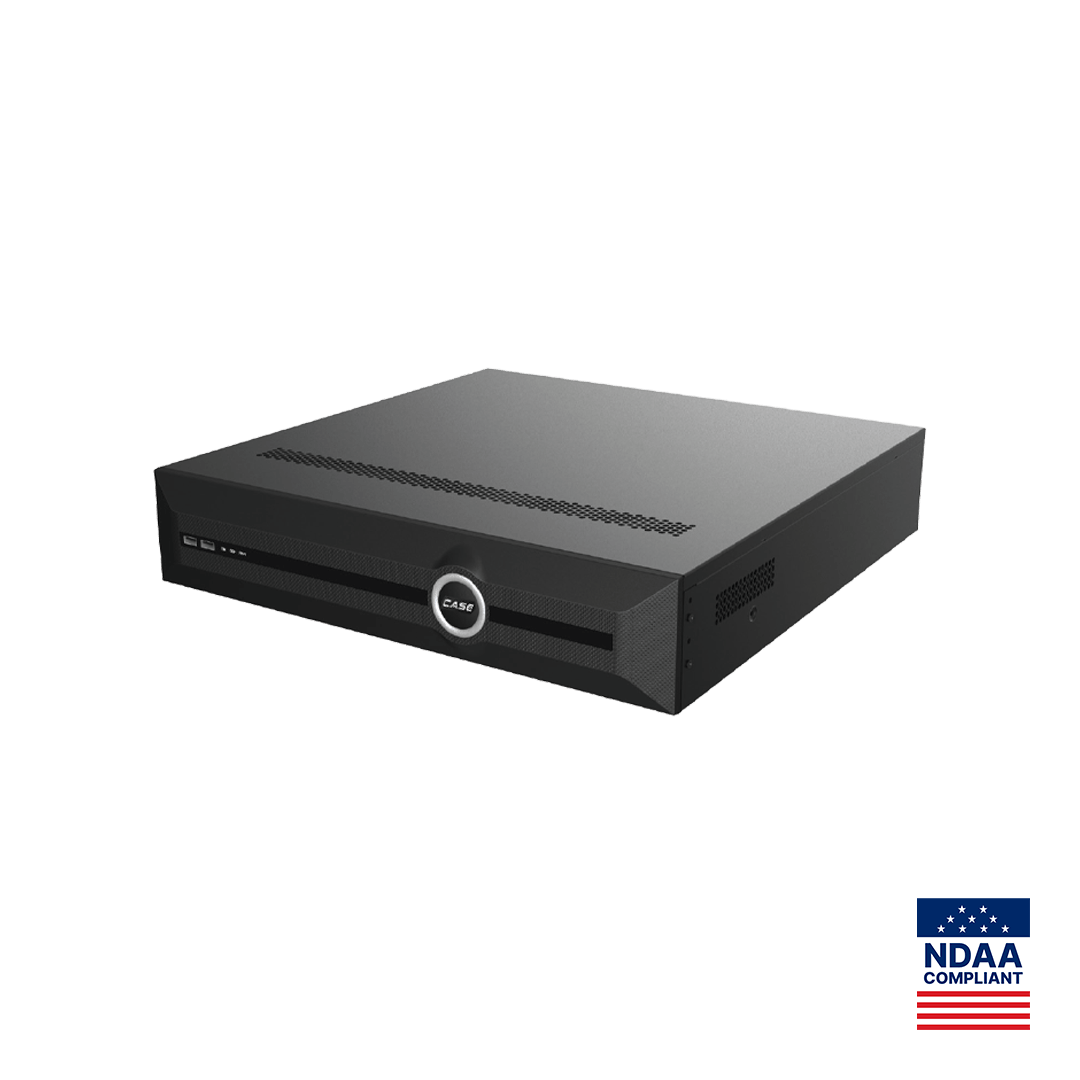



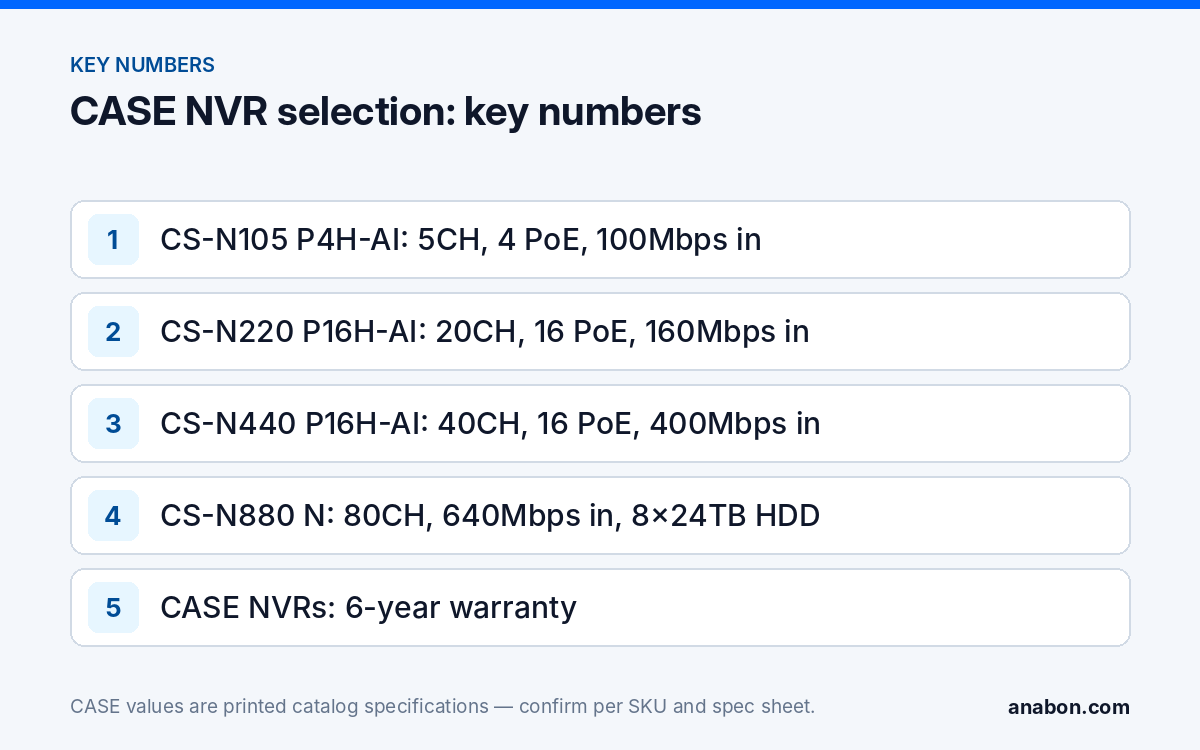
Quick answer: Pick the CASE NVR by three printed numbers, in this order: the channel count of the finished site, the incoming bandwidth with AI on if you will use it, and whether the cameras plug into the NVR’s own PoE ports or into an external switch. CASE channel counts run 5, 10, 20, 40 and 80, mapping onto the 4, 8, 16, 32 and 64 you are used to with spare channels built in. CASE NVRs carry a 6-year warranty.
The full CASE NVR table, as printed
Nine current models cover 5 to 80 channels; six are PoE NVRs with their own camera ports and three take every camera over the network. All record up to 16MP per channel. Every figure below is as printed in the CASE Catalog 2027 Q1; never carry a number from one row to another.
| SKU | Channels | PoE ports | Bandwidth in / out (AI on) | Storage | Alarm I/O | Display | AI by NVR / VCA Search |
|---|---|---|---|---|---|---|---|
| CS-N105 P4 | 5CH | 4 | 100Mbps / 80Mbps | Up to 10 TB per HDD | 1-ch relay out (1A, 24VDC) | HDMI + VGA (simultaneous) | None printed |
| CS-N105 P4H-AI | 5CH | 4 | 100Mbps / 80Mbps | Up to 10 TB per HDD | 4-ch TTL in; 1-ch relay out | HDMI + VGA (simultaneous) | Basic set + VCA Search |
| CS-N110 P8 | 10CH | 8 | 100Mbps / 80Mbps | Up to 10 TB per HDD | 1-ch relay out (1A, 24VDC) | HDMI + VGA (simultaneous) | None printed |
| CS-N110 P8H-AI | 10CH | 8 | 100Mbps / 80Mbps | Up to 10 TB per HDD | 4-ch TTL in; 1-ch relay out | HDMI + VGA (simultaneous) | Basic set + VCA Search |
| CS-N220 P16H-AI | 20CH | 16 | 160Mbps (AI on: 120Mbps) / 80Mbps | Up to 10 TB per HDD | 4-ch TTL in; 1-ch relay out | HDMI + VGA (simultaneous) | Basic set + VCA Search |
| CS-N440 M-AI | 40CH | N/A | 400Mbps / 400Mbps (AI on: 200Mbps / 200Mbps) | 4x10TB HDD | N/A | 1xHDMI + 1xVGA (independent) | Full set + VCA Search |
| CS-N440 P16H-AI | 40CH | 16 | 400Mbps / 400Mbps (AI on: 200Mbps / 200Mbps) | 4x10TB HDD | 16 inputs / 4 outputs | 1xHDMI + 1xVGA (independent) | Full set + VCA Search incl. License Plate Search Support |
| CS-N880 N | 80CH | N/A | 640Mbps / 320Mbps | 8x24TB HDD | 16 inputs / 4 outputs | HDMI1 + VGA1, HDMI2 + VGA2 (independent) | None printed |
| CS-N880 H-AI | 80CH | N/A | 400Mbps / 400Mbps (AI on: 320Mbps / 200Mbps) | 8x24TB HDD | 16 inputs / 4 outputs | HDMI1 + VGA1, HDMI2 + VGA2 (independent) | Full set + VCA Search incl. License Plate Search |
The basic AI by NVR set on the 5-, 10- and 20-channel AI units is printed as Face Detection, Face Recognition, Tripwire, Double Tripwire, Perimeter and Smart Motion Detection. The full set on the 40- and 80-channel AI units adds Video Structuralization (excludes vehicle detection), Object Abandon, Object Missing, Running, Parking, Heatmap, Sleeping on Duty Detection, On Duty Detection and Loitering. License Plate Search on the CS-N440 P16H-AI and CS-N880 H-AI is an NVR search function, not an LPR camera claim. Face recognition is offered only after the use case, region and legal requirements (state privacy laws in the US; provincial laws and PIPEDA in Canada) are confirmed. AI functions are confirmed per model, firmware and project configuration.
Why are CASE channel counts 5, 10, 20, 40 and 80?
Most recorder lines are sold in 4, 8, 16, 32 and 64 channels, and most camera schedules are written against those sizes. CASE prints 5, 10, 20, 40 and 80, which gives every tier 25 percent more channels than the size you were about to quote. That margin absorbs the camera the customer adds at handover or the PTZ that goes onto the loading yard a year later. The mapping:
- 4-channel job → CS-N105 P4 or CS-N105 P4H-AI (5CH, 4 PoE ports).
- 8-channel job → CS-N110 P8 or CS-N110 P8H-AI (10CH, 8 PoE ports).
- 16-channel job → CS-N220 P16H-AI (20CH, 16 PoE ports).
- 32-channel job → CS-N440 M-AI (40CH, no PoE) or CS-N440 P16H-AI (40CH, 16 PoE ports).
- 64-channel job → CS-N880 N (80CH, no AI) or CS-N880 H-AI (80CH, full AI set).
Quote the channel count of the finished design, not of phase one; an NVR replaced in year two because four cameras were added is a margin problem you can avoid at the quoting stage.
Built-in PoE ports or an external switch?
A PoE NVR powers the cameras from its own ports, which saves a switch, a power supply and a patch panel on a small site and keeps the camera network isolated from the customer’s LAN. The trade-off is reach and headroom: every camera must be within 328 ft (100 m) of the NVR, and the built-in ports on the 5-, 10- and 20-channel units are printed as 10/100 Mbps, fine for a camera stream but not a place to hang a second switch. The PoE budget of the built-in ports is on each SKU’s spec sheet rather than in the catalog table, so request it and check it against the camera draw at night, when IR, white light and heaters switch on.
An external switch is the answer when cameras sit more than 328 ft (100 m) from the rack, when the channel count exceeds the PoE ports, or on 40- and 80-channel sites, where the CS-N440 M-AI, CS-N880 N and CS-N880 H-AI print no PoE ports and take cameras over their 10/100/1000 Mbps RJ-45 ports. For the switch itself, the CS-POE33024PF prints 24×10/100/1000M PoE ports, IEEE 802.3af/at, 30W max per port, a total PoE budget of 400W / 600W depending on the version and 2×1000M SFP fiber uplinks.
Decide in four checks
- Count the finished cameras; if it exceeds the PoE ports, plan a switch for the remainder or for all of them.
- Measure the longest run from the rack; over 328 ft (100 m) means a switch near the cameras, an extend-mode port or fiber.
- Add up the camera power draw at night and compare it with the PoE budget on the spec sheet.
- Decide whether the camera network stays isolated on the NVR ports or joins the customer’s VLAN, and harden the NVR either way.
Bandwidth: the number that decides more than the channel count
Incoming bandwidth is the total bitrate the NVR accepts from all cameras at once, and it is the figure most often ignored on a quote. As a worked example only: ten 4MP cameras set to a 4 Mbps main stream need 40 Mbps, which fits the 100Mbps printed for the CS-N110 P8H-AI. Twenty 8MP cameras at 8 Mbps need 160 Mbps, which matches the CS-N220 P16H-AI with AI off but exceeds the 120Mbps it prints with AI on, so you lower the bitrates, use the S+265 codec where the camera supports it, or move up to a 40-channel unit. Compare the sum of the bitrates you intend to run with the AI-on figure. For the retention side, the Search Config Tool includes a storage calculator and our NVR storage calculator guide covers drive sizing.
Which CASE NVR for which site?
- Retail store or small branch office, up to 5 cameras. CS-N105 P4H-AI when the customer wants Tripwire, Perimeter and VCA Search, or CS-N105 P4 for plain recording; four cameras on the built-in ports, a fifth over the LAN. The 4-ch TTL inputs and 1-ch relay output on the AI unit suit alarm companies tying the recorder to a panel.
- Office, clinic or small plant, 6 to 10 cameras. CS-N110 P8H-AI or CS-N110 P8: 8 PoE ports, channels 9 and 10 over the LAN.
- Mid-size commercial site, 12 to 20 cameras. CS-N220 P16H-AI: 16 PoE ports, four more channels over the 10/100/1000 uplink, 160Mbps incoming; see the CS-N220 P16H-AI profile.
- Warehouse or distribution yard, 20 to 40 cameras. CS-N440 P16H-AI where 16 cameras sit on the NVR and the rest on a switch, with 16 alarm inputs / 4 outputs for dock-door contacts; CS-N440 M-AI where everything arrives through switches over its 2×RJ-45 10/100/1000 ports. Both print 4x10TB HDD and the full AI set.
- Multi-building site or campus, up to 80 cameras. CS-N880 H-AI for the full AI set, License Plate Search and 8x24TB HDD, with HDMI1/VGA1 and HDMI2/VGA2 independent outputs for a security desk and a manager’s office. CS-N880 N where AI by NVR is not required and the 640Mbps incoming bandwidth matters more.
Two rows deserve a second look. Display: the 5-, 10- and 20-channel units print HDMI and VGA simultaneous (one layout on both), while the 40- and 80-channel units print independent outputs (different layouts per monitor). Storage: the 40-channel units print 4x10TB HDD and the 80-channel units 8x24TB HDD; the smaller units print up to 10 TB per HDD, with the bay count on the SKU spec sheet.
Warranty: 6-year on CASE NVRs
CASE cameras and CASE NVRs carry a 6-year warranty. CASE PTZ cameras carry a 3-year warranty. CASE accessories carry unlimited warranty. Hard drives are supported through back-to-back manufacturer warranty. The warranty runs through you: your customer contacts you, and Anabon supports the claim behind the scenes through the approved warranty process. The category breakdown is in CASE warranty by category; the current range is listed in the CASE NVR collection, with pricing behind your business-account login.
What to tell your customer
“We are sizing the recorder for the cameras you will have, not just the ones going in today, so spare channels and bandwidth are built in. Cameras near the rack plug straight into the recorder; the far ones run through a switch so they get full power at night. The recorder carries a 6-year warranty through us; the hard drives carry their own manufacturer’s warranty.” For warranty and service, please contact the installer or company that supplied your system.
FAQ
What does 20 channels with 16 PoE ports mean on the CS-N220 P16H-AI?
Sixteen cameras can plug straight into the NVR’s own PoE ports, which are 10/100 Mbps as printed, and up to four more can be added through the 10/100/1000 uplink port from a switch elsewhere on the network. The channel count is the recording limit; the PoE count is only how many cameras the NVR can power itself.
Can I use an external PoE switch instead of the NVR’s built-in ports?
Yes, and on 40- and 80-channel sites you must, because the CS-N440 M-AI, CS-N880 N and CS-N880 H-AI print no PoE ports. A switch such as the CS-POE33024PF prints 24 PoE ports at 30W max per port with a 400W / 600W total budget depending on the version. Count the budget against the camera draw, not just the ports.
Does switching AI on reduce the bandwidth an NVR accepts?
On several models, yes, and the catalog prints both figures. The CS-N220 P16H-AI prints 160Mbps incoming with AI off and 120Mbps with AI on; the CS-N440 M-AI and CS-N440 P16H-AI print 400Mbps / 400Mbps falling to 200Mbps / 200Mbps with AI on. Size the camera bitrates against the AI-on figure if you plan to use AI by NVR.
Are the hard drives covered by the 6-year CASE NVR warranty?
No. CASE NVRs carry a 6-year warranty; hard drives are supported through back-to-back manufacturer warranty, which means the drive vendor’s own term applies and Anabon coordinates the claim through you. Use surveillance-rated drives, record the serial numbers on the handover sheet, and route any warranty request through your dealer or business account, never from the end user directly.