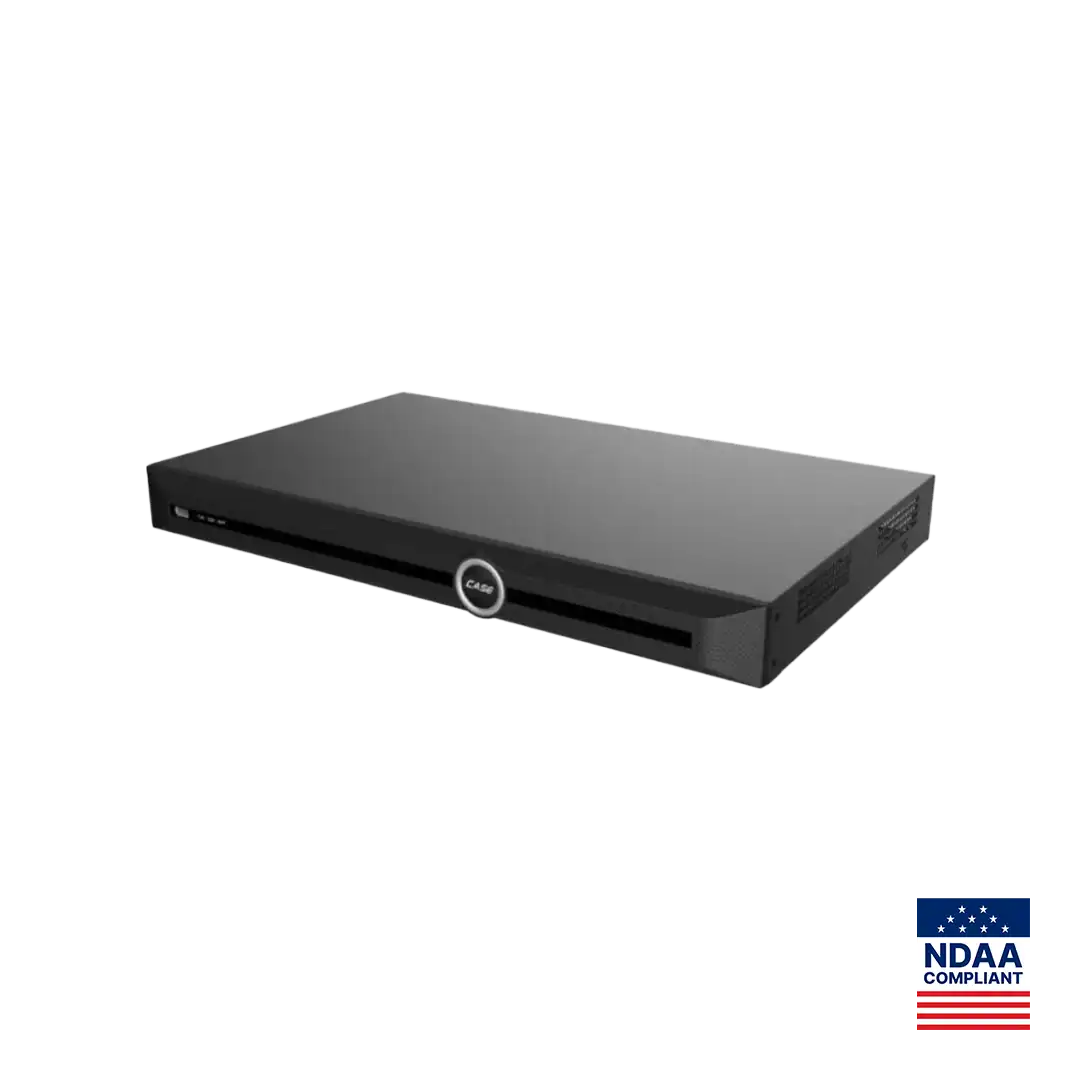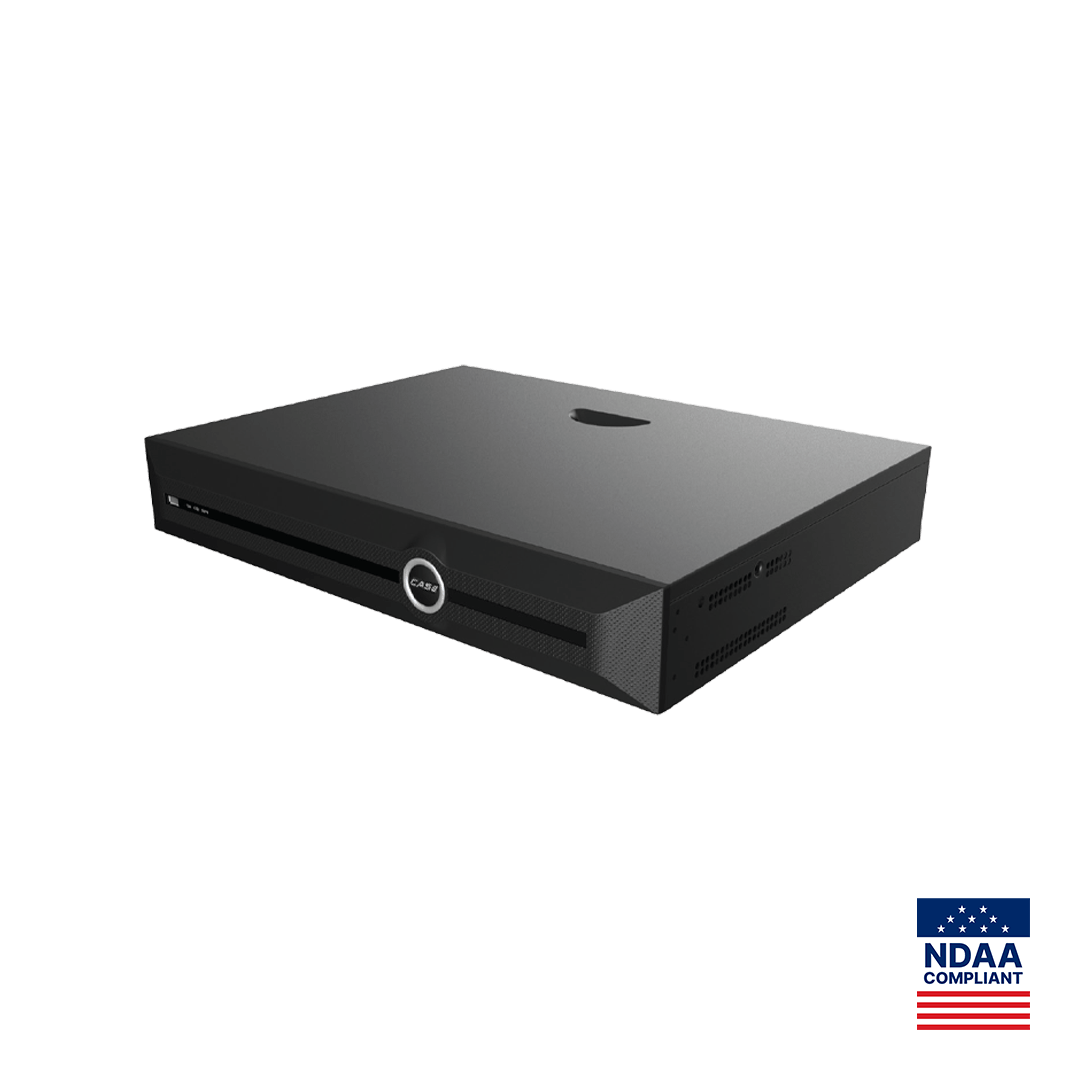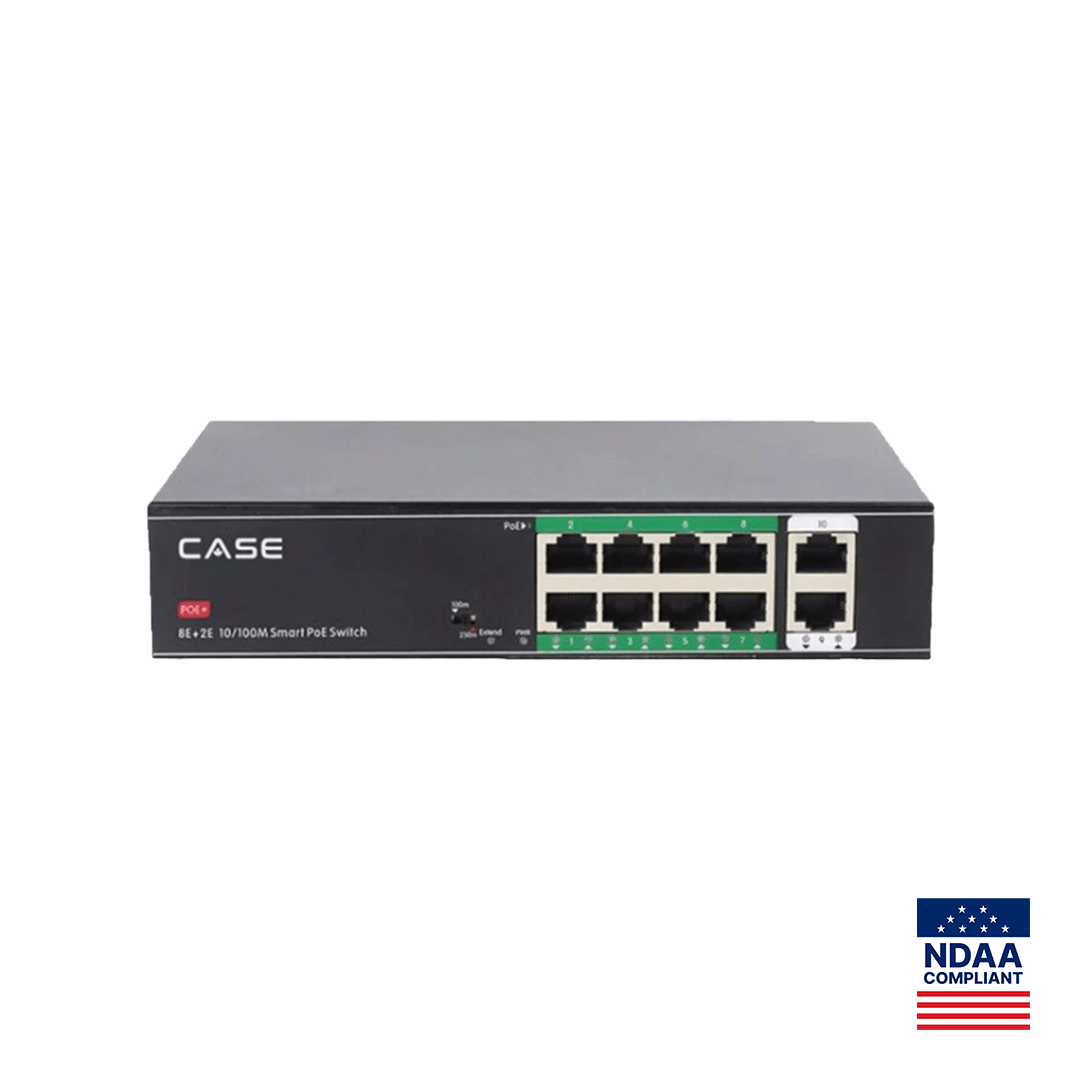



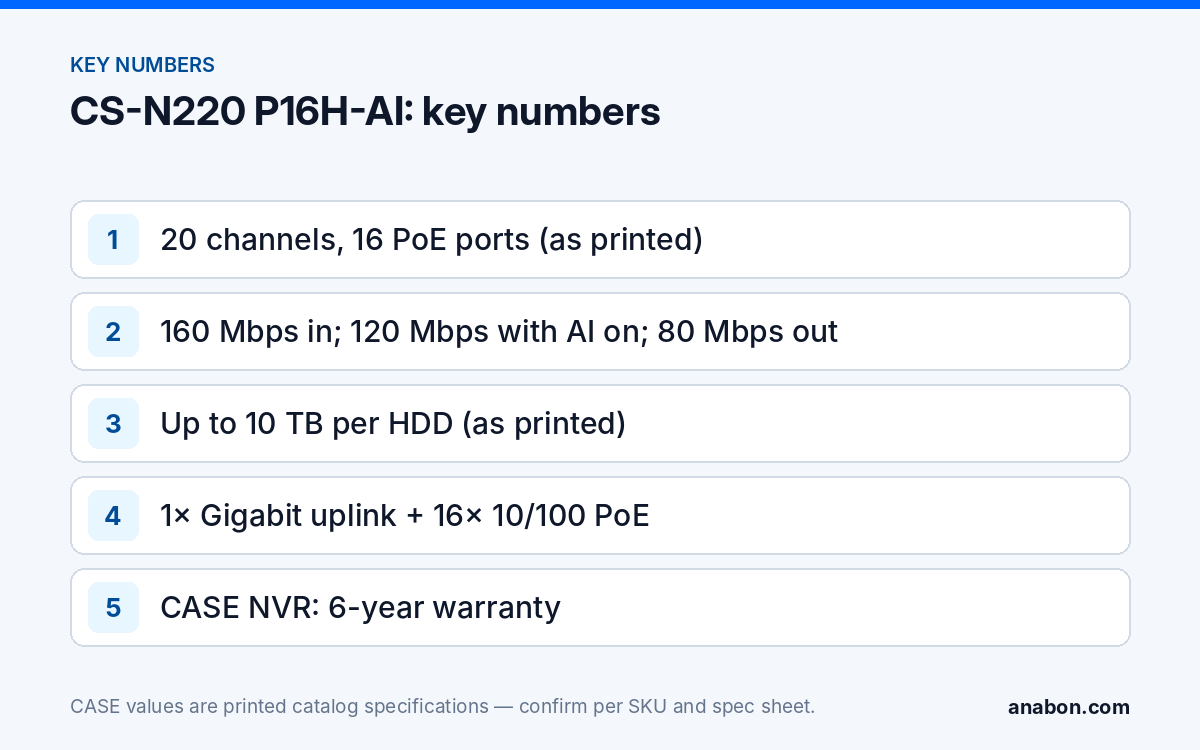
Quick answer: When a job calls for a 16-channel PoE NVR, the CASE CS-N220 P16H-AI is usually the better line on the bill of materials: 20 channels, 16 PoE ports, 160Mbps incoming bandwidth (120Mbps with AI on), 80Mbps out, HDMI and VGA simultaneous, up to 10 TB per hard drive, and the AI by NVR and VCA Search sets printed in the catalog. The four channels beyond the PoE ports take cameras from an external switch — what a growing office, store or small warehouse asks for a year after handover. CASE NVRs carry a 6-year warranty, serviced through you.
Why 20 channels with 16 PoE ports, and what do the extra four do?
The two numbers answer two different questions. PoE Port: 16 is how many cameras it powers and connects directly on its own 10/100 Mbps ports. IP Video Output: 20CH is how many cameras it records. The four channels in between arrive through the single Gigabit uplink from an external PoE switch anywhere on the customer’s network.
That gap is the reason to prefer this unit over a recorder that stops at 16 of both. Typical uses:
- A loading-dock or yard cluster 500 ft (about 150 m) from the rack, fed by a CS-H1108PLS — 8 PoE ports, 100W budget and an 820 ft (250 m) Extend Mode as printed — with one uplink back to the LAN.
- Cameras on the IT department’s existing PoE switch in a second building.
- The “just two more cameras” call twelve months after handover, without replacing the recorder.
- A camera that needs more power than a built-in port provides; the PoE budget is not in the catalog row, so take it from the spec sheet before assigning a PTZ or a heated housing to the recorder.
The 16 PoE ports are 10/100 Mbps and the uplink is the only Gigabit port: 1×RJ-45, 10/100/1000 Mbps self-adaptive Ethernet port 16×RJ45, 10/100 Mbps self-adaptive as printed. Remote viewing, the four network cameras and exports all share that uplink.
How much bandwidth is left when AI is on?
The printed row is Bandwidth I/O: 160Mbps (AI on: 120Mbps) / 80Mbps. Incoming is the sum of camera main streams the recorder can take; it drops to 120Mbps when AI by NVR is running, as printed; plan with the AI-on figure. Outgoing is what it can push to CASE Connect clients and exports at the same time. Plan with the AI-on figure unless the customer has ruled out recorder-side analytics in writing.
| Planning case (illustrative stream settings, not printed specs) | Sum of main streams | Against 120Mbps (AI on) | Against 160Mbps (AI off) |
|---|---|---|---|
| 16 cameras, each main stream set to 4 Mbps | 64 Mbps | Fits | Fits |
| 20 cameras, each main stream set to 4 Mbps | 80 Mbps | Fits | Fits |
| 20 cameras, each main stream set to 6 Mbps | 120 Mbps | At the limit | Fits |
| 20 cameras, each main stream set to 8 Mbps | 160 Mbps | Does not fit | At the limit |
The per-camera figures are stream settings you choose, not CASE specifications; read the real bitrate from each camera’s stream page at your resolution, frame rate and codec, add a margin for motion-heavy scenes, and use S+265 where camera and NVR firmware support it. Storage follows the same arithmetic — up to 10 TB capacity for each HDD as printed, bay count from the spec sheet — so size retention with the NVR storage calculator before ordering drives.
Which AI runs on the recorder, and what can you search?
Two rows define the analytics. AI by NVR as printed: Face Detection, Face Recognition, Tripwire, Double Tripwire, Perimeter, Smart Motion Detection. VCA Search as printed: Early-warning Search, Behavior Search, Safety Helmet Search, Thermographic Retrieval, Duty Search, Electric Bicycle Retrieval, Face Search (Search by face attributes), Smart Motion Detection.
On a job, that means the recorder can apply tripwire and perimeter rules to cameras without their own analytics, and the operator can search recordings by event type instead of scrubbing a timeline. The 40- and 80-channel CASE AI NVRs print a longer list; this basic set is the right one for an office or a store. Three limits before anyone promises a feature:
- Which cameras’ events appear in which search is confirmed per model, firmware, software version and project configuration — not assumed from the row.
- Face Detection and Face Recognition are printed, but using them is a legal decision: Illinois (BIPA) and other US state biometric laws apply, and in Canada PIPEDA with Quebec as the most restrictive jurisdiction. Confirm use case, region and the customer’s legal position in writing first; lead with the non-biometric functions by default.
- Thermographic Retrieval and Safety Helmet Search depend on cameras that generate those events; they are search functions on the recorder, not capabilities it adds to an ordinary turret.
Which sites fit, and which do not?
| Site | Verdict | Why |
|---|---|---|
| Office, 8–16 cameras, one rack | Fits | All cameras on built-in PoE; room for four more over the LAN |
| Retail store with a back-lot camera cluster | Fits | Lot cluster on a CS-H1108PLS over the Gigabit uplink |
| Small warehouse, 12 interior + 4 dock cameras | Fits | Dock cameras on a remote switch; 4-ch alarm input for door contacts |
| Multi-tenant building with a planned expansion to 24 cameras | Does not fit | Specify the CS-N440 P16H-AI: 40 channels, 16 PoE, 400Mbps in (AI on: 200Mbps) as printed |
| Site needing 16 alarm inputs or independent dual monitors | Does not fit | This unit prints 4 TTL inputs, 1 relay output and HDMI/VGA (Simultaneous); independent outputs are printed on the 40- and 80-channel units |
| Twelve bt-class PTZ cameras on built-in ports | Check first | PoE budget is not printed in the catalog row; confirm on the spec sheet or power PTZs separately |
Choosing between the 10-, 20- and 40-channel units is covered in Choosing the Right CASE NVR. The short version: when the camera count today is between nine and sixteen and the customer has mentioned growth, this is the unit.
What are the installation and handover notes?
- Two networks, one rule. The 16 PoE ports form the recorder’s own camera subnet; the Gigabit uplink joins the customer’s LAN. Give the uplink a static address agreed with the IT contact and leave camera addressing to the recorder; most “NVR doesn’t show cameras” calls trace back to this, as explained in the DHCP troubleshooting guide.
- Cable runs. Ethernet to each built-in PoE port is limited to 328 ft (100 m); longer runs need an extender, a remote switch or fiber, never a longer patch.
- Displays. HDMI and VGA (Simultaneous) as printed; whether the two outputs can show different layouts is confirmed per model and firmware — one for the wall monitor, one for commissioning.
- Alarm I/O. 4-ch, TTL inputs, 3mA, 3.3VDC, 1-ch, relay output, 1A, 24VDC as printed. The inputs suit door contacts or a panic button; the relay output can drive a strobe or a panel zone within the printed 1A, 24VDC.
- Drives. Install surveillance-rated drives of up to 10 TB each as printed and record the serials; hard drives are supported through back-to-back manufacturer warranty.
- Hardening. Change the admin password, create a named operator account for the customer, close unused services and set the firmware to the current version from the download area. The steps are in Hardening a CASE NVR.
- Remote viewing. CASE Connect is the official app experience for CASE systems. App features and remote access options should be confirmed by model, software version, and project configuration. Hand the login to a named person, not a shared mailbox.
- Third-party cameras. ONVIF profiles supported are S, T, and G, with M on pinhole models. Third-party behavior is confirmed per platform and project.
Spec table — CS-N220 P16H-AI as printed
| Item | As printed | Field note |
|---|---|---|
| IP video output | 20CH | Recording channels |
| PoE port | 16 | Built-in, 10/100 Mbps each |
| Bandwidth I/O | 160Mbps (AI on: 120Mbps) / 80Mbps | Plan against the AI-on figure |
| Resolution | 16MP | Maximum supported resolution as printed |
| Display ports | HDMI and VGA (Simultaneous) | Mirrored outputs |
| Storage | Up to 10 TB Capacity for each HDD | Bay count on the spec sheet |
| Alarm I/O | 4-ch, TTL inputs, 3mA, 3.3VDC, 1-ch, relay output, 1A, 24VDC | Door contacts in, strobe out |
| Ethernet port | 1×RJ-45, 10/100/1000 Mbps self-adaptive Ethernet port 16×RJ45, 10/100 Mbps self-adaptive | One Gigabit uplink |
| AI by NVR | Face Detection, Face Recognition, Tripwire, Double Tripwire, Perimeter, Smart Motion Detection | Basic set; biometrics need legal review |
| VCA Search | Early-warning Search, Behavior Search, Safety Helmet Search, Thermographic Retrieval, Duty Search, Electric Bicycle Retrieval, Face Search (Search by face attributes), Smart Motion Detection | Per camera events, confirmed per firmware |
| Warranty | CASE NVR | 6-year, through the installer |
Not printed in the catalog row, so read them from the spec sheet before quoting: PoE budget per port and total, number of drive bays, dimensions and rack-mount option, power consumption and operating temperature.
What to tell your customer
“The recorder we’ve specified records up to 20 cameras and powers 16 of them directly, so you have room to add cameras later without replacing it. It runs on its own separate camera network and connects to yours through one port that we agree with your IT contact. You’ll view it through CASE Connect on your phone. The recorder carries a 6-year warranty; hard drives are supported through back-to-back manufacturer warranty; all service goes through us.”
FAQ
Is the CS-N220 P16H-AI a 16-channel or a 20-channel NVR?
It records 20 channels and has 16 built-in PoE ports, as printed. Sixteen cameras plug straight into the recorder and are powered by it; four more are recorded from an external PoE switch over the Gigabit uplink. If a specification says “16-channel PoE NVR”, this unit meets the PoE count and adds four channels of headroom.
Why does the bandwidth drop from 160 to 120 Mbps with AI on?
The printed row is 160Mbps incoming (AI on: 120Mbps) and 80Mbps outgoing. When AI by NVR is running, the recorder spends part of its processing on analytics, so the camera bandwidth it accepts is reduced. Plan the sum of main streams against 120Mbps unless the customer has ruled out recorder-side analytics in writing.
Can it run face recognition on an ordinary office camera?
Face Detection and Face Recognition are printed in the AI by NVR row, but whether a given camera model and firmware supplies usable faces is confirmed per project, and using biometrics is a legal decision under US state laws such as Illinois BIPA and, in Canada, PIPEDA with Quebec as the strictest jurisdiction. Lead with tripwire, perimeter and smart motion.
How many hard drives and how much storage does it take?
The catalog prints up to 10 TB capacity for each HDD and does not print the number of bays, so take the bay count from the spec sheet. Size retention from real camera bitrates with the NVR storage calculator, use surveillance-rated drives and record serials; hard drives are supported through back-to-back manufacturer warranty, not the CASE NVR warranty.
What warranty applies to the recorder and the system around it?
CASE cameras and CASE NVRs carry a 6-year warranty. CASE PTZ cameras carry a 3-year warranty. CASE accessories carry unlimited warranty. Hard drives are supported through back-to-back manufacturer warranty. Warranty service runs through the installer or dealer; an end user should contact the installer or company that supplied their system rather than the distributor.