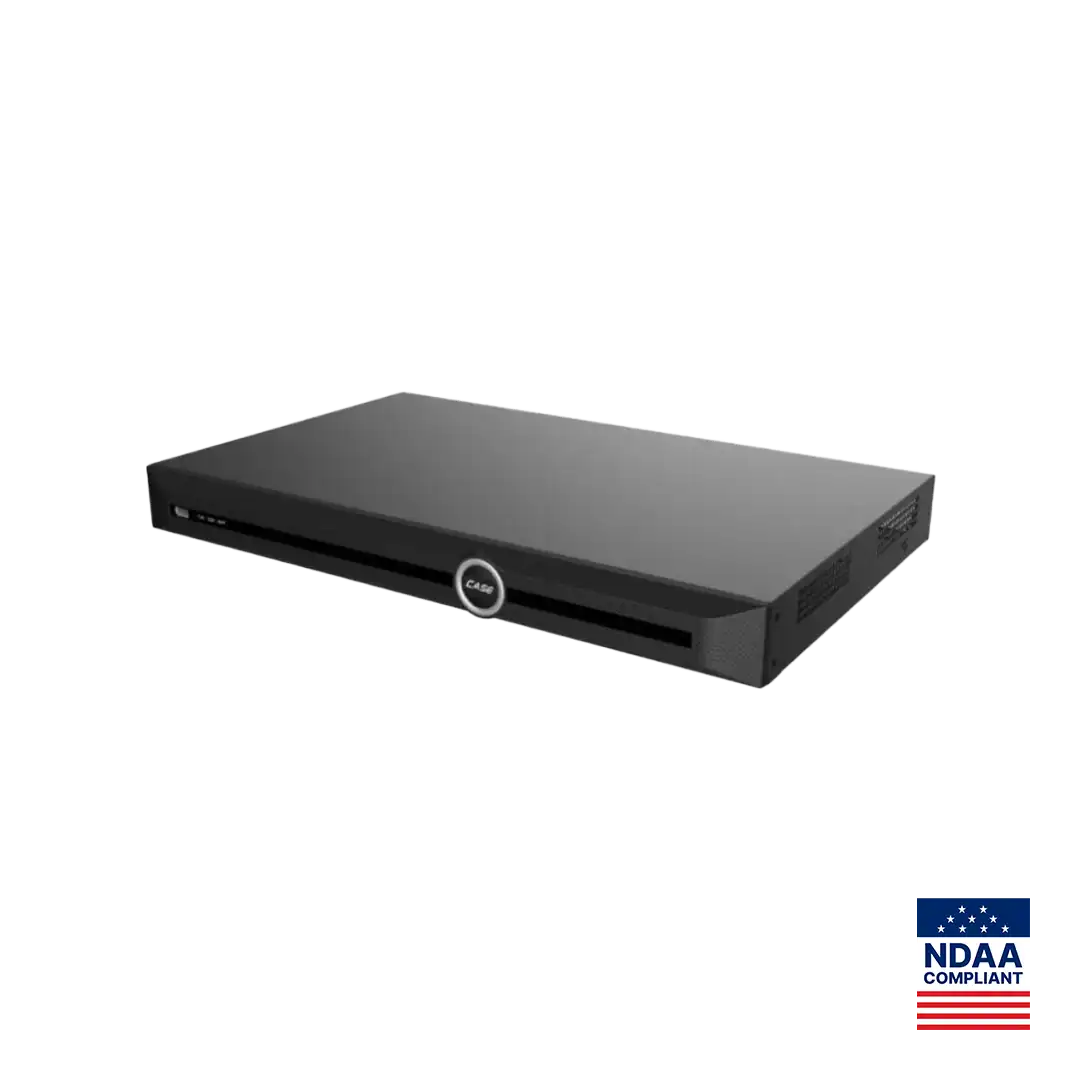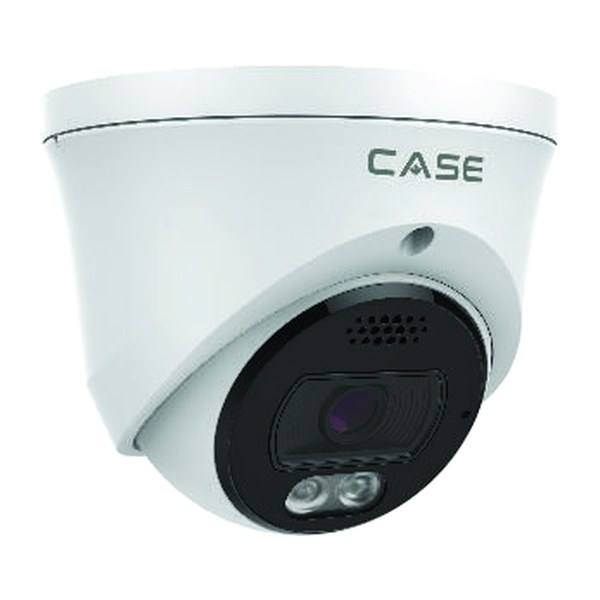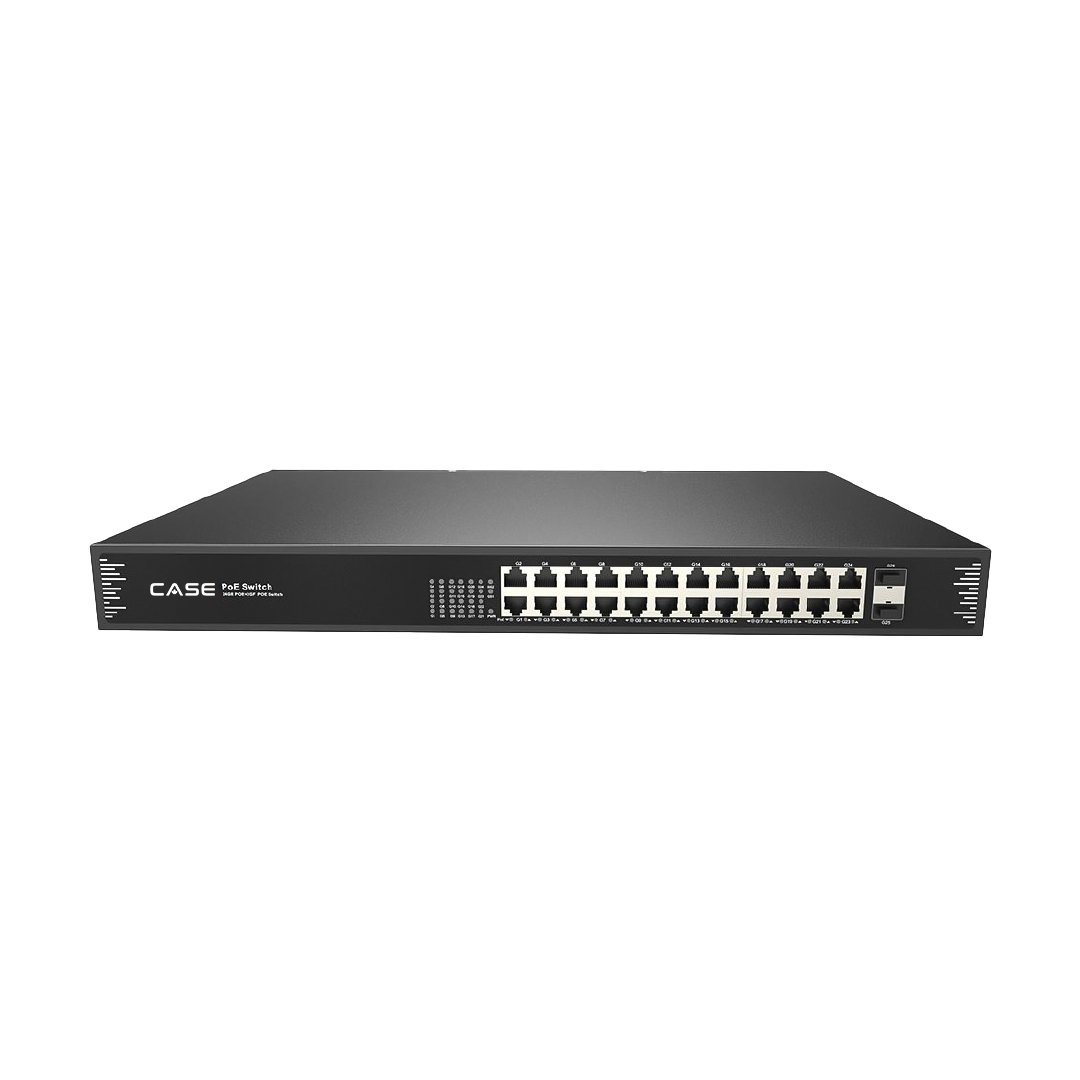



Quick answer: NDAA compliance for security cameras refers to Section 889 of the John S. McCain National Defense Authorization Act for Fiscal Year 2019 (Public Law 115-232), which bars federal agencies, their contractors and the recipients of federal grants and loans from buying or using “covered” telecommunications and video surveillance equipment produced by named companies and their subsidiaries and affiliates. The prohibition attaches to the equipment, so compliance is proven per model with documentation, not per brand with a logo. CASE offers NDAA-compliant options for compliance-sensitive projects. Anabon confirms the exact products and provides the official compliance documentation for each project.
Section 889 in plain English
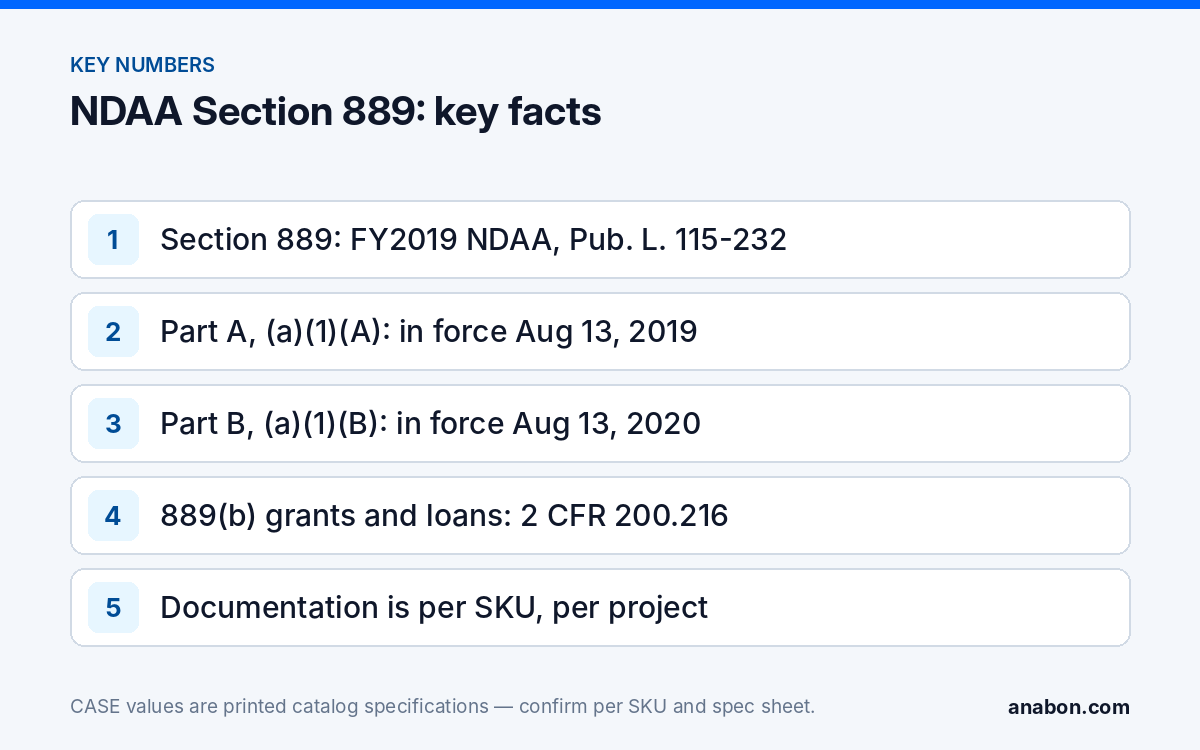
Section 889 was signed into law on August 13, 2018, and came into force in two stages. It defines covered telecommunications equipment or services as telecommunications equipment from two named companies and video surveillance and telecommunications equipment from three further named companies, together with their subsidiaries and affiliates, where the video surveillance equipment serves public safety, security of government facilities, physical security surveillance of critical infrastructure or other national security purposes. The named companies are listed in the statute text, linked from the Wikipedia article in the references. Three parts matter to an installer:
| Provision | What it prohibits | In force | Who it binds | What it means on your job |
|---|---|---|---|---|
| Part A, §889(a)(1)(A) | Federal agencies procuring, obtaining, extending or renewing a contract for equipment, systems or services that use covered equipment as a substantial or essential component or as critical technology | August 13, 2019 | Federal agencies and, through the FAR, every contractor and subcontractor selling to them | What you sell on a federal job must be free of covered equipment, and you certify it (FAR 52.204-24 / 52.204-26) |
| Part B, §889(a)(1)(B) | Federal agencies contracting with an entity that itself uses covered equipment or services, whether or not that use is for the federal work | August 13, 2020 | Any company holding a federal contract | Your own office cameras and network gear are in scope; the certification uses a reasonable-inquiry standard |
| §889(b), grants and loans | Spending federal grant or loan funds on covered equipment or services | August 13, 2020 (2 CFR 200.216) | Grant and loan recipients: schools, transit agencies, municipalities, utilities, hospitals | The buyer must show the purchase is an allowable cost; they will ask you for the documentation |
The contract clauses are FAR 52.204-24 (the representation you make on each offer), 52.204-25 (the prohibition flowed into the contract) and 52.204-26 (the annual representation in the federal contractor registration system). A wrong representation is the contractor’s liability under federal false-statement rules, which is why this is a documentation problem, not a marketing problem. In the US, the separate FCC Covered List under the Secure and Trusted Communications Networks Act restricts equipment authorizations for covered equipment and has been tightening toward components; treat it as a second list to check. Canadian procurement requirements are applied case by case (see below).
Who must comply: federal, grant-funded and state rules
The statute binds three groups; the installer meets all three through the buyer’s paperwork.
- Federal agencies and their contractors. A federal building, a base, a port facility or a courthouse, plus every prime and subcontractor on it; the general contractor’s FAR representation depends on your equipment list.
- Holders of federal contracts, for their own use (Part B). A logistics company, a university or a hospital that holds any federal contract must not use covered equipment in its own systems, even at a site with no federal work; their facility managers now ask for documentation on ordinary replacement cameras.
- Recipients of federal grants and loans. School safety grants, transit security grants, port and airport grants, rural utility loans. The funding condition travels with the money through 2 CFR 200.216, and the grant officer, not the end user, decides whether your submittal is an allowable cost.
Beyond the federal statute, a growing number of US states have adopted their own restrictions on covered equipment for state agencies and local governments, and defense suppliers under CMMC assessments are asked for physical-security supply-chain records as evidence. In Canada there is no single statute mirroring Section 889; federal and provincial buyers set supply-chain security requirements case by case in the tender, and a Canadian integrator bidding on a US federally funded site faces Section 889 exactly like a US firm. In both countries, read the RFP’s compliance section and the funding announcement before you quote a single camera. Our guide to reading a video surveillance RFP shows where that language hides.
Why brand-level claims do not survive a review
A badge that says “NDAA compliant” on a website or a catalog cover is a statement about a brand. Section 889 is written about equipment: a specific model, its components and the companies that produced it, including subsidiaries and affiliates. Four things follow.
- The reviewer matches models, not brands. The camera schedule on your submittal lists SKUs, and the compliance letter must name those same SKUs in the same spelling. CS-I8WS S-2.8mm and CS-I8WS SD-2.8mm are different products with different spec sheets; a letter for one is not evidence for the other.
- Components and relationships are in scope. The definition reaches subsidiaries, affiliates and equipment that uses covered components as a substantial or essential part. White-label and OEM arrangements are exactly what a procurement officer is trained to probe, and the FCC’s component-level direction makes that probe sharper every year.
- Portfolios are mixed. A brand can carry documented models alongside models with no documentation. “The brand is compliant” says nothing about the unit on the drawing.
- The certification is yours. FAR 52.204-24 is signed by the offeror. When the reviewer asks what your representation rests on, “the vendor’s website says so” is not an answer; a dated, model-specific document is.
This is why Anabon does not describe the whole CASE line as compliant and confirms the exact SKUs for each project instead. Product documentation is supplied per SKU. For any project with origin, NDAA, or other compliance requirements, Anabon provides the official per-SKU documentation and project-specific confirmation — the document is the answer, so your bid survives a procurement review.
What a per-SKU documentation pack contains
Build the pack while you build the camera schedule and bill of materials, so both use identical SKU spellings and quantities. A complete pack holds:
- The compliance statement for each SKU on the schedule, naming the exact model and, where issued that way, the hardware or firmware version; cameras, NVRs, PoE switches and injectors alike, because network equipment is reviewed under Section 889 too.
- The spec sheet for each SKU, with the same spelling as the schedule (for example CS-N220 P16H-AI, not a shortened form).
- Your own FAR 52.204-24 representation and, for a prime, the 52.204-26 record, with a note of what each rests on.
- For grant-funded work, the page of the funding announcement or grant agreement that carries the 889 / 200.216 condition, so the reviewer sees you read it.
- A separate TAA statement where the buy runs through a GSA Schedule or the RFP asks for it; TAA is a different rule with its own document.
- A check of the FCC Covered List for every model on the schedule, dated.
- A cover sheet that maps each schedule line to its documents, with the project name and date; keep the pack with the submittal and again in the O&M manual at handover.
Confirm every project-level claim at quote, proposal and bid stage, not after award; a gap discovered at submittal review with equipment already ordered is the worst moment to find it.
How Anabon supports compliance-sensitive bids
Anabon Security Inc. is a North American B2B distributor of CASE and other professional security brands, and compliance documentation support is part of what the channel receives. Send the SKU list from your camera schedule with the project name, the buyer type (federal contract, grant-funded, state or provincial body) and the submittal deadline. Anabon confirms which exact products are documented for that requirement, proposes a documented alternative where a line item is not, and supplies the official compliance documentation for each project. When NDAA documentation is required, please ask Anabon for the approved compliance package for the relevant product or project.
Two boundaries keep the pack credible. First, Anabon makes no statement about where products are made, in any direction; the per-SKU document carries whatever the reviewer needs to see. Second, the confirmation is project-specific and dated, because requirements, lists and firmware move. Anabon never deals with your end customer: the pack goes to you, your company’s name is on the submittal and the relationship stays yours. If a compliance section is making you pass on a bid, bring it to us first through bid opportunities; how the support works is covered in Who is Anabon.
What to tell your customer
“Section 889 applies to the equipment, not to a brand name, so we document every model on your drawing individually. Our submittal will include a compliance statement and spec sheet for each camera, recorder and switch, matched line by line to the schedule, plus the certification our company signs. If your funding or contract carries additional requirements, give us the clause and we will document against it before we order anything.”
FAQ
Is NDAA compliant the same as TAA compliant?
No. Section 889 of the NDAA restricts covered telecommunications and video surveillance equipment from named companies and their subsidiaries and affiliates. The Trade Agreements Act is a separate rule about where a product is produced or substantially transformed, applied mainly to GSA Schedule and certain federal buys. Each is answered with its own per-SKU document; one letter does not cover the other.
Does Section 889 apply to a private business with no government contracts?
Not directly. The statute binds federal agencies, their contractors and the recipients of federal grants and loans. A private warehouse or retailer is not covered by Section 889 unless it holds a federal contract, in which case Part B restricts the equipment the business itself uses, even on sites unrelated to the contract. Separate state laws may still apply to public bodies in that state.
My customer is a school district or transit agency spending a federal grant. Does 889 apply?
Yes, through Section 889(b), implemented in 2 CFR 200.216. Federal grant and loan funds may not be used to buy covered equipment or services, and the grant agreement usually repeats that condition. The recipient is responsible for allowable costs, so expect them to ask you for per-SKU documentation before they release the purchase order. Read the funding announcement with the RFP.
Does Section 889 apply in Canada?
Section 889 is a United States federal statute. A Canadian integrator bidding on a US federally funded site faces it exactly like a US contractor, because it attaches to the equipment and the funds. Inside Canada there is no mirror statute; federal and provincial buyers apply supply-chain security requirements case by case in the tender documents, so read each RFP and verify with the procurement authority.
Are all CASE products NDAA compliant?
We do not make a blanket statement, and you should not repeat one. CASE offers NDAA-compliant options for compliance-sensitive projects. Anabon confirms the exact products and provides the official compliance documentation for each project. Send the SKU list from your camera schedule, and the pack that comes back names the exact models the reviewer will see on your submittal.
References
- National Defense Authorization Act for Fiscal Year 2019 — Wikipedia
- Issue: Section 889 Compliance — Security Industry Association (SIA)
- What NDAA Section 889 Really Means for Federal Grants — Security Industry Association (SIA)
- NDAA Section 889 Update: Grant Funding for Equipment Replacement — Security Industry Association (SIA)
- Federal Acquisition Regulation — Wikipedia
- Trade Agreements Act of 1979 — Wikipedia