


Quick answer: TAA and NDAA are two different tests on the same federal paperwork. The Trade Agreements Act (TAA) asks where a product was produced or last substantially transformed; it applies to federal acquisitions above a value threshold and to every item on a GSA Schedule contract. Section 889 of the FY2019 NDAA asks who produced the equipment and bans products of named companies, their subsidiaries and affiliates, on federal contracts and federally funded purchases. A project can require one, the other or both, and each is answered with its own per-SKU document, never a brand-level statement. Not legal advice; verify clause text and thresholds with counsel.
What does TAA require, in one paragraph?
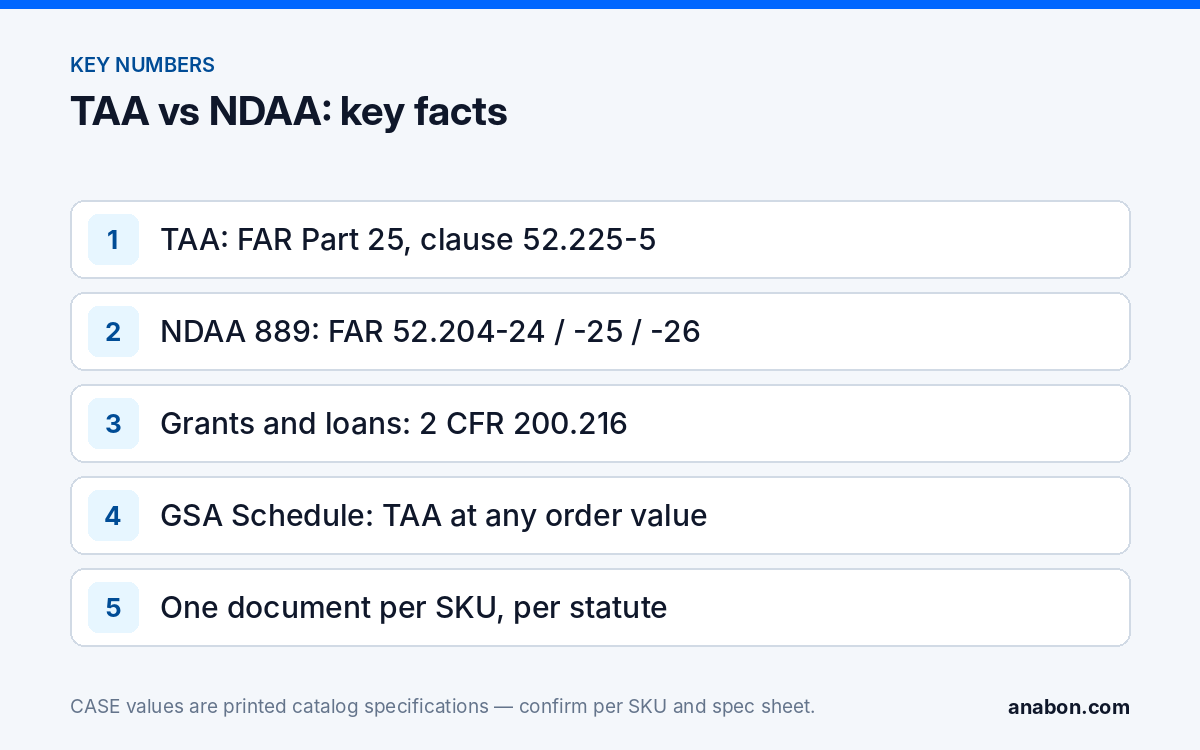
The Trade Agreements Act of 1979 lets the US government open its purchasing to trading partners under the WTO Agreement on Government Procurement and the US free trade agreements. Its working rule sits in FAR Part 25, subpart 25.4, and the clause you will see in a solicitation is FAR 52.225-5, Trade Agreements, with the certificate at FAR 52.225-6. When the clause applies, the agency may accept only US-made or designated country end products: an item wholly produced in, or last substantially transformed in, the United States or a designated country (the WTO GPA parties, free-trade-agreement partners, least developed countries and Caribbean Basin countries listed in FAR 25.003). The test is applied item by item to the product in its final form, and it is a question of origin, not of ownership. The clause triggers at an acquisition value that the FAR adjusts every two years, so read the current figure in FAR 25.402. And a GSA Multiple Award Schedule contract carries the Trade Agreements clause for every product on the Schedule, whatever the value of the individual order, which is why GSA Schedule cameras and TAA compliant cameras are in practice the same question.
What does NDAA Section 889 require, in one paragraph?
Section 889 of the John S. McCain National Defense Authorization Act for Fiscal Year 2019 (Public Law 115-232) prohibits federal agencies from procuring, and federal contractors from using, covered telecommunications equipment or services: telecommunications and video surveillance equipment produced by companies named in the statute, together with their subsidiaries and affiliates. Part A (in force August 13, 2019) covers what the government buys and what you deliver on a federal contract. Part B (August 13, 2020) covers what a federal contractor itself uses, even on sites unrelated to the contract. Section 889(b), implemented through 2 CFR 200.216, bars federal grant and loan funds from buying covered equipment, which is how a school district, a transit agency or a hospital ends up asking you for documents. The clauses are FAR 52.204-24 (the offer-level representation), 52.204-25 (the prohibition) and 52.204-26 (the annual representation in SAM); check the current clause text. Section 889 is about who produced the equipment; it says nothing about where. The FCC Covered List adds a separate equipment-authorization layer, covered in FCC Covered List and the 2026 component rule; the full statute walk-through is in What is NDAA compliance for security cameras?
Why are TAA and NDAA not the same checkbox?
The two certifications sit in different FAR subparts because they test different facts.
| Item | TAA | NDAA Section 889 |
|---|---|---|
| Question it answers | Where was the end product produced or last substantially transformed? | Who produced it, and is that company, or a parent, subsidiary or affiliate, named in the statute? |
| Legal source | Trade Agreements Act of 1979; FAR Part 25 | FY2019 NDAA Section 889; FAR subpart 4.21; 2 CFR 200.216 |
| Clauses in the solicitation | FAR 52.225-5 and 52.225-6 | FAR 52.204-24, 52.204-25 and 52.204-26 |
| Trigger | Federal acquisitions above the FAR 25.402 threshold; every item on a GSA Schedule | Any federal contract (Parts A and B); any purchase with federal grant or loan funds |
| Unit of proof | The end product, item by item | The equipment, item by item, plus its producer’s corporate tree |
| Who certifies | The offeror, usually the Schedule holder or the prime | The offeror; 52.204-25 flows down to subcontracts, and the grant recipient answers for funded purchases |
| What the per-SKU document shows | The origin determination for that exact SKU | That the exact SKU is not covered equipment and its producer is not a named company or affiliate |
| Can one letter cover both? | No | No |
A product can pass one test and fail the other in either direction, because one looks at the place of transformation and the other at the producer’s corporate tree. The reviewer will not infer one answer from the other, so neither should your submittal.
Which projects need TAA, NDAA or both?
Decide by funding source and contract vehicle, not by the customer’s industry: a hospital spending its own money and one spending a federal grant are two different rows.
| Project type | TAA | NDAA Section 889 | Note |
|---|---|---|---|
| Federal agency purchase above the FAR 25.402 threshold | Yes | Yes | Both clause sets appear in the solicitation |
| Federal agency purchase below the threshold | Usually no | Yes | The Buy American Act evaluation preference (FAR 25.1) may apply instead; read the clauses |
| Order under a GSA Schedule, any value | Yes | Yes | TAA is a condition of the Schedule contract itself |
| Federal grant or loan funds (schools, transit, hospitals, municipalities, utilities) | Not by the statute itself | Yes (2 CFR 200.216) | The recipient’s own procurement rules and any domestic-preference condition in the award (2 CFR 200.322) still apply; verify the award terms |
| A federal contractor’s own facility | No | Yes (Part B) | Applies to the contractor’s cameras and network gear even with no federal money in the job |
| State or local government, no federal funds | No | Not directly | Several states have their own restrictions that mirror the federal list; check the state procurement code |
| Private commercial site | No | No | The customer may require either by policy (corporate standard, insurer, landlord); treat it like a contract requirement |
| Canadian public sector | No (US statute) | No (US statute) | Canadian federal and provincial tenders apply their own trade-agreement obligations and supply-chain security requirements case by case; read the tender. A Canadian integrator on a US federally funded site follows the US rows |
How do you read the RFP for the right clause?
Specification writers often type “TAA/NDAA compliant” in Division 28 without saying which statute binds the owner. The clauses in Division 00 or the funding reference tell you:
- Search for “52.225”. A hit on 52.225-5 or 52.225-6 means TAA applies to the end products you deliver.
- Search for “52.204-24”, “52.204-25”, “52.204-26” or “889”. Any hit means Section 889 applies and you certify on your offer.
- Search for “2 CFR 200”, “200.216” or a federal award number. A hit means the buyer is spending federal grant or loan money and must show the purchase is an allowable cost.
- Check whether the order will be placed under a GSA Schedule or another federal contract vehicle. If yes, TAA applies at any value.
- If the specification says “TAA compliant” with no clause anywhere, ask the consultant in writing which statute the owner is bound by. Do not answer a TAA question with an NDAA letter.
- Record the answer for each line of your camera schedule and bill of materials, including switches, injectors and the NVR; reviewers check network equipment as closely as cameras.
In Canada, read the tender’s trade-agreement section and any supply-chain security annex, then put the same written question to the procurement authority; we know of no Canadian mirror of Section 889; verify with counsel.
What does per-SKU documentation look like for each?
A document that survives a procurement review names the exact SKU in the spelling on your submittal, states the specific fact the clause asks for, is dated, and comes from a party that can stand behind it. A TAA document states the origin determination for that SKU. An NDAA document states that the SKU is not covered telecommunications equipment under Section 889 and that its producer is not a named company, subsidiary or affiliate. Each is issued per SKU: a letter for CS-I8XQ II-2.8mm does not cover CS-I8XQ I-2.8mm, and a letter for the cameras does not cover the CS-POE33024PF switch they plug into. Include every powered device on the drawing.
CASE offers NDAA-compliant options for compliance-sensitive projects. Anabon confirms the exact products and provides the official compliance documentation for each project. Product documentation is supplied per SKU. For any project with origin, NDAA, or other compliance requirements, Anabon provides the official per-SKU documentation and project-specific confirmation: the document is the answer, so your bid survives a procurement review. TAA status is confirmed by SKU, spec sheet and region. Where a document exists for a SKU, it is supplied; where it does not, we say so, and you specify a SKU that carries it. Nothing is stated as universal, and nothing is denied where it is documented. What to request before a bid is listed in The NDAA documentation pack.
What to tell your customer
“TAA and NDAA are two different tests. TAA is about where each product was produced or transformed; NDAA Section 889 is about who produced it. Your project is bound by [the clause we found], so we are submitting a separate document for each model, in the exact model spelling. Procurement reviewers do not accept brand-level statements, so we do not use them.”
FAQ
Is TAA compliant the same as NDAA compliant?
No. TAA is an origin test applied to the end product under FAR Part 25: was it produced or last substantially transformed in the United States or a designated country? NDAA Section 889 is a producer test: is the equipment from a named company, subsidiary or affiliate? A product can pass one and fail the other, and each needs its own per-SKU document.
Does a GSA Schedule order also need NDAA documentation?
Yes. The Schedule contract carries the Trade Agreements clause, so every product offered must meet TAA at any order value, and the Schedule holder also makes the Section 889 representations under FAR 52.204-24 and 52.204-26. The ordering agency may ask for both documents on the camera schedule, so prepare the NDAA letter per SKU alongside the TAA determination.
My customer is spending a federal grant. Do they need TAA?
Not from the Trade Agreements Act itself, which governs federal agency acquisitions. A grant recipient is bound by 2 CFR 200.216, which bars covered equipment under Section 889, and by its own procurement rules plus any domestic-preference condition written into the award under 2 CFR 200.322. Read the award terms and verify with the grant administrator before you answer.
Does TAA or NDAA apply in Canada?
Both are United States statutes, so they do not bind a Canadian public buyer spending Canadian funds. Canadian federal and provincial tenders carry their own trade-agreement obligations and supply-chain security requirements, applied case by case in the tender documents. A Canadian integrator on US federal work follows the same rows as a US contractor: Section 889 on federal contracts and federally funded purchases, and TAA where the federal acquisition clause applies.
Are CASE cameras TAA compliant?
TAA status is confirmed by SKU, spec sheet and region, not by brand. Anabon supplies the official per-SKU documentation where it exists, together with project-specific confirmation, and tells you plainly when a SKU does not carry it so you can specify one that does. We do not make a blanket statement in either direction, because that is exactly what a procurement reviewer rejects.