


Quick answer: The FCC Covered List names communications equipment and services judged to pose an unacceptable national-security risk; covered equipment may not receive new FCC equipment authorization in the US, the approval a device needs before it can be imported or marketed. In its Third Report and Order (FCC 26-50, adopted July 22, 2026, published in the Federal Register on September 11, 2026) the FCC extended that prohibition to devices containing Covered List logic-bearing components; the rule took effect on October 13, 2026, and online marketplaces must display FCC IDs from 2027. For an installer the change is that the brand on the label settles nothing: the answer is dated per-SKU documentation covering both Section 889 and equipment authorization status. This article reflects the status as of October 20, 2026 and is not legal advice.
What is the FCC Covered List, and how is it different from Section 889?
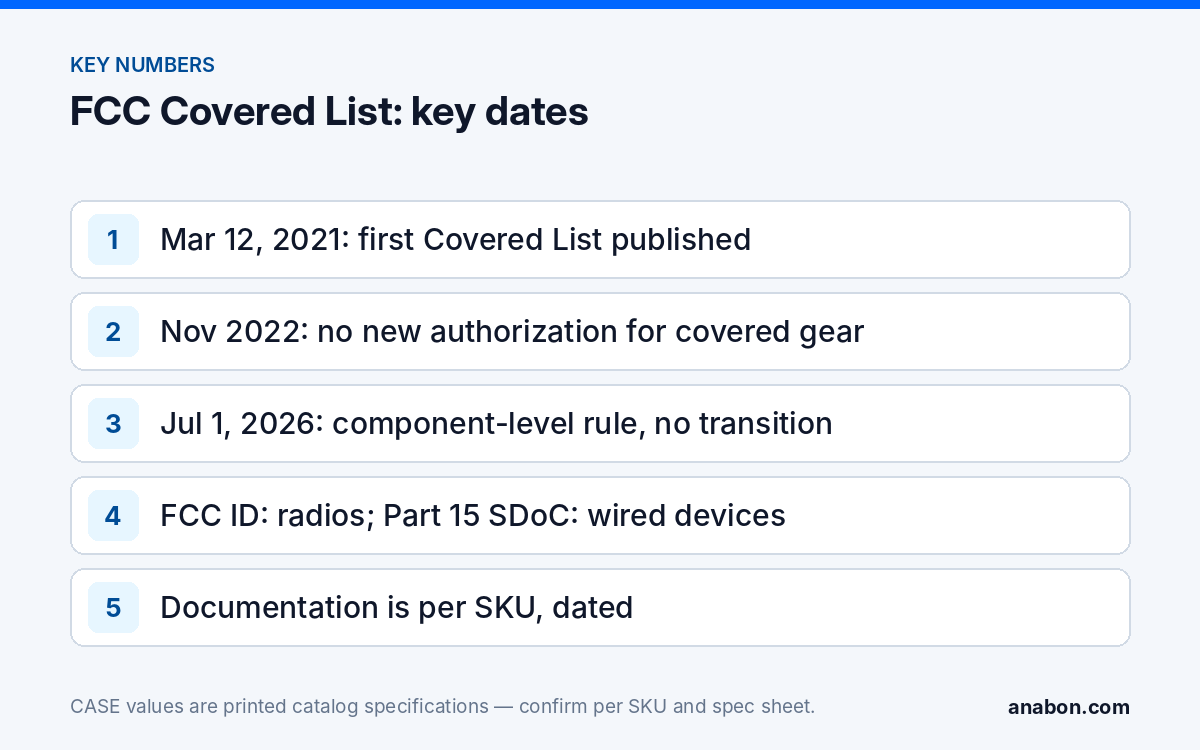
The Covered List was created under the Secure and Trusted Communications Networks Act of 2019, signed in March 2020, which directed the FCC to publish and maintain a list of communications equipment and services judged to pose an unacceptable risk to national security. The first list appeared on March 12, 2021 and has been expanded since. The Secure Equipment Act of 2021, signed in November 2021, directed the FCC to stop granting equipment authorizations for anything on that list, and the FCC’s November 2022 Report and Order did so: no new authorizations for covered equipment, including video surveillance equipment from the named entities.
Installers meet two rules that are often spoken of as one. Section 889 of the FY2019 National Defense Authorization Act governs what federal agencies, their contractors and federal grant recipients may buy and use (see NDAA compliance for security cameras). The Covered List, through the equipment authorization rules, governs whether a device may be imported and marketed in the US at all, for any buyer. In Canada we know of no equivalent list (verify with counsel); radio equipment certification runs through ISED (Innovation, Science and Economic Development Canada), and supply-chain restrictions have come through procurement decisions case by case, so read each tender.
| Rule | Who it binds | What it restricts | Where an installer meets it |
|---|---|---|---|
| Section 889, FY2019 NDAA (US) | Federal agencies, their contractors, federal grant and loan recipients | Buying or using covered telecommunications and video surveillance equipment | The compliance clause of the RFP; your FAR 52.204-24 representation |
| FCC Covered List and equipment authorization (US) | Anyone importing or marketing the equipment in the US | New FCC authorization for covered equipment and, from October 13, 2026, for devices containing covered components | Whether a model can lawfully be sold to you; the FCC ID or Part 15 declaration on the datasheet |
| Canadian procurement requirements (CA) | Federal and provincial buyers, case by case | Set in the tender; no statutory list | The security and supply-chain clauses of the tender |
What did the 2026 component order change?
Until 2026 the prohibition attached to equipment produced by the entities on the list. On July 22, 2026 the FCC adopted a Third Report and Order in its equipment authorization proceeding (ET Docket No. 21-232, FCC 26-50), released it on July 23 and published it in the Federal Register on September 11, 2026. It made four changes installers should know:
- Component level. A device that contains Covered List logic-bearing components or modules is treated as covered for authorization purposes, even when the brand on the label is not listed. The question moved from “who sells this camera” to “what is inside it”.
- Effective date. The component-level prohibition took effect on October 13, 2026 for new authorizations; applications already pending on that date were exempt unless later amended to change a logic-bearing component.
- FCC ID display. Online marketplaces must display a valid FCC ID for certified devices they list: from March 1, 2027 where the marketplace has physical access to or title over the device, and from June 1, 2027 where it relies on seller certification.
- No retroactive revocation in this order. Previously authorized equipment may continue to be marketed, imported and used under its existing authorization; a streamlined revocation process was only proposed for comment in the accompanying Further Notice.
| Date | Event | What it meant for installers |
|---|---|---|
| August 13, 2018 | FY2019 NDAA signed; Section 889 enacted | Federal procurement and grant restrictions, in force 2019 and 2020 |
| March 12, 2020 | Secure and Trusted Communications Networks Act signed | FCC directed to publish the Covered List |
| March 12, 2021 | First Covered List published | Named entities’ equipment flagged as a national-security risk |
| November 11, 2021 | Secure Equipment Act signed | FCC directed to stop authorizing covered equipment |
| November 2022 | FCC Report and Order on equipment authorization | No new authorizations for covered equipment, including video surveillance equipment from named entities |
| July 22, 2026 (adopted); October 13, 2026 (effective) | FCC Third Report and Order | Component-level scope from October 13, 2026; FCC ID display by online marketplaces from March 1 / June 1, 2027; no retroactive revocation |
The practical consequence lands on white-label and relabeled products. A camera or recorder sold under a brand that has never appeared on the list can still contain a module or logic-bearing component that does, and that is now the regulator’s question. A datasheet does not print component sourcing; only a per-SKU statement from the brand or its distribution channel answers it.
What should installers check on a datasheet and on the device?
Work through this list for every SKU on a compliance-sensitive job:
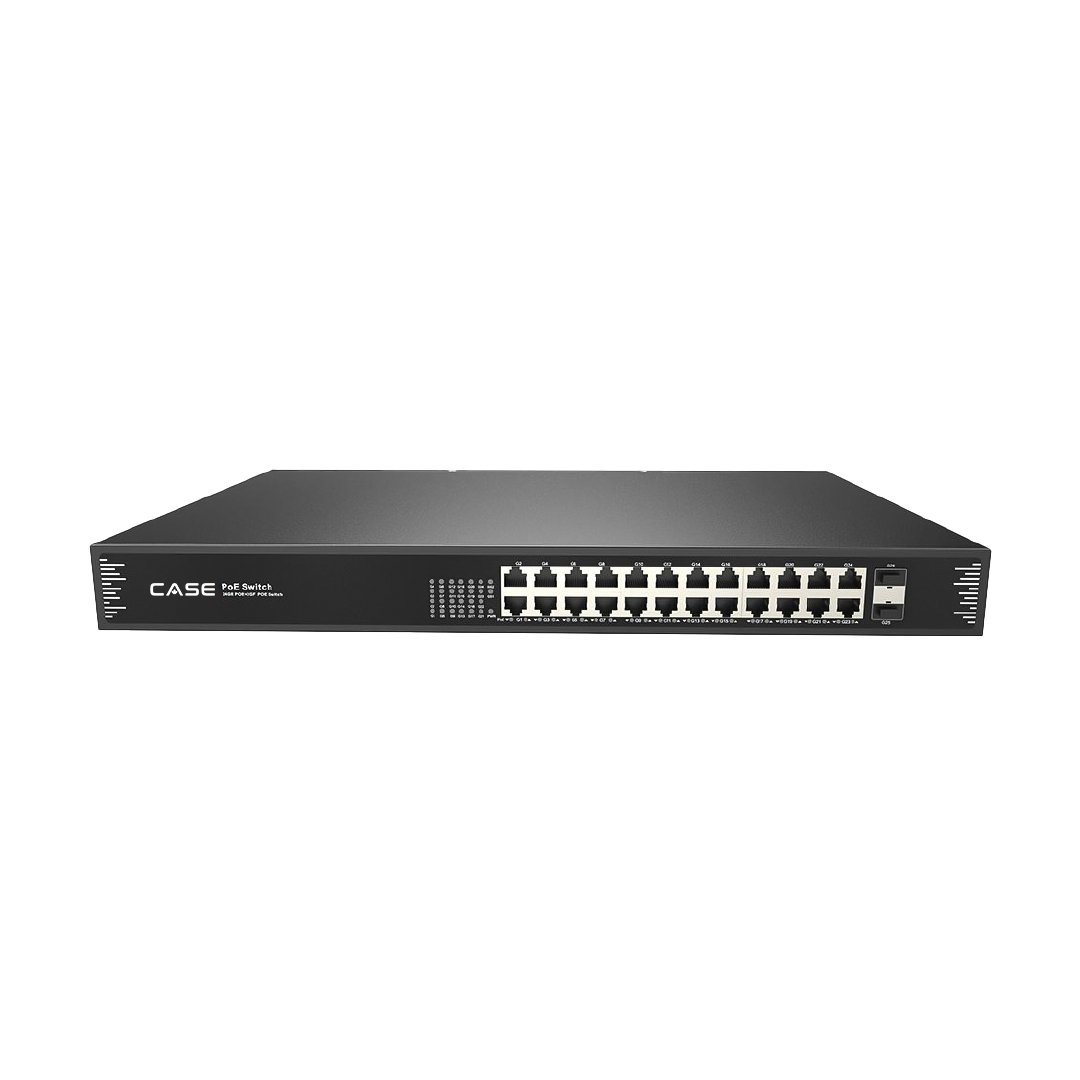
- Which authorization route the device uses. Devices with a radio (Wi-Fi, cellular, Bluetooth) need FCC certification and carry an FCC ID. Most wired digital devices, including a PoE camera with no radio, use the Supplier’s Declaration of Conformity under Part 15 and carry a compliance statement instead, so a missing FCC ID on a wired camera is not a warning sign by itself. For example, the CS-POE33024PF PoE switch prints “FCC Part 15 Class B” among the marks in its certifications row; Part 15 Class B is the stricter of the two digital-device emission limits (in Canada: ICES-003), and it says nothing either way about the Covered List.
- The exact model and hardware version. Authorizations and declarations are issued per model and variant. Match the full SKU spelling on the datasheet, the label and your schedule (CS-N220 P16H-AI, not a shortened form).
- Radio modules. A camera with Wi-Fi or cellular contains a module with its own FCC ID; since the 2026 order, that module is exactly the kind of component a reviewer asks about.
- Brand versus producer. The label brand is not evidence of what is inside; where a product is relabeled, ask for a component-level statement.
- Firmware version. Read it from the device’s system information page; compliance statements are issued against versions.
- A dated check. Record when you checked the Covered List and the authorization record; both change, and a reviewer wants to see when you looked.
If the datasheet raises a question it cannot answer, do not answer it from memory. Product documentation is supplied per SKU. For any project with origin, NDAA, or other compliance requirements, Anabon provides the official per-SKU documentation and project-specific confirmation — the document is the answer, so your bid survives a procurement review.
What is the documentation posture for bids?
The 2026 order did not change how a bid is won on compliance; it raised the standard of evidence. Reviewers ask three questions, and each has a document:
| Question the reviewer asks | Document that answers it | Who provides it |
|---|---|---|
| Is this model, by its exact SKU, outside Section 889’s definition of covered equipment? | Per-SKU Section 889 compliance statement, dated, naming the model and version | The brand or its distribution channel, through Anabon |
| Does the device hold valid FCC equipment authorization, and does the 2026 component-level rule affect it? | The FCC ID record or Part 15 declaration for that model, plus a per-SKU component statement where the RFP asks for one | Datasheet and label; statement through Anabon |
| Does the bidder stand behind the equipment list? | Your FAR 52.204-24 representation (US) or the tender’s supply-chain declaration (Canada) | You, the offeror |
Build the pack SKU by SKU as described in the NDAA documentation pack, including switches, injectors and the recorder. CASE offers NDAA-compliant options for compliance-sensitive projects. Anabon confirms the exact products and provides the official compliance documentation for each project. Anabon makes no statement about where products or their components are made, in any direction; the per-SKU document carries what the reviewer needs to see. Where a tender also asks for TAA, that is a separate rule with its own document (TAA vs NDAA).
Dated note: verify the current status before you rely on this
Everything above describes the position on October 20, 2026. Four things can move after that date: the FCC can add entities or equipment to the Covered List; the revocation question left open in the 2026 Further Notice can return in a later order; enforcement guidance can define “component” more precisely; and US states can add covered-equipment rules for public bodies (in Canada: procurement guidance can change tender language without any statute changing). Before you cite any of this in a proposal, check the current list and the latest order, write the date of your check into the document, and ask counsel where a legal threshold decides the bid.
What to tell your customer
“Two separate US rules apply to camera equipment: Section 889 restricts what federal and grant-funded buyers may use, and the FCC’s equipment authorization rules decide what may be sold in the US at all. Since October 13, 2026 the FCC rule reaches the components inside a device, so we do not rely on a brand name. We document every model on your schedule individually, with the date of each check, before we order.”
FAQ
Does the 2026 order make cameras already installed on my sites illegal?
The 2026 order governs new FCC equipment authorizations and states that previously authorized equipment may continue to be marketed, imported and used under its existing authorization. Whether a federal or grant-funded buyer may continue to use particular equipment is a Section 889 question, not an authorization question. Verify both against the current rule text and with counsel before advising a customer.
A wired PoE camera on my schedule has no FCC ID. Is that a problem?
Not by itself. FCC certification with an FCC ID is required for devices with a radio. A wired digital device with no radio normally uses the Supplier’s Declaration of Conformity under Part 15 and carries a compliance statement rather than an ID. Check the datasheet for the Part 15 statement, confirm the exact model, and ask for the per-SKU documentation for the bid.
If a brand is not on the Covered List, is its camera fine under the component rule?
Not necessarily. Since the component rule took effect on October 13, 2026, a device containing Covered List logic-bearing components is treated as covered for authorization purposes regardless of the brand on the label. A datasheet does not print component sourcing, so a brand name settles nothing. Ask for a dated per-SKU statement that covers the model and version on your schedule.
Does the FCC Covered List apply to projects in Canada?
No. It is a US rule tied to FCC equipment authorization. In Canada, radio equipment certification runs through ISED, digital-device emissions follow ICES-003, and we know of no statutory Covered List (verify with counsel); supply-chain restrictions arrive through procurement decisions and tender clauses applied case by case. A Canadian integrator selling into the US must still meet the FCC rules for equipment marketed there.
What exactly should I ask Anabon for on a compliance-sensitive bid?
Send the SKU list in catalog spelling with quantities, the project name, the buyer type, the compliance clause and the submittal deadline, and say whether the RFP asks for FCC authorization details or TAA as well. Anabon confirms the exact products and provides the official compliance documentation for each project, together with a dated, project-specific written confirmation.
References
- Secure and Trusted Communications Networks Act of 2019 — Wikipedia
- Secure Equipment Act of 2021 — Wikipedia
- Title 47 CFR Part 15 — Wikipedia
- FCC mark — Wikipedia
- National Defense Authorization Act for Fiscal Year 2019 — Wikipedia
- Issue: Section 889 Compliance — Security Industry Association (SIA)
- Protecting Against National Security Threats to the Communications Supply Chain through the Equipment Authorization Program (FCC 26-50, Third Report and Order) — Federal Register, September 11, 2026
- List of Equipment and Services Covered by Section 2 of the Secure Networks Act — FCC