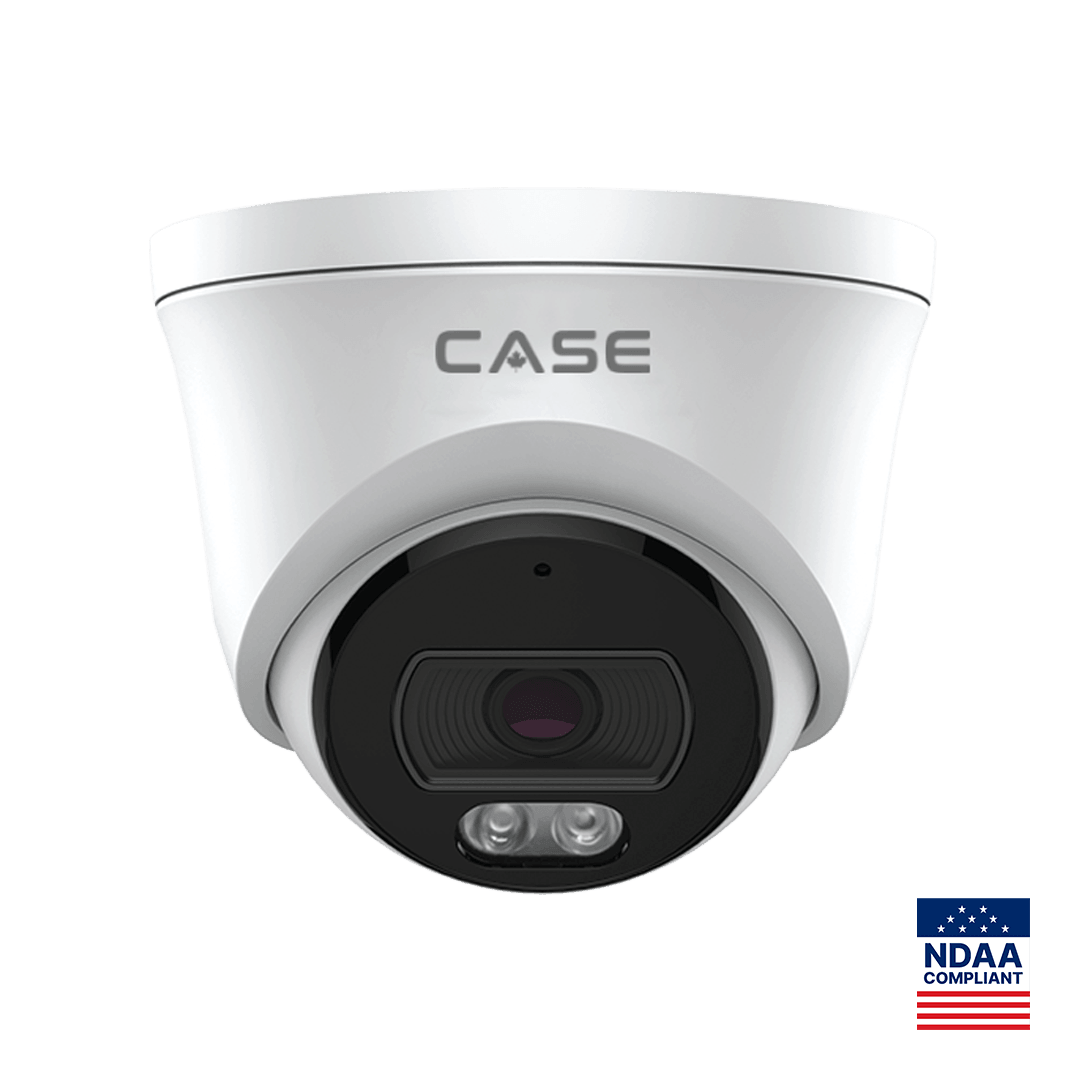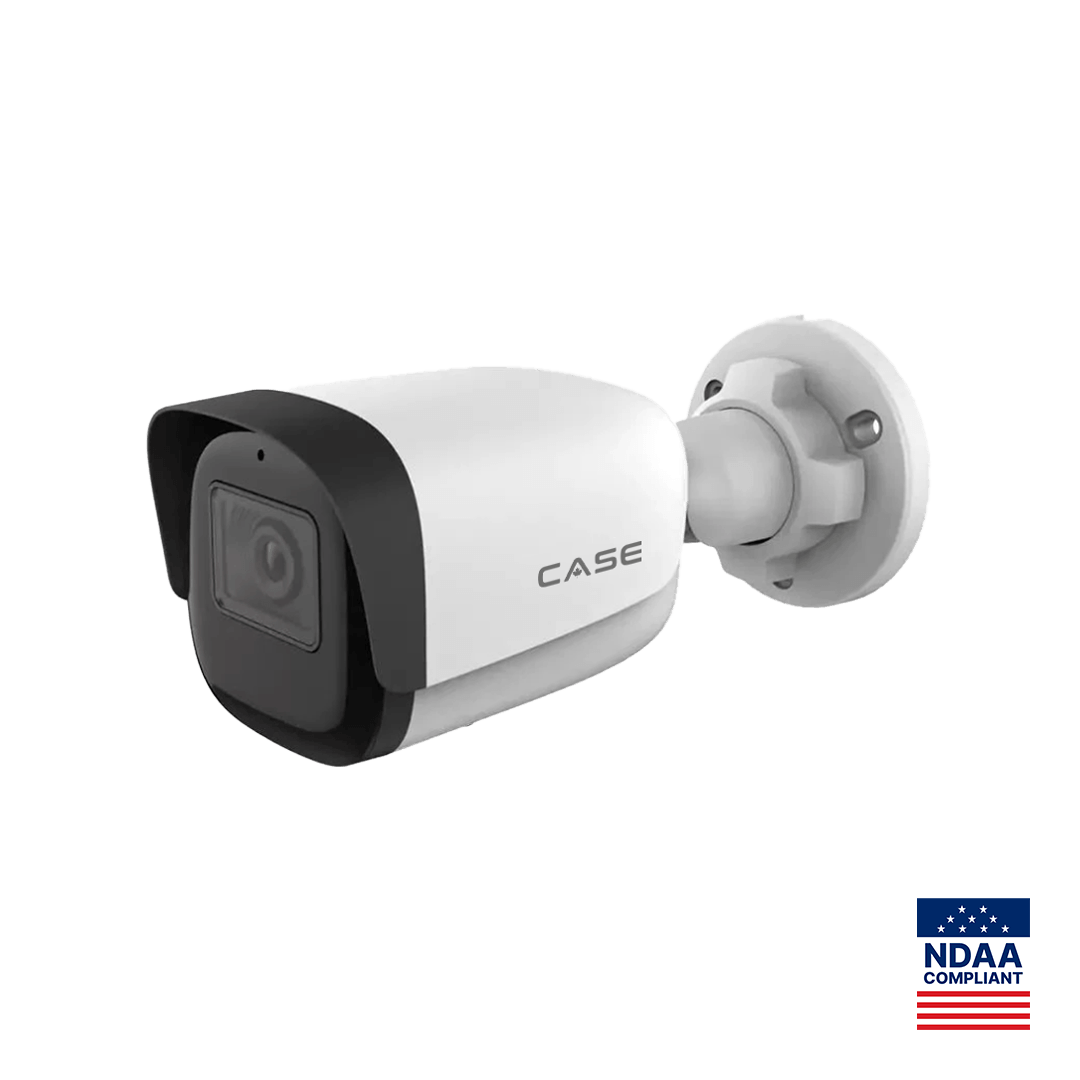


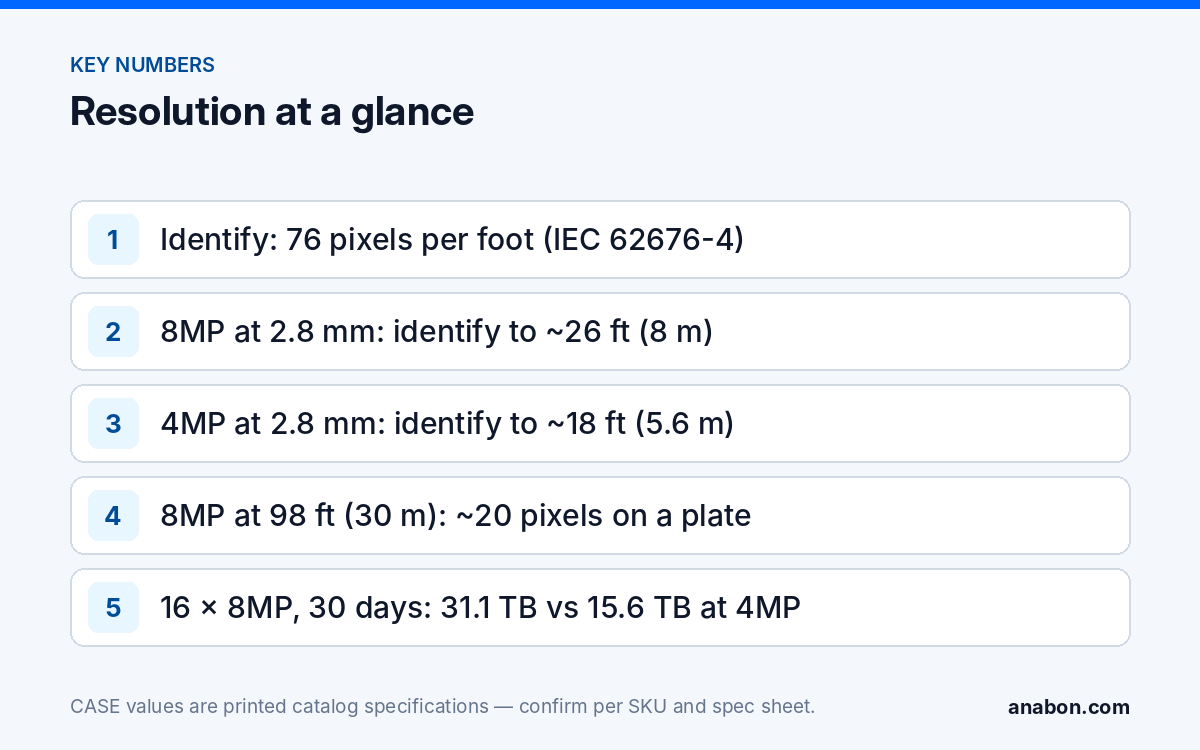
Quick answer: Resolution sets how many pixels the camera has to spread across the scene; the lens decides how wide that scene is. With a 2.8 mm lens and a common 1/2.7-inch sensor, a 4MP camera identifies a person (76 pixels per foot, IEC 62676-4) to about 17 to 18 ft (5.5 m), 5MP to about 21 ft (6.4 m) and 8MP to about 26 ft (8 m); none of them reads a plate at 98 ft (30 m), where the same 8MP camera puts about 20 pixels across a 12-inch plate. Choose 8MP for coverage and cropping room, 5MP at 30 fps for fast scenes, and put the lens choice first where identification distance is the brief.
Resolution is not detail: pixels per foot, again
A camera’s resolution is a fixed budget of pixels: 2688 × 1520 on CS-I4HS L-2.8mm, 3072 × 1728 on CS-I5XS SD-2.8mm, 3840 × 2160 on CS-I8XS SD-2.8mm and CS-I8WS S-2.8mm, as printed in their Max. Resolution rows. Detail is how many of those pixels land on the subject, measured in pixels per foot (PPF), and that depends on the scene width the lens draws at the subject’s distance:
PPF = horizontal pixels ÷ scene width (ft), where scene width = distance × sensor width ÷ focal length
Doubling the pixels does not double the identification distance. Going from 2688 to 3840 horizontal pixels adds 43 percent more pixels per foot at any distance; going from a 2.8 mm to a 4 mm lens adds the same 43 percent for nothing in storage. Resolution is the slower lever; the lens is the faster one, and the camera field of view calculator runs both.
The IEC 62676-4 levels for a person, in pixels per foot: 8 to detect, 19 to observe, 38 to recognize, 76 to identify (25, 63, 125 and 250 pixels per meter). Everything below is computed against those thresholds with a 5.4 mm sensor width assumption; the exact sensor format and horizontal angle for a CASE SKU are on its spec sheet, and the figures are design estimates, not promises about any site.
4MP vs 5MP vs 8MP: computed identification distances with a 2.8 mm lens
| Resolution (printed example) | Horizontal pixels | PPF at 20 ft (6.1 m) | Identify (76 PPF) | Recognize (38 PPF) | Observe (19 PPF) | Printed frame rate at full resolution |
|---|---|---|---|---|---|---|
| 4MP, CS-I4HS L-2.8mm | 2688 | 70 | 18 ft (5.6 m) | 37 ft (11.1 m) | 73 ft (22 m) | 25fps |
| 5MP, CS-I5XS SD-2.8mm | 3072 | 80 | 21 ft (6.4 m) | 42 ft (12.7 m) | 83 ft (25 m) | 30fps |
| 8MP, CS-I8XS SD-2.8mm and CS-I8WS S-2.8mm | 3840 | 100 | 26 ft (8.0 m) | 52 ft (15.9 m) | 104 ft (32 m) | 20fps |
| 8MP with a 4 mm lens (for comparison) | 3840 | 142 | 37 ft (11.4 m) | 75 ft (22.8 m) | 150 ft (46 m) | per SKU |
Read the rows together with the printed IR rows. CS-I4HS L-2.8mm, CS-I5XS SD-2.8mm and CS-I8XS SD-2.8mm print 98 ft (30 m) IR; CS-I8WS S-2.8mm prints 164 ft (50 m). At the far end of that IR the scene is lit and the camera observes and detects, which is what alarms and tracking need; identification stops in the first 20 to 26 ft (6 to 8 m) on every one of them. Frame rate is the row most quotes miss: the two 8MP examples print 20fps at full resolution and the 5MP prints 30fps, which matters where the subject moves between frames.
Why 8MP with a 2.8 mm lens does not read a plate at 98 ft (30 m)
At 98 ft (30 m) a 2.8 mm lens on a 5.4 mm sensor draws a scene 189 ft (58 m) wide. Spread 3840 pixels across it and you have about 20 pixels per foot: a 12-inch (30 cm) plate is covered by roughly 20 pixels in total and each character by two or three. The same sensor behind a 12 mm lens draws a 44 ft (13 m) scene at that distance and puts about 87 pixels per foot on the plate, which is why plate work is a lens, angle and shutter problem first and a megapixel problem second. Plate reading is confirmed per project with the right camera and configuration; it is never implied from a resolution figure.
Low-light trade-offs: pixel size, sensor format and the printed lux figure
More pixels on the same size of sensor means smaller pixels, and a smaller pixel gathers less light in the same exposure. That is the physics behind the installer’s rule that a 4MP camera often gives a cleaner night image than an 8MP camera of the same generation and sensor format: more detail by day, more noise by night, and the encoder spends bits on that noise. Three things keep the rule honest:
- Sensor format is on the spec sheet, not in the resolution. An 8MP camera on a larger sensor can match a 4MP camera on a smaller one. Compare pixel size only when the sensor format is known.
- The printed minimum illumination is the comparable figure. CS-I4HS L-2.8mm, CS-I5XS SD-2.8mm, CS-I8XS SD-2.8mm and CS-I8WS S-2.8mm all print 0.002 Lux; CS-I4SV S-2.8mm, a 4MP PhotonX turret with no IR and 33 ft (10 m) white light, prints 0.0001 Lux. Where night evidence in color is the brief, the lux row and the illuminator rows decide, not the megapixel count. Low-light and full-color behavior is stated per SKU on the specification sheet and should be confirmed for the site.
- Illuminators change the question. Under IR every camera here records monochrome at its full resolution within the printed IR range; the 49 ft (15 m) white light printed for CS-I5XS SD-2.8mm and CS-I8XS SD-2.8mm lights the scene for color imaging to about that distance, confirmed per SKU. The night-imaging options are compared in full color night vision explained.
Wide dynamic range is printed per SKU too: Digital WDR on CS-I4HS L-2.8mm, 120dB on the three Sharp Series examples. For a doorway with daylight behind the subject, the WDR row can matter more than resolution.
Storage and bandwidth: what 8MP costs the recorder
Resolution decisions are drive and bandwidth decisions. Using the H.265, 15 fps planning bitrates from the NVR storage calculator (3 Mbps for 4MP, 4 Mbps for 5MP, 6 Mbps for 8MP) and 10.8 GB per Mbps-day:
| Resolution | Planning bitrate, H.265 at 15 fps | GB per camera per day | 16 cameras, 30 days continuous | NVR incoming, 16 cameras (main streams) |
|---|---|---|---|---|
| 4MP | 3 Mbps | 32.4 GB | 15.6 TB | 48 Mbps |
| 5MP | 4 Mbps | 43.2 GB | 20.7 TB | 64 Mbps |
| 8MP | 6 Mbps | 64.8 GB | 31.1 TB | 96 Mbps |
Sixteen 8MP cameras need twice the drives of sixteen 4MP cameras for the same 30 days, and twice the incoming bandwidth: 96 Mbps of main streams, plus sub-streams, against the 160Mbps (AI on: 120Mbps) printed for CS-N220 P16H-AI. At 30 fps the 8MP figure rises to about 9 Mbps per camera and the same 16 cameras no longer fit with AI on. Mix resolutions: 8MP where the extra pixels buy identification distance or cropping room, 4MP or 5MP where the job is overview, and set frame rate per channel. S+265 on static scenes lowers the average bitrate; size on H.265 and treat the saving as margin.
Picking resolution by use case
| Job | What decides it | Resolution and lens | CASE example (as printed) |
|---|---|---|---|
| Entrance door, face within 20 ft (6 m) | Identify level, backlight | 5MP or 8MP at 2.8 mm; 120dB WDR | CS-I5XS SD-2.8mm: 5MP, 3072×1728@30fps, IR 98 ft (30 m), white light 49 ft (15 m), 120dB, IP67 |
| Cash point, drive-through | Frame rate and identify level together | 5MP at 30fps over 8MP at 20fps | CS-I5XS SD-2.8mm prints 30fps; CS-I8XS SD-2.8mm prints 20fps at 3840×2160 |
| Lot or yard overview with cropping room | Coverage width, post-event zoom | 8MP at 2.8 mm, accept identification only near the camera | CS-I8XS SD-2.8mm: 8MP, Metal housing, IR 98 ft (30 m), white light 49 ft (15 m) |
| Long fence line or approach, cold site | Detection and observation range, temperature | 8MP with long IR; identification by a second, longer-lens camera | CS-I8WS S-2.8mm: 8MP, IR 164 ft (50 m), IP67, −40 °F to 149 °F (−40 °C to 65 °C) |
| Dark lot, color evidence at night | Minimum illumination, no IR | 4MP PhotonX over 8MP IR | CS-I4SV S-2.8mm: 4MP, 0.0001 Lux, white light 33 ft (10 m), 2688×1520@25fps |
| High-channel-count interior overview | Channel count, storage | 4MP at 2.8 mm | CS-I4HS L-2.8mm: 4MP, 2688×1520@25fps, IR 98 ft (30 m), Digital WDR, IP66 |
Housing is printed per SKU: CS-I5XS SD-2.8mm is Metal+Plastic, CS-I8XS SD-2.8mm and CS-I8WS S-2.8mm are Metal. The housing choice is covered in bullet vs dome vs turret. CASE cameras carry a 6-year warranty.
What to tell your customer
“Resolution tells us how many pixels the camera has; the lens tells us how far those pixels reach. We have placed higher-resolution cameras where you need to identify people and where you may want to zoom into recordings later, and matched the lens so a face at the door is captured at identification quality. A camera that sees a whole parking lot cannot also read a plate at the far end; where you need that, we specify a separate camera for it.”
FAQ
Is an 8MP security camera better than a 4MP camera?
It has 43 percent more pixels per foot at any distance with the same lens, so more cropping room and a longer identification distance: about 26 ft (8 m) against 18 ft (5.6 m) at 2.8 mm on a 5.4 mm sensor. It also costs twice the storage and bandwidth at planning bitrates and often prints a lower frame rate. Better depends on the job.
How far can a 4K security camera identify a person?
With a 2.8 mm lens and a 1/2.7-inch class sensor, about 26 ft (8 m) at the IEC 62676-4 identify level of 76 pixels per foot, and about 52 ft (16 m) at the recognize level. A 4 mm lens extends those to roughly 37 ft (11 m) and 75 ft (23 m). These are computed design estimates; confirm the angle on the spec sheet.
Can an 8MP camera read license plates?
Not by resolution alone. At 98 ft (30 m) a 2.8 mm lens spreads 3840 pixels across a 189 ft (58 m) wide scene, about 20 pixels per foot, so a 12-inch plate gets roughly 20 pixels. Plate reading needs a longer lens, a shallow angle, a fast shutter and a camera configured for it, confirmed per project; it is never implied from a megapixel figure.
Is 5MP a good compromise between 4MP and 8MP?
Often. CS-I5XS SD-2.8mm prints 3072×1728@30fps, so it carries 14 percent more horizontal pixels than the 4MP example and keeps 30 frames per second, where the 8MP examples print 20fps at full resolution. At a 4 Mbps planning bitrate it sits between the two for storage. For cash points and doorways with movement it is frequently the right call.
Does higher resolution make night images worse?
On the same sensor format, smaller pixels gather less light, so an 8MP camera can show more noise at night than a 4MP camera of the same generation. Compare the printed minimum illumination rather than assuming: the four examples here all print 0.002 Lux, and CS-I4SV S-2.8mm prints 0.0001 Lux with PhotonX. Low-light behavior is confirmed per SKU on the specification sheet.