

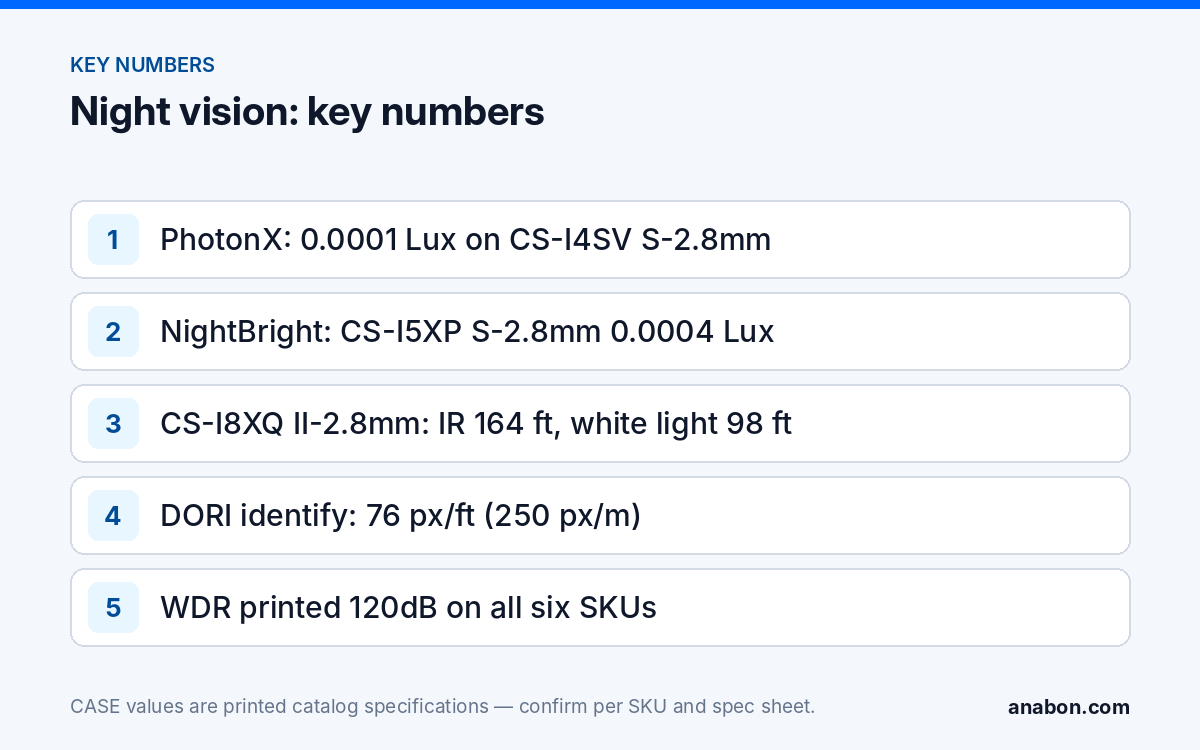
Quick answer: A camera produces night footage four ways: infrared (sharp but monochrome), white light (color, but the site is lit), a low-light sensor and lens that keep color from ambient light (CASE PhotonX, printed at 0.0001 Lux on CS-I4SV S-2.8mm and CS-I4UV S-4mm; NightBright on CS-I5XP S-2.8mm at 0.0004 Lux), and WDR, which decides whether headlights wreck the frame. Spec by the evidence the customer needs at the subject distance, not by the smallest lux figure on the sheet, and confirm it with a demo on site.
Why “lux rating” is the wrong first question
Every spec sheet prints a minimum illumination figure, and installers compare them as if they were a standard. They are not. The figure is a manufacturer measurement at the sensor under its own conditions: lens aperture, gain, shutter speed and acceptable noise. No shared test method exists across brands, and the easiest way to reach a small lux number is a slow shutter, which turns a walking person into a smear.
The useful question is evidence. At the real light level of the site, at the distance the subject will be, can the recording show clothing color, vehicle color, a plate, a face, with a shutter fast enough to freeze a walk? IEC 62676-4 gives a shared yardstick for the second half of that question: about 7.6 px/ft (25 px/m) on the subject to detect, 19 px/ft (63 px/m) to observe, 38 px/ft (125 px/m) to recognize and 76 px/ft (250 px/m) to identify. Night work adds the first half: enough usable light of the right kind at that distance. The proposal wording: low-light and full-color behavior is stated per SKU on the specification sheet and should be confirmed for the site.
For scale: a moonless overcast night is about 0.0001 lux, a clear moonless night about 0.002 lux, a full moon 0.05 to 0.3 lux, a lit walkway or parking lot commonly 20 to 50 lux, an office 320 to 500 lux. A printed 0.0001 Lux is a moonless overcast night on paper; what it means on a given loading dock is what the demo is for.
- Measure lux at the subject position at night with a meter, with the site lighting in its normal state (timers and motion switches included).
- Ask what the customer will accept: a lit camera, a dark camera, or one that lights up only on an event.
- Set the evidence target per position (detect at the fence, identify at the door), match the illuminator type and its printed distance to it, then demo the SKU on site.
IR: reliable, monochrome
At dusk the camera swings its IR-cut filter out of the optical path and switches on near-infrared LEDs; the sensor records a monochrome image lit by light people cannot see. The strengths: the scene stays dark to the eye, the range is long (CS-I8XQ II-2.8mm and CS-I8WS SD-2.8mm print IR 164 ft (50 m); CS-I86V I-180 prints 98 ft (30 m)), and a monochrome image with enough light is sharp enough for Human & Vehicle Classification, which CS-I8WS SD-2.8mm and CS-I86V I-180 print on their AI rows (CS-I8XQ II-2.8mm prints an extended classification list).
The weaknesses decide where IR is enough. Color is gone, so “a man in a red jacket driving a blue pickup” becomes “a man in a jacket driving a pickup”. Retroreflective material, plates and high-visibility vests bloom at close range; rain, snow and insects in front of the LEDs sparkle. And the printed IR distance is the illuminator’s rated throw, not an identification distance; at the end of a 164 ft (50 m) beam you detect, you do not identify. IR is the right answer for long perimeters, for sites that must stay dark, and as the fallback on cameras that carry white light.
White light: color, deterrence, trade-offs
A white-light illuminator keeps the camera in color after dark by lighting the scene itself. The printed distances are shorter than IR: 33 ft (10 m) on CS-I4SV S-2.8mm; 49 ft (15 m) on CS-I4UV S-4mm, CS-I5XP S-2.8mm and CS-I8WS SD-2.8mm; 98 ft (30 m) on CS-I8XQ II-2.8mm and CS-I86V I-180. Beyond that radius the camera is back on ambient light; the figure is a design limit, not a feature.
Two modes matter. Constant white light is a floodlight with a camera inside: color all night within range, and a visible statement that the area is covered. Event-triggered light is a deterrent: the camera stays dark or on IR until a person or vehicle crosses a rule. On CS-I8XQ II-2.8mm and CS-I86V I-180 this is the printed EW (Early Warning) function, with a speaker and, on CS-I8XQ II-2.8mm, red and blue light as printed. EW and AEW are deterrence features; availability is confirmed per SKU, behavior per firmware, software version and project configuration.
The trade-offs are why white light is specified position by position, not site-wide. Light spills onto neighbors’ windows and into drivers’ eyes; municipal lighting ordinances (US) and municipal bylaws (Canada) can limit it, and IES recommended practices are the consultant’s usual reference. Constant light attracts insects, and white light within 33 ft (10 m) does nothing for a subject at 98 ft (30 m). The clean approach: white light at doors, gates and pay stations where color evidence and deterrence matter; IR or ambient-light cameras on the long views (see parking lot security cameras).
Low-light sensors: PhotonX and NightBright
The third route is to need less light. A larger sensor and a wide-aperture lens collect more of the ambient light already on site (street lighting, a lit sign, a neighbor’s wall pack) and hold color without an illuminator. CASE prints two technology marks for this; they are not interchangeable.
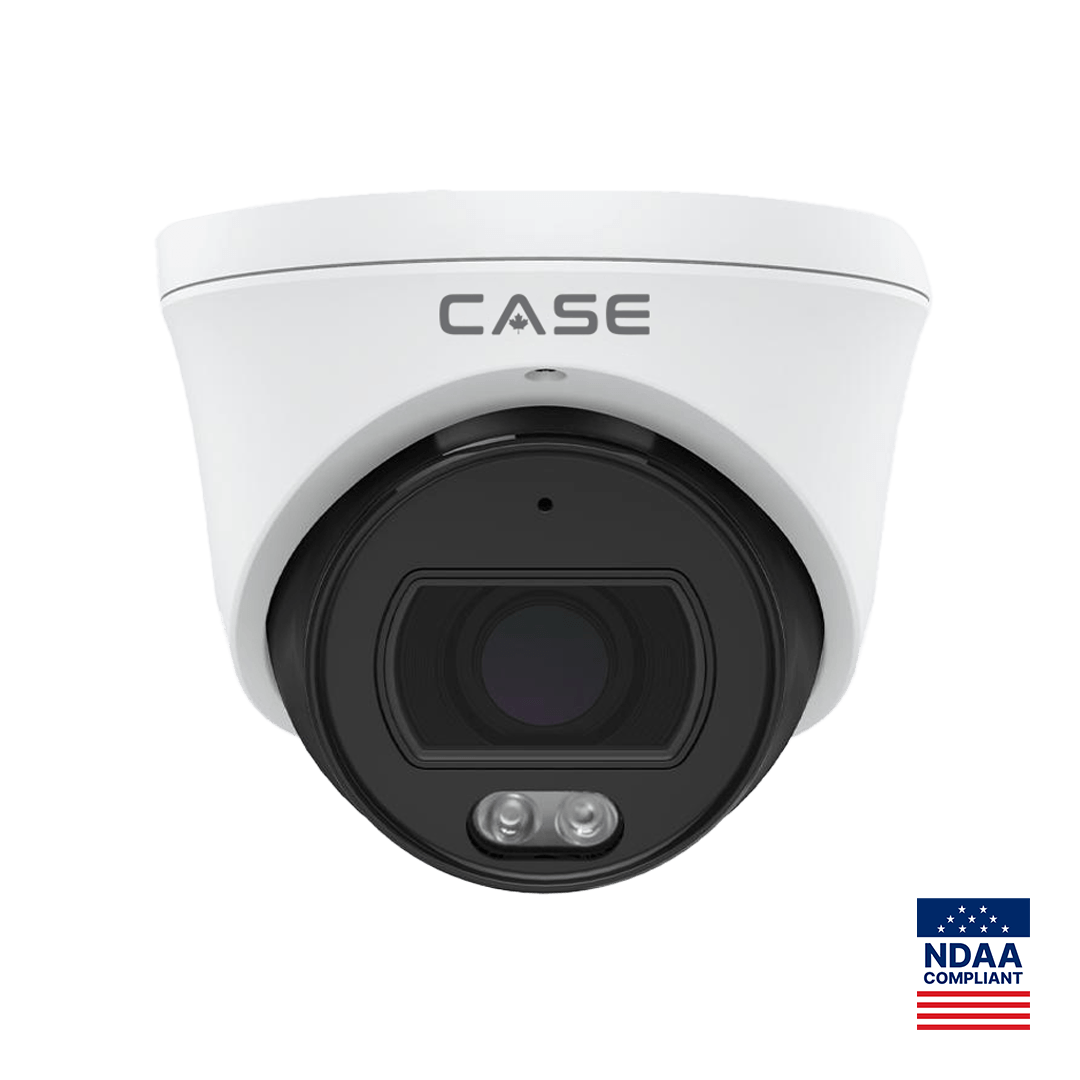
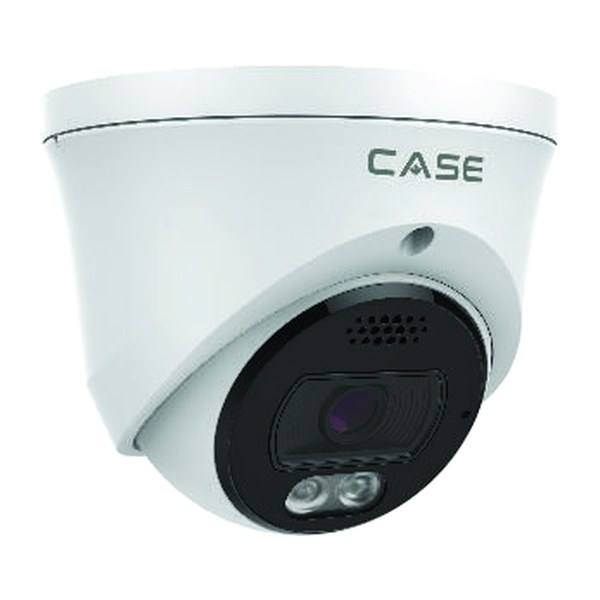
PhotonX is printed as color imaging to 0.0001 Lux for the technology, and the SKU row governs the claim: CS-I4SV S-2.8mm and CS-I4UV S-4mm print 0.0001 Lux; CS-I86V I-180 carries the PhotonX icon but prints 0.0009 Lux, so 0.0009 is the figure for that SKU. The two 4MP PhotonX units print IR “N/A”: color-only designs whose only illuminator is their white light at 33 ft (10 m) and 49 ft (15 m). With some ambient light, that is the point: color at night with the lights off. With none beyond that radius, a camera without IR has nothing to see, so plan ambient light or choose an IR-plus-white-light SKU. The CS-I4SV S-2.8mm profile covers the turret in detail.
NightBright is printed as 24-hour full color through a wide aperture, a large sensor and warm-light illumination. It appears on CS-I5XP S-2.8mm (0.0004 Lux, no IR, white light 49 ft (15 m)) and on IR-plus-white-light units such as CS-I8XQ II-2.8mm and CS-I8WS SD-2.8mm (both 0.002 Lux). Two reading rules: claim NightBright only where the sheet also prints a White Light Distance, and read the Min. Illumination row of the exact SKU rather than the icon. One letter matters here too: CS-I8WS S-2.8mm prints no white light; CS-I8WS SD-2.8mm prints 49 ft (15 m).
WDR: the other half of night footage
Most unusable night clips are not too dark; they are too contrasty. Headlights in a lot entrance, a lit lobby seen from a dark sidewalk, a canopy against a black street: one exposure cannot hold both ends, so the face is a silhouette or the plate a white bar. Wide dynamic range (WDR) combines exposures or tone-maps the output so both ends survive. All six SKUs here print 120dB; CS-I8XQ II-2.8mm prints “120dB, True WDR (TWDR)”, the multi-exposure method. The dB figure is manufacturer-stated and, like lux, not a cross-brand standard.
In practice: turn WDR on for mixed scenes (entrances, drive lanes, anything with vehicles approaching), leave it off for uniformly dark scenes where it adds noise, and test the entrance camera with headlights on during commissioning rather than at noon. The camera that passes the headlight test and holds color at the door is the one whose footage gets used.
Which CASE camera for which night?
| SKU | Form | Min. illumination | IR | White light | Night technology (icon) | Night scenario |
|---|---|---|---|---|---|---|
| CS-I4SV S-2.8mm | 4MP turret | 0.0001 Lux | None | 33 ft (10 m) | PhotonX | Doors and walkways with some ambient light; lights off |
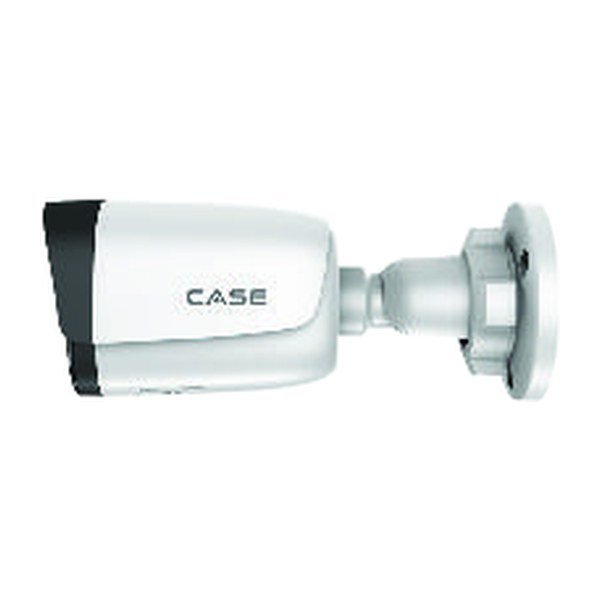
| CS-I4UV S-4mm | 4MP bullet, 4 mm lens | 0.0001 Lux | None | 49 ft (15 m) | PhotonX | Same role on a wall or pole |
| CS-I5XP S-2.8mm | 5MP turret | 0.0004 Lux | None | 49 ft (15 m) | NightBright | Entrances where constant or triggered light is acceptable |
| CS-I8XQ II-2.8mm | 8MP turret, mic and speaker | 0.002 Lux | 164 ft (50 m) | 98 ft (30 m) | NightBright, EW | Entrances and yards: IR by default, light and voice on an event |
| CS-I8WS SD-2.8mm | 8MP bullet | 0.002 Lux | 164 ft (50 m) | 49 ft (15 m) | NightBright | Long views with a lit near zone: IR reach plus color at the gate |
| CS-I86V I-180 | 8MP (4+4) stitched 180° turret | 0.0009 Lux | 98 ft (30 m) | 98 ft (30 m) | PhotonX, EW | Wide frontage from one position; color with light, IR without |
All six are CASE cameras: CASE cameras carry a 6-year warranty, handled through the installer or dealer. The form-factor side is covered in turret vs dome vs bullet. Where the customer needs to see the difference, the approved route is a demo at their own door: for approved demo products we provide a 90-day test period under the approved demo return process. This is not a general return policy.
What to tell your customer
“At night a camera records in black and white with infrared, in color with its own light, or in color from the light already on your site. We placed color cameras where color evidence matters, at your doors and gate, and infrared on the long views where lighting would disturb the neighbors. Each camera’s low-light figures come from the manufacturer’s specification sheet, and we confirmed them on site before handover.”
FAQ
Is a full color night vision security camera better than infrared?
It is better evidence where there is enough light for it: clothing and vehicle color survive. It is worse where no ambient light exists beyond the white-light radius, because color-only SKUs such as CS-I4SV S-2.8mm print no IR. Specify color at doors and gates, IR on long dark views, and IR-plus-white-light units where both are needed.
What does 0.0001 Lux actually mean on a spec sheet?
It is the manufacturer’s minimum illumination at the sensor under its own aperture, gain and shutter conditions; there is no shared test across brands. On the reference scale 0.0001 lux is a moonless overcast night. CS-I4SV S-2.8mm and CS-I4UV S-4mm print it; CS-I86V I-180 prints 0.0009 Lux. Judge the SKU on site footage, not on the number.
Does white light on a camera count as a deterrent?
Constant light is a visible statement; event-triggered light is the deterrent. On CS-I8XQ II-2.8mm and CS-I86V I-180 the printed EW (Early Warning) function lights up and speaks when a rule is crossed, and CS-I8XQ II-2.8mm prints red and blue light. EW and AEW are deterrence features; availability is confirmed per SKU and behavior per firmware and project configuration.
Do I need WDR on a night camera?
At any position where vehicles approach or a lit interior meets a dark exterior, yes: headlights and doorway glow are the usual cause of silhouettes and white plates. All six SKUs in the table print 120dB; CS-I8XQ II-2.8mm prints True WDR (TWDR). Turn it off on uniformly dark scenes and test entrances with headlights during commissioning.