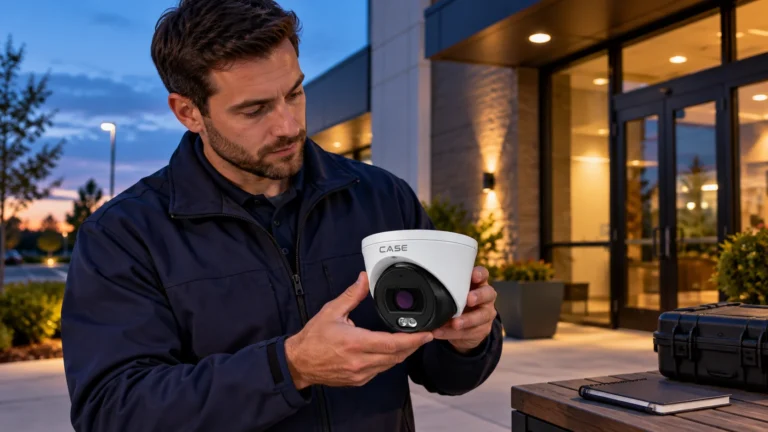



Quick answer: CS-I4SV S-2.8mm lists a 4 MP sensor,2.8 mm fixed lens,2688×1520 at 25fps,0.0001 Lux minimum illumination,10 m white light and IR N/A. It is a no-IR PhotonX candidate, not a guarantee of useful color identification at every low-light site. Confirm the actual exposure/lighting modes, required recorded task, power and environment, then test moving subjects in the real night scene.
On this page
What does PhotonX do on the CS-I4SV S-2.8mm, as printed?
PhotonX is the CASE low-light/full-color name used for this product. Its printed minimum-illumination row is0.0001 Lux, but the catalog row does not specify every test condition or guarantee motion detail, color fidelity or identification at that illumination. Select it from the actual task and measured/recorded site test rather than claiming that a brochure number turns darkness into usable evidence.
Compare exact-revision measurement conditions such as exposure, gain, lens and acceptance criterion before comparing lux ratings. IR N/A means no listed IR illuminator; it does not by itself prove that every monochrome/software mode is absent. White light10 m is not a hard optical cutoff, a guaranteed identification radius or a substitute for checking the scene and supported lighting behavior. The image-quality diagnostics guide explains general exposure effects, not CASE-specific settings or performance.
| Site check | Record before acceptance |
|---|---|
| Required target/task | Position, detail, motion, identification expectations and recorded result |
| Actual light | Night, shadows, weather, nearby fixtures and reflection/glare paths |
| Exposure/lighting | Supported modes, shutter/gain, actual white-light behavior and resulting color/motion detail |
| Mounting/lens | Actual field of view, target size/angle, access and approved assembly |
| Evidence of fit | Representative recorded clips and documented conditions/limits; no generic moonlight-lux table as a performance guarantee |
A lit canopy, walkway or parking area can be a useful candidate, but the fixture name or what an installer can see by eye does not quantify camera performance. Check actual light on moving targets, reflections, shadows and required task detail under representative conditions.
Where does a no-IR color turret beat an IR camera, and where does it not?
IR illumination commonly supports monochrome night imaging; this camera has no listed IR source and has a 10 m white-light row. Its actual color/motion result depends on scene light, exposure, optics and settings. Neither approach wins every task; confirm the supported modes and test the required recorded result.
| Scene/task | Assessment for this model |
|---|---|
| Lit entrance, walkway or near loading area | Candidate after actual field-of-view, motion, exposure, light/privacy and recording test |
| Parking or headlights | Verify actual task and glare;120 dB WDR does not guarantee plates, colors or faces |
| Unlit or long-range target | No listed IR and fixed2.8 mm lens constrain options; assess lighting/optics/another documented design and test |
| No visible light permitted | Confirm whether required performance is possible in an allowed supported mode; do not promise this white-light camera or every IR alternative |
| Cold/exposed installation | Check exact device, power, entry parts, assembly, ambient and startup requirements separately |
CS-I4UV S-4mm is a different catalog candidate with 4 mm fixed lens,0.0001 Lux,white light15 m and a -35°C to +65°C operating row (physical PDF25). CS-I4SV S-2.8mm lists -40°C to +65°C (PDF16). Those rows do not establish identical image behavior, lighting controls, field of view or cold-start capability. Compare the exact required view, power/environment and actual recording before substituting. Use the full-color night vision guide to compare the lighting approaches.
What are the installation notes for a camera without IR?
Plan the actual task, supported settings and safe assembly before mounting. The absence of listed IR changes one illumination option, but does not remove ordinary exposure, glare, moisture, power or service constraints:
- Night task: test the actual target size, angle, movement and available light; human eyesight is not a lux meter or an acceptance test.
- Lighting: confirm supported continuous/scheduled/event modes and test the actual beam, exposure, privacy/neighbour impact and power. The10 m row is not a guaranteed useful radius.
- View/mount: use the actual field-of-view specification and approved compatible assembly. There is no universal8–10 ft height for every face/plate task; verify recorded detail and safe service access.
- Audio/I/O: the catalog lists a microphone, speaker N/A,Audio I/O N/A and Alarm I/O N/A. Confirm actual authorized audio use and supported functions; do not promise talk-down, an external relay or every event interface from these rows.
- Card storage: the512 GB row does not establish an automatic outage backup or recorder synchronization. Confirm supported card, configured recording/retention and actual retrieval/recovery.
- Environment: IP67 and metal housing do not certify the entire installed assembly, cold start or snow/ice clearance. Follow exact entry/seal/mount and environmental instructions.
- Power: obtain the actual revision’s source/class, maximum/startup load and environmental requirements before sizing the port and shared budget.
Spec table — CS-I4SV S-2.8mm as printed
Metric values are the catalog’s; the imperial conversions are ours for North American drawings.
| Catalog item | Published row | Planning limit |
|---|---|---|
| Sensor / lens | 4 MP /2.8 mm fixed | Confirm exact field of view and required recorded target detail |
| Maximum output | 2688×1520 at 25fps | Actual simultaneous settings and client/recorder support |
| Minimum illumination | 0.0001 Lux | Test conditions and moving-target result required; no identification guarantee |
| Lighting | IR N/A;white light10 m | Actual supported modes, scene light, exposure and impact |
| WDR | 120 dB | Not a guarantee against every headlight/glare condition |
| Environment / housing | IP67;Metal;-40°C to +65°C,0–95% RH | Exact approved assembly, conditions, power and startup limits |
| Audio / alarms | Microphone Yes;Speaker N/A;Audio I/O N/A;Alarm I/O N/A | No listed speaker/external audio/alarm terminals; verify actual authorized functions |
| Memory | 512 GB | Approved card and configured recording/retrieval; not automatic backup |
| Compression | S+265/H.265/H.264B/H.264M/H.264H/Motion JPEG | Actual client/recorder support, image quality and measured load |
| Camera analytics | Tripwire,Perimeter,Human & Vehicle Classification | Exact firmware/rules and end-to-end event test |
| Warranty | Six-year catalog badge | Exact written product/order terms; other system components separate |
Which NVR should you pair it with?
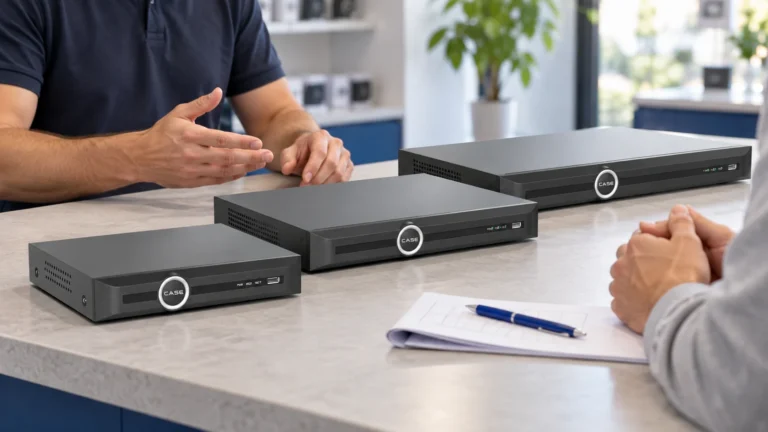
Confirm the camera’s supported rules and how the chosen recorder/software receives, records and searches the actual events. CS-N110 P8H-AI lists 10 channels/eight PoE ports and100/80 Mbps in/out; CS-N220 P16H-AI lists 20/16 and160 input (AI on 120)/80 output. The CS-N220 P16H-AI spotlight covers its row. Neither pairing automatically enables every camera or recorder AI feature; check power, streams, decode, storage, interfaces and the real workflow. Drive terms are separate.
- Use only a supported codec/stream configuration that meets image-task requirements; S+265 does not guarantee savings or decoder compatibility.
- Budget actual input/output, decode, AI and storage with reserve under the intended modes.
- Verify actual source events, rules, supported channels and VCA Search results rather than infer them from feature lists.
- For CASE Connect, verify current supported app/version and device/account behavior; Android is available and iOS forthcoming. CASE Station and CASE Cloud remain separate functions/products.
- For third-party recording, check exact firmware/client conformance and required functions; no blanket S/T/G/M or full interoperability follows from the CASE name.
How do you prove it before the quote?
Agree a representative night comparison with the customer, including equivalent task, exposure/light conditions, movement and recorded results. A fixed week or one matching hour is not universal proof. Approved demo purchases may have a 90-day test period under the approved demo return process/conditions; this is not a general return policy. Use private business-account pricing and request the exact supported documents before committing.
What to tell your customer
This model has a very-low-light catalog rating, white light and no listed IR illuminator. We will check its actual view and moving-target recordings under the lighting your site permits, then document the supported settings and limitations. The lux number and10 m lighting row are not guarantees of true color or identification everywhere. Product and service terms will be confirmed separately.
FAQ
Does the CS-I4SV S-2.8mm need ambient light to work at night?
It needs a supported combination of scene light, illumination and exposure to meet the actual recorded task. IR is listed N/A and white light10 m, but that distance is not a hard cutoff or guaranteed useful radius. Confirm the exact lighting/mode behavior and test representative moving targets before accepting a dark-site design.
What is the difference between PhotonX and NightBright?
PhotonX and NightBright are CASE low-light/full-color names, not interchangeable performance specifications. Compare the exact SKU’s minimum-illumination test conditions, lens, sensor/output, exposure and supported light modes, then the required moving-target recording. A name, icon or lux number alone does not establish which camera performs better; do not substitute an unverified or retired model from an older comparison.
Can it give spoken warnings or trigger a relay?
The catalog lists Built-In Speaker N/A,Audio I/O N/A and Alarm I/O N/A, with a built-in microphone. Do not promise talk-down or a wired relay from those rows. If the project needs audio/light deterrence or a control output, confirm a documented appropriate model, supported workflow and authorized use rather than assume every EW model provides the same functions.
Is it suitable for Canadian winters?
The catalog operating row is -40°C to +65°C at 0–95% RH, with IP67 and metal housing. This is not proof of every cold start, icing, snow, installed seal or power-source condition. Confirm exact approved startup/environment and assembly requirements and the limits of the switch/injector and route; avoid a blanket claim that this is the coldest or best winter model.
What warranty applies to this camera and its recorder?
General category policies are a starting point, not a warranty for every SKU. Confirm the term, exclusions and claim process for the exact model and revision in writing. Project Series items, intercoms, powered accessories and model-specific exceptions need their own confirmation; hard-drive claims follow the applicable drive-manufacturer terms. The catalog shows a six-year badge for this SKU; confirm the actual written product/order conditions. Recorder, drive, powered accessories and labour/service terms need their own scope and confirmation through the partner channel. Use the CASE warranty by category guide to organize the confirmation.
References
- Anabon: exact product/revision documents
- Anabon Technical Support
- Axis: general image-quality diagnostics, not a CASE performance specification
- ONVIF: exact conformant products and firmware