

Quick answer: A recording-only camera produces evidence after the fact. An active deterrence camera adds a reaction: when an on-camera rule such as a tripwire or perimeter is crossed by a classified human or vehicle, it switches on white light (red and blue light on the Generation II turrets), plays a voice or siren through a built-in speaker and pushes an alarm, then records as usual. CASE calls this EW (Early Warning); AEW adds auto-tracking on PTZ models. EW and AEW are deterrence features; availability is confirmed per SKU. Specify them where nobody should be on site at that hour: yards, lots, construction sites, loading areas.
How does Early Warning work: detect, light, audio?
EW is a chain of three steps on the camera itself. First, detection: an on-camera rule (Tripwire, Perimeter, plus Double Tripwire on the Generation II turrets) fires only when the object that crossed it is classified as a human or a vehicle. That classification is the difference between a deterrent and a nuisance: a branch in the wind or a headlight sweep across the fence is not a person, so the light stays off. Human/Vehicle Classification is printed on the AI row of every Intelligent-series EW camera in this article; the Value-series CS-I85N L-180 prints Smart Alarm (Human & Vehicle Detection).
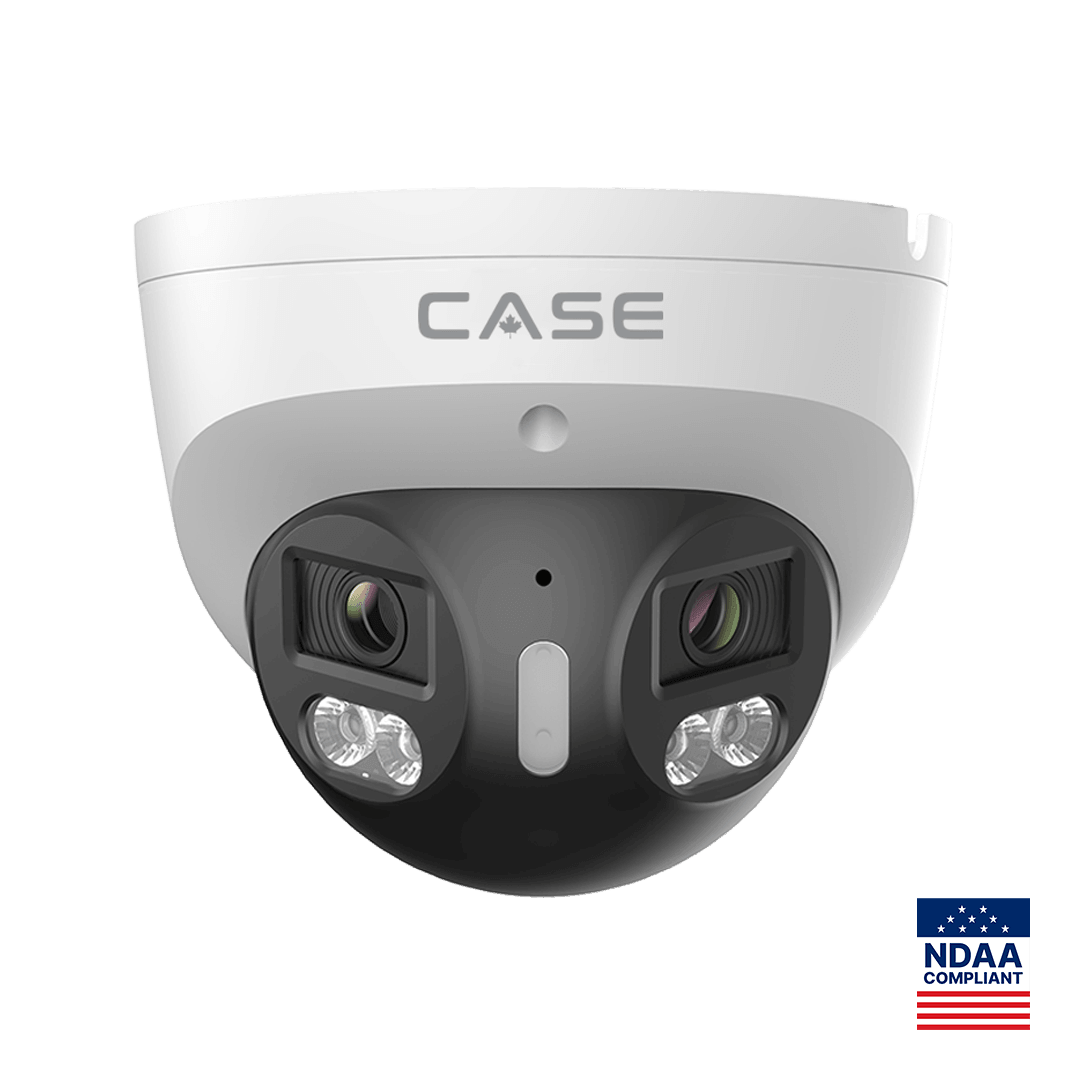
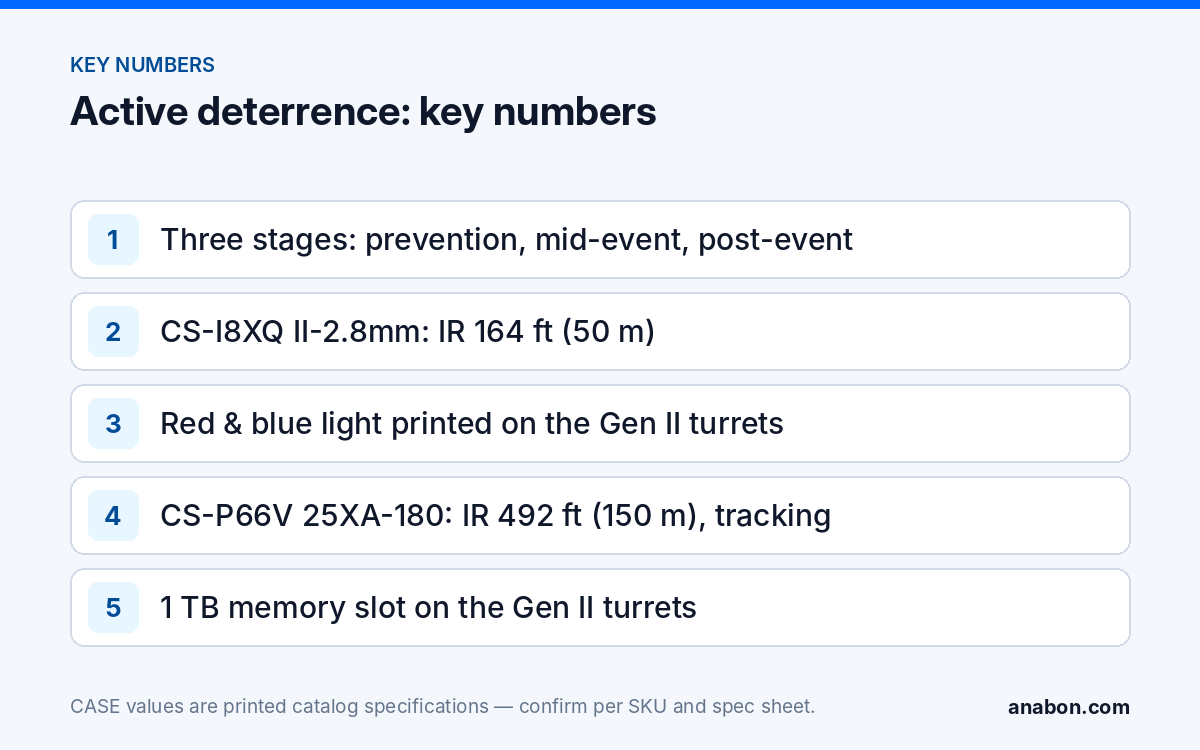
Second, light: the white-light illuminator switches on so the person is lit, in color, and knows it. On CS-I8XQ II-2.8mm and CS-I5XQ II-2.8mm the catalog also prints a Red & Blue Light row as Yes, a flashing signal recognized from a distance. Third, audio: a built-in speaker plays a recorded message or a siren. The sequence is configured on the camera; whether it runs while the NVR is unreachable is confirmed per SKU and firmware on the bench, and the alarm output (printed 1/1 on the turrets and the bullet) can drive a relay, a strobe or a panel input.
Configuration is where EW succeeds or fails. The rule must sit where a legitimate person never walks during the armed schedule. A commissioning checklist:
- Draw the tripwire or perimeter inside the property line, not on the sidewalk, and test it by walking the real approach path.
- Set the arming schedule from the customer’s closing routine, with a buffer for staff leaving late.
- Choose human only, vehicle only, or both, per camera: a yard gate wants both, a pedestrian door usually wants human only.
- Record a message that names the site and the action, and set the volume for the distance, not the maximum.
- Walk the site at night and confirm light, sound and the alarm in CASE Connect from outside the fence.
AEW: what does auto-tracking add?
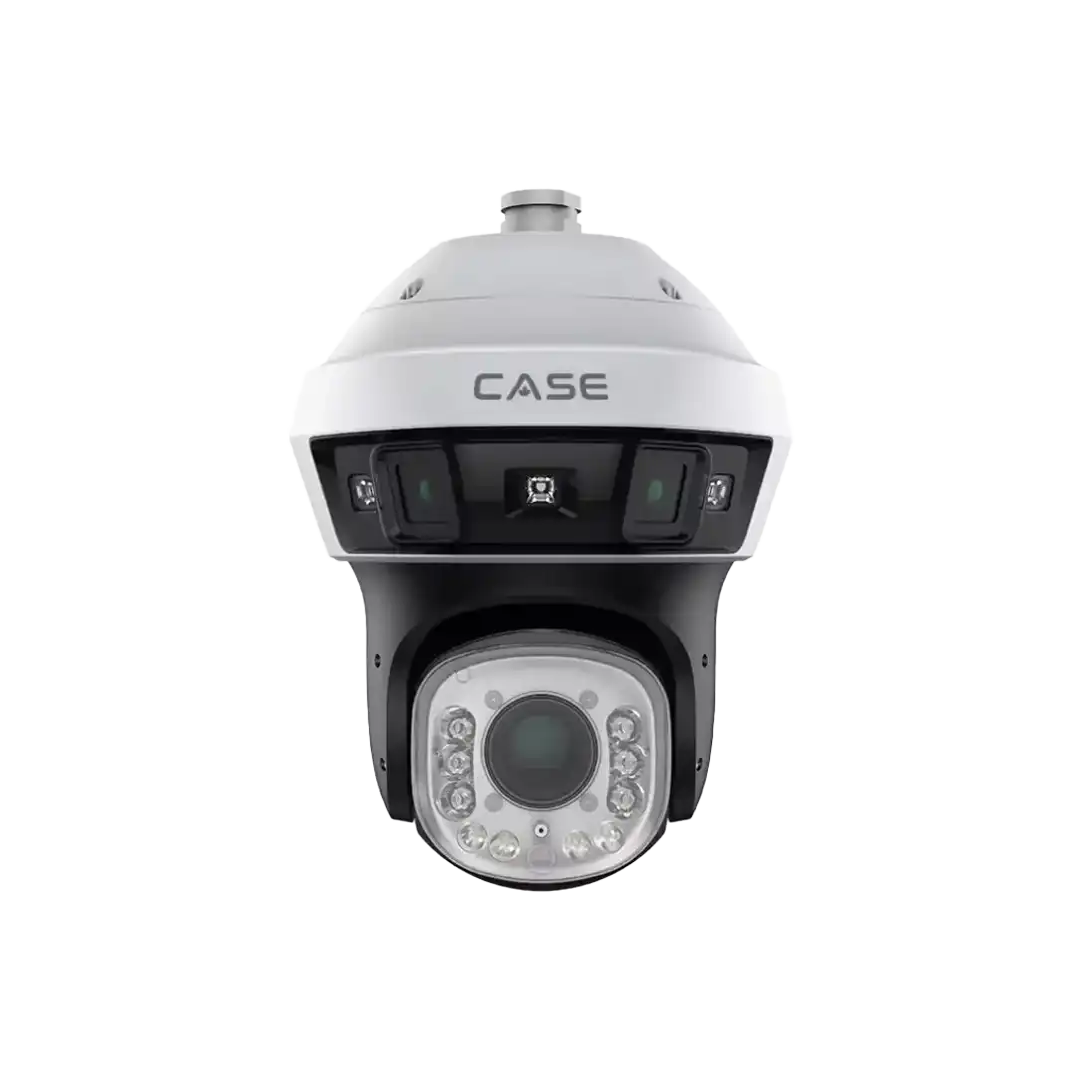
A fixed EW camera reacts to a zone. AEW (Auto-tracking Early Warning) is EW on a PTZ with auto tracking: when the rule fires, the PTZ zooms to the target and follows it while the deterrence outputs printed for that SKU run, producing a close, continuous record of one person across a large area instead of a wide frame with a few pixels on them. On CS-P66V 25XA-180 the catalog prints Auto Tracking as Yes, a 6MP 180° panorama channel and a 4MP 25X PTZ channel (4.8-120mm), IR 492 ft (150 m), a built-in speaker and alarm I/O 2/1: the panorama watches the whole yard, the PTZ chases. The laser deterrent on the large PTZs is a separate feature, a deterrent and not an illuminator, offered on selected models only. AEW is confirmed per SKU, firmware and project configuration before it goes into a proposal; CASE PTZ cameras carry a 3-year warranty.
Prevention, mid-event, post-event: three stages instead of one
Show the customer what each stage does and does not do. Recording-only covers the third stage; EW covers all three.
| Stage | Recording-only camera | EW camera | AEW PTZ |
|---|---|---|---|
| Prevention (person approaches) | Nothing visible; a dark camera | Light and voice at the rule line; the person knows a reaction has started | Same, plus the PTZ visibly turns toward them |
| Mid-event (person stays) | Recording continues; no one is told | Alarm notification in CASE Connect, alarm output to a relay or panel, repeated audio | Same, with the PTZ following at zoom |
| Post-event (next morning) | Footage searched by time; usable only if the person was in range and lit | Lit, color footage with classification metadata; CASE AI NVRs print an Early-warning Search row under VCA Search | Close zoomed footage of the same person across the area |
None of this guarantees that a person leaves; some do not. What EW changes is that the system acts at the moment that matters and leaves a better record if the person stays. Say it in those terms, without crime-reduction percentages you cannot source for that site.
Where does deterrence pay: yards, lots and construction?
Deterrence pays where the rule can be drawn around a place nobody should be at that hour.
- Contractor and equipment yards. Fenced, closed at night, copper and converters on the ground. A perimeter rule on the fence line and light and voice at the gate; CS-I8WQ I-2.8mm prints IR 164 ft (50 m), white light 49 ft (15 m) and an operating range of −40 to 149 °F (−40 to 65 °C), which matters in the northern US and across Canada.
- Parking lots after hours. Dealers, truck lots, self-storage aisles. A stitched 180° unit such as CS-I86V I-180 covers a frontage from one mount with a built-in loudspeaker and white light 98 ft (30 m); layout is in parking lot security cameras.
- Construction sites. A perimeter that moves every month and material in the open. EW turrets on a trailer or temporary pole, a PTZ with AEW where the site is large; see construction site security cameras.
- Loading docks and rear doors. A human-only rule after closing, where a lit face at the door is the evidence the customer needs.
Where it does not fit: a retail floor during opening hours, a lobby, any scene where the rule would fire on legitimate traffic. There, classification still cuts false alarms for search, but the light and voice stay off.
CASE deterrence line-up as printed in Catalog 2027 Q1
| SKU | Form | Resolution | IR | White light | Red & blue light | Mic / speaker | Protection |
|---|---|---|---|---|---|---|---|
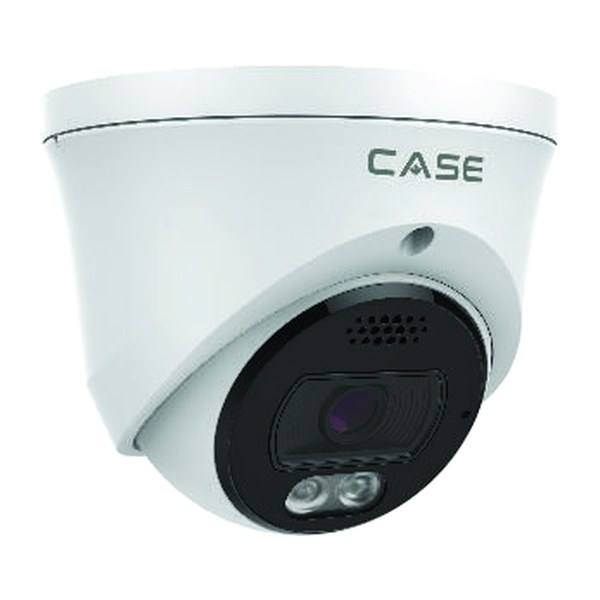
| CS-I8XQ II-2.8mm | Turret, Intelligent, Gen II | 3840×2160@30fps | 164 ft (50 m) | 98 ft (30 m) | Yes | Yes / Yes | IP66 |
| CS-I5XQ II-2.8mm | Turret, Intelligent, Gen II | 3072×1728@30fps | 164 ft (50 m) | 98 ft (30 m) | Yes | Yes / Yes | IP66 |
| CS-I8XQ I-2.8mm | Turret, Intelligent | 3840×2160@20fps | 98 ft (30 m) | 49 to 66 ft (15-20 m) | No | Yes / Yes | IP66 |
| CS-I5XQ I-2.8mm | Turret, Intelligent | 2880×1620@30fps | 98 ft (30 m) | 49 ft (15 m) | No | Yes / Yes | IP66 |
| CS-I8WQ I-2.8mm | Bullet, Intelligent | 3840×2160@20fps | 164 ft (50 m) | 49 ft (15 m) | Not printed | Yes / Yes | IP67 |
| CS-I86V I-180 | Stitched 180° turret | 4640×1728@25fps | 98 ft (30 m) | 98 ft (30 m) | Not printed | Yes / Yes | IP67 |
| CS-I82V I-180 | Stitched 180° bullet | 4640×1728@25fps | N/A | 49 ft (15 m) | Not printed | Yes / Yes | IP67 |
| CS-I85N L-180 | Non-stitched 180° bullet, Value | 2560×1440@20fps | 164 ft (50 m) | 98 ft (30 m) | Not printed | Yes / N/A | IP67 |
| CS-P66V 25XA-180 | 180° panorama + 25X PTZ | Panorama 3840×1568@30fps | 492 ft (150 m) | Not printed | Not printed | Speaker Yes | IP66 |
The Generation II turrets are the upgrade path: IR and white light reach farther than Generation I, red and blue light is printed, the memory slot is 1 TB against 512 GB, and the AI row grows to include Visible Light Smoke & Fire Detection, confirmed per use case, firmware and region before it is mentioned to a customer. CS-I85N L-180 carries the EW icon with white light 98 ft (30 m), but its speaker row prints N/A, so confirm the audio side on the spec sheet before promising a voice warning. CASE cameras carry a 6-year warranty; CS-P66V 25XA-180 is a PTZ and carries a 3-year warranty; both are handled through the installer or dealer. The Generation II turrets in detail: CS-I8XQ II-2.8mm and CS-I5XQ II-2.8mm.
Setting expectations: wind, neighbors and the law
False triggers. Human/Vehicle Classification cuts them sharply compared with motion detection, but a rule drawn across a public sidewalk still fires on every passer-by, and a camera aimed into headlights needs its zone redrawn. Commission the rules at night, then review the first week’s alarms and tighten.
Light and sound on neighbors. White light of 98 ft (30 m) and a voice message at 2 a.m. reach past the fence. Municipal lighting and noise ordinances (US) and bylaws (Canada) can limit both: aim the light into the property, set the volume for the approach distance and agree a schedule the customer can defend to the business next door.
Audio and signage. A spoken warning is output, not recording. Where the built-in microphone records audio, state recording-consent laws (US) and federal and provincial privacy law including PIPEDA (Canada) apply, and signage is expected; see the audio recording laws checklist and verify with counsel. CASE Connect is the official app experience for CASE systems; its alarm features and remote access options are confirmed by model, software version and project configuration.
What to tell your customer
“Your cameras record all the time. The ones at the gate and along the fence also react: when a person or vehicle crosses the line we drew, after hours, the camera lights the area, plays a warning and sends an alert to your phone, and the footage is lit and in color. It will not stop everyone, but it acts at the moment it matters instead of only afterward. We will review the first week’s alerts with you.”
FAQ
What is an active deterrence camera?
A camera that reacts to an intrusion instead of only recording it. When an on-camera rule is crossed by a classified human or vehicle, it switches on white light, plays a voice message or siren through a built-in speaker and sends an alarm. On CASE cameras the feature is called EW (Early Warning); on PTZ models with auto tracking it is AEW. Availability is confirmed per SKU.
Does a security camera with siren and strobe light cause false alarms in wind?
Far fewer than motion detection, because the rule fires only on a classified human or vehicle, not on moving branches, rain or shadows. Human/Vehicle Classification is printed on every Intelligent-series EW SKU in this article. False triggers that remain usually come from a rule drawn across public space or a camera facing headlights; redraw the zone and review the first week’s alarms.
Which CASE camera prints red and blue light?
CS-I8XQ II-2.8mm and CS-I5XQ II-2.8mm print a Red and Blue Light row as Yes, together with IR 164 ft (50 m), white light 98 ft (30 m), a built-in microphone and speaker, and a 1 TB memory slot. The Generation I turrets print No on that row, and the other EW SKUs do not print it. Confirm the orderable configuration on the spec sheet.
Can I use the voice warning where neighbors are close?
Yes, with care. Aim the white light into the property, set the volume for the approach distance rather than the maximum, and arm the audio only during the hours the customer can defend. Municipal noise and lighting ordinances (US) and bylaws (Canada) may apply. Where the lot borders residences, a shorter light radius and a clear sign may serve the customer better.