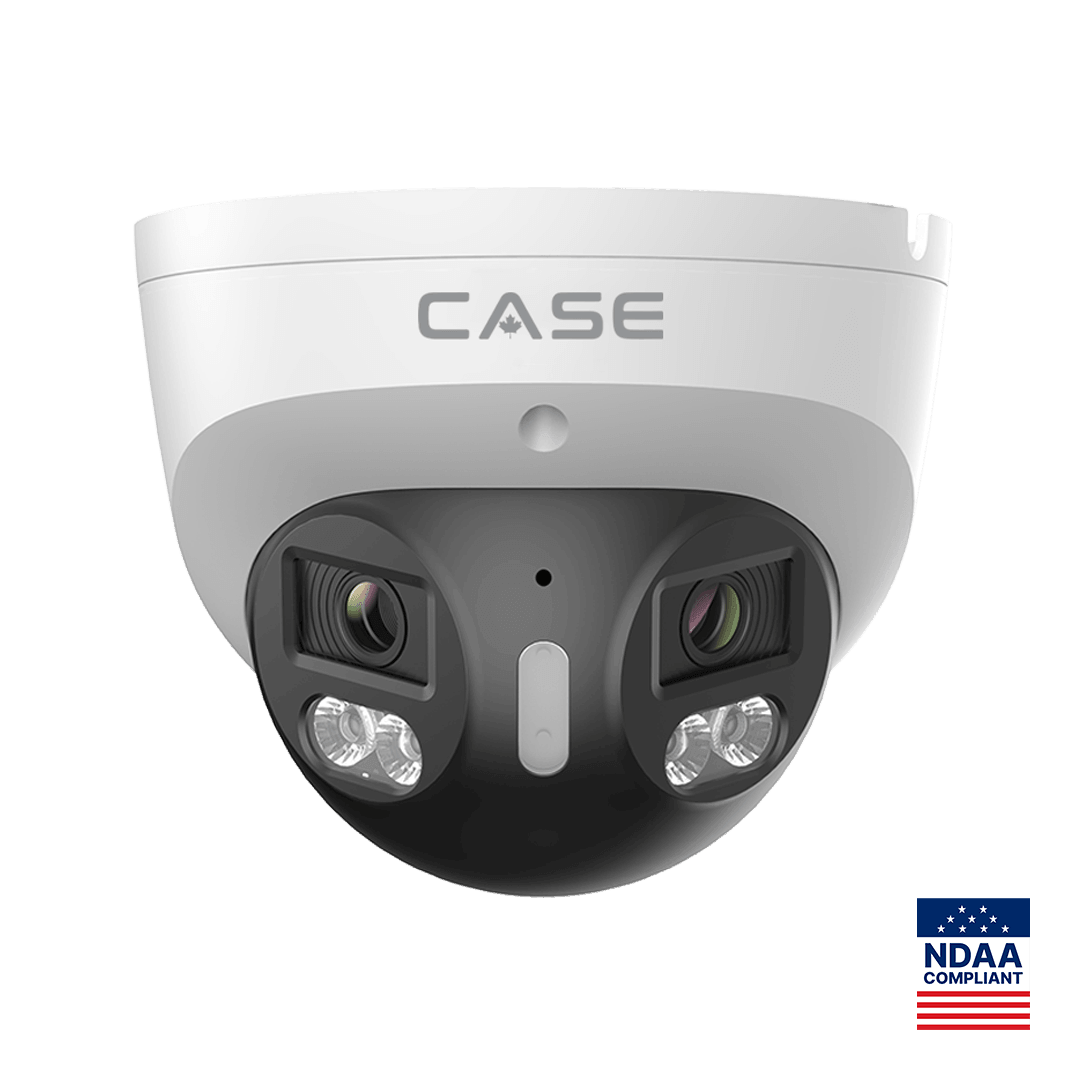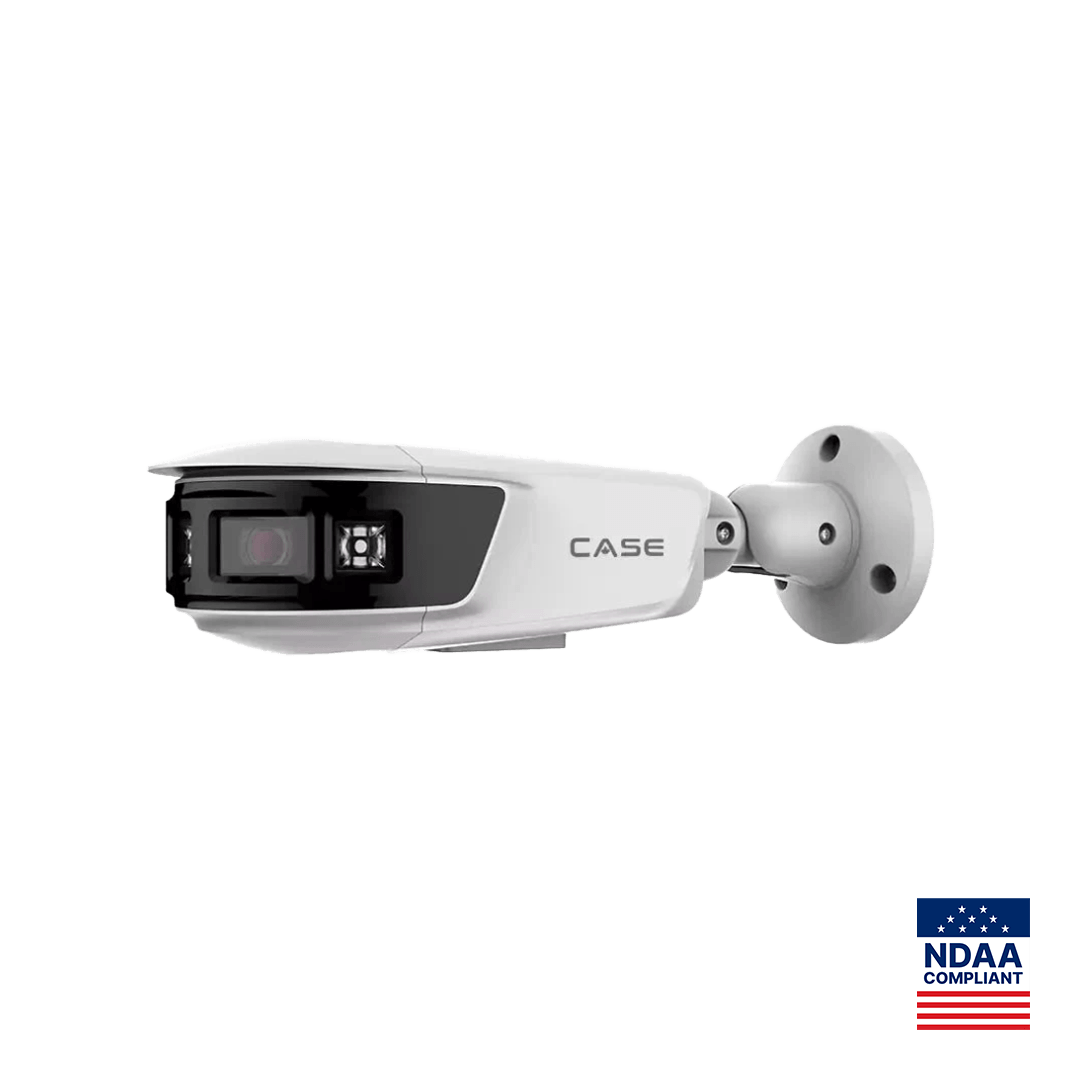


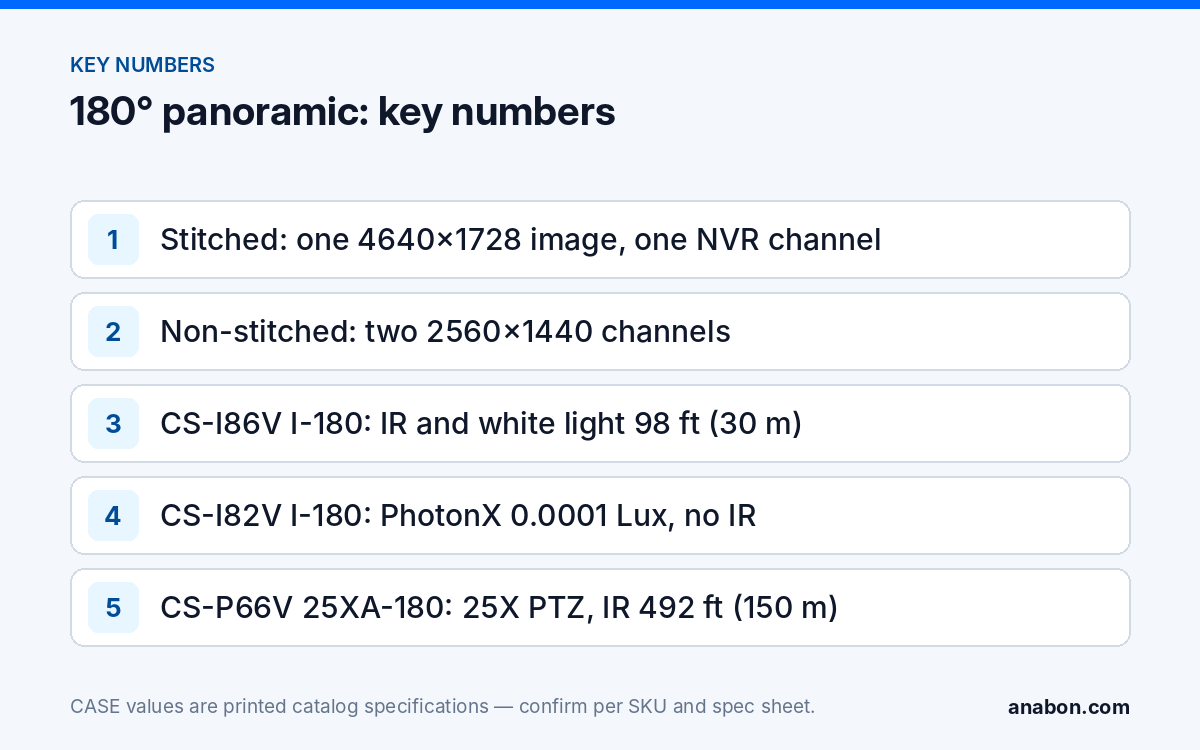
Quick answer: A 180 degree security camera puts two lenses in one housing. A stitched unit (CS-I86V I-180, CS-I82V I-180, the panorama channel of CS-P66V 25XA-180) joins the two sensors into one image, printed 4640×1728 on the fixed units, that the NVR treats as one channel. A non-stitched unit (CS-I85N L-180) delivers two separate 2560×1440 views, planned as two channels; the dual-lens CS-I8RN S-2.8mm is also printed 8MP (4+4) Non-Stitched, with its lens orientation confirmed on the spec sheet. Choose stitched for one continuous frontage from one mount; choose two cameras where the two directions need different lenses or distances.
Stitched vs non-stitched: what does the NVR see?
Both types start the same way: two 4MP sensors behind two fixed 2.8 mm lenses, angled apart so together they span about 180°. The difference is what leaves the camera. A stitched panoramic security camera processes the two sensors into a single wide frame on board; the NVR, CASE Connect and any export show one image, printed 4640×1728@25fps for CS-I86V I-180 and CS-I82V I-180. A non-stitched dual lens security camera sends two video streams; the NVR shows two tiles, each printed 2560×1440@20fps on CS-I85N L-180 and CS-I8RN S-2.8mm, and the operator joins them mentally.
That difference decides the day-two experience. With a stitched image, a person who walks across the lot stays in one clip; playback, export and the on-camera rules (Tripwire, Perimeter and Human & Vehicle Classification are printed on both stitched fixed units) run on one frame. With two channels, the same walk crosses a tile boundary, two clips are exported and rules are drawn twice. The stitched image has one cost of its own: the lenses sit a few inches apart, so an object very close to the join line can show a slight misalignment (parallax). Keep the first few feet clear of the evidence zone and it does not matter at working distances.
| Question | Stitched (one image) | Non-stitched (two channels) |
|---|---|---|
| What the operator sees | One wide frame, no tile boundary | Two tiles side by side |
| NVR channels to plan | One (confirm per NVR model and firmware) | Two (confirm per NVR model and firmware) |
| AI rules | Drawn once on the panorama | Drawn on each channel |
How do channels and bandwidth change?
Every CASE NVR prints two limits: IP video channels and incoming bandwidth. A stitched camera consumes one channel and one stream; a non-stitched unit consumes two of each. On a 20-channel recorder such as CS-N220 P16H-AI (printed 20CH, 16 PoE ports, incoming 160Mbps or 120Mbps with AI on) that is nineteen remaining channels against eighteen. Confirm how a dual-lens SKU enumerates on the NVR model and firmware before the camera schedule is final.
Bandwidth follows the pixel count and frame rate you set, not the housing. The printed resolutions give the frame sizes: a stitched 4640×1728 frame is about 8.0 million pixels; two 2560×1440 channels are about 3.7 million each, 7.4 million combined; the CS-P66V 25XA-180 panorama at 3840×1568 is about 6.0 million. At equal frame rate and compression the two types load the NVR about the same; the stitched unit spends it on one frame. S+265 is printed on all four fixed units. For the Mbps per camera and the headroom on a given recorder, use the IP camera bandwidth calculator and the NVR’s printed incoming and outgoing limits.
Pixel density along the arc, assuming the 4640 pixels spread evenly across 180°: 4640 divided by half the circumference at the subject distance.
| Subject distance | Approximate density, stitched 4640 px | Supports (IEC 62676-4 yardstick) |
|---|---|---|
| 30 ft (9 m) | 49 px/ft (161 px/m) | Recognize a known person |
| 50 ft (15 m) | 30 px/ft (97 px/m) | Observe: clothing, direction, vehicle type |
| 100 ft (30 m) | 15 px/ft (48 px/m) | Detect a person |
A panoramic security camera is therefore a context and tracking camera. Identification at the door still comes from a camera at the door.
Where does one 180° camera beat two cameras?
One mount, one cable, no seam to explain. That is the case for a stitched unit, and it is strongest where the scene is a continuous line in front of a wall: a storefront and its sidewalk, a row of parked cars along a building, a loading apron, a fence line seen from the building face. Against two separate cameras it saves a mounting point, a Cat6 run, a PoE port, an NVR channel and a second set of rules, and removes the overlap or gap between two separately aimed cameras.
Two cameras beat it when the two directions are not one scene: one side needs identification at 80 ft (24 m) and the other is a 20 ft (6 m) walkway, or the two views run along different walls from a corner with far ends at very different distances. And if the customer needs identification across the whole width, no 180° unit at 4640 pixels delivers it past roughly the first 20 ft (6 m); plan a wide unit for context plus narrow cameras for evidence.
- Stitched 180° first: continuous frontage, one wall, context and tracking, few mounting points or cable paths.
- Two cameras first: different distances or lens needs, two walls from a corner, identification needed on both sides.
- Non-stitched dual-lens: two tiles acceptable, Value-series feature set enough; plan two channels.
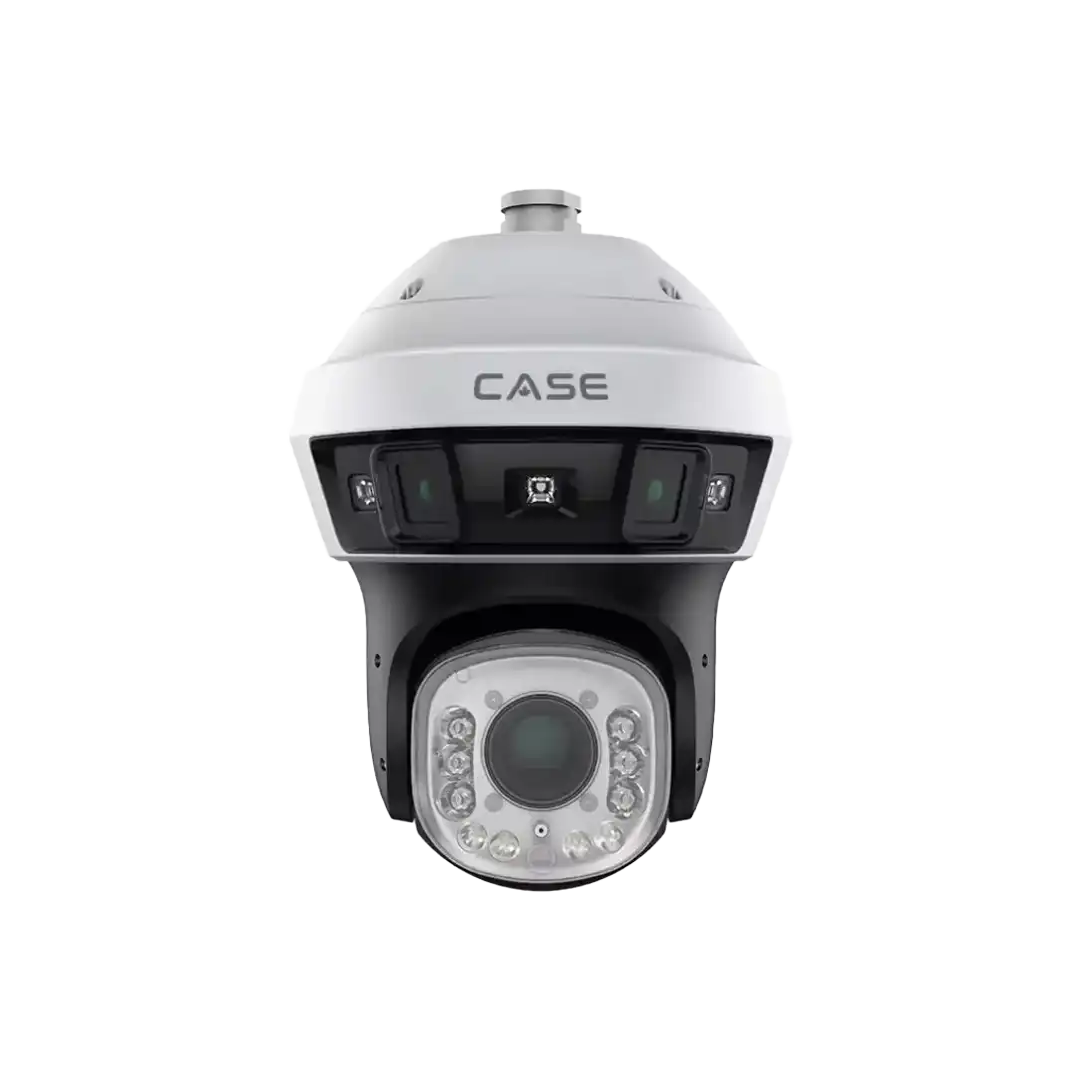
- Panorama plus PTZ (CS-P66V 25XA-180): a large yard where the panorama watches and the 25X PTZ with auto tracking goes to the target.
Mounting: corners, heights and parking rows
A 180° unit is mounted flat against a wall, facing out, so the two edges of the view run along the wall. Mount it in the middle of the frontage, not at one end, or half the field looks at the neighbor. A height of 10 to 14 ft (3 to 4 m) suits the turret form: above vehicles and hands, low enough that faces at the near curb are not foreshortened into hats. Tilt is small; a steep down-tilt wastes the panorama on asphalt.
On a building corner the choice is one unit on the diagonal, covering both approaches with the corner at the center of the frame, or two cameras, one per wall. The diagonal works when both approaches are open space of similar depth; two cameras work when the walls run into long, different scenes. For parking rows, mount on the building face centered on the lot and let the panorama hand off to a dedicated camera at the entrance lane for plates and faces; see parking lot security cameras.
- Stand at the proposed mount, arms out at 180°, and check that nothing the customer cares about is behind that line.
- Check the join line: no door, gate or pay station within the first few feet in front of the camera.
- Confirm the near-field light: CS-I86V I-180 prints white light and IR at 98 ft (30 m); CS-I82V I-180 prints white light 49 ft (15 m), no IR, and PhotonX at 0.0001 Lux for ambient color.
- Walk the arc at night with the live view open in CASE Connect; a frontage with a dark end needs a second light source or a second camera.
CASE panoramic line-up as printed in Catalog 2027 Q1
| SKU | Type | Resolution (as printed) | IR | White light | Min. illumination | Audio / alarm I/O | Protection · Housing |
|---|---|---|---|---|---|---|---|
| CS-I86V I-180 | Stitched 180° turret, Intelligent | 4640×1728@25fps | 98 ft (30 m) | 98 ft (30 m) | 0.0009 Lux (PhotonX) | 1/1 · 1/1, mic and loudspeaker | IP67 · Metal |
| CS-I82V I-180 | Stitched 180° bullet, Intelligent | 4640×1728@25fps | N/A | 49 ft (15 m) | 0.0001 Lux (PhotonX) | 1/1 · 1/1, mic and speaker | IP67 · Metal + Plastic |
| CS-I85N L-180 | Non-stitched 180° bullet, Value | 2560×1440@20fps per channel | 164 ft (50 m) | 98 ft (30 m) | 0.02 Lux | N/A · N/A, mic only | IP67 · Plastic |
| CS-I8RN S-2.8mm | Dual-lens non-stitched, Sharp | 2560×1440@20fps per channel | 164 ft (50 m) | 98 ft (30 m) | 0.02 Lux | N/A · N/A, mic only | IP67 · Plastic |
| CS-P66V 25XA-180 | 180° panorama + 25X PTZ, Intelligent | Panorama 3840×1568@30fps | 492 ft (150 m) | Not printed | Panorama 0.0001 Lux, PTZ 0.001 Lux | 1/1 · 2/1, speaker | IP66 · not printed |
Rows that decide the pick. The two stitched fixed units carry the EW icon, a built-in microphone and speaker and on-camera Tripwire, Perimeter and Human & Vehicle Classification; CS-I86V I-180 prints an operating range of −31 to 149 °F (−35 to 65 °C), CS-I82V I-180 −40 to 149 °F (−40 to 65 °C). The two non-stitched units print Smart Alarm (Human & Vehicle Detection), DWDR, no memory slot and −22 to 140 °F (−30 to 60 °C); the catalog prints only “8MP (4+4) Non-Stitched” for CS-I8RN S-2.8mm, so confirm its lens orientation on the spec sheet before calling it a 180° unit. CS-P66V 25XA-180 prints Auto Tracking as Yes and power as AC24V, DC24V or PoE 802.3bt; its PTZ channel resolution is confirmed on the spec sheet. CASE cameras carry a 6-year warranty; CS-P66V 25XA-180 is a PTZ and carries a 3-year warranty; both flow through the installer or dealer. The stitched pair in detail: CS-I86V I-180 and CS-I82V I-180. To prove a frontage on the customer’s own wall: for approved demo products we provide a 90-day test period under the approved demo return process. This is not a general return policy.
What to tell your customer
“The camera on the front of the building sees the whole frontage in one picture, from one mount and one cable, so a person walking the length of your lot stays in one recording. It shows the whole scene and who went where; the camera at the door identifies faces. We centered it on the frontage and checked the full width at night before handover.”
FAQ
What is the difference between a stitched and a non-stitched 180 degree security camera?
Both use two 4MP sensors. A stitched unit joins them into one wide frame on the camera, printed 4640×1728 on CS-I86V I-180 and CS-I82V I-180, so the NVR records one channel. A non-stitched unit sends two 2560×1440 streams, as on CS-I85N L-180, so the NVR shows two tiles and you plan two channels, confirmed per NVR model and firmware.
How many NVR channels does a dual lens security camera use?
Plan one channel for a stitched camera and two for a non-stitched one, then confirm the count on the specific NVR model and firmware before the camera schedule is final. On a 20-channel recorder such as CS-N220 P16H-AI, a non-stitched unit leaves eighteen channels free instead of nineteen. Bandwidth follows the pixels and frame rate you set, not the number of housings.
Can one 180 degree camera replace two cameras on a parking lot?
For context and tracking along a frontage, yes: one mount, one cable, one channel and no seam. For identification it cannot, because 4640 pixels spread over 180° give roughly 30 px/ft (97 px/m) at 50 ft (15 m), an observation density. Keep a dedicated camera at the entrance lane or door for faces and plates, and let the panorama show the whole lot.
How high should a 180 degree security camera be mounted?
For a turret such as CS-I86V I-180, 10 to 14 ft (3 to 4 m) on a wall, centered on the frontage, with a small down-tilt. Higher mounts foreshorten faces at the near curb and spend the panorama on pavement; lower mounts invite tampering and are blocked by parked vans. Keep doors and pay stations out of the first few feet, where the two images meet.