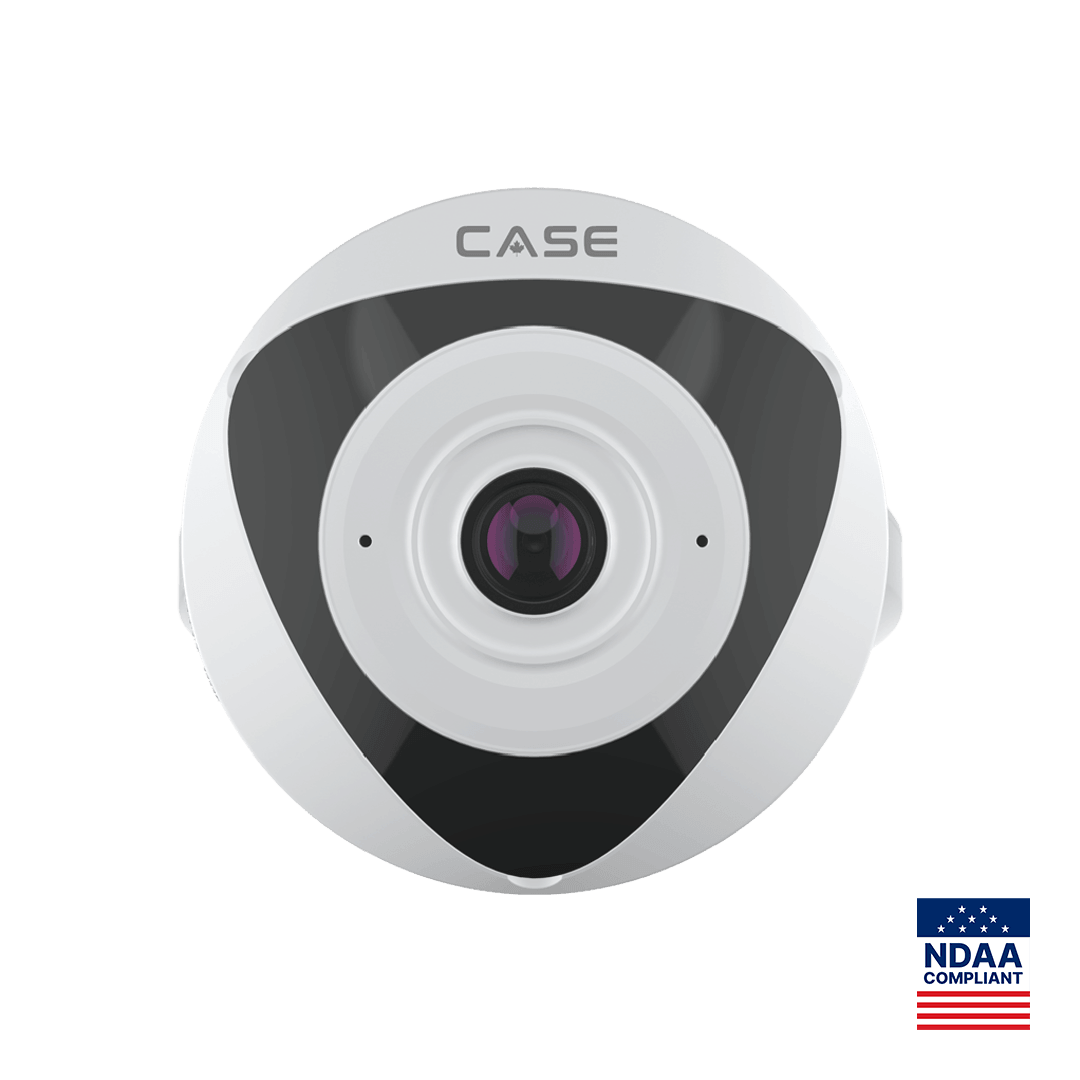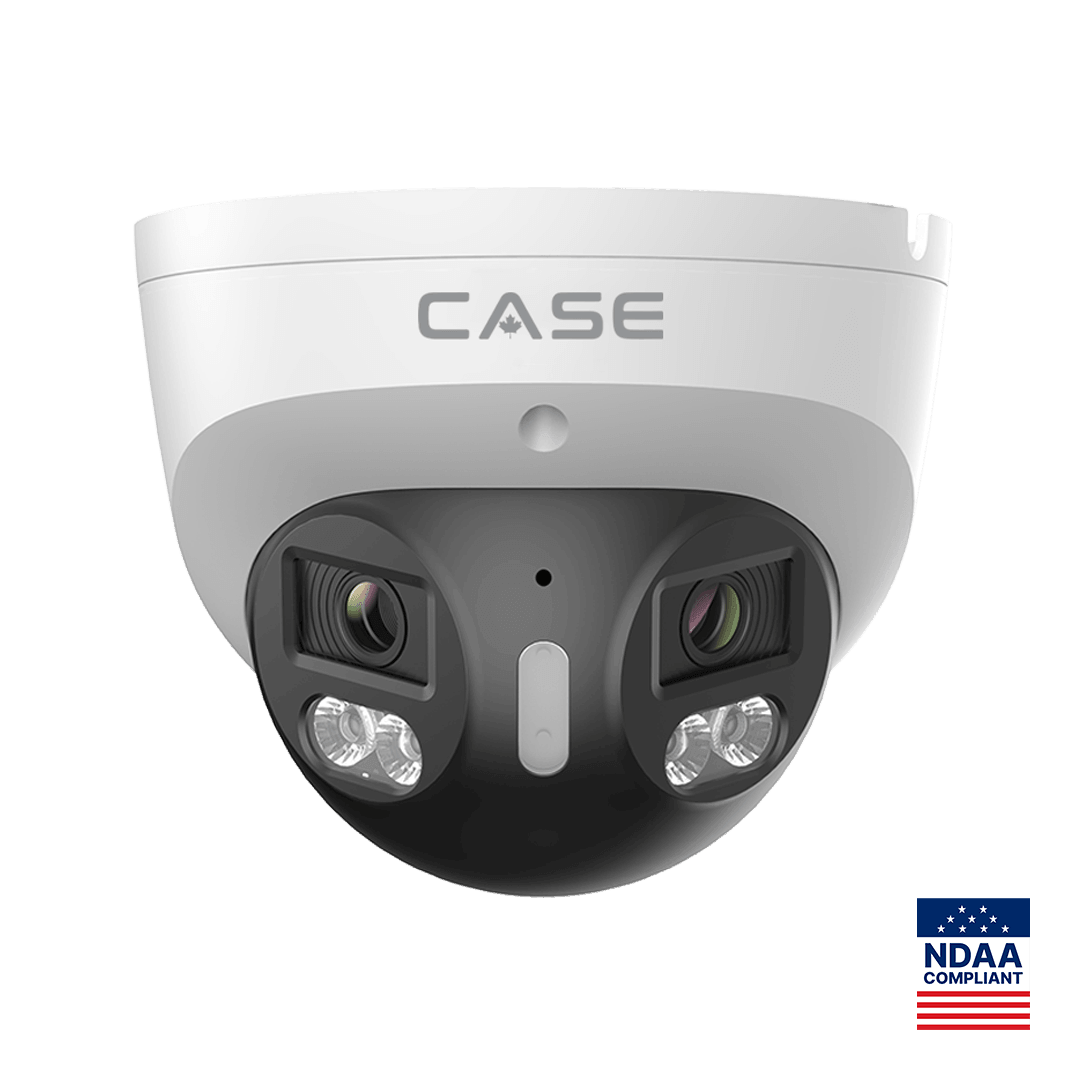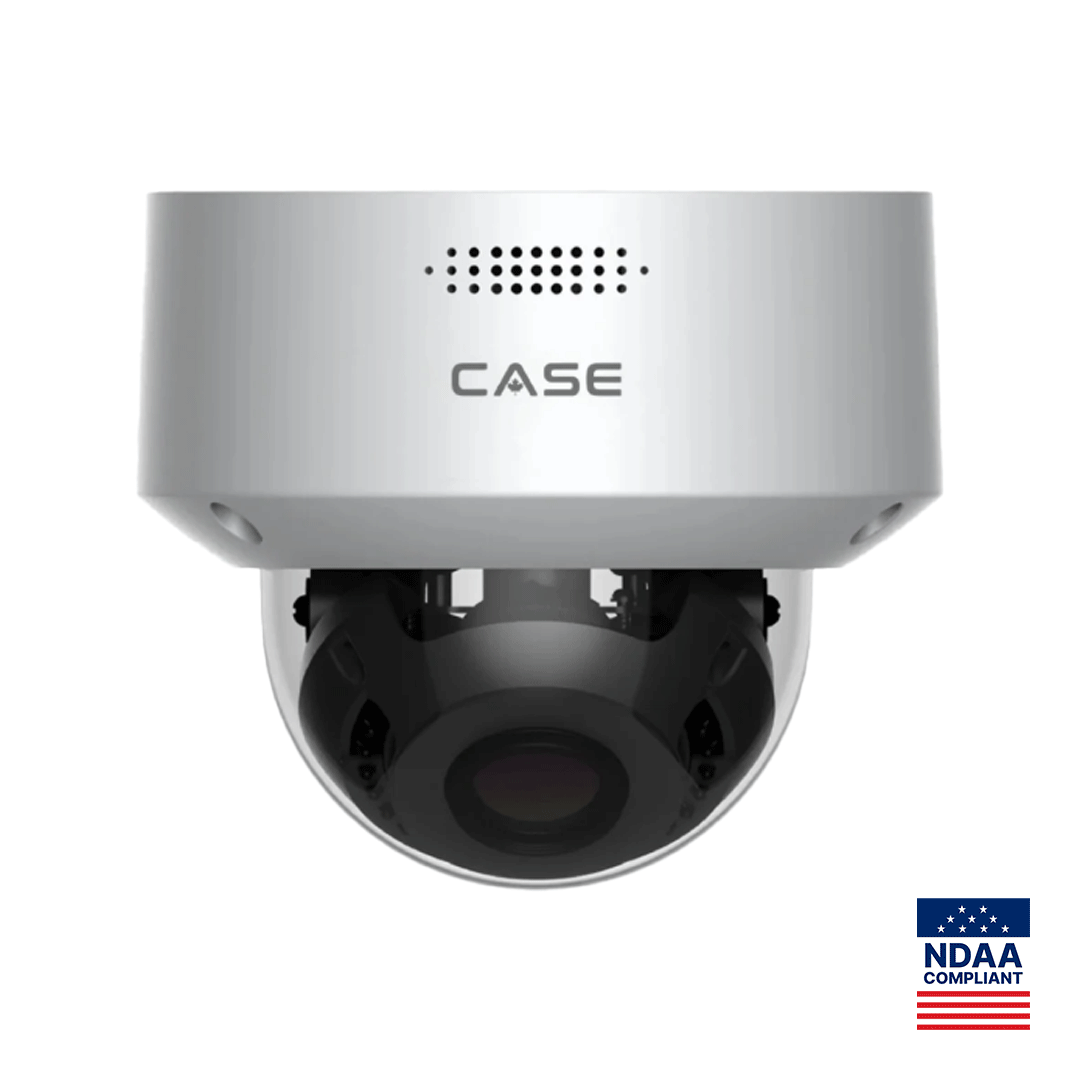


Quick answer: A ceiling-mounted fisheye security camera covers a whole room from one point and one cable, and with dewarping it is viewed as a panorama, a quad split or a virtual PTZ. Its limit is detail: pixels are spread over a hemisphere, so faces near the edges are small and people under the lens are seen from above. Use a fisheye for overview, flow and heatmaps in open rooms with ceilings around 9 to 12 ft (2.7 to 3.7 m); use a 180° stitched unit along a wall and fixed cameras at doors and registers where identification is the job. CASE’s indoor unit is CS-I5VN S-1.4mm, printed 5MP, 2592×1944@30fps, with Heatmap on its AI row.
How does fisheye coverage work, and what is dewarping?
A fisheye lens, 1.4mm on CS-I5VN S-1.4mm, projects a very wide field onto the sensor as a circle: straight lines bend, the center is magnified and the edges are compressed. Mounted on a ceiling and pointed straight down, one camera sees the floor in every direction. The raw circle is awkward to watch, so the image is dewarped: software maps it back to a flat view. The usual modes are a 360° or two 180° panoramas, a quad split that looks like four cameras, and a virtual PTZ that pans and zooms inside the recorded circle after the fact. Which modes exist, and whether dewarping runs on the camera, on the NVR or in the desktop software CASE Station, is confirmed per model, firmware and software version before it is written into a proposal.
Two consequences shape the design. Dewarping does not add pixels: a quad view of a 5MP circle divides the same 2592×1944 among four tiles. And the recording decision matters: recording the raw circle keeps every direction for later virtual PTZ; recording dewarped views fixes the framing at install time. Settle it with the customer before commissioning and label the choice in the handover documents.
- Mount at the center of the room, lens straight down; off-center mounts waste half the circle on a wall.
- Confirm the dewarping path (camera, NVR or desktop software) and the live view available in CASE Connect for that model.
- Decide raw-circle recording or dewarped recording with the customer and document it.
- Draw Tripwire or Perimeter rules on the dewarped view the firmware supports, and test them at the room edges.
Ceiling height and detail at the edges: how much do you lose?
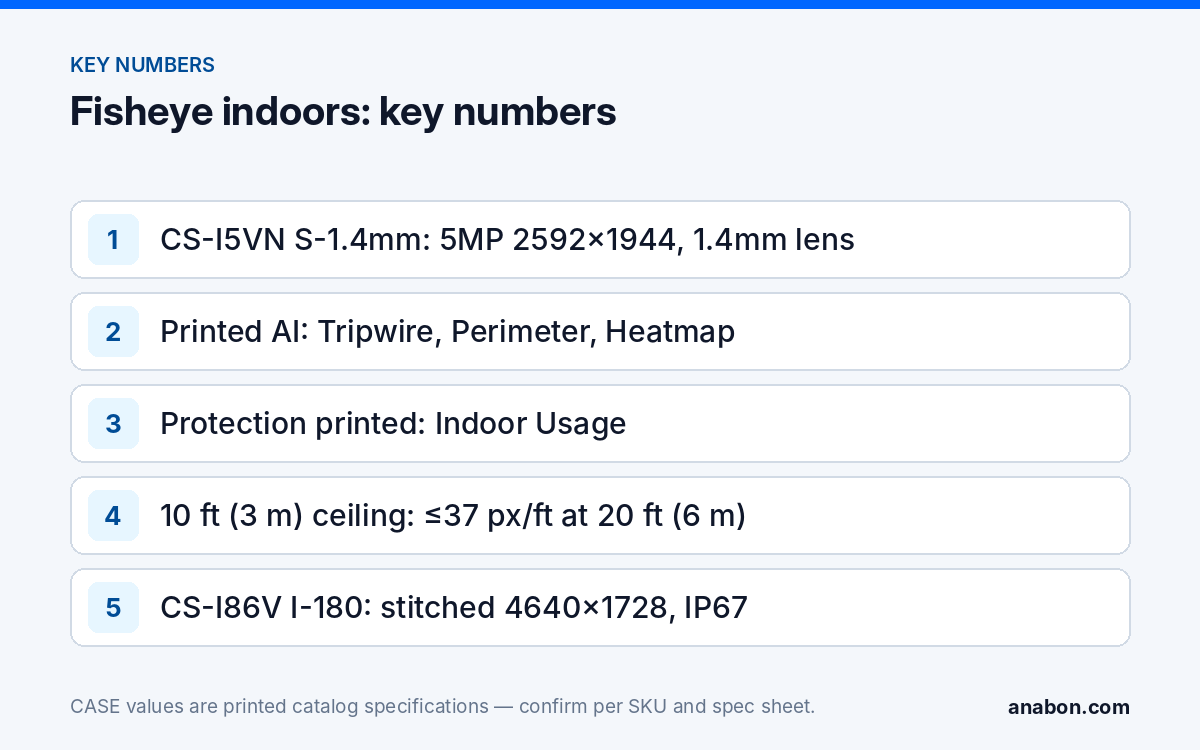
The fisheye trades detail for coverage, and the trade worsens with distance from the point under the camera. Near the center, a person is seen from above at high pixel density: the top of a head, not a face. Toward the edge, the person is seen more from the side, but at a long slant distance in the compressed part of the image. The table is a planning approximation for 2592 pixels spread across a 180° view, an upper bound (on a 2592×1944 sensor the image circle is often closer to 1944 pixels across, which lowers every figure by about a quarter; the exact angle and image circle of a SKU are on its spec sheet) on a 10 ft (3 m) ceiling, using the IEC 62676-4 yardstick of 7.6 px/ft (25 px/m) to detect, 19 px/ft (63 px/m) to observe, 38 px/ft (125 px/m) to recognize and 76 px/ft (250 px/m) to identify.
| Distance from the point under the camera | Slant distance to the subject | Approximate density | What it supports |
|---|---|---|---|
| Directly below | 10 ft (3.0 m) | 82 px/ft (270 px/m) | Identify-level pixels, but a top-of-head view |
| 10 ft (3 m) | 14 ft (4.3 m) | 58 px/ft (190 px/m) | Recognize a known person |
| 20 ft (6 m) | 22 ft (6.8 m) | 37 px/ft (121 px/m) | Observe; borderline recognize |
| 30 ft (9 m) | 32 ft (9.6 m) | 26 px/ft (85 px/m) | Observe: clothing, direction, what is carried |
| 40 ft (12 m) | 41 ft (12.6 m) | 20 px/ft (66 px/m) | Detect and follow movement |
Read it with the room. A 40 × 40 ft (12 × 12 m) sales floor with the camera at the center keeps every point within 28 ft (8.5 m) horizontally, so the whole floor sits in observe territory and the central aisles in recognize territory. A 60 × 80 ft (18 × 24 m) floor needs two fisheyes or a different approach; a 14 ft (4.3 m) ceiling moves the whole table down one row. Shelving and partitions above eye level block the grazing view at the edges whatever the arithmetic says: walk the room and look up from the far corners before you quote one camera.
Heatmaps and people flow: where does a fisheye pay?
The fisheye’s natural job is behavior, not identity. One camera over a sales floor, a showroom, a lobby or an open-plan office records where people go and how long they stay, and the Heatmap function printed on CS-I5VN S-1.4mm turns that into a color overlay of dwell and traffic. For a retailer that is merchandising data: which end cap draws people, which aisle is dead, where the queue forms at noon. For a facility manager it is space utilization. The same camera also shows the whole sequence of an incident, entrance to exit, that a dozen narrow cameras would cut into clips.
Set expectations on the data. A heatmap is aggregate and anonymous, which keeps it clear of the biometric questions face recognition raises under state laws (US) and PIPEDA and provincial privacy laws (Canada); signage for video recording is still expected, and counsel verifies the rest. People Counting is not printed on CS-I5VN S-1.4mm; it is printed on other CASE SKUs such as CS-I8MS I-2.7-13.5mm, so a customer who wants counts at the door gets a dome there, not a count from the fisheye. How heatmap results are displayed and exported is confirmed per NVR model, software version and firmware. Retail layouts are covered in retail security cameras.
Multi-sensor and panoramic alternatives: when is one camera the wrong shape?
A multisensor camera puts two or more independent sensors in one housing, each with its own lens and stream: several conventional views from one mount and one cable. A 180° stitched camera joins two sensors into one wide frame. Both keep a normal perspective, which the fisheye gives up, and both are shaped for a wall, not a ceiling. CS-I86V I-180 is the CASE stitched unit: 8MP (4+4), 4640×1728@25fps, IR and white light 98 ft (30 m), PhotonX at 0.0009 Lux, IP67 and Metal; on the long wall of a room it covers the floor in one undistorted strip with far more pixels per foot across the width than a ceiling fisheye. Stitched and non-stitched units are compared in 180 degree security cameras.
| Indoor question | Ceiling fisheye | 180° stitched on a wall | Several fixed cameras |
|---|---|---|---|
| Coverage shape | Full circle around one point | Wide strip in front of one wall | Whatever you aim |
| Perspective | Top-down center, grazing edges; needs dewarping | Normal, one continuous frame | Normal |
| Faces and registers | Poor beyond the near zone | Good along the near half of the strip | Best: one camera per door or register |
| Cables, mounts, NVR channels | One, one, one | One, one, one (stitched) | One per camera |
| Best for | Open rooms, flow, heatmaps, incident overview | Long rooms, frontages, corridors seen from the end wall | Entrances, POS, stock rooms, anything that must identify |
In practice the indoor design is a mix: one fisheye for the floor, a 180° unit along the long wall of a rectangular room, and fixed cameras at the doors and registers. The fisheye explains what happened; the fixed cameras say who.
CASE fisheye: CS-I5VN S-1.4mm as printed in Catalog 2027 Q1
| Row | Printed value | What it means on site |
|---|---|---|
| Image sensor / lens | 5MP / 1.4mm Fixed | One circle of 2592×1944@30fps; field of view is not printed, confirm on the spec sheet |
| Protection | Indoor Usage | Indoor only: no outdoor, canopy or wash-down positions |
| Max. IR distance | 98 ft (30 m) | Lights-off coverage of a room after hours; min. illumination 0.02 Lux |
| AI | Tripwire, Double Tripwire, Perimeter, Heatmap | Rules on the dewarped view plus dwell and traffic overlay; no People Counting printed |
| Audio / alarm I/O | 1/1 · 1/1, built-in microphone | External speaker or panel input possible; no built-in speaker |
| WDR · Housing | 120dB · Metal+plastic | Handles a lobby with glass doors; Metal+plastic housing as printed |
| Memory slot · Operating range | 512 GB · −40 to 149 °F (−40 to 65 °C), 0~95% RH | Edge recording; a cold-storage candidate indoors, condensation confirmed per spec sheet |
Two cautions from the catalog page. The protection row prints Indoor Usage, so the unit is not quoted for a loading canopy or a parking structure however convenient the ceiling looks. No field-of-view or mounting-orientation row is printed, so the angle, the dewarping modes and the supported mounting positions come from the spec sheet and firmware. CASE cameras carry a 6-year warranty, handled through the installer or dealer. To show the customer a dewarped view of their own floor: for approved demo products we provide a 90-day test period under the approved demo return process. This is not a general return policy. In detail: CS-I5VN S-1.4mm and CS-I2PN S-3.7mm.
What to tell your customer
“The camera in the middle of the ceiling sees the whole floor from one point. It shows the full picture, where people go and how long they stay, and gives you a heatmap of your floor; it does not identify faces, the cameras at the doors and registers do that. We centered it in the room, set the view the way you asked, and confirmed the far corners on screen before handover.”
FAQ
Is a fisheye security camera good for identifying people?
No. Pixels are spread over a hemisphere, so a person directly below is seen from above and a person at the edge is small and viewed at a grazing angle. On a 10 ft (3 m) ceiling a 5MP fisheye reaches roughly recognize density within about 10 ft (3 m) horizontally and observe density beyond. Use it for overview, flow and heatmaps, and fixed cameras for faces.
What is dewarping on a 360 camera indoor?
Dewarping is the software step that maps the fisheye’s circular image back to flat views: a panorama, a quad split or a virtual PTZ the operator can pan and zoom inside the recording. It adds no pixels; a quad view shares the same 2592×1944 among four tiles. Whether it runs on the camera, the NVR or CASE Station, and which modes exist, is confirmed per model, firmware and software version.
How high can the ceiling be for a fisheye camera?
Around 9 to 12 ft (2.7 to 3.7 m) is the comfortable range for a 5MP unit; higher ceilings lower the density everywhere and move the whole coverage table down a row, while very low ceilings put heads too close to the lens and increase occlusion by shelving. Above about 14 ft (4.3 m), consider two fisheyes, a 180° unit on the wall or fixed cameras.
Does a fisheye camera count people?
Not every model. CS-I5VN S-1.4mm prints Tripwire, Double Tripwire, Perimeter and Heatmap on its AI row and no People Counting; counting is printed on other CASE SKUs such as CS-I8MS I-2.7-13.5mm, usually placed over a doorway. A heatmap shows where people spent time and how traffic flowed; it does not produce a count. Confirm the function per SKU and firmware before promising numbers.