


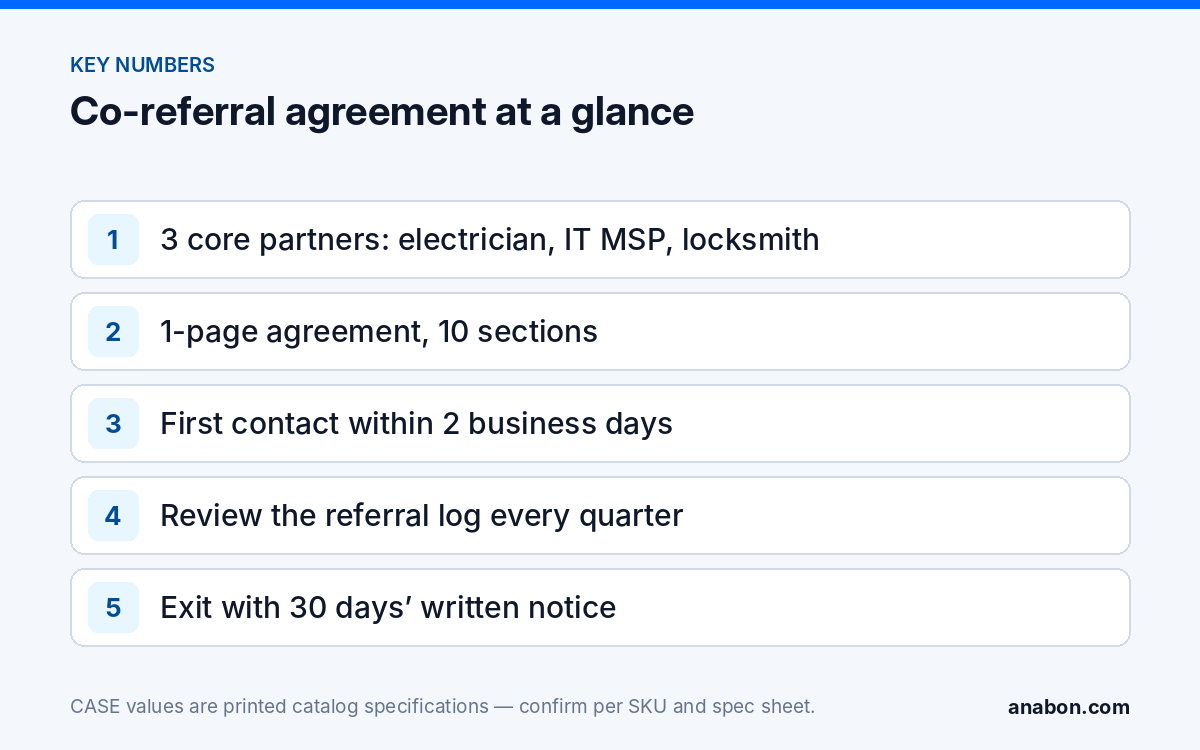
Quick answer: A co-referral agreement is a one-page understanding between your security company and a trade that meets your customers first, typically a licensed electrician, an IT managed service provider (MSP) or a locksmith. It defines what counts as a qualified referral, who owns the customer, how each side says thank you, and how referrals are logged and reviewed. Keep it simple, reciprocal and in writing, and have it reviewed for your state or province; this article is not legal advice.
Why do co-referral partners work better than bought leads?
Bought leads reach a customer who is already comparing several companies. A trade partner reaches the customer earlier, at the moment the need appears: the electrician doing a tenant fit-out who notices there is no camera wiring, the MSP replacing a firewall who hears that the old recorder is exposed to the internet, the locksmith rekeying a back door the morning after a break-in. That customer has not started shopping yet, and the introduction comes from someone they already trust.
The partnership also works in the other direction. Your site surveys uncover undersized circuits, flat networks and worn door hardware every week. Passing those to a reliable trade makes you more useful to the customer and gives the partner a reason to keep you in mind. For referral sources beyond trades, see security camera installation leads and the referral program guide.
Who should you partner with, and what does each trade bring?
| Partner | When they meet your customer | What they can refer to you | What you can refer to them | Agree up front |
|---|---|---|---|---|
| Licensed electrician | Tenant fit-outs, panel upgrades, new construction, parking-lot lighting | Camera and recorder rough-in, new buildings, lot coverage | Dedicated circuits for recorders and racks, exterior power, lighting for dark camera positions | Who pulls which cable; electrical work stays with the licensed electrician under the NEC (in Canada, the CEC) |
| IT MSP | Network refreshes, firewall replacements, office moves | Recorder replacements, remote-viewing problems, multi-site customers | Switching, VLANs, firewall rules and internet service for camera traffic | Who owns the camera VLAN and remote-access rules after handover |
| Locksmith | Rekeys after break-ins, door hardware, master key systems | Post-incident coverage, entrances, door-related evidence | Door hardware, rekeys, safes | Where camera work ends and access hardware begins |
Two or three strong partners are better than ten weak ones. Pick companies whose work you would put your own name next to, who answer the phone, and who serve the same commercial customers you want. Property managers, general contractors, alarm monitoring companies and fence and gate installers can join later on the same terms.
What goes into a one-page co-referral agreement?
Copy the outline below into your own document and fill it in with each partner. Keep it to one page so both sides actually read it. Have it reviewed by counsel for your state or province before you sign; requirements differ, and this outline is not legal advice.
| Section | What to write | Example wording |
|---|---|---|
| Parties and purpose | Both company names, contacts, service areas | “The parties will refer suitable commercial customers to each other.” |
| Qualified referral | The definition both sides use (next section) | “A named contact who agreed to be contacted about a real project.” |
| Referral process | How a referral is passed and how fast it is answered | “Introduction by email with the customer copied; first contact within two business days.” |
| Customer ownership | Each side keeps its own customer relationship for its own scope | “Neither party will offer the other party’s core services to a referred customer.” |
| Scope boundaries | Who does what on a mixed job | “Line-voltage work by the electrician; low-voltage cabling and cameras by the security company.” |
| Thank-you and reciprocity | Non-cash or reciprocal recognition, and any fee terms reviewed locally | “Reciprocal referrals, joint customer events and listing on each other’s partner page.” |
| Disclosure | The customer knows a referral relationship exists | “Both parties will tell the customer they work together.” |
| Customer information | What data is shared and how it is protected | “Only contact details needed for the introduction, with the customer’s consent.” |
| Responsibility | Each side quotes, insures and stands behind its own work | “Each party is solely responsible for its own work, warranty and insurance.” |
| Term, review and exit | Length, review cadence, notice to end | “Twelve months, reviewed quarterly, ended by either party with 30 days’ written notice.” |
How do you define a qualified referral so nobody argues later?
Most partnerships break down over one question: did that job come from me? Settle it before the first referral with a short definition both sides sign.
- A named person at a company, with a phone number or email address.
- The customer agreed to be contacted by the receiving company.
- A real need with a location, not a general “they might want cameras someday.”
- Not already an active customer or open quote of the receiving company.
- Inside the receiving company’s service area and type of work.
- Logged in the shared referral log within two business days of the introduction.
A referral that misses one of these is still welcome; it simply does not count toward the quarterly review.
How do you track referrals and keep the partnership fair?
Use one shared sheet per partner, or a tab in the sheet you already run for your pipeline (the simple CRM sheet works). Copy these columns into it:
| Column | What goes in it |
|---|---|
| Date | Date of the introduction |
| From / To | Which company referred and which received |
| Customer | Company name and contact |
| Consent | Yes or no: customer agreed to be contacted |
| Job type | Cameras, power, network, door hardware |
| First contact | Date the receiving company reached the customer |
| Status | Contacted, surveyed, quoted, won, lost, not qualified |
| Thank-you | What was sent and when |
Fairness comes from a few habits rather than from exact accounting:
- Review the log together every quarter: referrals sent, referrals received, response times and outcomes.
- Count introductions, not only won jobs; a partner cannot control your close rate.
- Report back on every referral, including the lost ones and why.
- Expect imbalance; an electrician on new construction may send more than you can return in a given quarter.
- If response times slip twice in a row, raise it at the review rather than quietly stopping referrals.
Which legal and licensing points should you check first?
This section lists questions to take to counsel and your licensing body; it is not legal advice.
- Referral fees. Some licensed trades and some jurisdictions restrict or require disclosure of paid referrals. Check state laws (in Canada, provincial laws) before offering any fee; reciprocal and non-cash thank-yous avoid most of the questions.
- Licensing boundaries. Electrical work follows the NEC (in Canada, the CEC) and local licensing. Low-voltage licensing for security work varies by state and municipality (in Canada, by province); verify the local code.
- Customer data. Share only the contact details needed, with consent. In Canada, PIPEDA and provincial laws apply to personal information; in the US, check state privacy laws.
- Non-solicitation wording. Clauses that restrict who either side may work for can be limited by state or provincial law; keep them narrow and specific to referred customers.
- Insurance. Confirm each partner carries coverage for its own work before you introduce them to a customer.
What if a referral is bigger than your usual job?
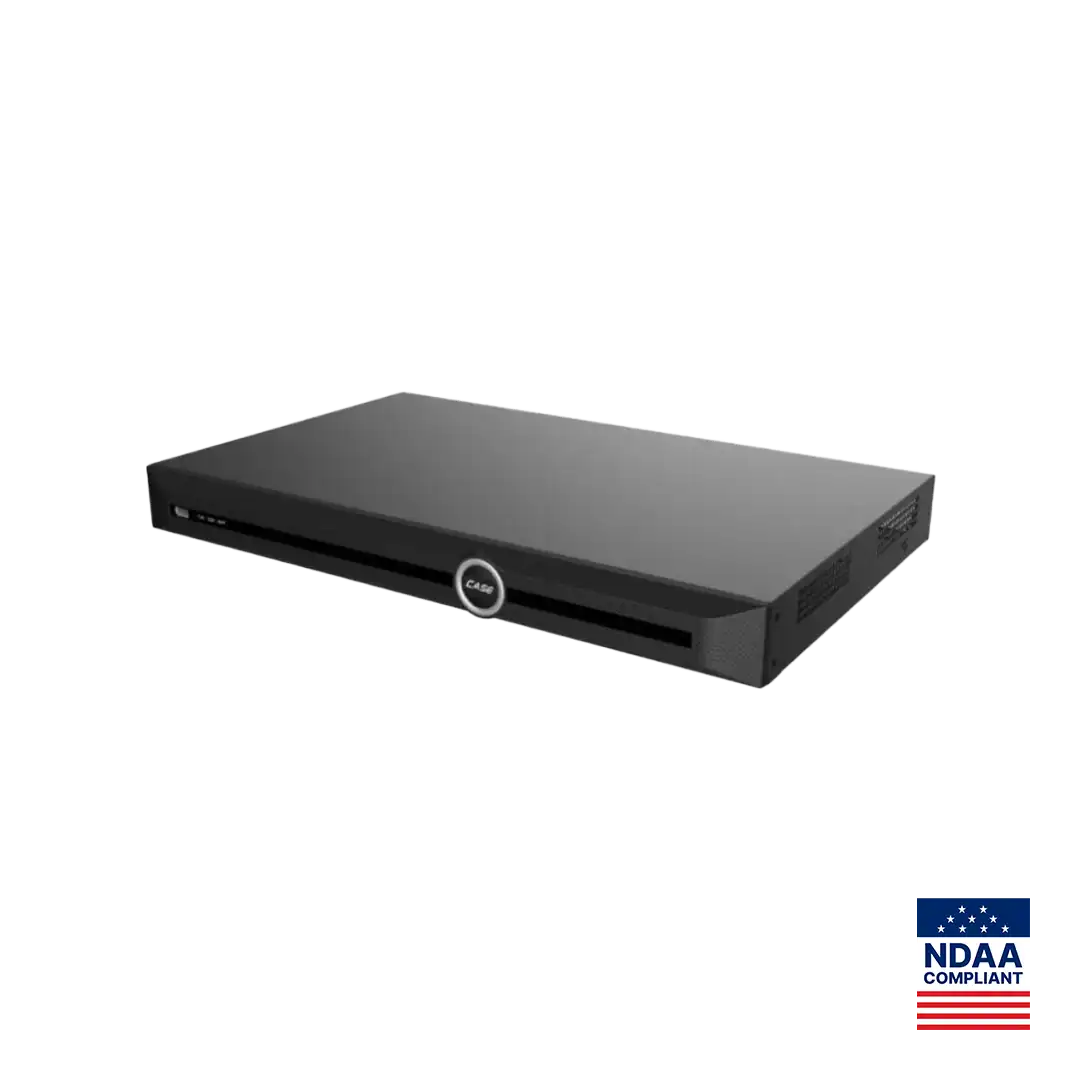
A good trade partner will eventually hand you a warehouse, a multi-building campus or a site with compliance requirements. Do not turn it down because it is larger than your usual work. Bring us the opportunity before you say no. Anabon supports installers, integrators, dealers, and approved business accounts with CASE product distribution, technical support, warranty coordination, and project guidance, and never sells to your customer. A project review before you quote helps you size the recorder, PoE and coverage. For example, a recorder with built-in PoE such as the CS-N220 P16H-AI, with 16 PoE ports as printed, powers its cameras from the recorder, which keeps the electrician’s scope to the circuit feeding the rack.
What to tell your customer
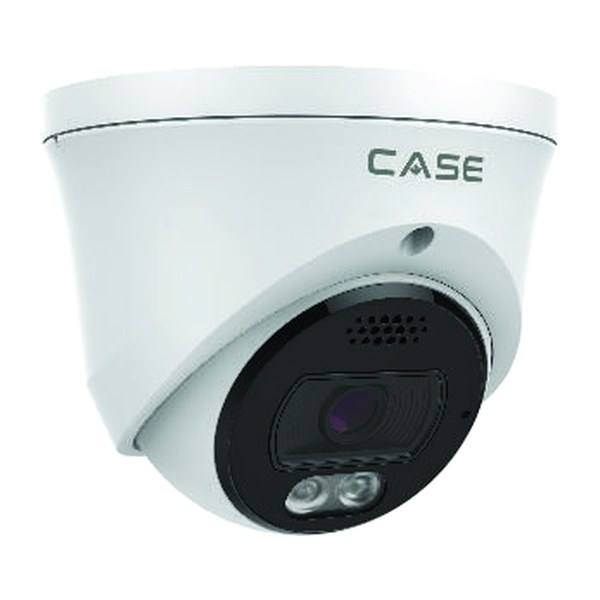
“We work with a licensed electrician and an IT company we trust. If your project needs them, we will introduce you, and each company quotes, insures and stands behind its own work. Your cameras and recorder stay with us: CASE cameras and CASE NVRs carry a 6-year warranty, and you call us for service.”
FAQ
Should I pay referral fees to electricians, MSPs or locksmiths?
Start with reciprocal referrals and non-cash thank-yous, such as joint customer events, a listing on your partner page or priority scheduling. Paid referral fees can be restricted or require disclosure in some licensed trades and jurisdictions, so check state laws (in Canada, provincial laws) and have counsel review the terms before you offer any fee.
How do we split a job that needs an electrician and a security installer?
Write the boundary into the agreement and into each quote. Line-voltage work, such as new circuits and exterior power, stays with the licensed electrician under the NEC (in Canada, the CEC). Low-voltage cabling, cameras, recorders and configuration stay with you. Each company quotes its own scope directly to the customer and stands behind its own work.
What if an IT MSP partner wants to install cameras too?
Raise it at the quarterly review instead of letting it fester. Agree on the boundary: many MSPs prefer to own the network, VLANs and firewall rules and leave cameras, recorders and site work to a security specialist. If both companies want the same work, end the agreement cleanly with the notice period you set rather than competing for the same referred customers.
How many referral partners should a small security company have?
Two or three active partners are usually enough to start: one electrician, one IT MSP and one locksmith who serve the same commercial customers you want. Add partners only when you can respond to their referrals within the agreed time. A partner who waits a week for a callback stops referring, however good the agreement looks on paper.
Do I need a lawyer for a one-page referral agreement?
Having counsel review it once is worth the time, because referral fees, non-solicitation wording and customer data sharing are treated differently by state and province. After that review, reuse the same outline with each partner and change only names, service areas and scope boundaries. This article describes common practice and is not legal advice.