

Quick answer: Specify a fixed 2.8 mm lens where the camera sits close to what it must show: doors, lobbies, counters, short corridors and gate throats. Specify a varifocal lens where the distance or scene width is uncertain at quote time, where the only mounting point is far from the subject, or where one model must cover several positions. A motorized varifocal moves the final framing from the ladder to the NVR screen and allows re-framing without a truck roll; on the CASE line, “Motorized” is printed on CS-I4KS L-2.8-12mm and CS-I4US L-2.8-12mm.
What does a varifocal lens actually buy you?
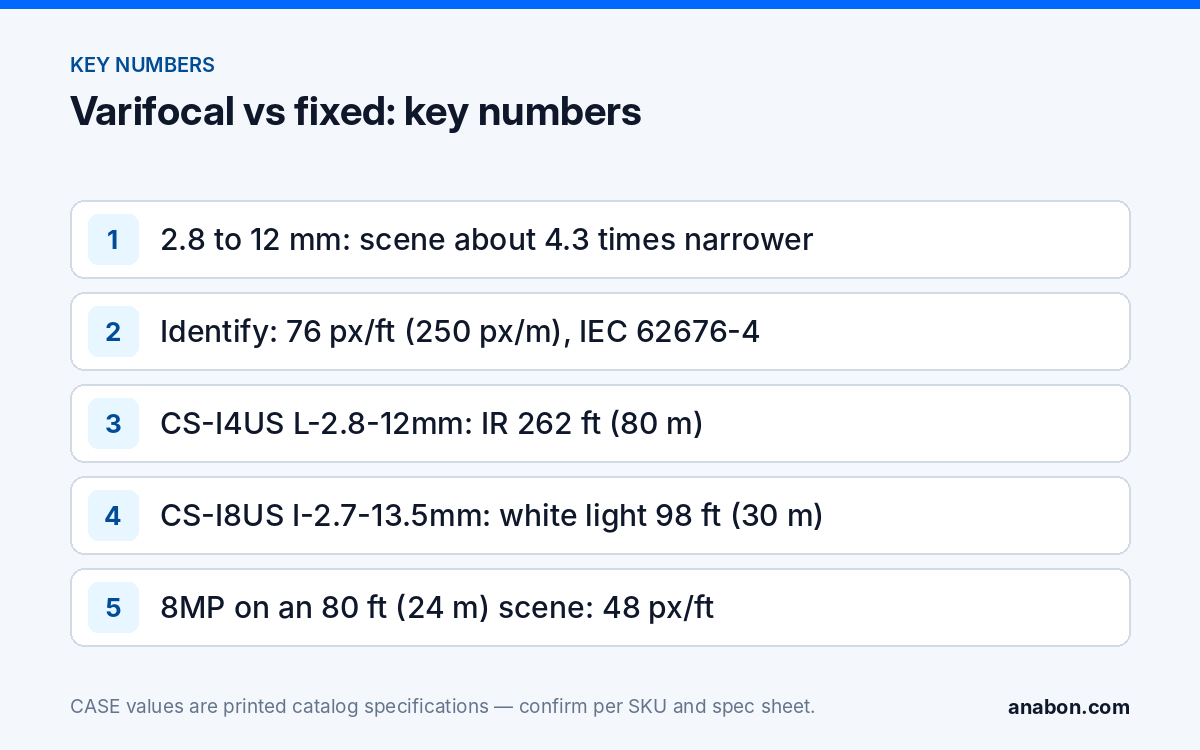
A varifocal lens lets you set the focal length after the camera is mounted, anywhere inside the printed range. Focal length controls how wide the scene is at the distance of the subject, and therefore how many pixels land on a person or a plate. Scene width at a given distance is proportional to that distance divided by the focal length, so moving from 2.8 mm to 12 mm makes the scene about 4.3 times narrower and puts about 4.3 times as many pixels on the same subject; 2.7 mm to 13.5 mm is a factor of 5.
Pixel density decides whether footage is usable. IEC 62676-4 gives the usual yardstick: about 7.6 px/ft (25 px/m) on the subject to detect a person, 19 px/ft (63 px/m) to observe, 38 px/ft (125 px/m) to recognize someone already known, and 76 px/ft (250 px/m) to identify a stranger. The table shows what the two CASE resolution classes deliver for a given scene width at the subject: 2560 pixels across on the 4MP units (printed 2560×1440) and 3840 on the 8MP units (printed 3840×2160).
| Scene width at the subject | 4MP, 2560 px across | 8MP, 3840 px across | What that density supports |
|---|---|---|---|
| 20 ft (6 m) | 128 px/ft (420 px/m) | 192 px/ft (630 px/m) | Identify a stranger |
| 40 ft (12 m) | 64 px/ft (210 px/m) | 96 px/ft (315 px/m) | Recognize; identify with 8MP |
| 80 ft (24 m) | 32 px/ft (105 px/m) | 48 px/ft (157 px/m) | Observe; recognize with 8MP |
| 160 ft (49 m) | 16 px/ft (52 px/m) | 24 px/ft (79 px/m) | Detect and observe only |
A fixed lens fixes the scene width for each distance; a varifocal lets you narrow the scene until the subject row reaches the density the customer is paying for. For the angle each focal length gives on a specific sensor, use the SKU spec sheet and the camera field of view and lens calculator.
Fixed lens: when 2.8 mm is right
Most cameras on most jobs should still be fixed-lens: in the first zone in front of the camera 2.8 mm gives the widest useful scene, there is nothing to set on site, nothing to drift, and nothing to document except the aim. A fixed lens camera is the right call when the subject must pass close to the camera anyway.
- Doors, vestibules and gate throats: the person walks through a 3 to 6 ft (1 to 2 m) opening at a known distance.
- Lobbies, cash counters and reception desks: a wide scene a few yards deep, where context matters as much as density.
- Short corridors, stairwells and elevator lobbies: the far end is inside the pixel budget, and a narrow lens would miss the side doors.
- Repeat positions on a multi-site rollout: one fixed SKU, bench-configured and aimed the same way.
The limit is arithmetic from the table: with 2560 pixels across, identification density holds only while the scene is about 33 ft (10 m) wide or less; with 3840 pixels, about 50 ft (15 m). Beyond that width a fixed camera observes and detects; it does not identify. Housing is a separate decision, covered in bullet vs dome camera vs turret.
The hidden cost: ladder time versus remote focus
The varifocal decision is as much about labor as optics, and the labor never appears on the bill of materials. A manual varifocal is set with the dome open, on a ladder, with a monitor in the other hand; the bubble goes back on and the image is checked again because the bubble shifts it. A new framing after the first night’s footage is a second visit; a re-striped lot is a third.
A motorized varifocal camera moves zoom and focus to the NVR menu or the camera’s web page: framing is set from the ground, repeated for ten cameras from one chair, and changed later from the office. On the CASE line, “Motorized” is printed in the lens row of CS-I4KS L-2.8-12mm and CS-I4US L-2.8-12mm. The 2.7-13.5 mm units (CS-I8MS SD-2.7-13.5mm, CS-I8MS I-2.7-13.5mm, CS-I8TS I-2.7-13.5mm and CS-I8US I-2.7-13.5mm) print the lens range only; the adjustment method and any remote zoom and focus path are confirmed per SKU on the spec sheet and per firmware before you quote them as remote-adjustable.
Count the time before you choose:
- Cameras whose final framing cannot be known before the mount is up: far rows, long drives, positions chosen on a drawing.
- Minutes per camera for a ladder-based zoom and focus, including the night check, multiplied by those cameras.
- Expected re-framings in the first year and the travel time of each.
One short visit in total: a fixed or manual varifocal lens is fine. Several visits: the motorized unit pays for itself in truck rolls, and the proposal should say so in those words: framing adjusted from the recorder, no ladder for later changes.
Scenarios: corridors, parking lots and loading docks
Corridors. A fixed 2.8 mm camera at the end of a 100 ft (30 m) corridor identifies in the first stretch and only observes the rest, because the scene widens past the walls into ceiling and floor. A varifocal set toward the long end of its range narrows the scene to the corridor width and pushes recognition density most of the way down; side doors near the camera drop out of frame, so a second wide camera at the far end often completes the pair.
Parking lots. The mounting point is usually a building corner or a light pole 100 to 200 ft (30 to 60 m) from the rows the customer cares about. A 2.8 mm lens shows the whole lot as context with a handful of pixels per car in the far row; a varifocal narrows to the entrance lane or the row with the most incidents. For night work the printed IR distance matters: CS-I4US L-2.8-12mm and CS-I8TS I-2.7-13.5mm both print 262 ft (80 m) of IR, the illuminator’s rated throw, not an identification range. Layout rules are in parking lot security cameras.
Loading docks. The dock camera looks from the wall at a trailer door 30 to 60 ft (9 to 18 m) away, against daylight outside and shadow inside. The varifocal frames exactly the door and the trailer tail, and WDR decides whether the driver’s face survives the backlight: CS-I8MS SD-2.7-13.5mm and CS-I8MS I-2.7-13.5mm print 120dB; CS-I8TS I-2.7-13.5mm and CS-I8US I-2.7-13.5mm print “120dB, True WDR (TWDR)”. Dock layout is covered in warehouse security cameras.
CASE varifocal line-up as printed in Catalog 2027 Q1
| SKU | Form · Series | Lens (as printed) | Resolution | IR | White light | Protection · Housing | Operating range |
|---|---|---|---|---|---|---|---|
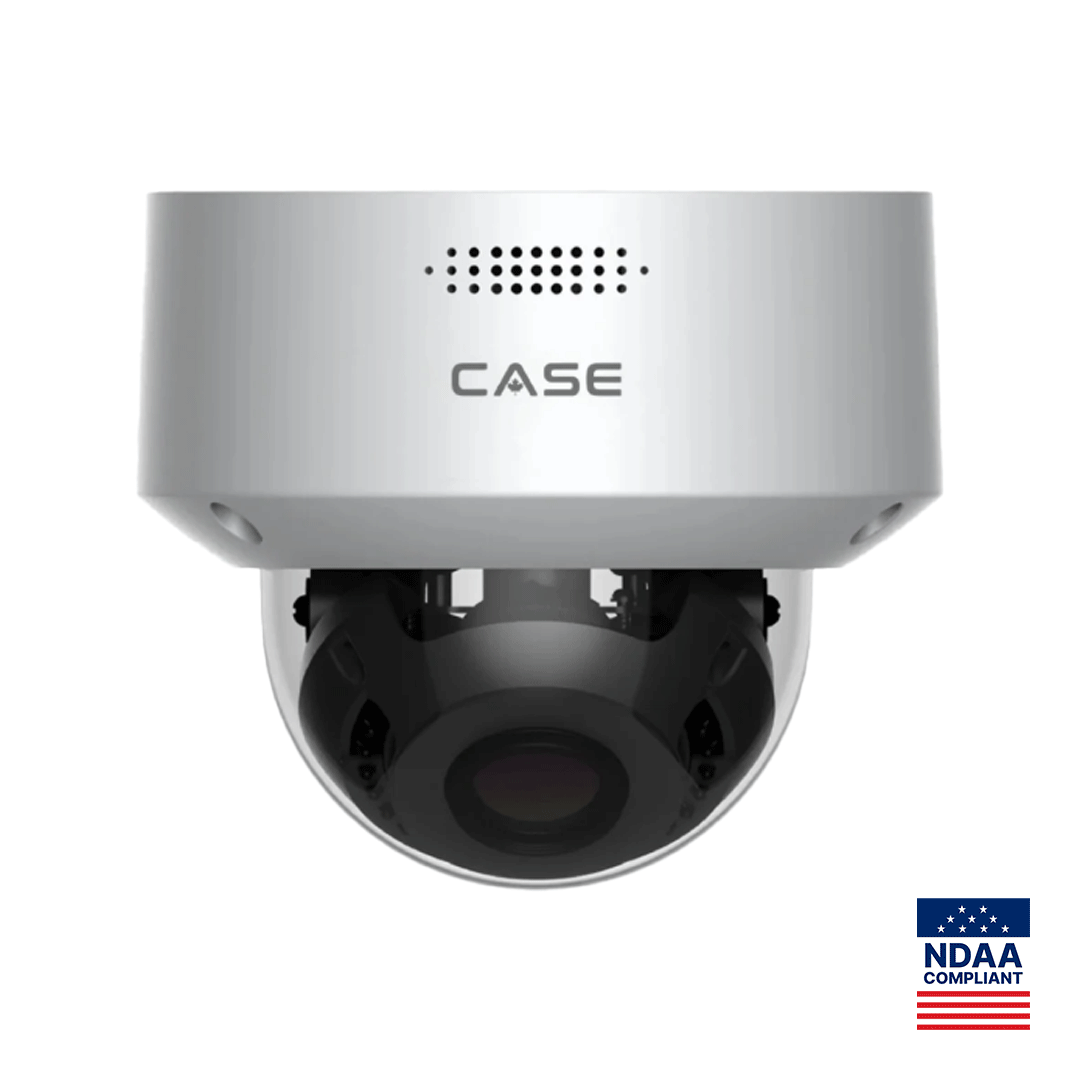
| CS-I4KS L-2.8-12mm | Dome · Value | Motorized 2.8-12 mm | 2560×1440@30fps | 98 ft (30 m) | N/A | IP67, IK08 · Plastic | −22 to 140 °F (−30 to 60 °C) |
| CS-I8MS SD-2.7-13.5mm | Dome · Sharp | 2.7-13.5 mm | 3840×2160@20fps | 164 ft (50 m) | 49 ft (15 m) | IP67, IK10 · Metal | −31 to 149 °F (−35 to 65 °C) |
| CS-I8MS I-2.7-13.5mm | Dome · Intelligent | 2.7-13.5 mm | 3840×2160@30fps | 164 ft (50 m) | N/A | IP66, IK10 · Metal | −31 to 149 °F (−35 to 65 °C) |
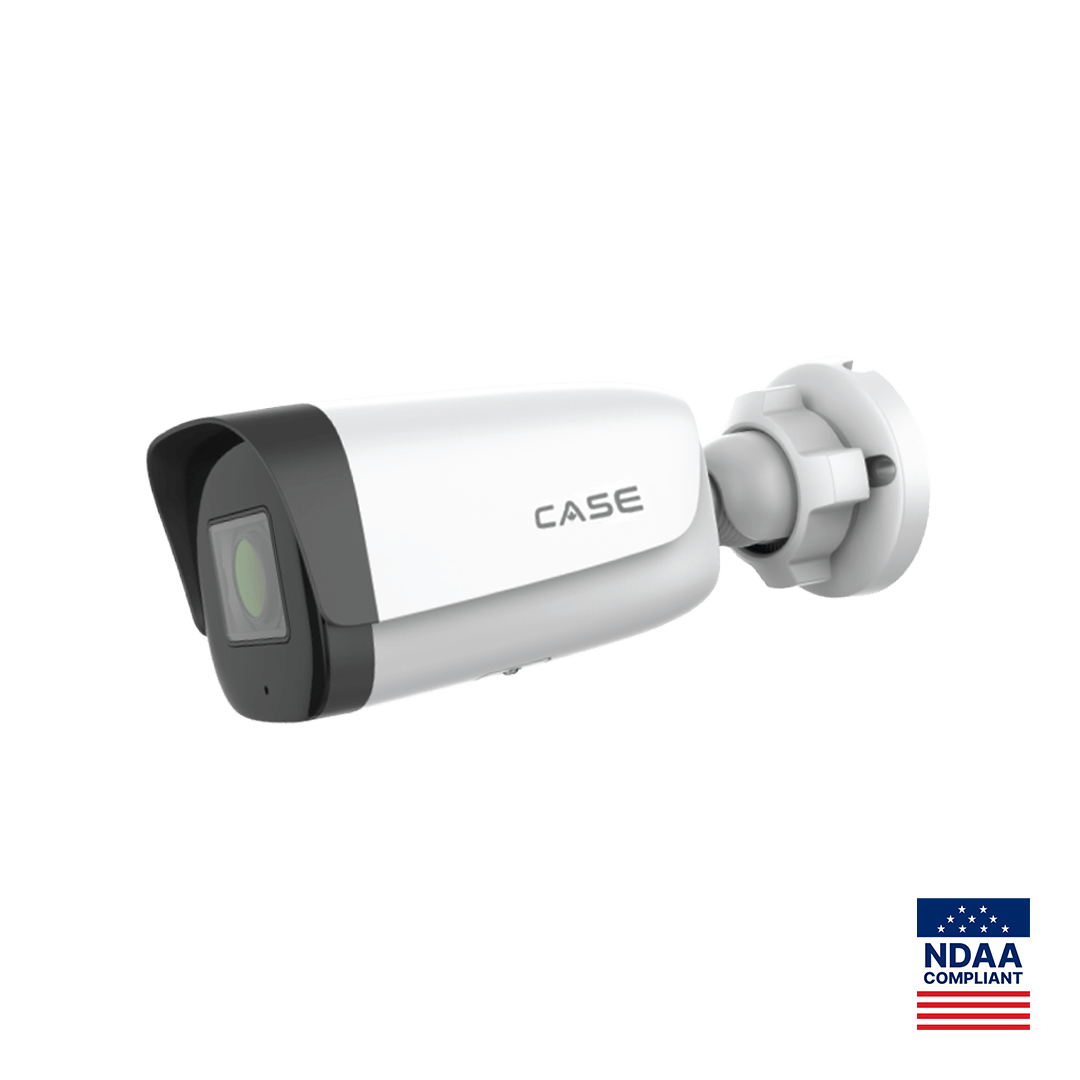
| CS-I4US L-2.8-12mm | Bullet · Value | Motorized 2.8-12mm | 2560×1440@30fps | 262 ft (80 m) | Not printed | IP67 · Metal + Plastic | −22 to 140 °F (−30 to 60 °C) |
| CS-I8TS I-2.7-13.5mm | Bullet · Intelligent | 2.7-13.5 mm | 3840×2160@30fps | 262 ft (80 m) | None (printed for CS-I8US I-2.7-13.5mm only) | IP67 · Metal | −31 to 149 °F (−35 to 65 °C) |
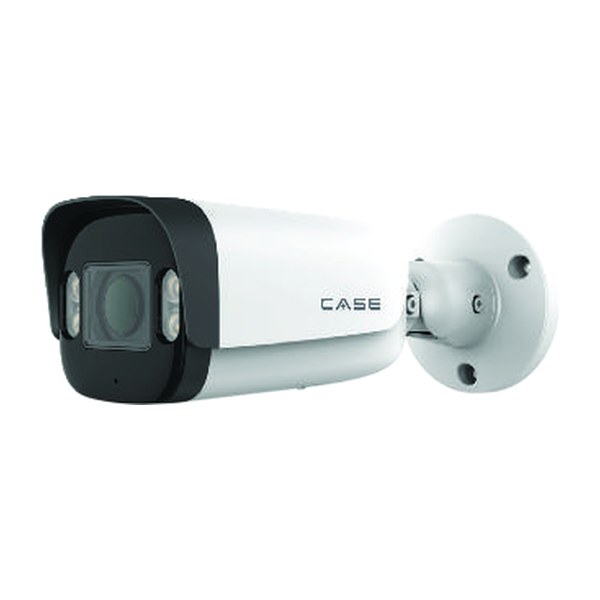
| CS-I8US I-2.7-13.5mm | Bullet · Intelligent, new in 2027 Q1 | 2.7-13.5 mm | 3840×2160@30fps | 262 ft (80 m) | 98 ft (30 m) | IP67 · Metal | −31 to 149 °F (−35 to 65 °C) |
The rows that decide the pick. White light is printed for CS-I8US I-2.7-13.5mm only, the variant new in 2027 Q1; CS-I8TS I-2.7-13.5mm is IR only. CS-I8MS I-2.7-13.5mm prints no white light but carries a 16-function on-camera AI row, from Tripwire and Perimeter to Heatmap, People Counting and Safety Helmet Detection; CS-I8TS I-2.7-13.5mm and CS-I8US I-2.7-13.5mm also print 16 functions, adding Non-motor Vehicle and Pet classification. The two Value SKUs print “Smart Alarm (Human & Vehicle Detection)” and no audio or alarm I/O; the Intelligent units print audio 1/1 and alarm 2/1, the Sharp dome 1/1 and 1/1. All six print a 512 GB memory slot and S+265. CASE cameras carry a 6-year warranty, handled through the installer or dealer. To show the customer the framing before committing: for approved demo products we provide a 90-day test period under the approved demo return process. This is not a general return policy.
What to tell your customer
“Where a camera is close to the people it needs to show, we specified a fixed wide lens: nothing to adjust, nothing to drift. Where a camera has to reach across the lot or down the corridor, we specified a varifocal lens and set the zoom so the area that matters has enough pixels to identify a person; on the motorized units we can re-frame from the recorder without a ladder. We confirmed every framing on site, by day and at night, before handover.”
FAQ
Is a motorized varifocal camera worth it over a fixed lens?
It is when the framing cannot be settled before the mount is up, or will change later. The optics are the same at any given focal length; what you buy is the ability to set zoom and focus from the recorder instead of a ladder, and to re-frame without a visit. On close positions such as doors and counters a fixed 2.8 mm lens does the job.
What does a 2.8-12mm camera mean in practice?
The lens can be set anywhere between 2.8 mm, the widest scene, and 12 mm, the narrowest: about 4.3 times narrower, with about 4.3 times the pixels on the subject at the same distance. CS-I4KS L-2.8-12mm and CS-I4US L-2.8-12mm print Motorized 2.8-12 mm; the 8MP units print 2.7-13.5 mm, a 5:1 range. The angle at each setting is on the SKU spec sheet.
Does zooming in reduce the IR range?
The printed IR distance is the illuminator’s rated throw and does not change with the lens setting: CS-I4US L-2.8-12mm and CS-I8TS I-2.7-13.5mm print 262 ft (80 m), the varifocal domes 164 ft (50 m) or 98 ft (30 m). Zooming in concentrates pixels, not light, so a subject inside the lit zone gains detail. Check focus at night as well as by day.
Can I set the zoom and focus from the NVR?
On a motorized varifocal camera, zoom and focus are adjusted from the recorder menu or the camera’s web page rather than at the lens. Motorized is printed in the lens row of CS-I4KS L-2.8-12mm and CS-I4US L-2.8-12mm; for the 2.7-13.5 mm SKUs the adjustment method is confirmed on the spec sheet and per firmware before it is promised in a proposal.