


IoT and AI for Integrators: From Sensor Data to Useful Action
Understand how sensing, connectivity and AI fit together. Plan data quality, integration, privacy and field acceptance for a practical IoT project.

By Anabon Security Inc. — Technical Support
On this page
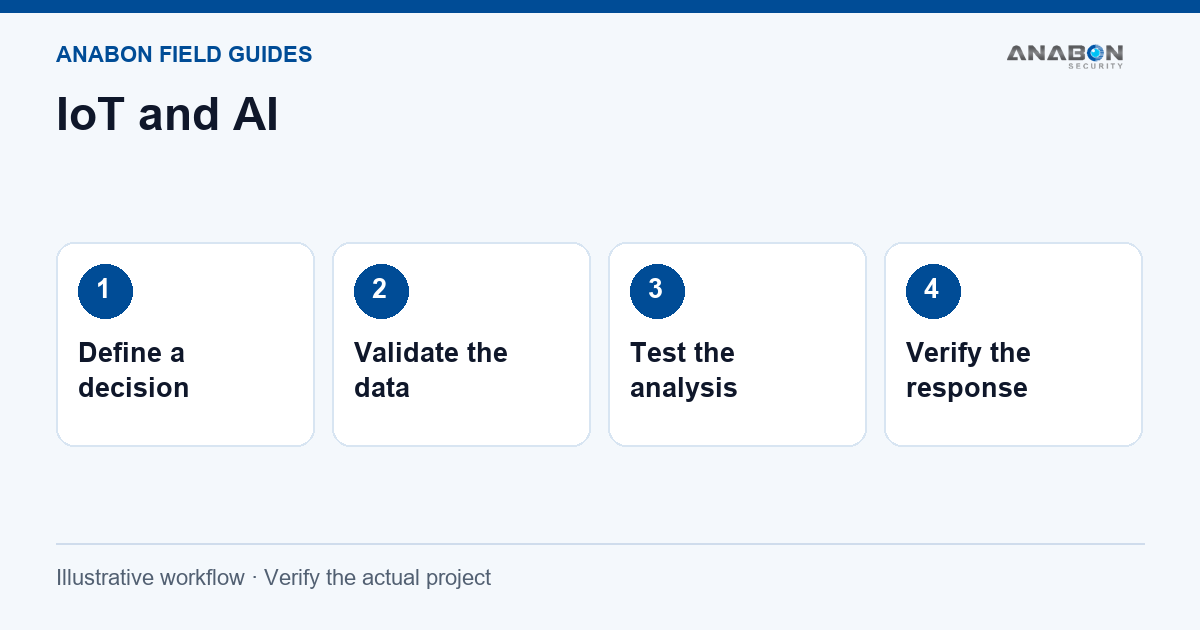
Begin with a decision, not a technology list
A site team wants to know whether a room is being used, whether a valve responded or whether a camera alert needs attention. Each question needs different data and a different response. Start by writing down the decision, who owns it and how quickly it needs to be made.
For an installer or integrator, this keeps the project specific. A dashboard with many readings is not automatically a useful system. Agree on the small set of events or measurements that will change what the operator does.
Keep the four parts of the system clear
| Part | Question to answer |
|---|---|
| Sensing | What does the device measure or observe, and under which conditions? |
| Connectivity | How does that information reach the application, and how is a missing update detected? |
| Analysis | Is a threshold enough, or is a supported analytics function needed? |
| Response | Who receives the result, what will they check, and what action is permitted? |
IoT connects physical devices with systems that exchange their information. AI can be part of the analysis, but many useful projects start with a clear threshold, schedule or status rule. Do not add a model where a simpler tested rule meets the requirement.
Make data quality visible
Check the sensor position, clock, units, reporting interval and device identity. A correct measurement with the wrong room label can lead to the wrong action. A chart that quietly reuses an old value can make a disconnected device look healthy.
Test expected values, missing messages and obvious outliers. Decide whether the system should show stale data, raise an alert or wait for a person to review it. Keep the original measurement separate from any calculated score so that an operator can understand the result.
Choose connectivity for the job
Ethernet, Wi-Fi, cellular and low-power radio networks have different deployment requirements. Compare the data volume, power supply, physical environment and acceptable update interval. Do not assume a low-power sensor network is suitable for continuous video.
LoRaWAN is documented by the LoRa Alliance. A manufacturer-specific device-to-device feature is a separate capability: confirm the exact supported products and configuration. The presence of the word LoRa in two product descriptions does not establish that they can communicate in the required way.
For camera networking, the NVR IP and DHCP guide covers the distinction between address settings and the physical or routed path.
Evaluate analytics in the real scene
Write a small test set from the actual site conditions: normal operation, the intended event and situations that might confuse the rule. Include changes in lighting, view obstruction, operating schedules and the number of people or objects where relevant.
Record missed events and unwanted alerts separately. A single accuracy percentage does not show both problems or explain what was tested. Confirm the exact camera, analytics device, firmware and integration combination before committing to a function.
The edge AI box planning guide explains how to test the input stream, analytics event and receiving system as one chain.
Set boundaries for privacy and automated actions
Ask what data is necessary, who can access it and how long it should be kept. For video or personal information, the project owner must review the intended use and applicable requirements. A local analytics device does not by itself establish an anonymous or private deployment.
Keep a human review point when a wrong result could cause harm or significant disruption. Do not use a general camera alert as a substitute for a required safety system. Define the approved fallback if the application or communications path is unavailable.
Turn the pilot into an acceptance test
- Choose one room, zone or camera view with a named operator.
- Record the device list, network path and configured rules.
- Test normal operation and the agreed fault cases.
- Confirm the message or event arrives with the correct location and time.
- Ask the operator to follow the response procedure and record the result.
Expand after the agreed checks pass, with the settings and limitations documented. This is more useful than promising that AI will improve every part of a building.
Match the next step to the application
For workplace sensing, use the smart office planning guide. For outdoor control, use the smart irrigation guide. When a project needs video equipment, compare IP cameras, NVRs and network switches against the actual design.
Ask Anabon Technical Support to review the exact models, required event and receiving system before a project commitment.
Related field guides
References: LoRa Alliance specifications.