


Solar and 4G Security Cameras: Plan Power, Coverage and Recording
Plan an off-grid camera around the actual load, seasonal sunlight, cellular signal and recording path. A field checklist for security integrators.

By Anabon Security Inc. — Technical Support
On this page
- Define the view and the recording requirement
- Account for every powered device
- Design for the actual season and mounting position
- Test cellular service where the equipment will sit
- Select a documented system configuration
- Commission power, connection and evidence separately
- Hand over the assumptions as well as the equipment
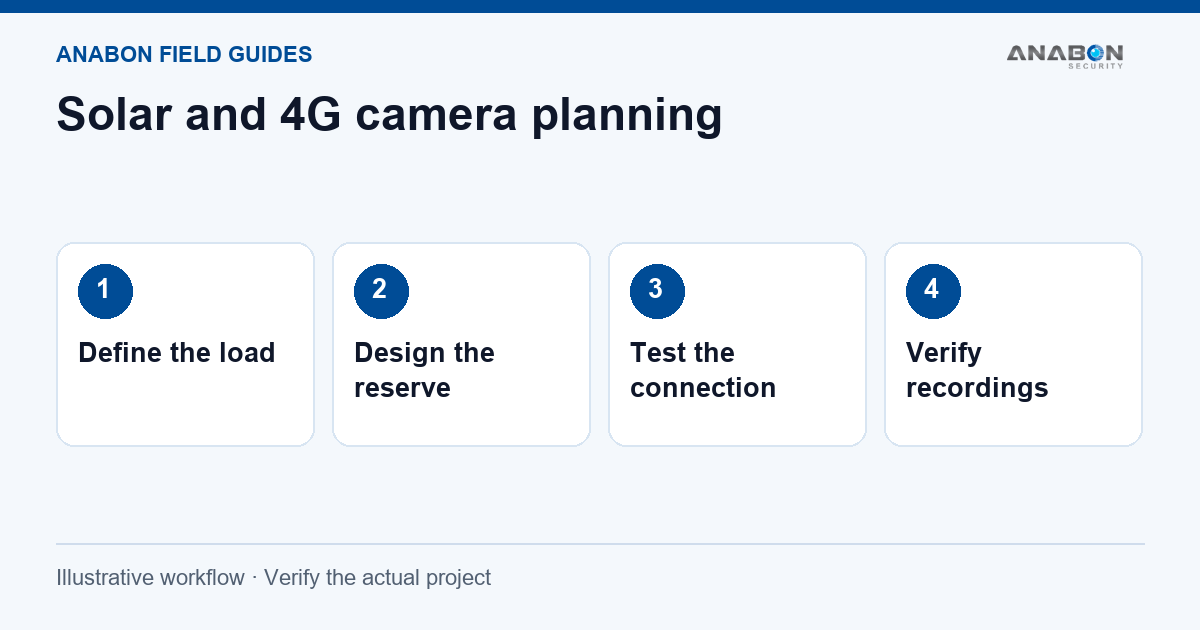
Define the view and the recording requirement
A remote yard, temporary works area or farm entrance may need video where a power or data cable is difficult to provide. Begin with the required view: what must the operator see, at what distance, during which hours and under what lighting? Then decide where recordings must be stored and who needs access.
A camera that wakes for selected events is a different design from a continuously operating camera and recorder. Write down the required operating pattern before comparing equipment. Include the acceptable response to a long period of poor weather or a lost mobile connection.
Account for every powered device
The camera is only one load. A router, radio, switch, recorder, enclosure equipment and conversion losses may also use energy. Use the actual operating and peak requirements for the selected configuration, including night illumination and any functions that increase demand.
| Question | What to record |
|---|---|
| Operating pattern | Continuous or scheduled operation; permitted sleep behavior; night-time functions. |
| Complete load | Camera, communications, storage and supporting equipment, with the applicable supply requirements. |
| Battery reserve | Usable energy and operating limits for the specified battery, temperature and allowed discharge. |
| Solar recovery | Site shading, panel orientation and the design season, checked by the responsible system designer. |
Do not divide a nominal battery label by the camera rating and present the result as a guaranteed runtime. Confirm the supplier’s calculation, assumptions and recovery plan for the entire installed system.
Design for the actual season and mounting position
Check sunlight at the proposed position, including trees, nearby structures and seasonal shading. Agree on panel access for cleaning and maintenance. The mount, wind loading, cable route and enclosure installation belong in the site design, not in a last-minute equipment substitution.
Cold weather can affect the permitted operation and charging of the chosen battery. Obtain the current operating limits and protection requirements for the exact equipment. A summer demonstration does not establish winter availability.
Test cellular service where the equipment will sit
Check the intended carrier, SIM service, antenna arrangement and signal at the final mounting position. Test upload and remote viewing during representative operating hours. Confirm the supported radio bands and regional version rather than relying on the word 4G.
Agree with site IT and the service provider how remote access will work. A mobile connection may not provide a directly reachable public address. Use the supported access method; do not expose a camera management interface simply to make a demonstration work.
Estimate data use from the configured streams, viewing pattern and upload rules. Keep local recording and remote viewing as separate requirements. Test what continues when the mobile connection is interrupted.
Select a documented system configuration
Browse solar security solutions after the load and access requirements are clear. For a specific system reference, review CASE CSP-S2560H4L and confirm the complete ordered configuration, connected loads and installation conditions. Its panel and battery specifications are not a promise of autonomy for an arbitrary camera setup.
If the design uses a separate IP camera or NVR, confirm the power interfaces, network path and environmental installation for each component. Optional equipment shown with a solar system must not be assumed to be included.
Commission power, connection and evidence separately
- Verify the required camera view in daylight and at night.
- Check the power readings and charge behavior against the approved design.
- Test live access and a recorded clip through the agreed cellular path.
- Perform the approved connection-loss test and confirm local behavior.
- Confirm alert recipients, maintenance access and the documented recovery procedure.
For analytics, use the edge AI evaluation checklist and test the intended event in the actual view. For addressing problems, use the NVR IP and DHCP guide. Neither guide replaces the solar power design.
Hand over the assumptions as well as the equipment
Provide the site and load calculation, exact hardware list, power diagram, SIM and service responsibilities, recording settings and commissioning results. State who checks low-power warnings, loss of connection and panel condition.
Send the site photographs, operating pattern and required retention to Anabon Technical Support before a project commitment. A clear brief is the starting point for a usable off-grid installation.