


Quick answer: There is no single US federal law on security cameras, and a 50-state summary is out of date the week it is written. Ask three questions for every site instead: Does the camera look into a place where people have a reasonable expectation of privacy? Does it capture audio, and does that state require consent from one party or from everyone recorded? Does the system collect biometric identifiers such as face templates, and does the state regulate them? Add the state’s workplace-notice rules, write the date of your check into the proposal and verify thresholds with counsel. This is a technical summary, not legal advice (in Canada: PIPEDA and the provincial laws apply; see video surveillance privacy in Canada).
Why does a checklist beat a 50-state table?
State legislatures amend recording, privacy and biometric statutes every session, and a camera job is never “a state”; it is a location type, an audio decision and an analytics decision in that state. A retail floor with microphones off in Texas and a staff room with microphones on in Illinois are different legal situations under the same brand of camera. A checklist forces the three decisions that actually change the legal answer, and it survives the next amendment because it tells you what to look up rather than what the answer was. Everything below reflects October 20, 2026; the sample table is dated for that reason.
Question 1: Where may the camera look? Expectation of privacy
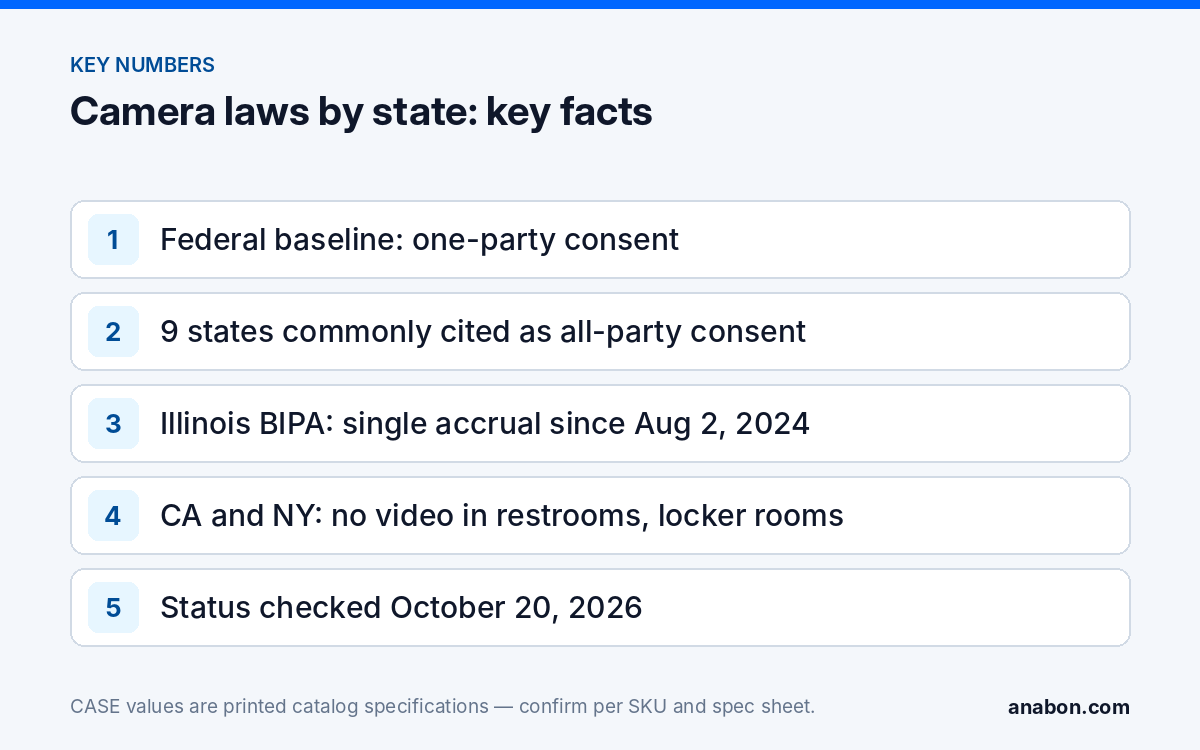
Video-only recording of the public and semi-public areas of a business (sales floor, lobby, parking lot, loading dock, corridors) is generally lawful in every state. The line is the reasonable expectation of privacy. Restrooms, locker rooms, changing rooms, hotel rooms, medical examination rooms and the interior of a residence seen through a window are places where recording is prohibited or heavily restricted, and states commonly criminalize covert recording where people undress under video-voyeurism or unlawful-surveillance statutes (verify the statute for the site). Some states add explicit workplace rules: California Labor Code section 435 and New York Labor Law section 203-c both bar video recording in restrooms, locker rooms and changing rooms.
The installer’s control is placement. Aim each camera at its documented purpose, reduce the field of view or apply privacy masking where a neighbor’s windows or a residential yard would otherwise be in frame (masking is configured per camera and confirmed per model and firmware), and write the purpose of each camera on the as-built drawing. A dome in a corridor outside a changing room is defensible; one that sees past the door is not.
Question 2: Is audio captured, and is this a one-party or all-party consent state?
The federal Wiretap Act (18 U.S.C. section 2511) permits recording a conversation with the consent of one party. States may require more, and nine are commonly cited as requiring the consent of all parties to record a private conversation: California, Florida, Illinois, Maryland, Massachusetts, Montana, New Hampshire, Pennsylvania and Washington. Several others have partial rules (civil remedies, in-person versus telephone distinctions), so the commonly cited list is a starting point, not the statute. Check the current text through NCSL and the state legislature’s site.
A security camera with a microphone records ambient conversations between people who have given no consent, and the business owner is not a party to its customers’ conversations. In an all-party state that is a direct exposure; in a one-party state it is still a privacy and notice question. The practical default is audio recording off. Where a customer has a documented purpose (a two-way intercom at a gate, an audio warning at a dock), enable only what the purpose needs, post notice and keep the written approval. Note the difference between a speaker and a microphone: an audio warning played through a camera’s speaker records nothing, while an enabled microphone does even if nobody is listening live. Two CASE examples make the settings concrete: the CS-I5PS S-2.8mm prints Built-In Microphone Yes with Built-In Speaker N/A and Audio I/O 1/1, and the CS-I5XQ II-2.8mm prints Built-In Mic/Speaker Yes / Yes. On both, audio is set in the camera’s stream settings and in the NVR’s record settings (menu names confirmed per model and firmware), and the handover file states the result per camera. The audio recording laws checklist goes deeper.
Question 3: Does the system collect biometric identifiers?
Face templates, used for face recognition or face search, are biometric identifiers, and a growing set of state laws regulates their collection. The strictest is the Illinois Biometric Information Privacy Act (BIPA, 2008): written notice, a written release before collection, a published retention and destruction policy, and a private right of action; an amendment effective August 2, 2024 limited damages to a single accrual per person per method of collection. Texas regulates capture or use of biometric identifiers with notice-and-consent requirements enforced by the attorney general, and its 2026 artificial-intelligence statute carves out security uses, so purpose documentation carries the burden there. Washington has a biometric identifier law, New York City requires commercial establishments that collect biometric identifier information to post signage, and the comprehensive state privacy laws enacted in about twenty states (2026 count; verify) treat biometric data as sensitive data requiring consent.
For an installer the rule is simple: face recognition and face capture are per-SKU, per-firmware functions that stay off unless the customer has a lawyer-reviewed notice and consent program. A printed feature is not permission. The CS-I5XQ II-2.8mm prints Face Detection / Capture of up to 32 faces / 16 faces, and the CS-N220 P16H-AI prints Face Detection and Face Recognition under AI by NVR; both are confirmed per use case, firmware, region and legal requirement before anyone enables them. Design on Human & Vehicle Classification, Tripwire and Perimeter by default, and read when not to promise facial recognition before the customer asks.
What do workplace notice laws add?
Several states require employers to tell employees about electronic monitoring. Connecticut requires prior written notice of electronic monitoring in the workplace; Delaware’s notice rule and New York’s Civil Rights Law section 52-c (in force since May 7, 2022) address monitoring of telephone, email and internet use, New York with written notice and acknowledgment, so check with counsel whether a given video deployment falls in scope. Unionized workplaces may also need bargaining before cameras are added or moved; that decision belongs to the customer’s HR and legal team, not the installer. Your contribution is a camera schedule that shows exactly what is recorded and where, which is what a notice has to describe.
Sample table: five high-volume states (status checked October 20, 2026)
The table shows how the three questions resolve in five states that come up often on bids. It is a worked example, not a reference: verify each entry against the current statute before you rely on it.
| State | Audio: consent rule | Biometric law | Workplace and other notes |
|---|---|---|---|
| California | All-party consent for confidential communications (Penal Code section 632) | CCPA/CPRA treats biometric data as sensitive personal information | Labor Code section 435: no video in restrooms, locker rooms, changing rooms |
| Texas | One-party consent (Penal Code section 16.02) | Capture or Use of Biometric Identifier Act: notice and consent, attorney-general enforcement; 2026 AI statute carves out security uses | No statewide monitoring-notice statute identified; verify |
| Illinois | All-party consent for private conversations (eavesdropping statute, 720 ILCS 5/14) | BIPA: written notice, written release, retention policy, private right of action; single accrual since August 2, 2024 | BIPA applies to employee biometrics (time clocks, access) as well as customers |
| Florida | All-party consent (Florida Statutes section 934.03) | No stand-alone biometric statute identified as of the check date | Video voyeurism statute (section 810.145) covers covert recording where people undress |
| New York | One-party consent (Penal Law section 250.05) | New York City: signage required where a commercial establishment collects biometric identifier information | Labor Law section 203-c: no video in restrooms, locker rooms, changing rooms; Civil Rights Law section 52-c: electronic monitoring notice |
Where do you check current state law?
- NCSL (National Conference of State Legislatures) tracks privacy, recording and biometric legislation by state and is the fastest way to see what changed this session.
- The state legislature’s website for the statute text itself; quote the section number in your proposal, not a summary.
- The state attorney general for enforcement guidance and, in some states, model notices.
- Counsel wherever a threshold decides the design: all-party audio, any biometric function, any camera near a privacy-sensitive area.
- Your own file: record the statute, the date you checked it and the decision taken, and re-check at every service renewal.
What to tell your customer
“Camera law in this state comes down to three decisions: where the cameras look, whether they record sound and whether we use any face-based analytics. Our design keeps every camera on its documented purpose and out of private areas, leaves audio recording off unless you approve it in writing after legal review, and leaves face recognition off. The camera schedule we hand over describes exactly what is recorded, which is what any notice to staff or the public has to say.”
FAQ
Is it legal to record video without audio in a business?
In every state, video-only recording of the public and work areas of a business is generally lawful, provided cameras do not look into places with a reasonable expectation of privacy such as restrooms, locker rooms and changing rooms. Some states add explicit workplace rules, for example California and New York. Post notice where the state or the customer’s policy calls for it and document each camera’s purpose.
Which states require consent from everyone to record a conversation?
Nine states are commonly cited as all-party consent states for private conversations: California, Florida, Illinois, Maryland, Massachusetts, Montana, New Hampshire, Pennsylvania and Washington. Others have partial or civil rules, and definitions of a private conversation vary. Treat the list as a prompt to read the current statute through NCSL and the legislature’s site, and keep camera microphones off unless the customer approves recording after legal review.
Does Illinois BIPA apply to a camera that only detects faces?
BIPA regulates the collection of biometric identifiers, including scans of face geometry. Whether a given detection function creates such a scan depends on how the model and firmware process the image, which is why Anabon confirms analytics per SKU, firmware and project. For Illinois sites, keep face recognition and face capture off unless the customer has a lawyer-reviewed written notice, release and retention policy.
Do I need to tell employees about new cameras?
Connecticut requires prior written notice of electronic monitoring, while Delaware and New York require notice for monitoring of telephone, email and internet use; check the scope for video with counsel. Other states rely on general privacy and labor principles, and unionized sites may require bargaining. The customer’s HR and counsel decide the notice; the installer supplies a camera schedule that states exactly what is recorded and where.
How often should the legal check be repeated?
At every proposal and at every service renewal, because recording, privacy and biometric statutes change each legislative session. Write the statute section, the date of the check and the resulting design decision into the proposal and the handover file. When a customer later asks to enable audio or a face-based function, treat it as a new check, not a settings change.