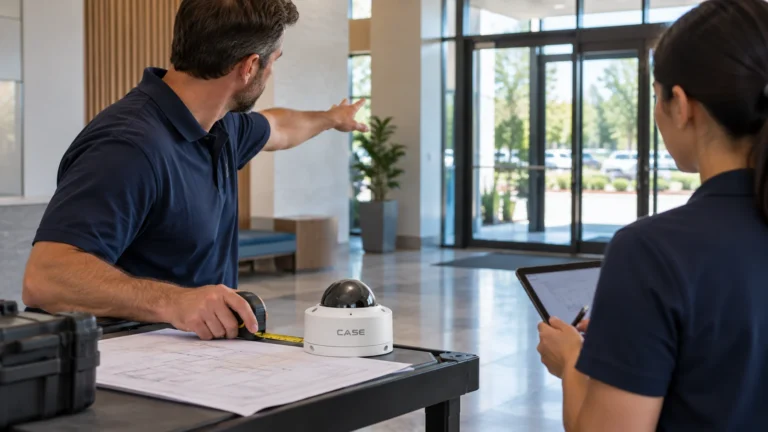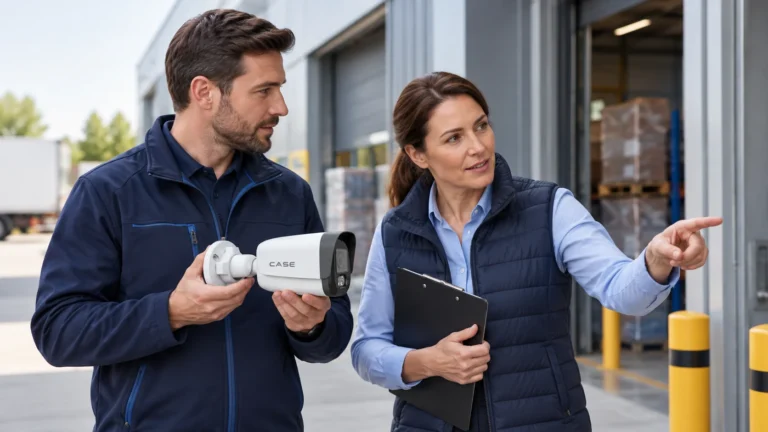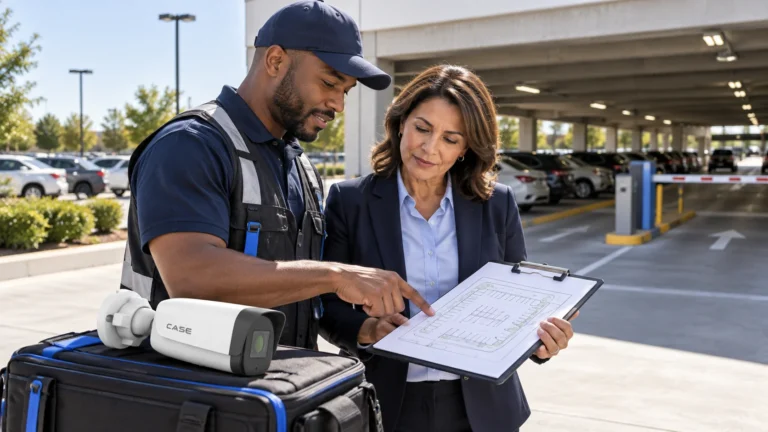



Quick answer: Choose height and angle from the required recorded target, the actual camera view and the site constraints. Test a person or vehicle moving through the agreed capture zone by day and night. There is no universal door-camera height, thirty-degree cutoff or identification distance for a focal-length label. Keep overview, detailed evidence, plate tasks and permitted active responses distinct and record what each tested position can do.
On this page
Which of the four goals is this camera for?
Assign each position a clear primary task and acceptance test. A camera can serve more than one task if the actual recorded result meets each one; category labels do not decide court acceptance. State the applicable standard edition and project requirement. IEC 62676-4:2025 is a later application-guideline edition than the older 2014 DORI framework, so do not present one old pixel-density label as a universal current identification guarantee. The updated pixel-density planning guide explains the limits of the simplified model.
| Primary task | Placement question | Evidence to keep |
|---|---|---|
| Useful face detail at an entrance | Where will the required face view, size and angle be available without unacceptable obstruction? | Representative recorded moving targets in the agreed day/night conditions |
| Context and movement overview | Which area and routes must remain visible, and which details are outside the task? | Recorded coverage at near/far positions, occlusions and relevant lighting |
| Plate task | Which lane, capture zone, speeds, plate region and required output apply? | Task-specific recorded plate tests, separate from an overview claim |
| Approved active response | Where can the exact supported light/audio/event workflow operate within the site policy? | Intended/unwanted events, output/notification behavior and operator controls |
Use dedicated views where the actual evidence tasks need them. A lower entrance position or a higher overview position is a design candidate, not a rule that one always identifies and the other never can. Mark each position’s required and accepted tasks, remaining limits and any additional view needed on the drawing.
How high and how steep for a 2.8 mm or 4 mm lens?
For a measured target-plane width, horizontal recorded pixels divided by width gives an ideal pixel-density estimate. A rectilinear view can also be estimated as width = 2 × distance × tan(horizontal FOV/2) for the relevant geometry. Use the exact documented/verified FOV and output mode; 2.8mm or 4mm does not establish a universal angle. Distortion, crop, tilt, target pose, movement and light still need recorded testing. The field of view and lens calculator helps with planning, not acceptance by itself.
| Example recorded output | Illustrative measured width | Ideal horizontal density | Limit |
|---|---|---|---|
| 2688 pixels | 10m | 268.8 pixels/m | Arithmetic example, not a tested identification width |
| 3072 pixels | 10m | 307.2 pixels/m | Actual view/crop and recorded moving target still need verification |
| 3840 pixels | 10m | 384 pixels/m | No focal-length, distance or evidence guarantee follows from this row |
The old 250 pixels/m identification reference does not certify a person or a legal outcome. Choose the project’s applicable task/standard edition, estimate the view with the actual model and test it. Do not derive a guaranteed six-metre 8MP range or assume every listed resolution recognizes someone at nine metres. A narrower view may improve sampling while losing coverage; verify both tasks before changing the lens.
Tilt geometry helps plan a position. As an illustration, a camera 2.7m high viewing a 1.7m-high target at 3m horizontal distance looks down by arctan(1/3), about 18°. Target height, approach, hats, posture and mounting constraints vary. A thirty-degree line is not a universal point where identity succeeds or fails; demonstrate the required recorded view with representative people and movement.
What are the face-capture rules at an entrance?
- Agree the required face view and actual approach path, including door states, queues and likely occlusions.
- Choose a practical capture zone and permitted mounting point from the actual FOV, target distance, access and vandalism constraints; do not prescribe one width or height for every door.
- Check the complete cover/mount adjustment instructions and keep the final position within them.
- Test backlight, sun, movement and night lighting. CS-I8XQ II-2.8mm and CS-I5XQ II-2.8mm list 120dB True WDR; CS-I4SV S-2.8mm lists 120dB. Those rows do not guarantee a face image.
- Confirm face detection/capture and any biometric workflow separately for the actual firmware/client, required function and site-specific privacy approval. A printed face count is not a complete integration or legal permission.
The II pages list a built-in microphone and speaker, but hardware presence does not authorize audio capture or guarantee every client workflow. Separate recording, listening and talk-down and keep unapproved capture disabled. Agree the actual site authority/consent, notice, purpose and safeguards before enabling it. Use the audio-recording review checklist to document the unresolved permissions and safeguards.
Where do plates and parking cameras go?
A parking overview can show context without meeting the plate task. Define the actual lane, target distances, speeds, plate region, headlight conditions and required recorded/exported result, then choose a supported task-specific design. Mounting angles and plate size must follow the exact model/application guidance and testing; a generic thirty-degree limit or dedicated-camera label alone does not guarantee legibility.
Older schedules may name CSP-I4LQ I-LPR-8-32mm. It is owner-confirmed retired from the active offering, not a current standard project-quoted option. Any residual stock or service question needs separate confirmation, and no like-for-like replacement is established here. Send the actual plate task, geometry and recording/client requirements to Anabon for a current candidate review. Parking lot security cameras covers the scene planning.
- Overview: choose a supported position from the required coverage, obstructions and recorded detail.
- Plates: use the actual lane/task and model-specific capture constraints; retain representative recorded tests before making a performance commitment.
Which lighting mistakes ruin otherwise good placement?
Include the lighting the camera will actually face in the placement test. Sun, door states, headlights, reflections and movement can change the result even when the mechanical mounting is correct.
- Fixtures and glare: check the actual luminaire, reflections, insects and target illumination; a one-metre setback is not a universal cure.
- Sun and backlight: assess relevant times/seasons and door states. Re-aim, change the view or lighting, or document a verified limitation rather than assuming a fixed daily blind period.
- IR reflection: check the exact cover/shield design and nearby surfaces. A daytime night-mode setting is preliminary, not final night acceptance.
- Color task: test actual recorded color/motion at the target. CS-I4SV S-2.8mm lists no IR and 10m white light; the named II turrets list 50m maximum IR and 30m white light. These reaches and minimum-lux rows are not identification or color guarantees.
Coordinate the proposed camera view with the actual lighting design and site requirements. Record distribution, glare, moving-target detail and representative night recordings, rather than using a brochure lux value as a standalone pass threshold. Confirm any lighting recommendations and permissions with the responsible project reviewer.
Where does an EW deterrence turret belong?
EW/AEW names refer to model-specific active-response capabilities. Confirm the actual trigger, available outputs, schedules, notification path and fault behavior. The named II turrets (including CS-I8XQ II-2.8mm) list white light, red/blue light and a speaker, but that does not prove one universal response sequence or prevention result. Assess any laser-equipped product separately under its exact classification/instructions; do not assign a universal laser role or safety status from the label.
- Place the camera where its verified view and permitted outputs serve the intended approach and target task.
- Agree zones, hours, light/audio limits and legitimate-traffic cases with the site reviewer; being inside a property line is not automatic permission.
- Test intended and nuisance events, actual output/notification delivery and an authorized suspension/override process.
- Keep recorded evidence and active response as separate acceptance tasks. Printed IR/white-light reaches do not establish their useful operating boundaries.
False-alarm control and zone design are in Active deterrence cameras: Early Warning (EW/AEW) light and audio vs recording only.
What to tell your customer
We will agree the task for each view, choose a supported position and test the final recording at the required target locations and lighting. The drawing will state the accepted coverage and detail, active responses where permitted and any remaining limits. A height, lens label or pixel count alone is not an identity or plate-reading promise.
FAQ
What is the best height for a security camera at a door?
Choose from the actual target view, approach, FOV, recorded detail, support and service/vandalism constraints. Eight to nine feet can be a planning example, not a universal best height. Verify the final angle and representative moving faces by day and night; being above ten feet does not by itself decide the result.
How many pixels per foot do I need to identify a face?
State the applicable task and standard edition first. The older 2014 DORI identification reference often quoted as 250 pixels/m (about 76 pixels/ft) is not a universal current guarantee, and IEC 62676-4 has a 2025 edition. Pixel density is a planning estimate; actual pose, image quality, motion and lighting need recorded acceptance tests. Do not infer a tested distance from an assumed FOV.
Can an overview camera on a pole also read license plates?
It may or may not meet that task; verify representative recorded plates, speeds, lighting and angles against the agreed requirement. An overview label does not prove failure or success, and a dedicated LPR label does not prove integration or legibility. The older CSP-I4LQ I-LPR-8-32mm is retired from the active offering; request a current task-specific review rather than treating it as an active quote option.
How much down-tilt is too much for a face camera?
There is no universal angle at which every face becomes unusable. Use the actual target height, distance and approach to estimate the view, then test representative faces, posture, hats, movement and lighting in the recording. Stay within model/mount limits and adjust the position or add a view if the agreed task is not met.
Where should a deterrence turret with white light and a speaker be mounted?
Use a position that meets the tested view and approved response task within the exact mount and model limits. Agree zone, schedule, light/audio permissions and operator controls, then test intended/unwanted events and recording separately. The II turret’s printed 30m white light and 50m maximum IR do not set guaranteed response or evidence distances. Use the active deterrence planning guide to keep response controls separate from recording acceptance.
References
- Anabon: exact-model and revision documents
- IEC 62676-4:2025 — application-guideline edition and scope
- Axis: task-based pixel-density model and real-world limitations