


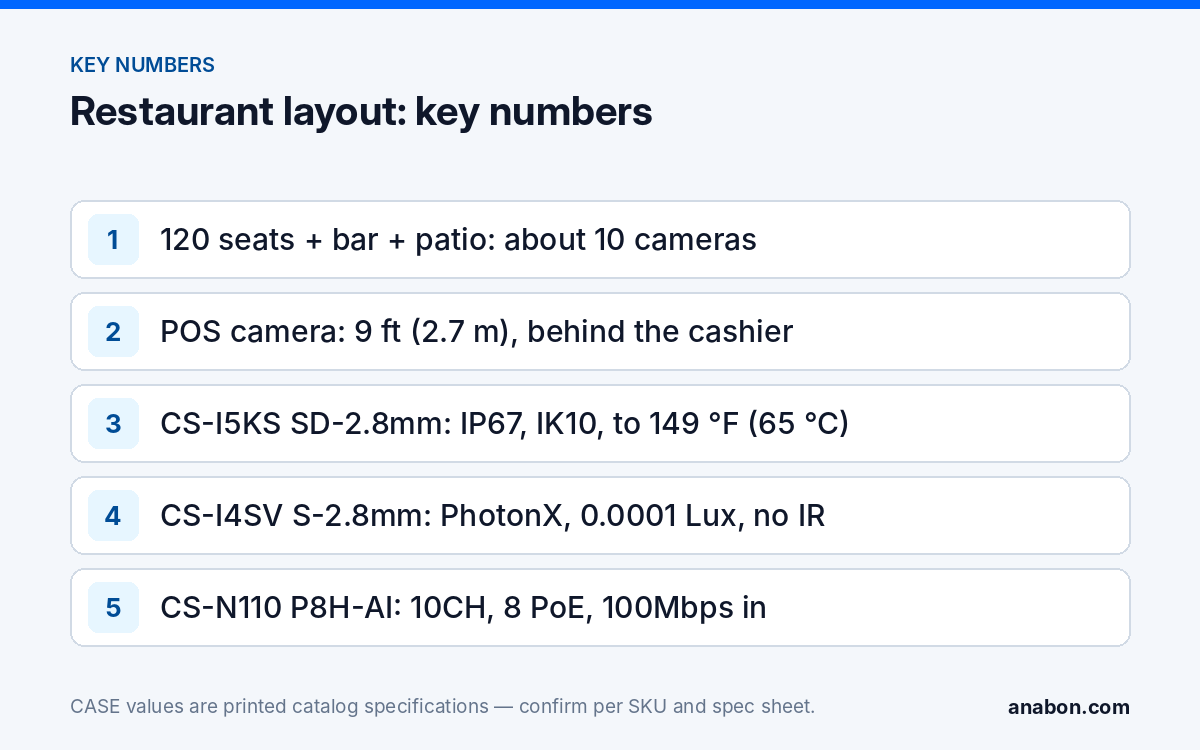
Quick answer: A restaurant spec is five zones: the entrance, every point of sale and the bar well, the kitchen line and back door, the office safe, and the patio after dark. Use IK10 domes at the registers and in the kitchen, keep every camera out of the hood exhaust zone, put a PhotonX turret on the patio so dine-and-dash footage is in color, and leave audio recording off unless the owner’s counsel approves it. A 120-seat restaurant with a bar and patio lands at about 10 cameras on a 10-channel NVR.
Entrance, POS, kitchen, patio: where does each camera go and what must it show?
Owners call about three things: a cash discrepancy, a guest who left without paying, and a liability claim from a fall. Each has a camera position. The entrance camera faces the door from inside at 8–9 ft (2.4–2.7 m), so every guest and delivery driver passes it at face height; 120dB WDR handles the daylight behind them.
POS cameras sit above and behind the cashier side at 9 ft (2.7 m), angled so the frame holds the screen, the drawer and the guest’s hands: one per terminal and one per bar register. Angle them so the guest’s PIN entry on the payment terminal is not readable, which the merchant’s card-processing rules may require. The office safe and count table get their own camera.
Over the dining room, one indoor fisheye at ceiling center gives the overview: the CS-I5VN S-1.4mm prints 5MP 2592×1944@30fps, a 1.4 mm fixed lens, IR 98 ft (30 m), audio 1/1, alarm 1/1 and Indoor Usage protection, with Tripwire, Double Tripwire, Perimeter and Heatmap in its AI row. Heatmap is a traffic-review tool for the owner, confirmed per model and firmware; it is not a people-count report.
| Zone | Example CASE SKU | Mount | What it must show |
|---|---|---|---|
| Entrance and host stand | CS-I5KS SD-2.8mm | Ceiling inside, 8–9 ft (2.4–2.7 m), facing the door | Every face entering, delivery drivers |
| POS and bar register | CS-I5KS SD-2.8mm | Ceiling behind the cashier side, 9 ft (2.7 m) | Screen, drawer, hands; PIN pad not readable |
| Dining room overview | CS-I5VN S-1.4mm | Ceiling center, 10 ft (3 m) | Table turns, server paths, falls |
| Kitchen line and pass | CS-I5KS SD-2.8mm | Ceiling, pass side, 9–10 ft (2.7–3 m) | Hands, plates, the walk-in door |
| Back door and receiving | CS-I5KS SD-2.8mm | Exterior wall over the door, 10 ft (3 m) | Deliveries, propped door, dumpster |
| Patio and exit gate | CS-I4SV S-2.8mm | Building wall, 9–10 ft (2.7–3 m), toward the gate | Guests leaving, in color, at night |
Heat, steam and grease: which housing survives the kitchen?
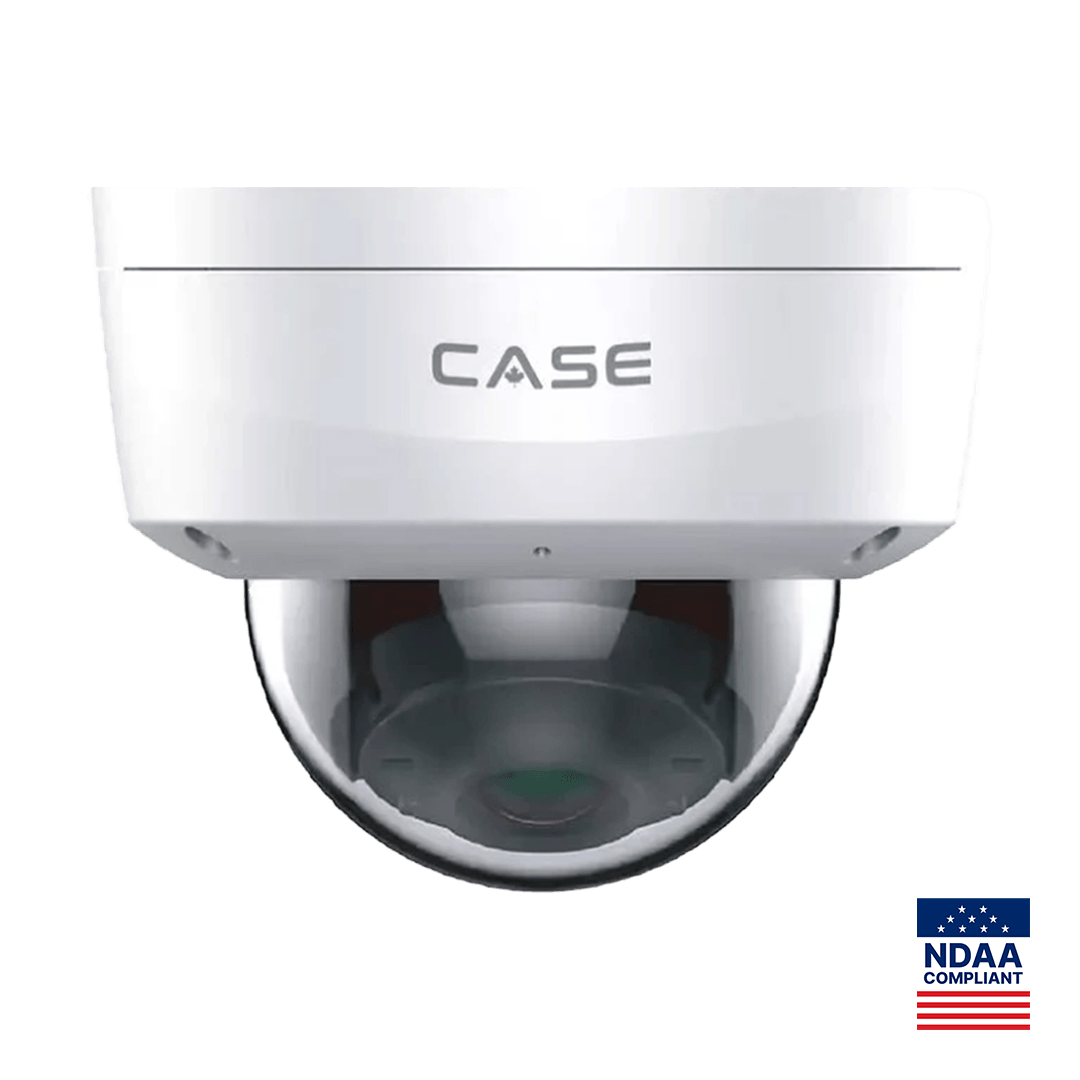
The CS-I5KS SD-2.8mm is the kitchen example: a 5MP dome, 3072×1728@30fps, IP67 and IK10, Metal+Plastic housing, IR 98 ft (30 m), white light 33 ft (10 m), 120dB WDR, with printed operating conditions of −31 °F to 149 °F (−35 °C to 65 °C) at 0–95% RH. That range is ambient air, not the surface temperature next to a flat-top. Three placement rules follow from it.
- Stay out of the hood zone. Nothing mounts on or inside the exhaust hood or within its capture area; the hood, duct and fire-suppression system fall under NFPA 96 in the US (the National Fire Code and provincial fire codes in Canada reference the same standard; verify the local code with the hood contractor). Mount on the ceiling at the pass side, 9–10 ft (2.7–3 m), looking down the line.
- Grease is a cleaning schedule, not a rating. IP67 covers dust and temporary immersion, not hose-down jets, so keep wash-down spray off the camera; neither rating stops a grease film on the dome bubble. Write a monthly wipe-down into the service agreement and check the spec sheet before using any cleaning agent.
- Keep the walk-in camera outside the walk-in. Point it at the cooler door from the kitchen side; a camera inside fogs every time the door opens.
IK10 earns its place where sheet-pan racks and bus carts pass within arm’s reach; see IP66 vs IP67 vs IK10 for what the ratings mean on site.
Night patios: how do you get a usable face at 11 pm under string lights?
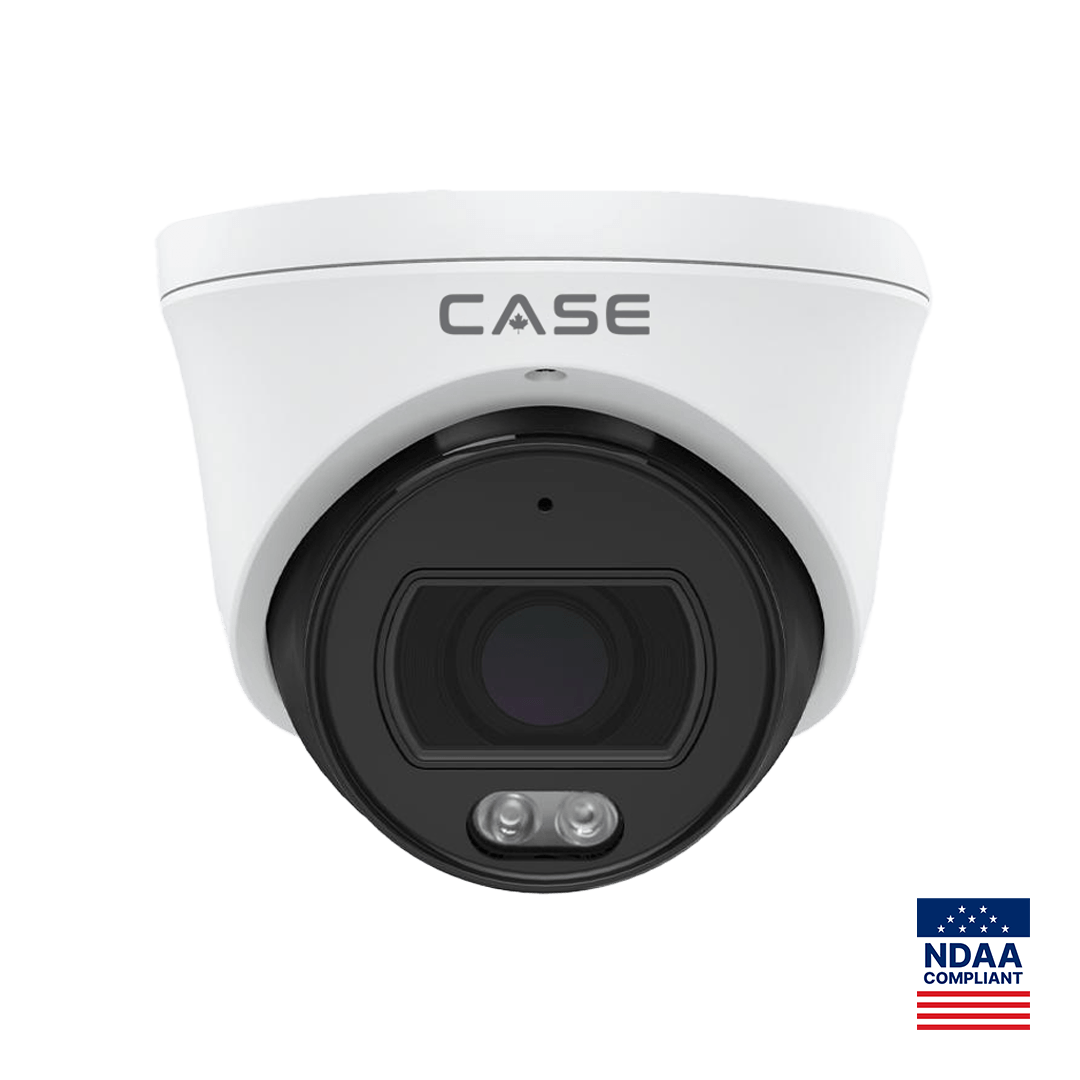
A patio after dark is string lights and candles, well under 1 lux at the tables, with a bright doorway behind it. IR turns that scene gray, flares off glassware and loses the clothing color that identifies a walk-out. The CS-I4SV S-2.8mm is a PhotonX turret with no IR: 4MP 2688×1520@25fps, 0.0001 Lux minimum illumination, white light 33 ft (10 m), 120dB WDR, IP67, Metal housing, −40 °F to 149 °F (−40 °C to 65 °C), with Tripwire, Perimeter and Human & Vehicle Classification printed. Low-light and full-color behavior is stated per SKU on the specification sheet and should be confirmed for the site.
Mount on the building wall at 9–10 ft (2.7–3 m) looking across the patio toward the exit gate, and put a second unit at the gate looking back at the exit path. Dine-and-dash footage then shows the face at the table and the direction of travel, with the white light on the gate camera only. For the IR, white-light and PhotonX decision, see Full Color Night Vision.
Audio and privacy limits: what does the owner have to agree to before you enable a microphone?
Several of these cameras print a built-in microphone (CS-I5KS SD-2.8mm) or audio 1/1 (CS-I5VN S-1.4mm). Recording a conversation is regulated separately from video. In the US the federal baseline is one-party consent and a group of states require consent from everyone recorded; in Canada the Criminal Code takes a one-party approach to private communications, and PIPEDA or the provincial private-sector laws (Quebec, Alberta, British Columbia) govern what a business may collect. Leave audio recording disabled by default, enable it only on the owner’s written instruction after their counsel has reviewed it, and post signage that mentions audio where it is on. Verify with counsel; the audio recording laws checklist and the state-by-state checklist cover the questions to ask.
- No cameras in restrooms, changing areas or anywhere a person undresses; none pointed through a restroom door.
- Staff break room and locker area: avoid; where the owner insists, written employee notice first.
- Signage at every public entrance (US and Canadian wording in Video Surveillance Signage); Quebec Law 25 adds notice and purpose statements, verify with counsel.
- Retention 30 days for dining and bar; 60–90 days for floor and kitchen cameras where slip-and-fall claims arrive late; confirm with the insurer.
- Written notice to employees of camera positions and purpose, kept in the HR file.
Sample schedule: a 120-seat restaurant with a bar and a 30-seat patio
The sample is a single-story restaurant: entrance and host stand, a 12-seat bar with one register, two server POS stations, an open kitchen line with a pass, a walk-in and dry storage, a back door to the alley, a small office with a safe, and a fenced patio with one exit gate.
| ID | Position | CASE SKU | Mount and height | Notes |
|---|---|---|---|---|
| R01 | Entrance | CS-I5KS SD-2.8mm | Ceiling inside, 9 ft (2.7 m) | Faces the door; WDR |
| R02 | Dining room | CS-I5VN S-1.4mm | Ceiling center, 10 ft (3 m) | Overview; Heatmap for the owner |
| R03 | Bar register | CS-I5KS SD-2.8mm | Behind the bar, 9 ft (2.7 m) | Drawer, screen, hands |
| R04 | Server POS stations | CS-I5KS SD-2.8mm | Ceiling, 9 ft (2.7 m) | One camera covers both stations |
| R05 | Kitchen line | CS-I5KS SD-2.8mm | Pass side, 9–10 ft (2.7–3 m) | Outside the hood zone |
| R06 | Walk-in and storage doors | CS-I5KS SD-2.8mm | Ceiling, 9 ft (2.7 m) | Cooler door from the kitchen side |
| R07 | Back door (exterior) | CS-I5KS SD-2.8mm | Over the door, 10 ft (3 m) | Deliveries; propped door; white light |
| R08 | Office safe | CS-I5KS SD-2.8mm | Ceiling corner, 8 ft (2.4 m) | Safe and count table |
| R09 | Patio | CS-I4SV S-2.8mm | Wall, 9–10 ft (2.7–3 m) | Toward the gate; PhotonX, no IR |
| R10 | Patio gate | CS-I4SV S-2.8mm | Gate post or wall, 9 ft (2.7 m) | Exit path; white light on |
| NVR | Office | CS-N110 P8H-AI | Lockable cabinet | 10CH, 8 PoE; two patio cameras via a small PoE switch |
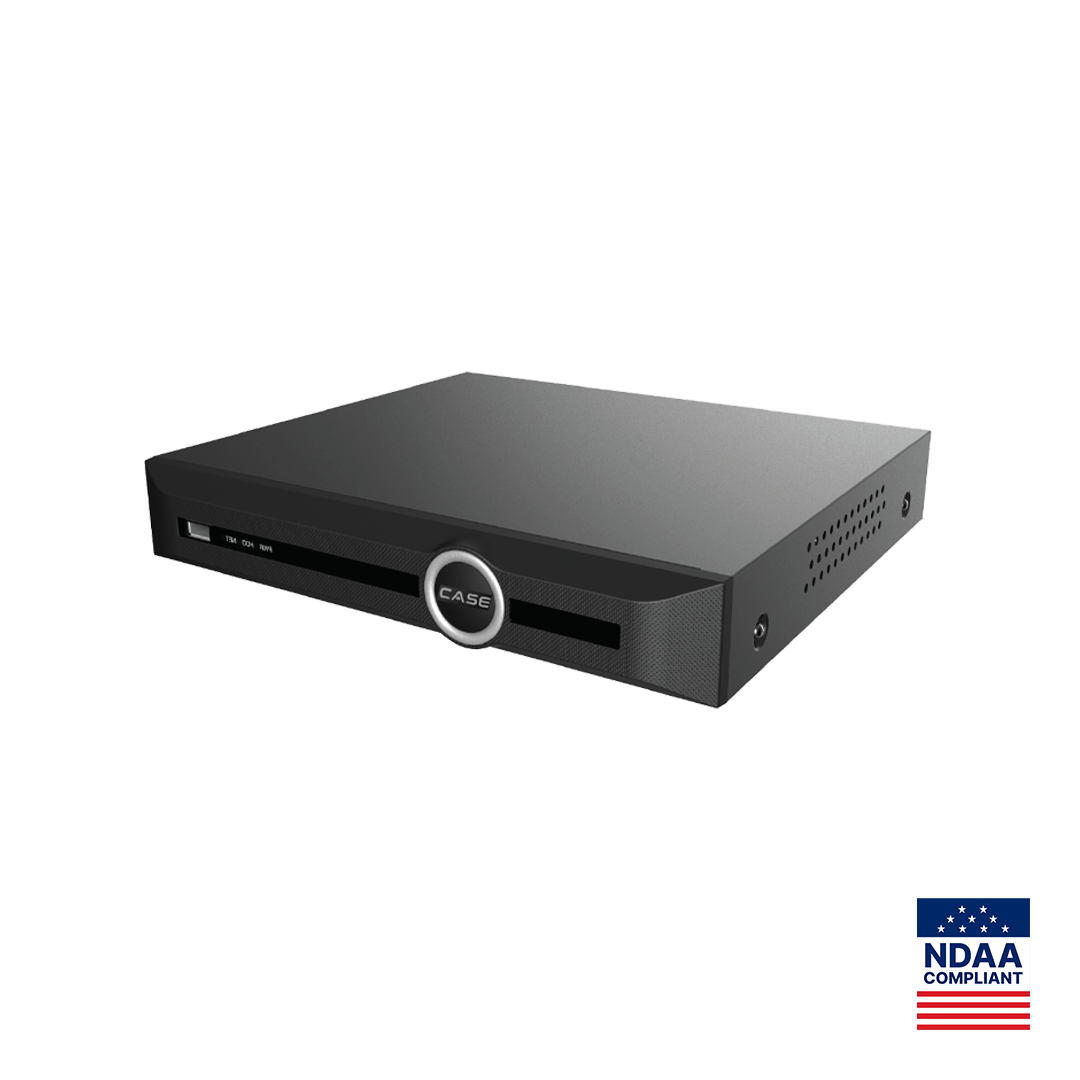
The CS-N110 P8H-AI prints 10 channels, 8 PoE ports and an 8+1 RJ45 10/100 Mbps port layout, so two cameras ride a small PoE switch on the uplink; incoming bandwidth is printed at 100Mbps and storage at up to 10 TB per HDD. Its AI by NVR row prints Tripwire, Double Tripwire, Perimeter and Smart Motion Detection among others; enable what the owner asked for, confirmed per model and firmware. Size the drives with the NVR Storage Calculator. Hard drives are supported through back-to-back manufacturer warranty.
What to tell your customer
“Every register and the bar well get a camera on the drawer and the hands, the kitchen line gets an impact-rated dome outside the hood zone, and the patio gets a camera that records in color at night so a walk-out leaves a usable face. Audio stays off unless your lawyer clears it, and there are no cameras in restrooms or changing areas. CASE cameras and CASE NVRs carry a 6-year warranty; support comes through us.”
FAQ
How many cameras does a restaurant with a bar and a patio need?
For a 120-seat single-story restaurant with a 12-seat bar, two server POS stations, an open kitchen, a back door, an office safe and a 30-seat patio, plan on about 10: one at the entrance, one fisheye over the dining room, one on the bar register, one on the POS stations, two in the kitchen, one on the back door, one on the safe and two on the patio.
Can a security camera go in a commercial kitchen?
Yes, outside the hood exhaust zone and off the hood itself, which is the fire-suppression area under NFPA 96 in the US (verify the local fire code in Canada). The CS-I5KS SD-2.8mm prints IP67, IK10 and operating conditions of −31 °F to 149 °F (−35 °C to 65 °C); that is ambient air, so mount it on the ceiling at the pass side and schedule a wipe-down for grease film.
Which camera works on a dark restaurant patio?
One that holds color without IR. The CS-I4SV S-2.8mm is a PhotonX turret printed at 0.0001 Lux minimum illumination with white light 33 ft (10 m) and no IR, so string-light scenes stay in color and glassware does not flare. Low-light and full-color behavior is stated per SKU on the specification sheet and should be confirmed for the site.
Can restaurant cameras record audio?
Only after the owner’s counsel has reviewed it. Several CASE cameras print a built-in microphone, but recording conversations is regulated separately from video: a federal one-party baseline with all-party-consent states in the US, and the Criminal Code plus PIPEDA or provincial private-sector laws in Canada. Leave audio recording disabled by default, enable it in writing, and add audio to the signage.