

Quick answer: For new camera work, run solid-copper Cat6; keep tested Cat5e that is already in the wall, and use Cat6A for backbone links and dense PoE bundles. Never use copper-clad aluminum. Hold every copper run inside the 328 ft (100 m) channel limit, shield only on industrial routes, put a grounded Ethernet surge protector on every run that leaves the building, and label and test each link before the camera goes up. The relevant code sections are NEC Article 725 and Chapter 8 (in Canada: CEC Sections 16 and 60); verify the local code.
Which of the three wiring topologies fits the site?
Every IP camera system is one of three diagrams, or a mix of them. Decide the topology first: it changes where power comes from, how many switches you buy and where the surge protectors go.
Diagram 1: camera direct to a PoE NVR
- Camera pigtail inside a junction box, one solid-copper Cat6 run of 328 ft (100 m) or less, straight to a PoE port on the NVR.
- The recorder powers the camera and addresses it on its own camera network.
- NVR LAN port to the customer router for remote viewing.
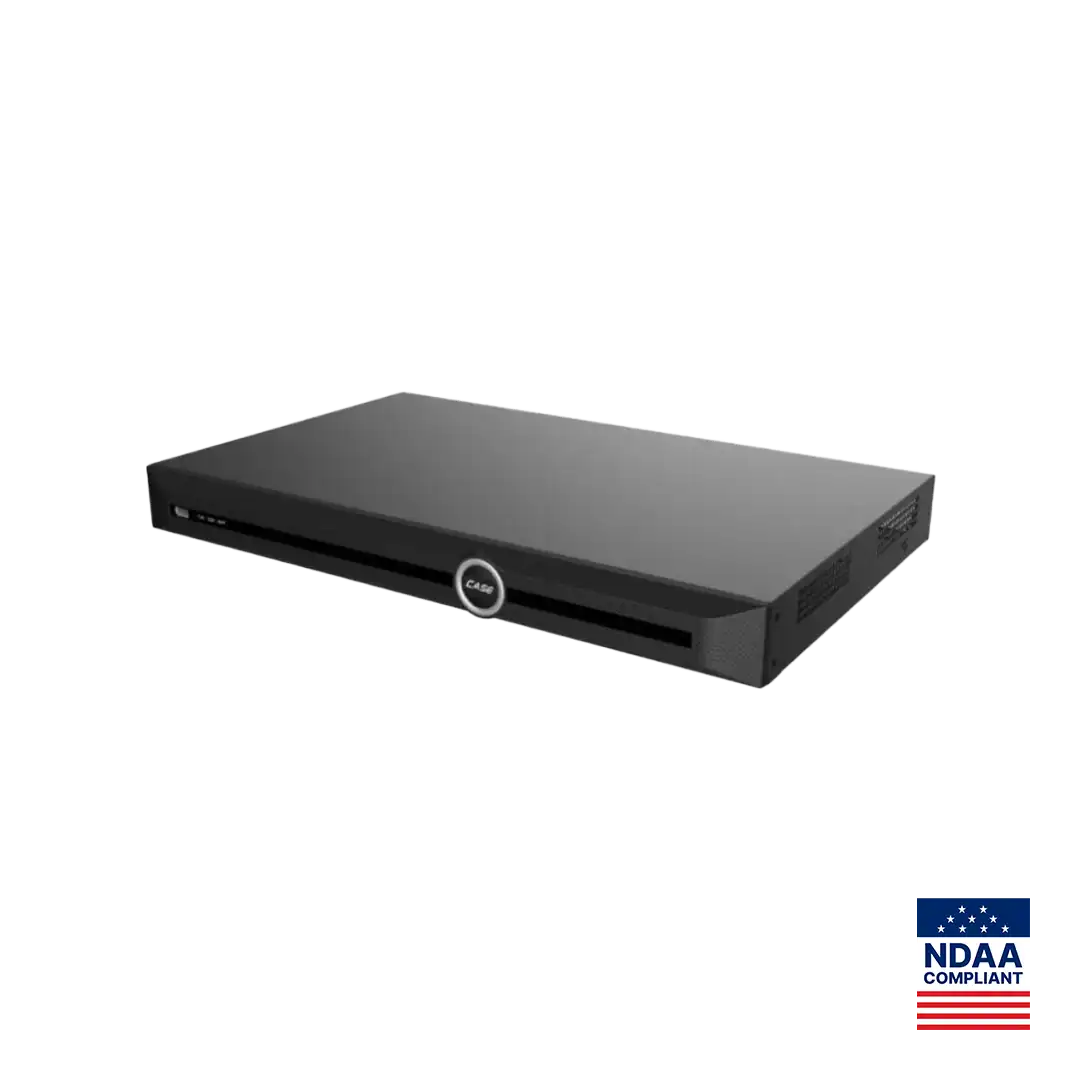
Example: the CASE CS-N220 P16H-AI prints 16 PoE ports and 20 IP channels, so 16 cameras land directly on the recorder and up to four more arrive through its 1×RJ-45 10/100/1000 Mbps uplink. Best for one building, up to 16 cameras and a simple handover.
Diagram 2: cameras to a PoE switch, switch to the NVR
- Camera to a PoE switch port over Cat6, 328 ft (100 m) or less per run.
- Switch uplink to the NVR LAN port, or to a camera VLAN the NVR also sits on; one switch per telecom room where cameras are spread across floors.
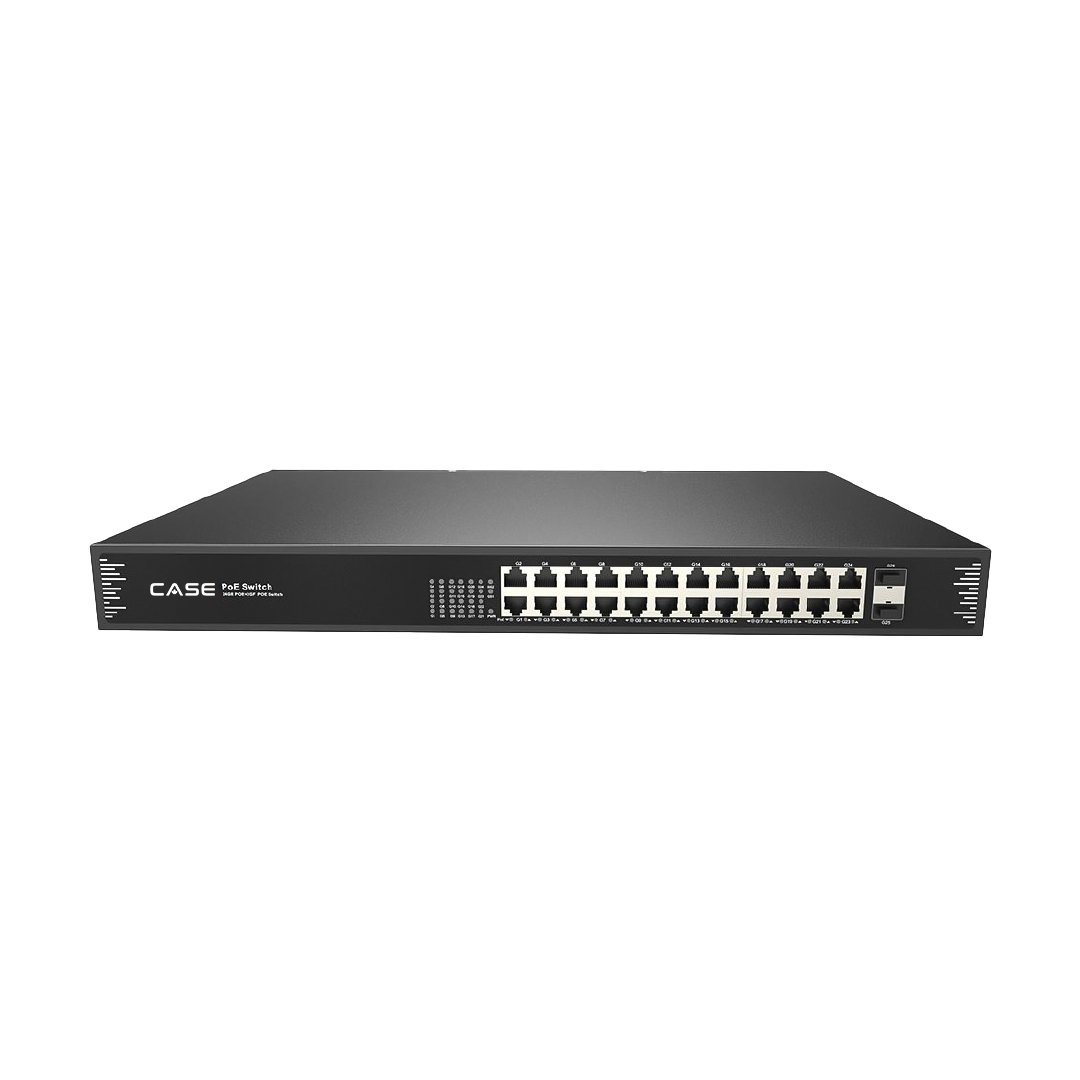
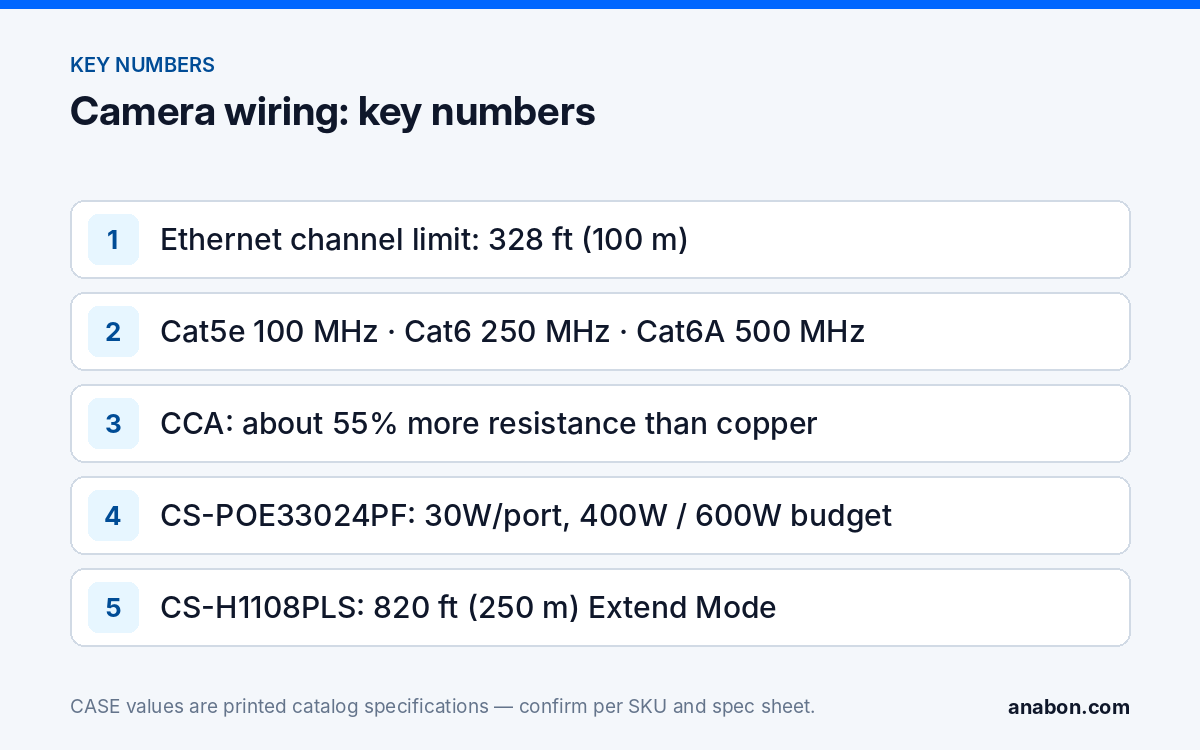
Example: the CS-POE33024PF prints 24×10/100/1000M RJ45 PoE ports, IEEE 802.3af/at, 30W per port, a total PoE budget of 400W / 600W (two versions) and 2×1000M SFP fiber uplinks. Budget, not port count, decides how many cameras one switch carries; the arithmetic is in our PoE budget calculator.
Diagram 3: fiber between buildings or out to a pole
- Cameras over Cat6 to a small PoE switch in the remote building or pole enclosure (local AC power required).
- Remote switch SFP uplink over fiber to an SFP port on the head-end switch, then to the NVR.
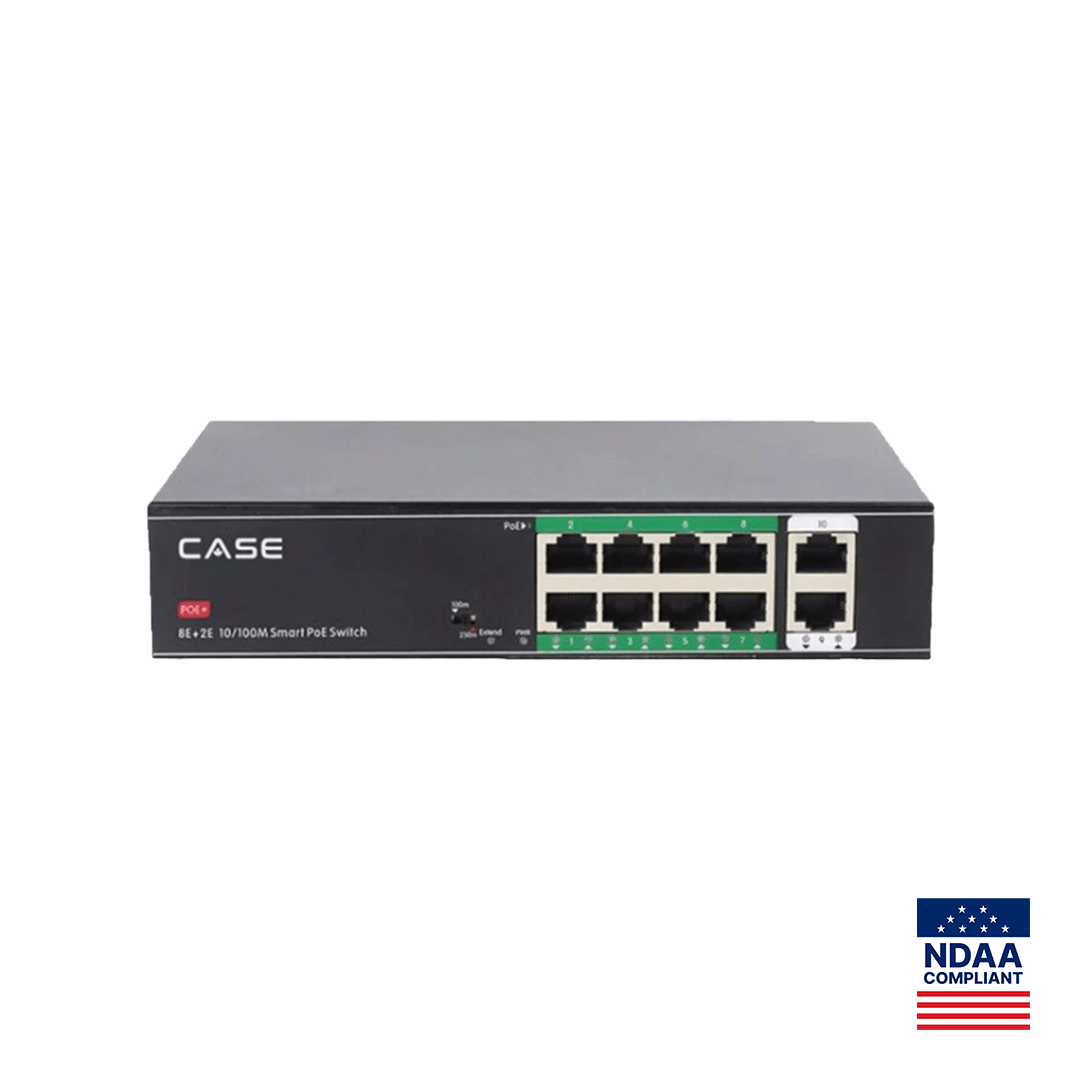
All-dielectric fiber (no metallic armor or strength member) has no metallic conductor, so it carries no surge current between structures. The CS-POE33108PF (8×Gigabit PoE, 130W / 250W, 2×1000M SFP) is the usual remote switch; where the cluster is still within copper reach, the CS-H1108PLS prints 8×10/100M PoE ports, a 100W budget and 328 ft (100 m) standard or 820 ft (250 m) in Extend Mode. Confirm the Extend Mode data rate on the spec sheet before you rely on it.
Cat5e, Cat6 or Cat6A: which one for cameras?
All three categories carry 1 Gb/s to 328 ft (100 m), and a camera stream is tens of megabits at most. The decision is about headroom, crosstalk margin and PoE behavior in a bundle, not whether the video fits.
| Category | Specified bandwidth | Data rate at 328 ft (100 m) | Typical conductor | Where it fits on a camera job |
|---|---|---|---|---|
| Cat5e | 100 MHz | 1 Gb/s | 24 AWG solid copper | Existing, tested runs; small retrofits |
| Cat6 | 250 MHz | 1 Gb/s (10 Gb/s only to about 180 ft (55 m)) | 23 AWG solid copper | Default for every new camera run |
| Cat6A | 500 MHz | 10 Gb/s | 23 AWG, larger jacket | Backbone between telecom rooms; dense PoE+ bundles; future 10 Gb |
Cat6 is the default for two reasons: its 23 AWG conductors have lower DC resistance than 24 AWG Cat5e, so a 30W camera on a long run sees less voltage drop and the bundle runs cooler, and its crosstalk margin absorbs terminations made on a ladder. Cat6A earns its larger diameter on the backbone and in PoE bundles; TIA’s TSB-184-A guidance recommends small bundles and derating length when cable temperature rises. Whatever the category, ANSI/TIA-568 defines the channel as a 295 ft (90 m) permanent link plus 33 ft (10 m) of patch cords, so measure from the camera pigtail to the switch port.
Why is copper-clad aluminum (CCA) off the truck?
CCA cable has an aluminum core with a thin copper skin. Aluminum conducts about 61 percent as well as copper, so a CCA conductor of the same gauge has roughly 55 percent more DC resistance. On a PoE camera run that means voltage drop, heat in the bundle and a camera that reboots at night when the IR array switches on. CCA also work-hardens and breaks at the IDC termination, and it does not meet the ANSI/TIA-568 conductor requirement, which specifies solid copper.
- Buy only cable marked solid bare copper and carrying a verified listing mark for its fire rating (CMR / CMP in the US; FT4 / FT6 in Canada).
- Weigh the box and scrape a conductor end: a 1,000 ft (305 m) carton of CCA is noticeably lighter, and a silver core under the copper color is CCA.
- Reject CCA at the quoting stage, even when the customer supplies it; write “solid copper, ANSI/TIA-568 compliant” into the proposal.
When do you shield, and where does the shield land?
Unshielded twisted pair (UTP) is the default for offices, retail, warehouses and most exteriors. Choose a shielded construction (F/UTP with an overall foil, or S/FTP with foil pairs and a braid) when the route is electrically noisy: alongside variable-frequency drives, welders, large motors or power conductors. On IP cameras, interference appears as CRC errors and packet loss on the switch port and as a camera that drops offline when a machine starts.
A shield only works when it is bonded. Terminate shielded cable on shielded jacks and a shielded patch panel, bond the panel to the telecommunications bonding busbar, and ground at one end only, the telecom-room end. Grounding both ends creates a ground loop unless both ends share the same grounding electrode system; the camera housing is never a ground reference. Cross power at 90 degrees and keep the separation your local code and ANSI/TIA-569 require.
- Shield when industrial EMI sources sit within a few feet of the pathway, or the pathway is shared with power.
- Do not shield to fix distance or PoE budget, and never as a substitute for SPDs and bonding on an exposed run.
Where does surge protection go on an outdoor run?
Every cable that leaves the building envelope is an antenna for induced surges and a path for ground-potential differences. Place an Ethernet surge protective device (SPD) where the run enters the building, with a ground lead of 3 ft (1 m) or less straight to the building grounding electrode system or the telecom busbar. Use a PoE pass-through SPD rated for the power class on that run: 802.3at for a 30W camera, 802.3bt where a PoE++ PTZ is fed. When the camera sits on a pole or a detached structure, add a second SPD at the camera end and bond the pole.
Built-in protection is a port specification, not a site design. The CS-POE33024PF and CS-H1108PLS both print “4KV lightning protection” and IP30, and the CS-PSE3301AC injector prints “IEC61000-4-2 (ESD) / Lightning protection”. Those figures cover ordinary transients at the port; they do not replace an external SPD and a proper ground. The pole and PTZ method is in Lightning and surge protection for outdoor and PTZ cameras.
How do you label, test and document each run?
Label both ends of every run with the camera ID from the camera schedule and the patch-panel port, in the same format on every job (for example CAM-07 / IDF-1 / P07). Test before the camera is mounted: a failed link is quick to fix with the ladder still up.
| Test | Tool | Pass criteria | Record in the job folder |
|---|---|---|---|
| Wiremap and length | Qualifier or certifier | Correct pin-out, no split pairs, under 295 ft (90 m) | Length per run |
| Category certification | Certifier (ANSI/TIA-568) | PASS for the installed category | Report per run |
| Link speed | Qualifier or switch port | 1000BASE-T negotiated (100 on NVR PoE ports) | Port status |
| PoE at the far end | PoE tester or camera status page | Camera stays up with IR on | Power class per camera |
Hand the test report to the customer with the as-built drawing; the full convention is in Labeling and documentation standard for camera installs.
Which NEC and CEC articles cover camera wiring?
PoE camera cable is low-voltage, not unregulated. The table names where to look; it is not a legal interpretation, and the authority having jurisdiction decides what applies on a site.
| Topic | US: NEC (NFPA 70) | Canada: CEC (CSA C22.1) |
|---|---|---|
| Class 2 power-limited circuits, including PoE | Article 725; Table 725.144 for bundled PoE cable ampacity (2017 edition onward) | Section 16 (Class 1 and Class 2 circuits) |
| Communications cable and building-entry protection | Chapter 8 (Article 800 and related) | Section 60 (electrical communication systems) |
| Cable flame ratings by space | CMP (plenum), CMR (riser), CM (general purpose) | FT6 (plenum), FT4 (riser and general) |
| Bonding and grounding | Article 250; Chapter 8 | Section 10 |
Two habits keep the inspection short: plenum-rated cable above any ceiling that handles return air, and the listing mark left visible at the patch panel. Editions differ by jurisdiction; verify the local code.
What to tell your customer
“We run solid-copper Cat6 to every camera, tested and labeled at both ends, inside the Ethernet distance limit so the cameras stay powered and online. Any cable that leaves the building gets a grounded surge protector. You receive the test report and the labeled drawing at handover.”
FAQ
Is Cat5e good enough for 4K security cameras?
Yes, within the 328 ft (100 m) channel limit: an 8MP camera stream is tens of megabits per second and Cat5e carries 1 Gb/s. For new runs use Cat6, because its 23 AWG conductors reduce PoE voltage drop and its margin forgives field terminations. Do not rip out tested Cat5e.
Can I run a PoE camera past 328 ft (100 m)?
Not on standard Ethernet; the ANSI/TIA-568 channel limit is 328 ft (100 m) including patch cords. Beyond that, use fiber with a remote PoE switch, a PoE extender, or the CS-H1108PLS, which prints 820 ft (250 m) in Extend Mode; confirm its data rate on the spec sheet first.
Do I need shielded cable for outdoor cameras?
Not by default. Outdoor runs need an outdoor-rated or direct-burial jacket and a grounded surge protector where they enter the building; shielding provides neither. Choose shielded cable only for industrial EMI, such as a pathway beside variable-frequency drives, and bond the shield at the telecom-room end only.
How do I know a box of cable is copper-clad aluminum?
Look for the words solid bare copper and a verified listing mark on the carton; a category number alone proves nothing. CCA cartons are noticeably lighter than copper of the same length, and a scraped conductor shows a silver core. If the carton omits the conductor material, treat it as CCA.
Does a PoE switch’s built-in lightning protection replace a surge protector?
No. The 4KV lightning protection printed for the CS-POE33024PF and CS-H1108PLS is a port specification against ordinary transients. A run that leaves the building still needs an external Ethernet surge protective device at the entry point, with a short ground lead to the grounding electrode system, and a second device at any pole camera.