


Quick answer: Use the site walk to verify conditions and record questions about network, power, cable paths, retention, privacy, access and schedule. Record who said what, then obtain required answers through the buyer’s formal question/addendum process. Verbal comments and your notes do not amend the bid documents. Turn confirmed answers into measured schedule/BOM inputs and flag unresolved requirements before pricing.
On this page
What do you bring, and who answers what?
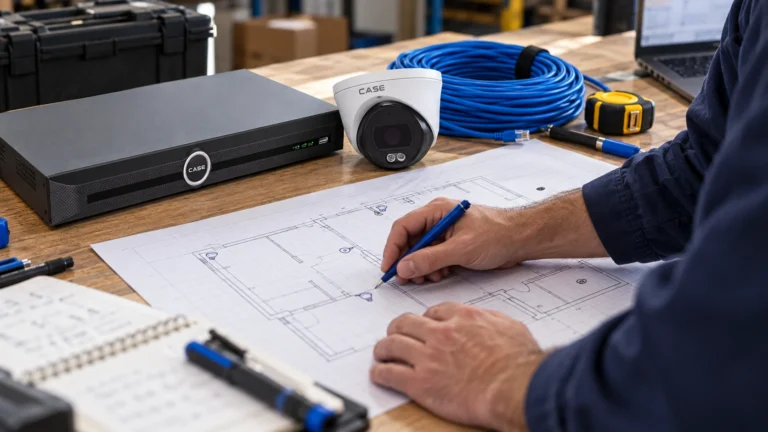
Bring the current permitted drawings, specification, draft tags, measuring tools and buyer’s walk instructions. Use the site survey planning guide to organize observations. Check photo permission and authorized room access. Keep measurements, observations and named verbal statements separate. Submit conflicts through the required written process before the deadline; a verbal comment or an unapproved qualification does not change the bid scope.
Network and power: what feeds the cameras?
Use these network and power answers to select each PoE switch, recorder path and cable route. Confirm who approves connections and who configures them; port count alone does not establish the power or data capacity.
- Q01. (C) What network topology and approval route apply? Ask whether cameras use a separate network, an approved VLAN or the recorder’s PoE interfaces, and who configures it. CS-N220 P16H-AI is a catalog example with 20 channels and 16 physical PoE ports (p.55). Suitability still depends on the actual channel presentation, bandwidth, power, storage and required functions; do not infer simultaneous AI capacity from the channel total.
- Q02. (O) Where are the telecom rooms and measured camera routes? For conventional structured copper cabling, count patch and equipment cords within the 328 ft (100 m) channel, normally including at most 295 ft (90 m) of permanent link. Fluke channel/permanent-link guidance explains the distinction and camera MPTL testing. Confirm the actual cable/application, environment and required test method; plan a supported alternative for longer routes instead of assuming an extender preserves every performance and PoE limit.
- Q03. (C) What power type/class and maximum load does each exact device need? Compare switch-side PSE allocation, cable loss, per-port limit and the confirmed total supply variant. An af/at 30W port is not a confirmed supply for a PTZ requiring 802.3bt; obtain the exact model sheets and power design.
- Q04. (O) What backed-up power and runtime are required at every closet and head-end? Identify the approved UPS/generator arrangement, device loads and actual runtime target. Include required circuits and supplies in the scope. Have the qualified electrical project team establish the locally adopted requirements, approvals and installation responsibilities; do not assume one NEC/CEC edition applies everywhere.
- Q05. (C) What recording bandwidth and remote-access path are approved? Catalog p.57, headed CS-N440 P16-H-AI, prints 400/400 Mbps and AI-on 200/200 Mbps. The index uses P16H-AI; obtain written identifier/revision confirmation before submittal. Check the actual AI-on input limit, required functions, outgoing use and owner-approved remote path. Neither the non-AI figure nor a brand name guarantees the required configuration.
Structure and cable paths: where does the cable go?
Structure questions become mounts, boxes, anchors, cable type and most of the labor hours.
- Q06. (O) What are the wall and ceiling types at each camera position: drywall, drop ceiling, concrete, block, metal deck, brick, insulated panel? Each one changes the mount, the junction box and the anchor.
- Q07. (C) Who supplies the pathways, and which cable and installation requirements apply? Record whether conduit, tray and supports belong to this scope or another trade. Have the project’s qualified team identify the locally adopted code, required cable rating, firestop and specification. Agree the split in writing; do not infer cable selection from a generic US or Canadian label.
- Q08. (O) Where may cable penetrate the exterior and who seals and firestops penetrations? Firestop and weatherproofing materials are small lines that stop a final inspection when missing from the estimate.
- Q09. (C) What mounting positions meet the actual evidence task? Record each height in ft (m), then test the angle, subject detail, lighting, motion and obstructions at that position. A height number alone neither proves face identification nor establishes that one view replaces another.
- Q10. (O) What access constraints exist: lifts, roof access, hot-work permits, escorted areas, night-only work? Equipment rental and escort time belong in the estimate.
Operations: retention, users and training
Use the NVR storage calculation guide with the approved retention target and stream assumptions. The operational answers also define authorized users, evidence export and training labor; required days alone do not prove a disk configuration is adequate.
- Q11. (O) What retention, stream settings and preservation policy apply to each view? Record resolution, frame rate and recording mode, then calculate usable storage and allowances. Catalog p.55 lists up to 10TB per HDD for CS-N220 P16H-AI; p.57 lists 4×10TB under CS-N440 P16-H-AI, subject to resolving the P16H/P16-H identifier discrepancy. Maximum supported capacity does not prove installed disks, usable days or an approved retention policy.
- Q12. (O) Who views live and recorded video, from where, and how many at once? Decides monitors at the head-end, user roles on the recorder and how many CASE Connect users you set up; app features and remote access options are confirmed by model, software version and project configuration.
- Q13. (O) Who exports evidence, and in what format do the police or insurer expect it? Decides the export workflow you train.
- Q14. (O) What training is expected: hours, attendees, shifts, recorded or not? Training is labor; night shifts often need a second session.
- Q15. (C) What are the acceptance criteria, test extent and witnessing requirements? Allow time for the agreed day/night and function tests, reports and punch items from the actual scope; do not assume a universal one-day test.
Compliance and privacy: what must the documents prove?
Compliance answers decide which documents you request and which positions or features you leave out.
- Q16. (C) Which exact procurement and technical clauses require evidence? Separate Section 889, FCC restrictions, origin/TAA, safety and other named requirements, with the actual jurisdiction, evidence and authorized reviewer. Request records for the offered SKU/revision/configuration. A brand statement, document request or missing catalog row is not proof of compliance or acceptance; keep unresolved evidence pending.
- Q17. (O) Which spaces and sightlines must be excluded or masked? Identify the actual institution, jurisdiction and applicable privacy/workplace framework with the responsible contact. Review private areas, neighbouring property and employee spaces. Do not apply PIPEDA or a private-business guideline automatically to every Canadian public institution, or assume a customer request settles a legal restriction.
- Q18. (O) Is audio actually required and permitted? Have the responsible project contact establish the applicable legal and policy requirements separately from video. Specify and verify the actual model’s approved no-audio configuration or equipment selection where required; a built-in microphone does not authorize recording private communications.
- Q19. (O) Who owns the privacy-notice and disclosure responsibilities? Identify the responsible organization and contact under the actual arrangements. Assign the notice content, locations, installation and maintenance in writing; do not assume every legal data role follows the name on the equipment invoice.
- Q20. (C) Are facial recognition or license plate functions expected? Facial recognition is discussed only after confirming the use case, model, software, region and legal requirements; in Quebec treat it as a project-review item. License plate reading is defined per project: on the camera, the recorder or another platform.
Schedule and phasing: when can you work?
- Q21. (C) What are the bid due date, the question deadline and the substitution deadline? Three dates that decide whether an alternative product can be approved; see How to Read a Video Surveillance RFP.
- Q22. (O) Is the site occupied during installation, and which areas and hours are off-limits? Occupied sites mean phasing and night rates.
- Q23. (C) What future recording channels, ports and power need an allowance? Reserve supported capacity against the full configuration. A 20-channel recorder carrying 18 recorded channels has two channels left; 18 physical cameras do not necessarily mean 18 channels. Check bandwidth, AI load, PoE and storage separately.
- Q24. (O) Who provides network drops, power and the internet connection, and by when? Each dependency gets a date in your schedule and a clarification in the bid.
- Q25. (C) What lead time is assumed, how long must the quote stay valid, and how are long-lead items handled? CASE Project Series items (CSP- prefix) are project-quoted; availability, certificates and lead time are confirmed in writing before you quote them. Protect the bid with Lead Times, Quote Validity and Substitutions.
From answers to BOM: how does each answer become a line?
Record confirmed inputs in the camera schedule template, then trace each schedule field to the corresponding bill-of-materials line. Label open questions instead of converting them into assumed requirements. The table below shows examples of questions that affect hardware and labor; it is not a final approved design.
| Question | Schedule field | BOM line it creates | Printed row to check |
|---|---|---|---|
| 1 Network topology | Switch or PoE port per tag | PoE NVR, or switches plus recorder | CS-N220 P16H-AI: 20CH, 16 PoE ports |
| 2 Distances | Cable route and length | Cat6 per run, extenders, fiber and SFP modules | CS-POE33024PF: 2×1000M SFP fiber uplinks |
| 3 PoE class | PoE class per tag | Verify compatible switch/PSE, injector or supply, per-port limit and total budget for the exact device | CS-POE33024PF: 30W per port, 400W / 600W total |
| 6 Surfaces | Mount and box per tag | Mount and junction box per camera, anchors by surface | Mount and box spec sheets per camera |
| 11 Retention | Days, fps, resolution per tag | Hard drive count and size | Catalog p.57 header CS-N440 P16-H-AI: 4×10TB HDD; resolve the P16H/P16-H identifier discrepancy before use |
| 16 Compliance | Documents required per tag | Per-SKU documentation request to Anabon | Per SKU, per project |
| 17–18 Privacy and audio | Mask zones; audio yes/no | Camera selection without microphone where required; signage | Built-In Microphone row of the chosen SKU |
| 25 Lead time | Long-lead flag per tag | Quote validity clause; CSP- written confirmation | Confirmed in writing per project |
Number walk observations and formal answers consistently. For every priced line, retain the supporting measurement or authorized clarification/addendum and revision. A named verbal statement remains a question until the required process confirms it. Ask Anabon to review the draft equipment, power and storage assumptions while the buyer retains control of project requirements and the installer keeps the customer relationship.
What to tell your customer
Our proposal identifies the document revisions, permitted observations and formal clarifications used for pricing. Verbal comments are recorded as questions until the buyer’s process confirms them. Any remaining assumption or exclusion is clearly identified and handled only as the solicitation permits, with an owner and next step for unresolved items.
FAQ
What is a pre-bid site walk for a security camera project?
It is the buyer’s scheduled pre-bid visit, mandatory only where the actual notice says so. Use it to compare permitted observations and measurements with the documents and record questions. Verify attendance requirements and the formal clarification route; the walk is not a blanket product approval or a guarantee that all conditions can be inspected.
Which questions matter most if the walk is short?
Five: the network topology (question 1), the distance from the farthest camera to the nearest switch location (2), retention days and frame rate (11), the compliance clauses that apply (16), and the substitution and bid deadlines (21). Those answers set the switch count, the cable plan, the drive count, the documentation request and the substitution window.
Can I raise substitutions during the walk?
Ask about the actual substitution procedure, form, deadline and approval authority. Record the consultant’s answer and submit the request through the required written route; 01 25 00 is only a possible project reference. The or-equal equivalence guide helps compare exact-model evidence and disclose differences, but it does not replace the required form. Nothing said during the walk approves a product.
What if the owner cannot answer the retention or privacy questions?
Submit the unresolved requirement through the authorized question process before its deadline. Check whether qualifications or assumptions are permitted and whether a missing answer prevents a compliant proposal. Do not silently choose a retention or privacy requirement that contradicts the specification; obtain the buyer’s written direction and appropriate specialist review.
References
- Anabon current documents and manuals
- Discuss the project and required documents
- Anabon site-survey planning guide