

Quick answer: A camera site survey captures five things the quote cannot do without: a photograph and purpose for every camera position, the real cable route length to each one, the mounting surface and height, the night lighting at each target, and the customer’s answers on network, power, retention and compliance. Walk the site once with a laser measure, a lux meter and a camera, fill the form below, and the bill of materials writes itself. Skip it and the quote carries a return visit nobody has budgeted for.
What do you walk and photograph on the first visit?
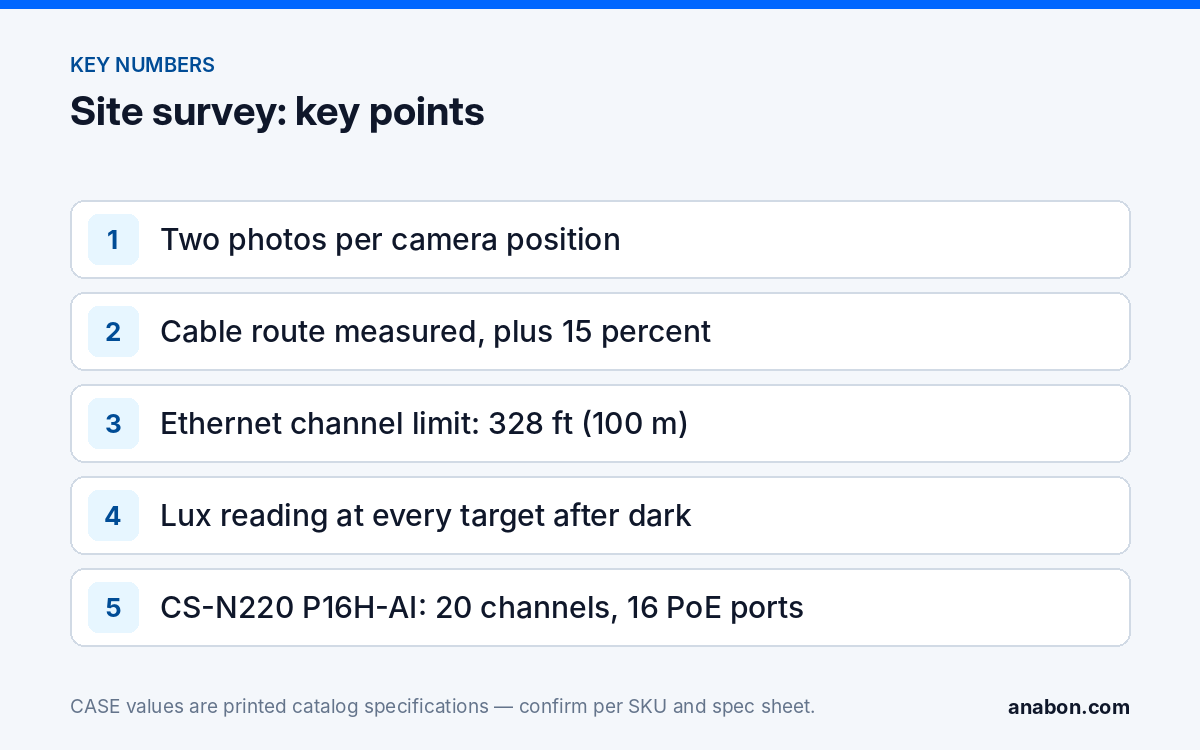
Start outside and walk the perimeter the way an intruder would, then every entrance, then the interior routes to the assets, then the room where the recorder will live. At each candidate camera position take two photographs: one from the mounting point looking at the target, one from the target looking back at the mounting point. The second photo shows you what the camera will have to look into: a wall pack, a window, the afternoon sun.
- Every entrance, dock, gate and fire exit, with its door swing and glass.
- Each candidate camera position: cladding (brick, stucco, metal panel, soffit), ceiling type indoors (tile, drywall, open deck), and whether a junction box or a corner, pole or pendant mount is needed.
- Existing cable pathways: conduit, cable tray, J-hooks, old coax or Cat5e that could be reused after testing.
- The recorder location: rack or shelf space, ventilation, a lockable door, AC outlets and whether a UPS exists.
- The demarcation point and the customer’s existing switches and router.
- Obstructions and seasonal change: trees in leaf, signage, parked trailers, snow banks along the fence.
- Night conditions: return after dark, or ask the customer for photographs; a lux meter reading at each target is worth more than any brochure.
Which measurements decide the bill of materials?
Each measurement below maps directly to a line on the quote. Measure the cable route as the cable will actually run, up, over and around, not point to point, and add 15 percent for service loops and terminations.
| Measurement | Why it matters | Tool | Decides |
|---|---|---|---|
| Cable route length per camera | Stays inside the 328 ft (100 m) Ethernet channel; sets Cat6 quantity | Measuring wheel, plans | Cable, extenders or fiber |
| Mounting height and surface | Anchors, boxes, mounts, lift or ladder | Laser measure | Mounts and labor |
| Distance from camera to target | Pixel density for the camera’s purpose | Laser measure | Lens and resolution |
| Camera count by type | Channels, PoE ports and budget, incoming bandwidth | Camera schedule | NVR and switch |
| Required retention (days) and recording mode | Drive count and size | Customer interview | Storage |
| Illuminance at each target after dark | IR, white light or low-light color choice | Lux meter | Night camera SKU |
| Distance between buildings or to poles | Copper limit, surge exposure | Measuring wheel | Fiber, remote switch, surge protection |
| Rack space, outlets, cooling | Where the recorder and switch can live | Tape measure | Rack hardware, UPS |
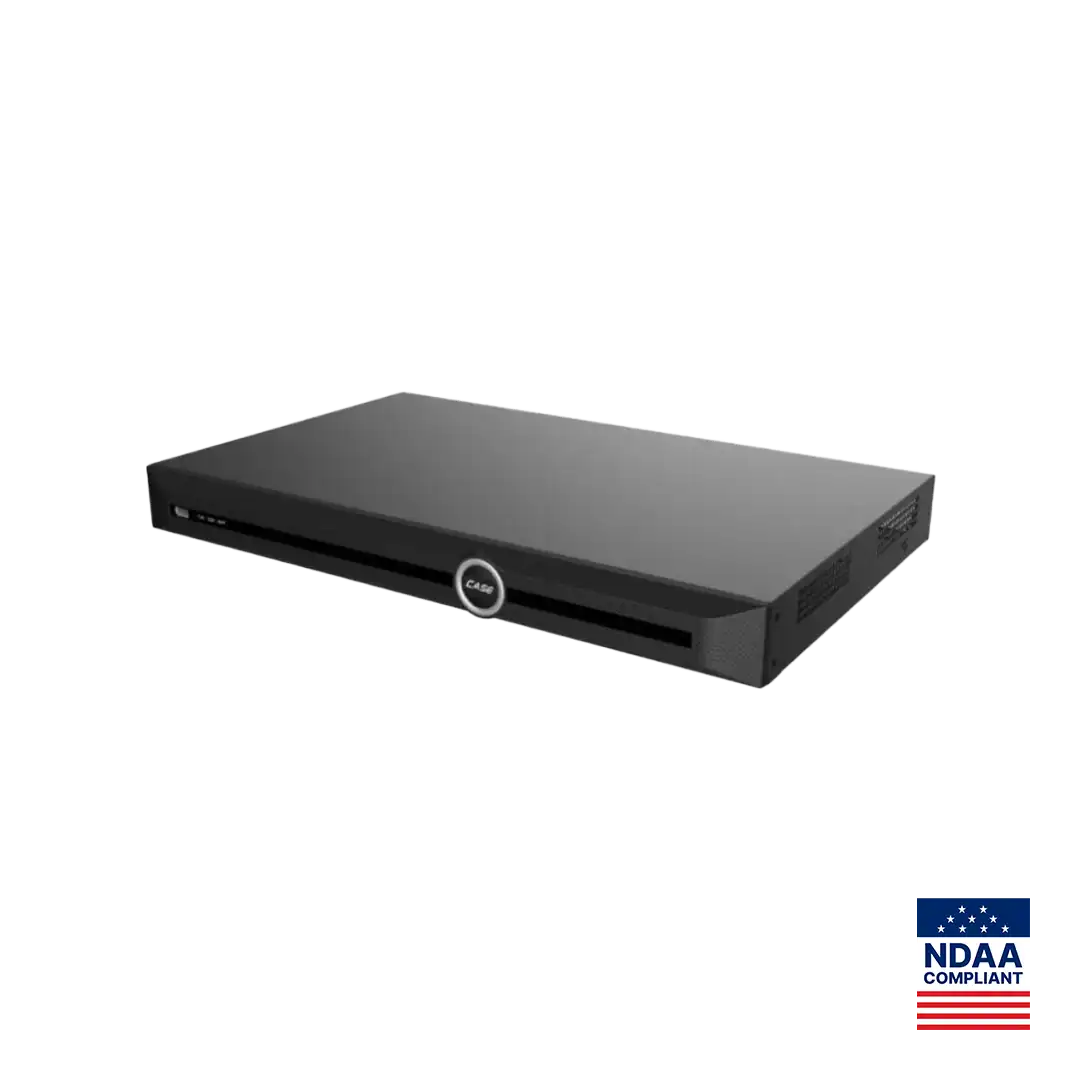
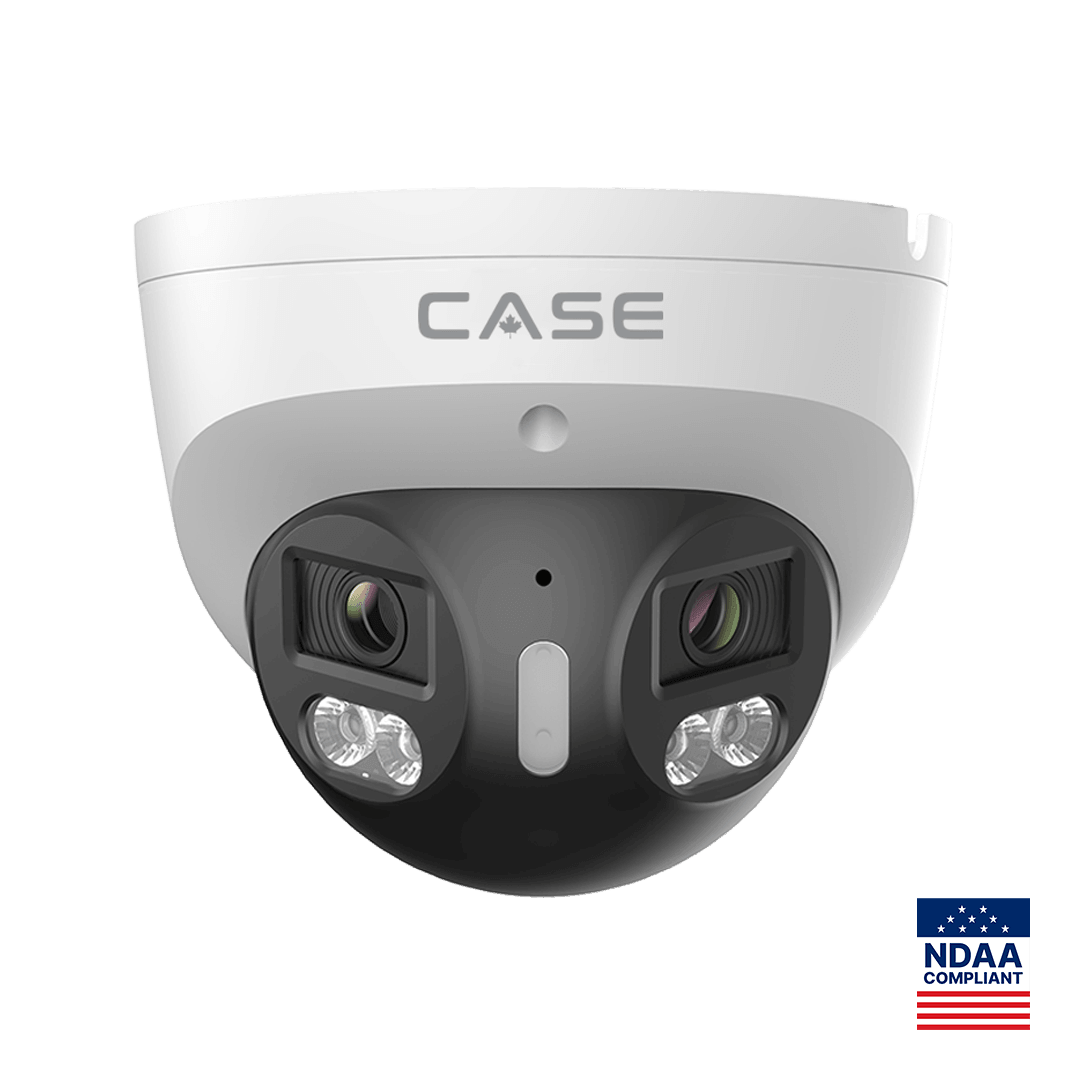
Two examples of how a measurement moves a line. A 180° position above a loading dock may replace two fixed cameras: the CS-I86V I-180 prints an 8MP (4+4) stitched sensor at 4640×1728, so one channel covers the apron. A camera count of 14 with growth to 18 points at a 20-channel recorder with 16 PoE ports, such as the CS-N220 P16H-AI, whose printed incoming bandwidth (160 Mbps, 120 Mbps with AI on) then caps the stream settings. The calculators for PoE budget and storage take the survey numbers directly.
What do you ask about the network and power?
The network questions are the ones installers forget to ask and then pay for on install day. Write the answer and the name of the person who gave it.
- Will cameras sit on their own switch and VLAN, or on the customer’s network? Who configures the VLAN?
- Static addresses or DHCP, and which range is reserved for cameras? (Address conflicts are a common cause of a recorder that cannot see cameras.)
- Who owns the firewall, and will remote viewing use P2P or a VPN? Port forwarding is not recommended.
- Internet upload bandwidth: it limits how many sub-streams remote users can watch at once.
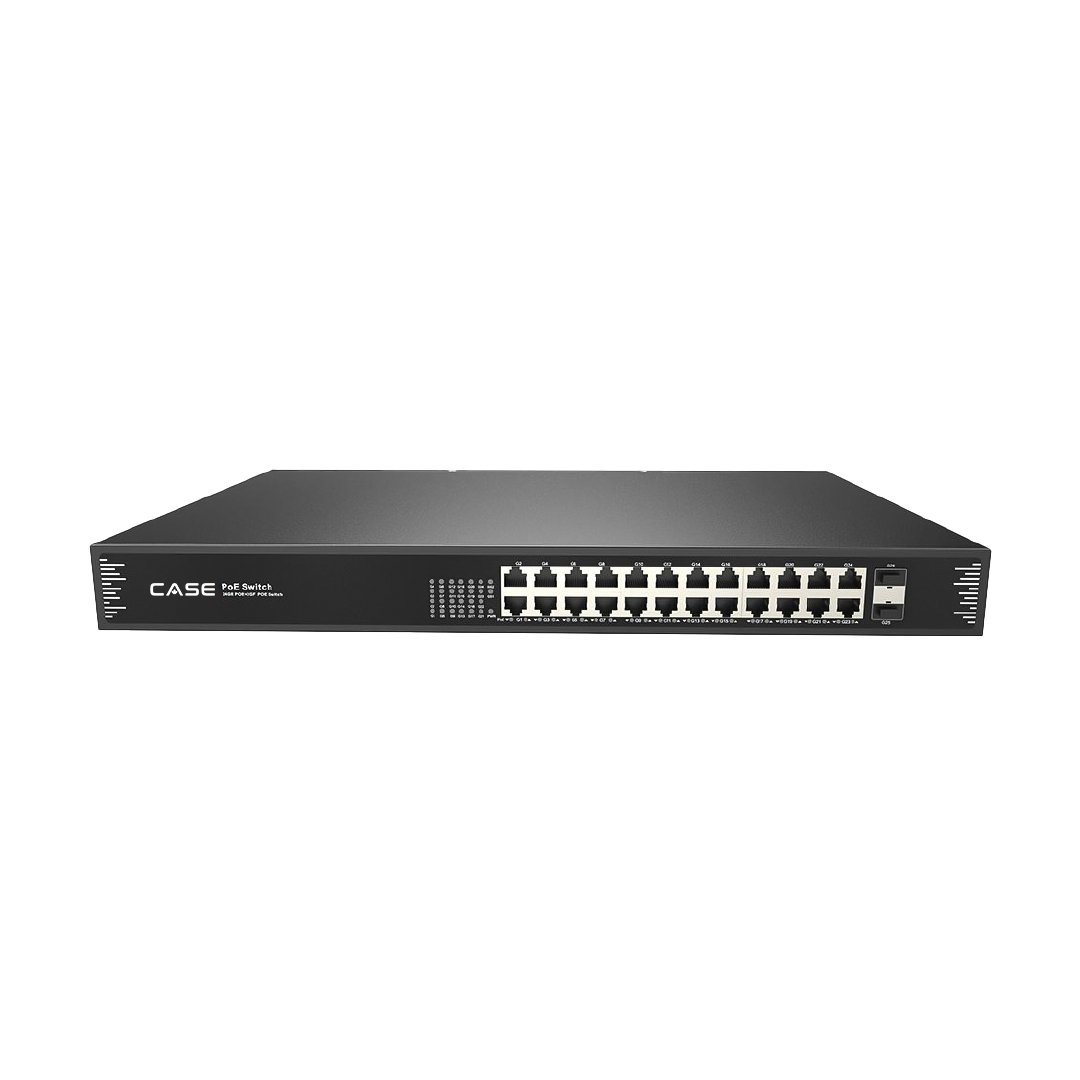
- Is there an existing PoE switch, and what is its remaining budget? Or does the design need its own, for example a CS-POE33024PF (24 ports, 30W per port, 400W / 600W total as printed)?
- AC outlets at the recorder and at every remote switch or pole enclosure; who provides them, and on which circuit.
- Power class of special cameras: a PTZ such as the CS-P48 63X prints PoE++ (IEEE 802.3bt) or DC36V ±25%, which a standard 802.3af/at switch does not supply.
- UPS: existing, to be supplied, or declined in writing.
- Grounding and surge: where does each exterior run enter the building, and is there a telecom ground available? (NEC Article 250 and Chapter 8 in the US; CEC Sections 10 and 60 in Canada; verify the local code.)
Which compliance and privacy questions belong on the form?
These questions take a minute to ask and weeks to resolve after the order ships.
- Procurement requirements. Is the customer a federal, state or provincial body, a contractor to one, or a regulated facility? If NDAA or similar requirements apply: CASE offers NDAA-compliant options for compliance-sensitive projects. Anabon confirms the exact products and provides the official compliance documentation for each project. Documentation is per SKU, requested before the quote, never assumed for a whole line.
- Audio. Will any camera record audio? Recording-consent rules differ by state (in Canada: PIPEDA and provincial law); default to audio off unless the customer has a documented reason.
- Privacy zones. Do any views include neighboring windows, a public sidewalk, a break room or a washroom door? Note them for masking or re-aiming.
- Signage. Who supplies and posts the notice signs the law or the sector requires?
- Retention policy. Who decides how long footage is kept, who may export it, and is there a sector rule (for example cannabis, schools, healthcare)?
- Analytics. Does the customer expect face or plate analytics? Both are confirmed per model, firmware, region and legal requirements, and in Canada face analytics are a project-review item.
None of this is legal advice; note the answers and tell the customer to verify with counsel where a legal threshold is involved. The documentation side is covered in The NDAA documentation pack: what to ask your distributor before a bid.
How does the survey turn into a bill of materials?
- One row per camera on the camera schedule: ID, location, purpose, mounting surface and height, target distance, cable route length, night lux reading.
- Assign SKU and lens per row from the purpose and distance, using the full SKU spelling with the series letter.
- Add the box and mount for each row from the camera’s spec sheet, version suffix exact.
- Size the recorder and switch from camera count, PoE budget and incoming bandwidth, with growth channels left free.
- Size storage from retention, recording mode and stream settings.
- Add infrastructure: cable by category and quantity, surge protectors for exterior runs, fiber and remote switches, rack, UPS, labels.
- Add the paperwork: compliance documentation requests, signage, the commissioning report template.
- Send the schedule to Anabon for a design review before you quote; a second pair of eyes on channel counts, PoE classes and SKU spellings is part of the distributor’s job.
The schedule and BOM layout is in Writing a camera schedule template and bill of materials; the three-stage install checklist that follows the quote is the security camera installation checklist.
Site survey form (copy it into your own template)
Paste the table into a spreadsheet or a notes app and repeat the camera-position block for each position. The field names match the camera schedule, so the survey becomes the first version of the as-built.
| Section | Field | Entry |
|---|---|---|
| Site | Name, address, contact, IT contact, date, surveyor | |
| Site | Site type and primary risks (theft, access, liability, safety) | |
| Site | Buildings and structures; distances between them | |
| Recorder room | Location, rack space, outlets, UPS, ventilation, lockable | |
| Network | Own switch or customer network; VLAN; static or DHCP; firewall owner; remote access method; upload bandwidth | |
| Power | Outlets at recorder and remote enclosures; special camera power classes | |
| Compliance | Procurement requirements; audio; privacy zones; signage; retention days; analytics expectations | |
| Camera position (repeat) | ID; location; purpose (identify, recognize, overview, deter); surface; height; mount and box; target distance; cable route length; entry point; night lux; photos (two) | |
| Totals | Camera count by type; cable total plus 15 percent; exterior runs; growth channels | |
| Open questions | Who answers, by when |
What to tell your customer
“The survey is what makes the quote accurate. We photograph and measure every camera position, check the lighting after dark, and confirm your network, power and record-keeping needs before we choose equipment. The quote you receive is built from those measurements, so there are no surprises on installation day.”
FAQ
How long does a site survey for security cameras take?
Allow one to two hours for a small commercial site and half a day for a multi-building property, plus a short return after dark or a request for night photographs. The time is recovered on install day: a measured cable route, a confirmed mounting surface and a known network plan remove the return visits that a quote written from the parking lot leaves out.
Do I need a lux meter on a camera site survey?
Yes, if the site has night coverage requirements. A reading at each target after dark tells you whether the position needs IR, white light or a low-light color camera, and it is the figure you compare with the minimum illumination printed on the spec sheet. Low-light and full-color behavior is stated per SKU and should be confirmed for the site.
What network information should I collect before quoting cameras?
Whether cameras get their own switch and VLAN, static or DHCP addressing and the reserved range, who owns the firewall, the remote access method (P2P or VPN, not port forwarding), internet upload bandwidth, any existing PoE switch and its remaining budget, and the name of the person who gave each answer. Write it on the form, not in your head.
How do I handle an NDAA question during the survey?
Record whether the customer or a funding body has procurement requirements. CASE offers NDAA-compliant options for compliance-sensitive projects, and Anabon confirms the exact products and provides the official compliance documentation for each project. Request the per-SKU documentation before the quote; never state that a whole product line is compliant.
How does the survey become a bill of materials?
Each camera position becomes one schedule row with purpose, distance, surface, height and cable length. From those rows you assign SKU and lens, add the box and mount from the spec sheet, size the recorder and switch from channel count, PoE budget and incoming bandwidth, size storage from retention, then add cable, surge protection and paperwork. Send the schedule to Anabon for review before you quote.