


Quick answer: A recorder’s channel count is only one limit. Check the actual device/views, formats, incoming/outgoing data, decoding, AI concurrency, storage, interfaces and peak power. Integrated PoE ports are separate from recording channels; external switches may supply more ports where all other resources and supported configurations fit. Do not promise twenty cameras from a 20CH label alone or assume one housing always uses one channel.
On this page
Channels, PoE ports and bandwidth: three different limits
Build a workload sheet that ties each camera/view and recording/client mode to its required resources. The three familiar numbers below are useful starting checks, not the only limits that can prevent a working design.
- Recording channels/views: the catalog labels IP Video Output as 5CH, 10CH, 20CH, 40CH or 80CH. Confirm actual camera/stream mapping, licensing if applicable and mode support; multiple sensors/views can affect channel use.
- Integrated PoE: port count, per-port standard, total power and delivered power are separate checks. Confirm peak/startup loads, cable design, reach and actual addressing/channel behavior; a camera is not automatically compatible because it plugs in.
- Data and processing: verify how the manufacturer defines input/output budgets, AI-on modes, decoding and concurrent functions. More frame rate does not imply a fixed bitrate multiplier; use the actual supported workload.
Outgoing data, simultaneous sessions and decoding/display limits also matter. They can prevent the required viewing/export workflow even where the recording input arithmetic fits. The IP camera bandwidth calculator separates payload estimates from complete recorder/network demands; do not claim that only three numbers determine capacity.
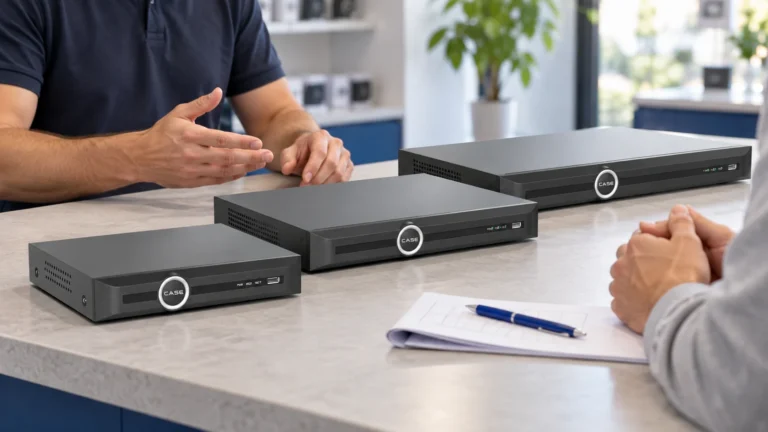
CASE NVR table: channels, PoE ports, bandwidth and resolution as printed
The following rows are transcribed from the catalog, not a validation of every camera/client combination. Resolution is a printed row; obtain exact format, frame-rate and processing limits before treating it as a supported mode on every channel simultaneously. The store spelling CS-N440 P16H-AI differs from the catalog title CS-N440 P16-H-AI; confirm ordering identity and revision before commitment.
| Full catalog SKU | Channels | PoE ports | Printed I/O bandwidth | Printed Resolution row |
|---|---|---|---|---|
| CS-N105 P4 | 5CH | 4 | 100/80 Mbps | 16MP |
| CS-N105 P4H-AI | 5CH | 4 | 100/80 Mbps | 16MP |
| CS-N110 P8 | 10CH | 8 | 100/80 Mbps | 16MP |
| CS-N110 P8H-AI | 10CH | 8 | 100/80 Mbps | 16MP |
| CS-N220 P16H-AI | 20CH | 16 | 160/80 Mbps; AI-on input 120 Mbps | 16MP |
| CS-N440 M-AI | 40CH | N/A | 400/400 Mbps; AI-on 200/200 Mbps | 16MP |
| CS-N440 P16-H-AI (identity/revision confirmation required) | 40CH | 16 | 400/400 Mbps; AI-on 200/200 Mbps | 16MP |
| CS-N880 N | 80CH | N/A | 640/320 Mbps | 16MP |
| CS-N880 H-AI | 80CH | N/A | 400/400 Mbps; AI-on 320/200 Mbps | 16MP |
These printed channel tiers can leave nominal channel room in a proposed four-, eight-, sixteen-, thirty-two- or sixty-four-view design. That is arithmetic, not proof of why the manufacturer chose them or capacity for future cameras. Reserve the actual required growth across all resources. Choosing the right CASE NVR covers selection beyond count. Confirm the term, exclusions and claim process for the exact model and revision in writing.
Worked example: 20 channels, 16 PoE ports and four cameras on a switch
Illustrative scenario: twenty required views, assumed one channel per camera for this calculation, with sixteen local and four remote camera positions. CS-N220 P16H-AI is a candidate to evaluate, not a validated design. Actual route lengths, camera modes, power, resilience and growth requirements still need review.
- Channels: twenty assumed single-channel views fill twenty channels. Multi-view handling and supported modes need confirmation; a larger recorder may be required for count, another resource or agreed growth.
- Topology: map actual local/remote routes and interfaces. A point 137 m from the rack cannot be approved by calling the same uninterrupted copper route less than 100 m. Assess nearer powered switching or supported fiber/extension, with qualified route/protection review.
- Illustrative data: 14×4 + 6×6 = 92 Mbps main-stream payload; adding twenty assumed 0.5 Mbps streams totals 102 Mbps. Against a 120 Mbps AI-on input row, that leaves 18 Mbps, or 15% of that row. This is arithmetic before other demand, overhead, peaks, processing and agreed headroom, not a pass certificate. No universal 30 fps multiplier follows.
- Power/storage: obtain exact per-port/total recorder and supplied-switch limits; check peak loads, loss, continuity, usable retention and actual supported drive/mode configuration. The PoE budget calculator is a planning aid.
CS-N110 P8H-AI lists ten channels/eight PoE ports, 100/80 Mbps I/O and 100 Mbps-class Ethernet interfaces. Confirm the required camera and client traffic in each direction and how the specified budgets apply; do not automatically add full-duplex input and output as one shared 100 Mbps pot. CS-N440 M-AI and CS-N880 H-AI have no integrated PoE, but their bandwidth/AI-on rows differ; do not call both a 400 Mbps AI-on design.
Adding cameras beyond the PoE ports: how the network side works
External-switch cameras need a supported reachable network configuration and actual recorder integration. The patterns below are candidates; their suitability depends on approved addressing, access controls, power, routes and the complete workload.
- Local external switching: a suitable CS-POE33108PF or CS-POE33024PF can supply separate ports/power. Confirm the supplied budget variant and supported network path; automatic discovery or plug-and-play is not universal.
- Remote switching: supported fiber/other links can serve remote positions, but central versus local recording also depends on outage behavior, storage, power and operator tasks. Designing a two-building site compares those requirements.
- Shared site network: agree camera and recorder interfaces, subnets/routing, firewall permissions and maintenance responsibility with IT. A VLAN alone is not security or reachability proof. NVR not showing cameras covers the diagnostic checks.
Moving a camera to external switching does not add recording channels or remove a network video recorder’s processing, storage or data limits. It changes the power/path architecture and may change which interface handles traffic; distance is still constrained by each actual link design. Verify actual view/channel mapping and the complete required recording/client workflow.
Resolution caps per channel and what counts as one camera
All nine listed recorder pages print a 16MP Resolution row. That does not establish that every stream format, frame rate, camera feature or simultaneous decoding/AI combination up to that number is supported. Confirm the exact device/firmware/client mode. The CS-I86V I-180 stitched resolution row alone does not establish one-channel use on every recorder.
- Data: resolution alone does not set bitrate. Any 2 or 6 Mbps example is an assumed rate, not an automatic cost of 2MP or 8MP.
- Multiple views: for CS-I8RN S-2.8mm, CS-I85N L-180 or CS-P66V 25XA-180, confirm actual device streams, addresses, channel/licence use and required functions with the intended recorder/client. Neither one housing nor a two-sensor label guarantees one or two channels.
- Display and analytics: verify concurrent decoding, layouts, playback/export and AI/event functions separately. Spare recording channels do not prove the required live-display or analytic workload fits.
Checklist before you write the channel count on a quote
- List exact cameras/views, firmware and required streams/functions; verify actual recorder channel/licence mapping.
- Check formats, recording modes, AI concurrency, decoding, client sessions and input/output budgets.
- Map measured routes, interfaces, addressing/access and resilience; select supported local/remote power and links.
- Calculate actual peak per-port/total PoE and complete network demand with an agreed margin.
- Size usable storage/retention and growth across every resource, not channels alone.
- Test actual recording, playback/export, day/night targets, client and relevant failure behavior; record results and pending items before acceptance.
What to tell your customer
We will check how many required views the recorder can handle in the actual modes, including power, network, processing and storage. External switches may help with ports and placement where the recorder still fits the workload. The proposal will state assumptions, growth room and tests; a socket or channel count alone is not the capacity promise.
FAQ
Can a 16-port NVR record more than 16 cameras?
Possibly. CS-N220 P16H-AI lists twenty channels and sixteen PoE ports. A supported external-switch configuration may provide separate power/ports for additional views if the full workload fits. The forty-channel PoE candidate also needs the catalog/store identity difference resolved. Check actual streams, formats, data, decoding, AI and storage before promising a camera count.
Does a camera on a switch use an NVR channel?
External power does not remove the recording resources a required camera/view uses. Verify actual channel/stream mapping and formats for that integration; one housing is not always one channel. The external switch changes power and path, while processing, data and storage requirements remain to be checked. Record the commissioning checks against that actual configuration.
Why do CASE NVRs have 5, 10, 20, 40 and 80 channels?
Those are the printed tiers in these catalog pages. Do not infer a guaranteed future camera allowance or manufacturer rationale from the sequence. A sixteen-view design on twenty channels leaves four nominal channels only if mapping is as assumed; data, power, decoding, AI and storage may constrain growth sooner.
Does a 4K camera use more channels than a 2MP camera?
Not necessarily. Actual supported view/stream mapping determines channels; resolution by itself does not prescribe one channel or a fixed bitrate. Check multi-view handling, formats, frame rates, decoding, AI and recording limits for the exact integration. A 16MP row alone does not approve every 4K workload.
How many cameras can a CS-N110 P8H-AI support?
The catalog lists ten channels, eight PoE ports and 100/80 Mbps I/O. Ten assumed single-channel compatible views may be a candidate configuration, with external power/ports where needed, but verify actual modes, peak power, network budgets, decoding, AI and storage. A 45 Mbps payload example alone is not complete system approval. The small-site NVR comparison puts the five- and ten-channel candidates side by side.
References
- Anabon: exact model/revision documents
- Anabon: complete network and recording commissioning checks