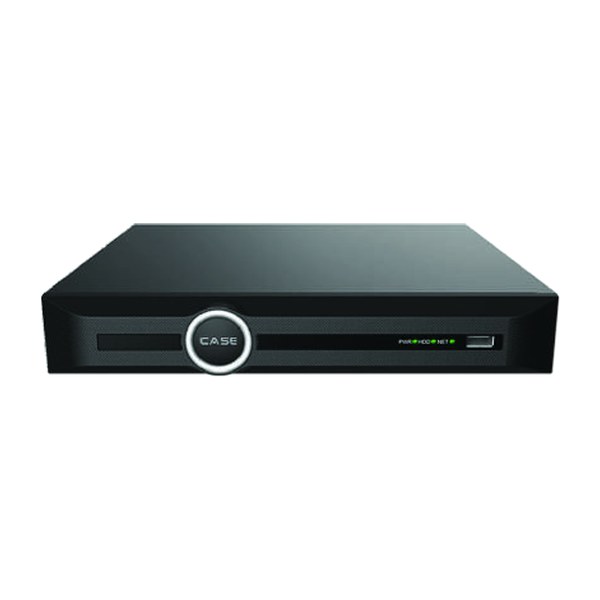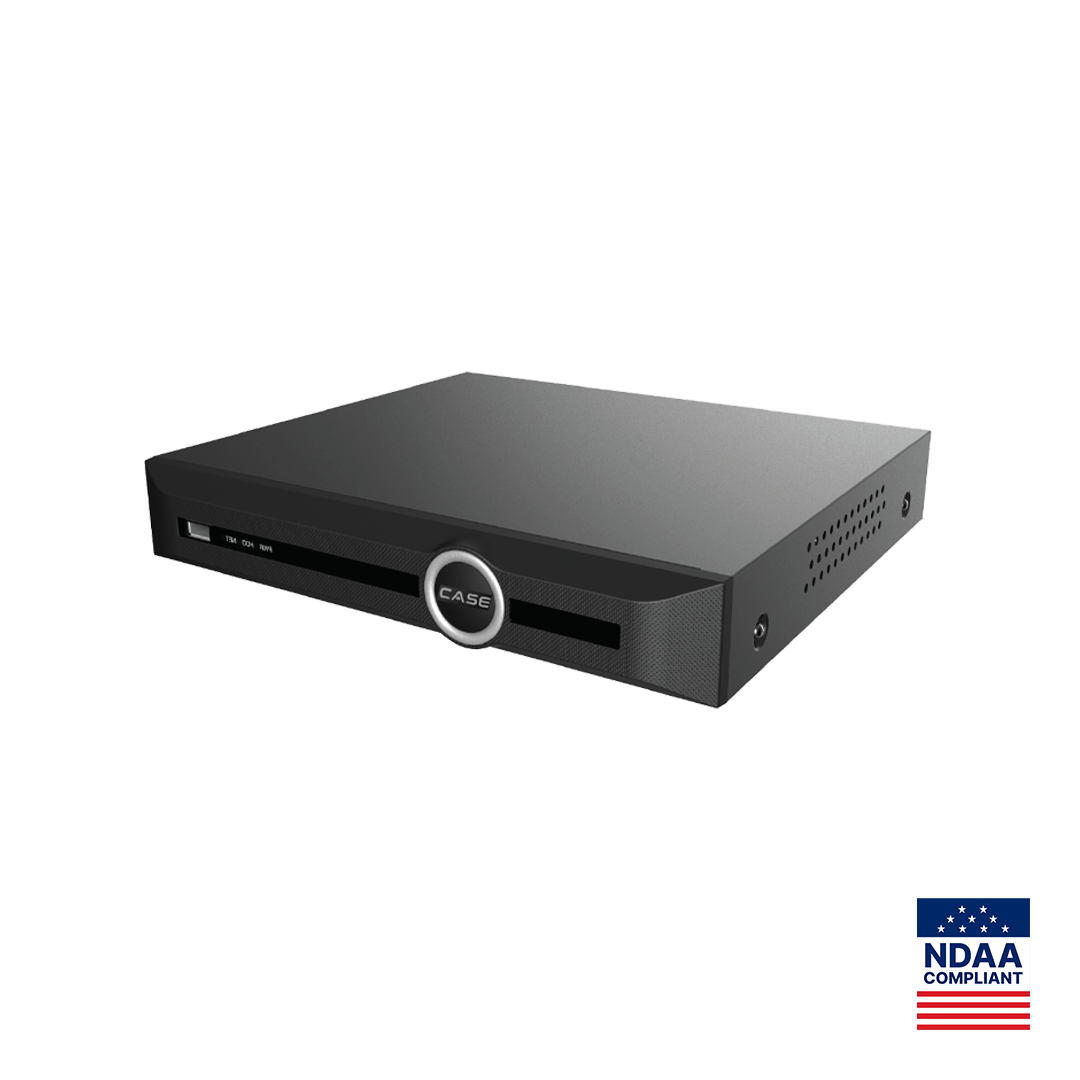


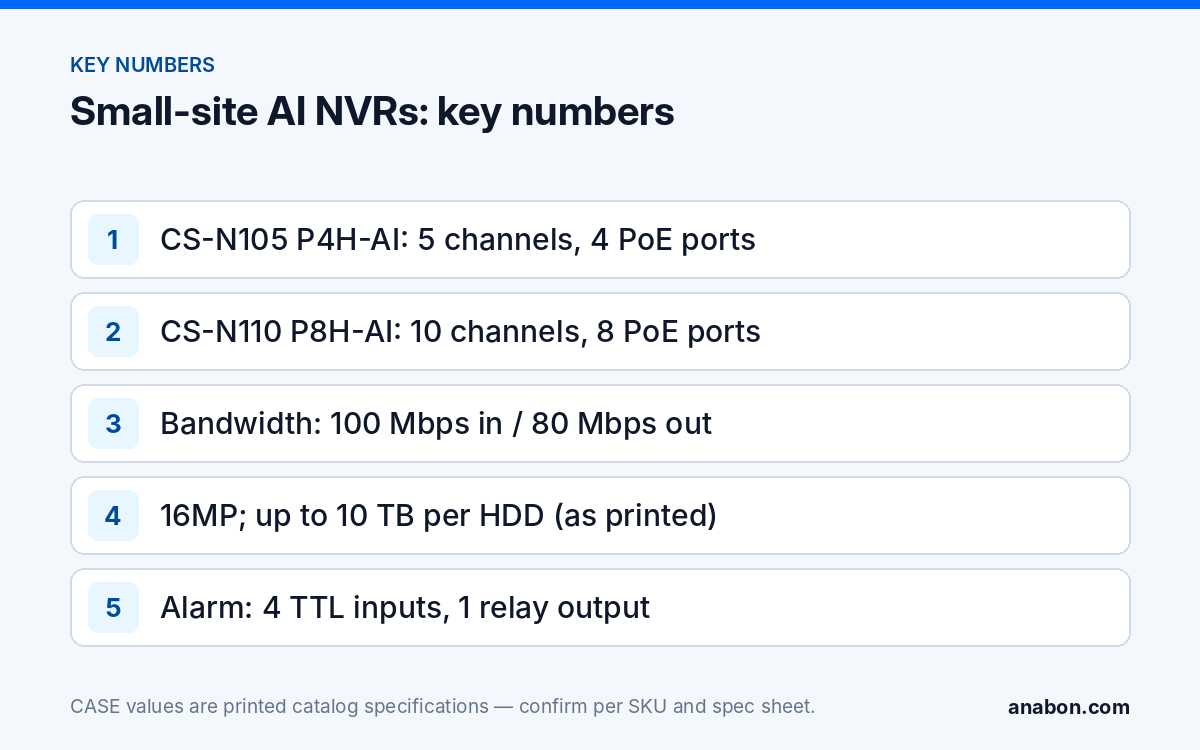
Quick answer: When a small store, office or clinic asks for a 4 channel PoE NVR with AI, the CASE CS-N105 P4H-AI records 5 channels with 4 built-in PoE ports, and the CS-N110 P8H-AI records 10 channels with 8. Both print the basic AI by NVR set and VCA Search, 100Mbps incoming and 80Mbps outgoing bandwidth, 16MP recording and up to 10 TB per hard drive. CASE NVRs carry a 6-year warranty, serviced through you.
What is in the basic AI set, exactly as printed?
Both recorders are Intelligent Series units and print the same two analytics rows. Quote them word for word; do not add functions from the larger CASE AI NVRs.
| Row | Printed functions (CS-N105 P4H-AI and CS-N110 P8H-AI) | What it means on the job |
|---|---|---|
| AI by NVR | Face Detection, Face Recognition, Tripwire, Double Tripwire, Perimeter, Smart Motion Detection | The recorder applies rules to camera streams, including cameras without their own analytics, as confirmed per model and firmware |
| VCA Search | Early-warning Search, Behavior Search, Safety Helmet Search, Thermographic Retrieval, Duty Search, Electric Bicycle Retrieval, Face Search (Search by face attributes), Smart Motion Detection | The operator searches recordings by event type instead of scrubbing a timeline |
This is the basic set. The 40- and 80-channel CASE AI NVRs print a longer AI by NVR list, and two of them add License Plate Search; neither of the small units prints those extras, so a proposal for a 5- or 10-channel site lists only the rows above. Three limits apply before you promise anything:
- Which camera events feed which search is confirmed per model, firmware, software version and project configuration, not assumed from the row.
- Early-warning Search, Thermographic Retrieval and Safety Helmet Search depend on cameras that generate those events. They are search functions on the recorder; they do not add a capability to an ordinary turret.
- Face Detection and Face Recognition are printed, but using them is a legal decision. US state biometric laws such as Illinois BIPA may apply, and in Canada PIPEDA and provincial laws apply, with Quebec the most restrictive jurisdiction. Confirm the use case and the customer’s legal position in writing and verify with counsel; lead with Tripwire, Perimeter and Smart Motion Detection by default.
For the difference between analytics on the camera and on the recorder, see AI NVR explained: AI by NVR vs AI on the camera.
When does a small site benefit from AI on the recorder?
Small sites rarely have someone watching live video. The value of AI by NVR and VCA Search is in two moments: fewer nuisance alerts after hours, and a faster answer when the owner calls asking what happened on Tuesday night. Typical fits:
- Small retail or convenience store, 3 to 5 cameras: a Tripwire on the back door after closing, a Perimeter rule on the rear lot, and VCA Search to pull a clip for a police report.
- Professional office or clinic, 6 to 10 cameras: Smart Motion Detection on entrances and the reception area, with its filtering behavior confirmed per model and firmware before you promise fewer nuisance alerts.
- Small warehouse or trade shop: Double Tripwire across a roll-up door to tell entering from leaving, and the 4 alarm inputs for door contacts.
When the customer only wants continuous recording and remote viewing, the non-AI siblings fit: the Sharp Series CS-N105 P4 and CS-N110 P8 print the same channel count, PoE ports, bandwidth, 16MP recording and storage rows, but no AI by NVR or VCA Search row and only one relay output. Quote the AI version when the after-hours rule or the event search is something the customer will use; quote the Sharp version when neither is on the requirement list.
What do 4 or 8 PoE ports and 100 Mbps really give you?
The CS-N105 P4H-AI records one more channel than it has PoE ports (5 and 4); the CS-N110 P8H-AI records two more (10 and 8). The printed Ethernet rows are 4+1 RJ45, 10/100 Mbps self-adaptive on the CS-N105 P4H-AI and 8+1 RJ45, 10/100 Mbps self-adaptive on the CS-N110 P8H-AI. The +1 port is the network uplink; the fifth camera on the CS-N105 P4H-AI, or the ninth and tenth on the CS-N110 P8H-AI, arrives through it from a PoE switch on the LAN. Note that every port, uplink included, is 10/100 Mbps, so remote viewing, the extra network cameras and exports share a 100 Mbps link.
The printed bandwidth row on both is 100Mbps / 80Mbps: incoming is the sum of camera main streams the recorder accepts, outgoing is what it can send to CASE Connect clients and exports at the same time.
| Planning case (illustrative stream settings, not printed specs) | Sum of main streams | Against 100Mbps incoming |
|---|---|---|
| 5 cameras, each main stream set to 4 Mbps | 20 Mbps | Fits |
| 5 cameras, each main stream set to 8 Mbps | 40 Mbps | Fits |
| 10 cameras, each main stream set to 6 Mbps | 60 Mbps | Fits |
| 10 cameras, each main stream set to 10 Mbps | 100 Mbps | At the limit; lower the bitrate or use S+265 |
Read real bitrates from each camera’s stream page and keep a margin for motion-heavy scenes. Run the numbers with the IP camera bandwidth calculator before the bill of materials is final.
The catalog row does not print the PoE budget per port or in total. Take both from the spec sheet before you assign a camera with a heater, white light, audio or a motorized lens to a built-in port. If the budget is short, power that camera from an external switch on the uplink side.
How do the alarm inputs and the relay output change the install?
This is the second practical difference between the AI and non-AI units. The CS-N105 P4H-AI prints 4-ch, TTL inputs, 3mA, 3.3VDC; 1-ch, relay output, 1A, 24VDC, and the CS-N110 P8H-AI prints the same values. The CS-N105 P4 and CS-N110 P8 print only the relay output: 1-ch, relay output, 1A, 24VDC.
- Use the inputs for dry-contact door sensors or a signal from the intrusion panel, so an alarm event marks the recording and can trigger an action.
- Use the relay to switch a strobe, a buzzer or a signal to another system. The printed rating is 1A at 24VDC; anything larger goes through an interposing relay with its own supply.
- Label every input and the relay at the terminal and in the as-built, and test each one at commissioning.
Wiring details, including flyback protection and interposing relays, are in NVR alarm inputs and relay outputs. Low-voltage wiring follows the NEC in the US (CEC in Canada); verify the local code.
Spec table: AI and non-AI units side by side
| Printed row | CS-N105 P4H-AI | CS-N110 P8H-AI | CS-N105 P4 | CS-N110 P8 |
|---|---|---|---|---|
| Series | Intelligent | Intelligent | Sharp | Sharp |
| IP Video Output | 5CH | 10CH | 5CH | 10CH |
| PoE Port | 4 | 8 | 4 | 8 |
| Bandwidth I/O | 100Mbps / 80Mbps | 100Mbps / 80Mbps | 100Mbps / 80Mbps | 100Mbps / 80Mbps |
| Resolution | 16MP | 16MP | 16MP | 16MP |
| Display Ports | HDMI and VGA outputs (Simultaneous) | HDMI and VGA outputs (Simultaneous) | HDMI and VGA (simultaneous) | HDMI and VGA (simultaneous) |
| Storage | Up to 10 TB capacity for each HDD | Up to 10 TB capacity for each HDD | Up to 10 TB capacity for each HDD | Up to 10 TB capacity for each HDD |
| Alarm I/O | 4 TTL inputs; 1 relay output | 4 TTL inputs; 1 relay output | 1 relay output | 1 relay output |
| Ethernet | 4+1 RJ45, 10/100 Mbps | 8+1 RJ45, 10/100 Mbps | 4+1 RJ45, 10/100 Mbps | 8+1 RJ45, 10/100 Mbps |
| AI by NVR / VCA Search | Basic set, as printed | Basic set, as printed | Not printed | Not printed |
Not in the catalog rows, so read them from the spec sheet before quoting: number of drive bays, PoE budget, power consumption, dimensions and operating temperature. Hard drives are sized from real bitrates and retention; the NVR storage calculator gives the method.
Installation and handover checklist
- Confirm channel count with one spare: 5 channels covers four PoE cameras plus one network camera; beyond that, step up to the CS-N110 P8H-AI.
- Bench-test cameras on the recorder before site day and record firmware versions.
- Add CASE cameras by plug-and-play on the PoE ports; for other cameras, ONVIF profiles supported are S, T, and G, with M on pinhole models. Third-party behavior is confirmed per platform and project.
- Set the AI rules the customer actually asked for, then trigger each one with a walk test and save the result in the commissioning report.
- Set NTP and the time zone so searches and exported clips carry the right time.
- Create a customer user without admin rights, set up CASE Connect on the customer’s phone, and keep the admin credentials in your records.
- Record drive serials; hard drives are supported through back-to-back manufacturer warranty, separate from the NVR warranty.
For projects with NDAA or other compliance requirements, ask Anabon for the per-SKU documentation before the quote goes out; CASE offers NDAA-compliant options for compliance-sensitive projects, and Anabon confirms the exact products and provides the official compliance documentation for each project.
What to tell your customer
“This recorder handles up to 5 cameras and powers 4 of them directly. It can flag a line crossing after hours and lets us search the recordings by event type, so finding a clip does not mean scrubbing through hours of video. You view it through the CASE Connect app on your phone. The recorder carries a 6-year warranty, and all service goes through us.”
FAQ
Is the CS-N105 P4H-AI a 4-channel or a 5-channel NVR?
It records 5 channels and has 4 built-in PoE ports, as printed. Four cameras plug into the recorder and are powered by it; a fifth is recorded from a PoE switch on the network side of the uplink. If a quote request says 4 channel PoE NVR with AI, this unit meets it and adds one channel of headroom.
What is the difference between the basic and the full AI set?
The small units print Face Detection, Face Recognition, Tripwire, Double Tripwire, Perimeter and Smart Motion Detection under AI by NVR. The 40- and 80-channel CASE AI NVRs print a longer list, and two of them add License Plate Search. Quote only the printed basic set for these two recorders, and confirm each function per camera model and firmware.
Should I quote the AI version or the CS-N105 P4?
Quote the CS-N105 P4H-AI when the customer will use after-hours rules, event search or alarm inputs for door contacts. Quote the Sharp Series CS-N105 P4 when the job is continuous recording and remote viewing only; it prints the same channels, PoE ports, bandwidth and storage rows but no AI rows and one relay output.
Can I run face recognition at a small retail store?
The function is printed, but using it depends on law and on the camera. US state biometric laws such as Illinois BIPA may apply, and in Canada PIPEDA and provincial laws apply, with Quebec the strictest. Confirm the use case in writing and verify with counsel. Start with Tripwire, Perimeter and Smart Motion Detection, which cover most small-site needs.
Why is the uplink only 10/100 Mbps, and does it matter?
The printed Ethernet row is 10/100 Mbps self-adaptive on every port, uplink included. For a 5- or 10-camera site that is normally enough, but remote viewing, the extra network cameras and exports share it. Use sub-streams for CASE Connect over cellular or slow upload links, and schedule large exports when nobody is viewing remotely.