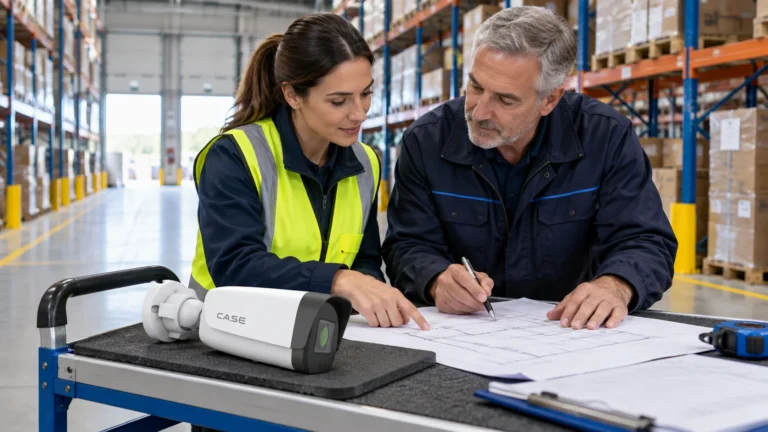



Quick answer: Survey a factory around the incidents it needs to review, the environment at each mounting point and the approved network path. Production, loading and yard cameras have different jobs. Ordinary surveillance or video analytics must not be presented as a machine safeguard, fire alarm or certified worker-protection system.
On this page
Separate security evidence from the safety system
Ask the plant manager what they need to understand after an event: movement through a stock area, a disputed delivery, unauthorized access or a missing item. Involve facilities, IT and the site’s safety team early. Record which requests are security observations and which belong to a separate engineered safety function. A saved clip can help review an event. That does not make the camera a protective device that stops a machine or reliably warns a forklift driver. Avoid implying that an ordinary analytics setting provides a guaranteed safety response. Have the responsible qualified team specify any separate safety system.
Survey the real mounting environment
Check heat, dust, vibration, oil mist, steam, cleaning methods and service access at each proposed position. Conditions beside a process can differ from conditions elsewhere in the room. Select IP cameras using the exact device and installation documentation rather than assuming one housing suits every plant area. The IP and IK rating guide helps separate enclosure ratings from the actual process and installation requirements.
| Area | Evidence task | Installation check |
|---|---|---|
| Production route | Movement of people or agreed materials | Moving equipment, obstructions, light flicker and vibration. |
| Loading dock | Arrival, transfer and departure sequence | Open-door contrast, trailers and parked loads. |
| Stock or tool area | Access to the nominated storage point | Shelving changes and a useful view during normal work. |
| Yard and vehicle gate | Vehicle route and entry event | Night lighting, weather, power and communications. |
Obtain the documented classification for any potentially hazardous area. OSHA 1910.307 is a US reference for electrical equipment and wiring in classified locations; it is not a Canadian rule or approval of this site. Weather or impact ratings do not establish hazardous-location suitability. Have the qualified project team confirm the exact equipment and installation requirements.
Prove moving detail at production and loading points
Test the line, lighting and doors in their normal operating state, using the proposed recording settings and intended display scale. At a dock, check both sides of an open door in bright daylight and the darkest working period, with the usual trailer, pallet stack and largest vehicle. Move or divide the view where one camera cannot show the agreed detail. Keep essential routes covered when a supplementary PTZ looks elsewhere. A separate plate task needs its own capture point and supported configuration; an empty-aisle still image proves neither moving detail nor forklift safety.
Equipment example: For an open staging overview, CS-I86V I-180 lists an 8MP (4+4) stitched image in the catalog (physical page 19). Test detail and the stitch areas with the actual loads and movement. Keep a separate closer view where required; panoramic imaging does not establish a forklift-safety function or every industrial environment’s suitability.
Respect the plant’s IT and OT boundaries
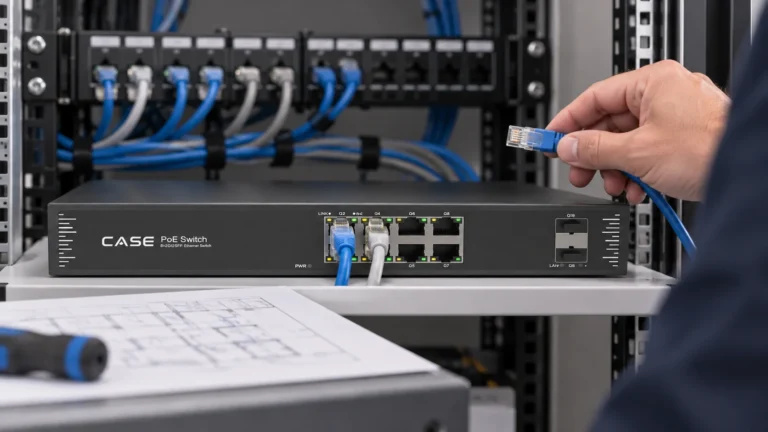
Have the plant network owner approve addressing, segmentation, remote access, time service and the maintenance path. A convenient port is not authorization to connect cameras to industrial controls. Check actual PoE power, uplinks, environment and remote-link requirements. NIST SP 800-82 Revision 3 is the September 2023 final OT-security reference; its publisher now lists an initial public draft of Revision 4. Confirm the project’s approved reference and change process. This guide does not authorize a plant connection or certify camera safety.
Size the recorder from streams and operating needs
Choose the recorder for actual channels, supported incoming bandwidth, usable disks and agreed expansion. Calculate storage from the owner’s target and stream settings, then verify recording age after run-in. Record concurrent viewing/export requirements and the agreed preservation process before normal overwrite. A floor-area example, resolution label or default bitrate is not proof of capacity for every proposed configuration.
Make acceptance part of the working shift
With permission, record a harmless delivery or movement along the agreed route, retrieve it, export it and replay it with the customer. Record lighting, equipment positions, labels, timestamps and accepted gaps. Use the customer handover checklist to document named roles, recovery, network approvals and fault response. Leave the as-built plan, firmware schedule and exact-model documents. Agree safe cleaning and service access with the plant, together with the approved staff-privacy responsibilities.
FAQ
Can surveillance analytics replace a machine safety control?
No such claim is made here. A safety function needs its own qualified design, equipment and approval. Specify security recording separately.
Does an outdoor rating make a camera suitable beside a dusty process?
Not by itself. Confirm temperature, contaminants, cleaning and any hazardous-area classification against the exact equipment and installation documents.
Prepare a plant-specific schedule
Send security camera technical support an approved site plan, environmental conditions, lighting-test requirements, network constraints and recording target. Identify safety functions and sensitive plant details that require a separate qualified review.
References
References reviewed October 30, 2026. NIST SP 800-82 Rev. 3 publication page: September 2023 final, with a September 21, 2026 note pointing to the initial Rev. 4 public draft. OSHA 1910.307 is a US hazardous-location reference. Apply the actual jurisdiction and qualified project requirements. Equipment example: current CASE catalog, physical page 19.