


Quick answer: A security camera installation business needs five things in place: the licenses and insurance your state or province requires, a few certifications that prove competence to commercial buyers, a distributor relationship that gives you private pricing, support and documentation, a short list of first commercial customers, and a simple tool stack. Growth into larger projects then comes from documentation, design support and the willingness to bring a bigger opportunity to your distributor before you turn it down.
What licensing and insurance does a security camera installation business need?
There is no single North American license for camera installers. Requirements are set by states, provinces and sometimes cities, and they differ in what they cover: low-voltage electrical work, alarm and security contracting, and in some places the individual technicians as well as the company. Treat the table as a list of where to check, not as legal advice, and confirm with the licensing authority and, where needed, a lawyer or accountant.
| Item | US: where to check | Canada: where to check |
|---|---|---|
| Business registration | State business registry; city or county business license | Provincial business registry; federal incorporation if chosen; municipal license where required |
| Low-voltage / electrical work | State or local electrical licensing board; work to the NEC as adopted locally | Provincial electrical safety authority; work to the CEC as adopted provincially |
| Security or alarm contractor license | State licensing board for alarm or security contractors, where one exists; some states also license technicians | Provincial security licensing rules, where they apply to installers; verify with the province |
| Sales tax registration | State sales and use tax registration | GST/HST registration and provincial sales tax where applicable |
| Workers’ compensation | State workers’ compensation requirements once you hire | Provincial workers’ compensation board |
Insurance is what commercial customers and general contractors ask for first. Plan for general liability, commercial auto for the van, workers’ compensation once you have employees, tools and equipment coverage, and professional liability (errors and omissions) if you design systems. Many property managers and contractors require a certificate of insurance naming them before you step on site, so keep it current and fast to send.
One more item that is not a license but affects every job: video privacy. Commercial customers carry obligations under state laws (US) and provincial laws and PIPEDA (Canada). You are not their lawyer, but knowing the questions makes you a safer contractor to hire.
Which certifications are worth having?
Certifications do two jobs: they train your people, and they give a facility manager or a consultant a reason to trust a small company. Pick the ones your buyers recognize rather than collecting all of them.
- Association training: the Electronic Security Association (ESA) in the US and the Canadian Security Association (CANASA) in Canada run training and education for security contractors; both are also where licensing and industry changes are discussed.
- Cabling credentials: BICSI installer and technician credentials show structured-cabling competence, which matters on commercial sites where the camera network shares pathways with IT.
- Project management: the Security Industry Association (SIA) offers the Certified Security Project Manager credential for those moving into larger jobs.
- Security management: ASIS International certifications such as the Physical Security Professional credential are recognized by corporate security buyers.
- Safety: work-at-height and site safety training required in your state or province, and whatever the general contractors you work for require on their sites.
- Product training: brand training on the line you standardize on, so every technician configures the recorder and the cameras the same way.
Why does a distributor relationship matter for supply?
A new installation business often starts by buying wherever the hardware is available that day. That works until a customer finds the same item listed online, a unit fails and nobody stands behind it, or a project needs documentation no retail listing can provide. A distributor relationship replaces those gaps with terms you can build a business on.
| Need | What the relationship provides |
|---|---|
| Margin protection | CASE is a channel-protected line. CASE pricing does not appear publicly online. You receive private pricing through login, your approved business account, and direct quotes. |
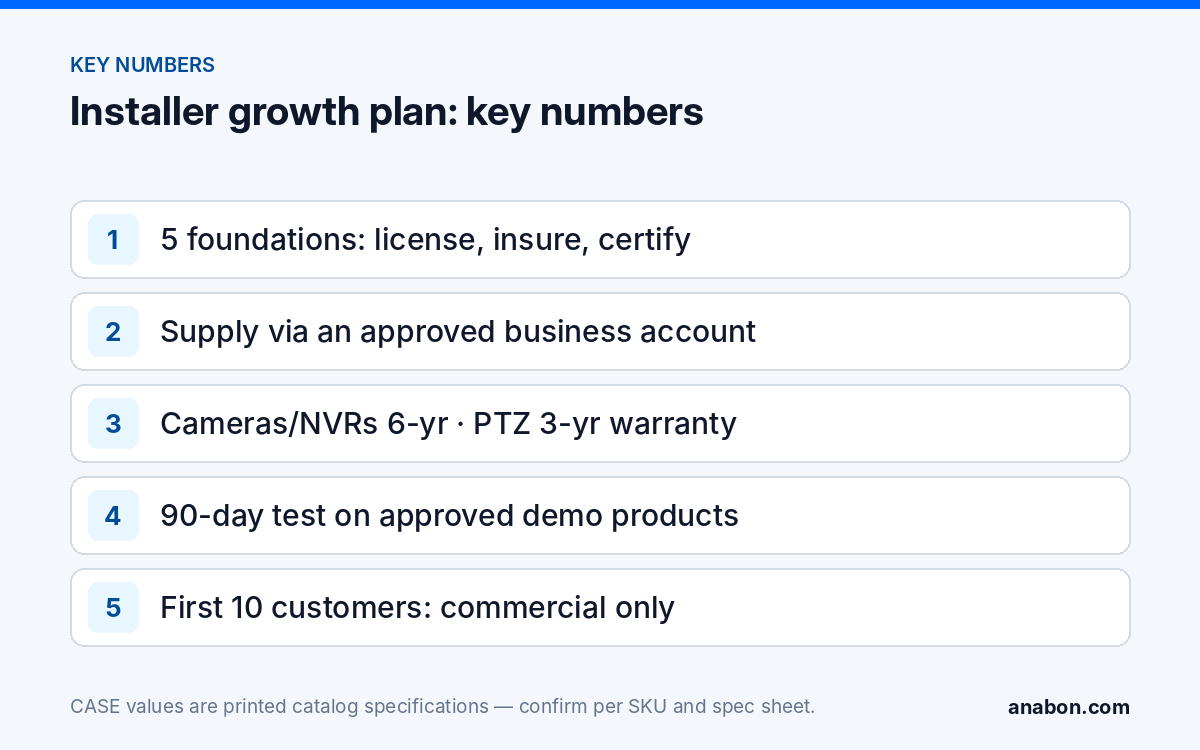
| Warranty | CASE cameras and CASE NVRs carry a 6-year warranty. CASE PTZ cameras carry a 3-year warranty. CASE accessories carry unlimited warranty. Hard drives are supported through back-to-back manufacturer warranty. Claims flow through you, never around you. |
| Trying before standardizing | For approved demo products we provide a 90-day test period under the approved demo return process. This is not a general return policy. |
| Documentation for bids | CASE offers NDAA-compliant options for compliance-sensitive projects. Anabon confirms the exact products and provides the official compliance documentation for each project. |
| Help on harder jobs | Technical support, product selection and project review before you quote |
Anabon Security Inc. is a North American B2B distributor of CASE and other professional security brands, and it works only with the trade: it never sells to your customer. The steps to open an account are in opening an Anabon business account, and the application itself is at the business account portal.
Who are your first 10 commercial customers?
The first ten customers decide what kind of company you become. Commercial work brings repeat visits, service agreements and referrals between businesses, so aim the first list there.
- Businesses you already know: former employers, suppliers, the people you have done electrical or IT work for.
- Property managers with several small buildings; one good job leads to the rest of the portfolio.
- Independent retail and restaurants, where cash handling and after-hours incidents create a clear need.
- Offices and medical clinics that need entrance, reception and parking coverage.
- Self-storage, yards and contractors’ lots with perimeter problems.
- Churches and nonprofits that need multi-building coverage and simple remote viewing.
- Electricians, IT service providers and locksmiths who meet these customers first and can refer you.
Two habits make the list work: a complete Google Business Profile, covered in the 45-minute setup guide, and a referral ask after every successful handover. More lead sources are in getting installation leads without buying them.
What is the simple tool stack?
A small company does not need enterprise software. It needs a few tools that everyone uses the same way.
- Customer and job sheet: one spreadsheet with leads, quotes, jobs, visit dates and open findings.
- Survey form, camera schedule and proposal template: the same three documents on every job, so quotes are consistent and hand off cleanly to the technician.
- Configuration tools: the Search Config Tool for device discovery, batch adding and storage sizing, and CASE Connect for the customer’s remote viewing at handover. App features are confirmed by model, software version and project configuration.
- Test gear: a cable certifier or verifier, a PoE tester, a laptop with the current firmware files, labels and a label printer.
- Accounting: bookkeeping software your accountant already supports, with job costing by project.
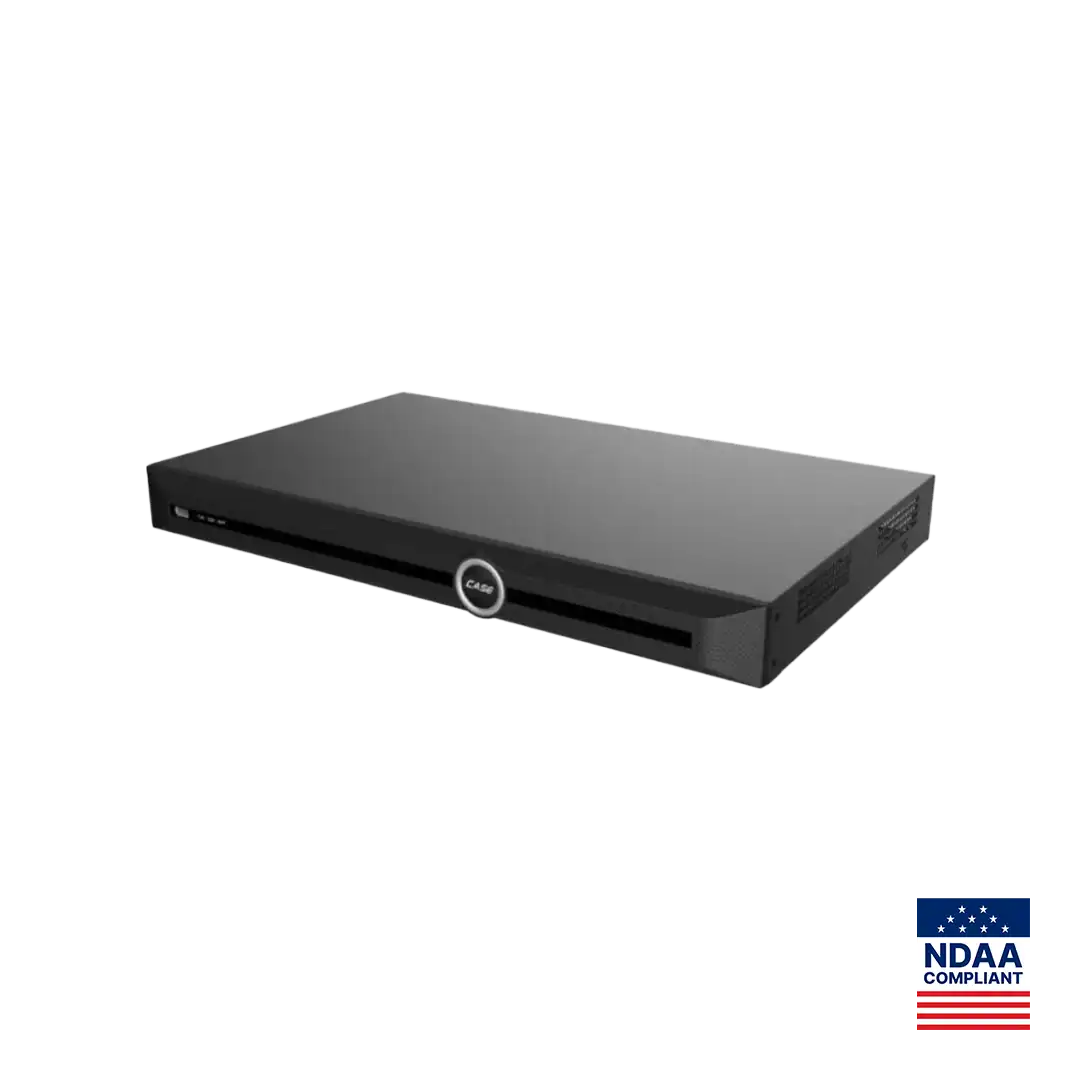
Standardizing on one recorder family and a few camera models multiplies the value of every tool. A technician who has configured twenty CS-N220 P16H-AI recorders, each with 20 channels and 16 PoE ports as printed, sets up the twenty-first faster and with fewer mistakes than one who meets a new interface on every job.
How do you grow into bigger projects?
The step from small jobs to projects with 40 or 80 cameras, several buildings or a public-sector bid is where most small companies stall. The work is not harder to install; it is harder to document, design and defend. The usual path:
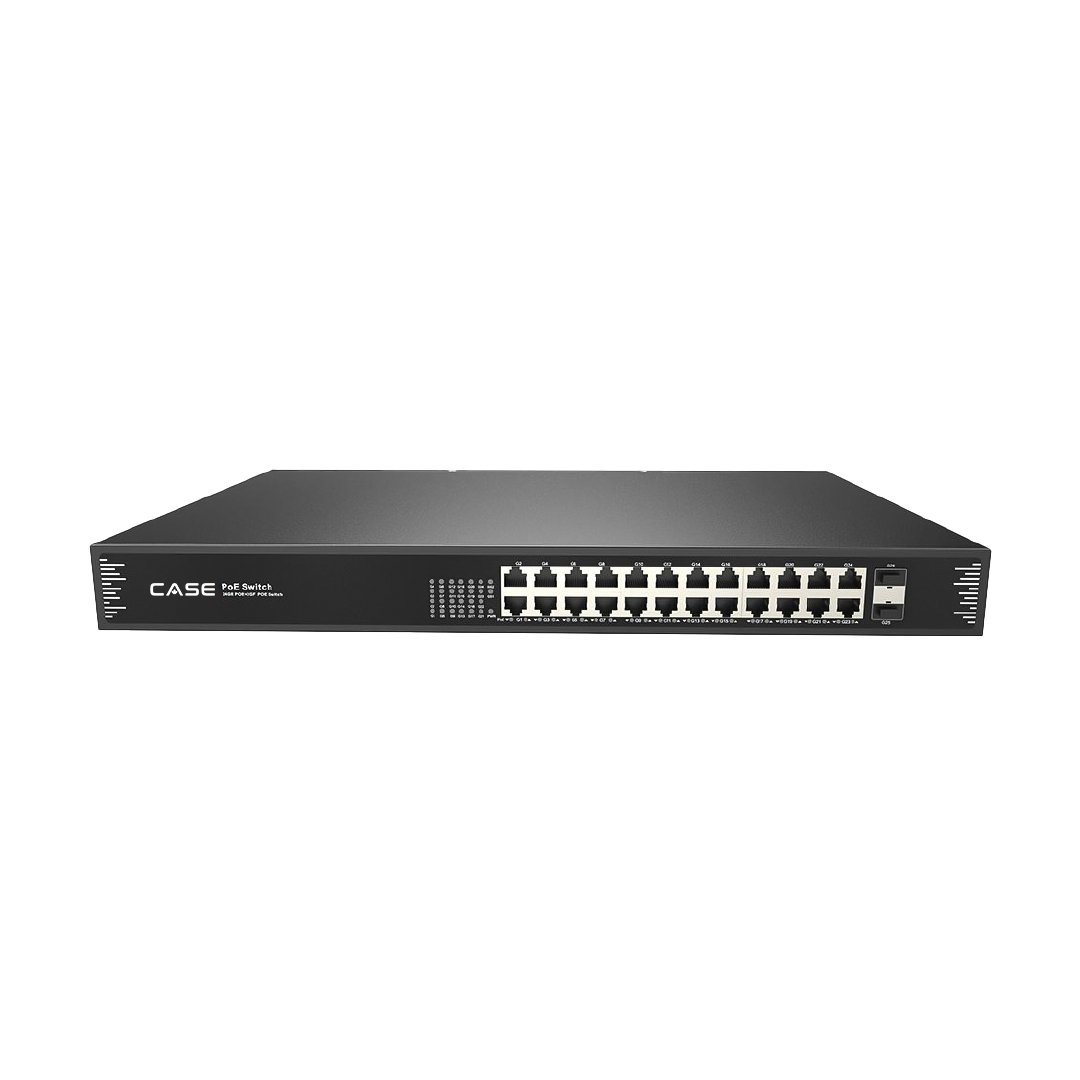
- Multi-building commercial sites with a single recorder or a recorder per building, and a designed PoE layer such as a 24-port switch like the CS-POE33024PF with 2 SFP fiber uplinks and a 400 W or 600 W PoE budget as printed.
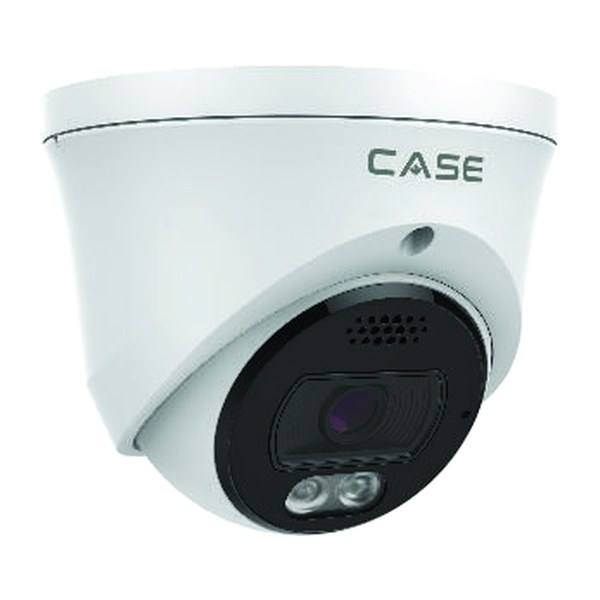
- Deterrence and AI projects where the outcome, not the camera count, wins the job: an EW turret such as the CS-I8XQ II-2.8mm, with EW availability confirmed per SKU, or an AI NVR with VCA Search.
- Bids and specified projects, which add submittals, compliance documentation and “or equal” evaluations; start with the RFP spec sections that decide the bid.
- Specialty requirements such as hazardous areas, thermal or long-range perimeter. CASE Project Series items are project-quoted; availability, certificates, lead time and warranty term are confirmed in writing per project.
The rule at every step: bring us the opportunity before you say no. A design review before the quote costs less than a change order after it.
What to tell your customer
“We are a licensed and insured commercial installer, and we stand behind every system we put in: warranty and service requests come to us. We standardize on a professional line with published specification sheets and warranty stated by category, and for projects with compliance requirements we provide per-product documentation from our distributor.”
FAQ
Do I need a license to install security cameras?
Often yes, but it depends on where you work. Many states, provinces and cities regulate low-voltage electrical work, alarm or security contracting, or both, and some license individual technicians as well as the company. Check with the state or provincial licensing authority and the city before you take paid work; this article is not legal advice.
What insurance does a security camera installer need?
Typically general liability, commercial auto, workers’ compensation once you hire, tools and equipment coverage, and professional liability if you design systems. Commercial customers and general contractors often ask for a certificate of insurance before work starts. Confirm coverage levels with a broker who works with contractors, since requirements vary by state, province and customer.
Which certification should a new installer get first?
Start with what your buyers and your work require: site safety training, then a cabling credential such as those offered by BICSI if you pull structured cable on commercial sites, and product training on the line you standardize on. Association programs from ESA in the US or CANASA in Canada add industry training and connections as you grow.
Why open a distributor business account instead of buying retail?
A business account gives you private pricing that your customer cannot find online, warranty handled through you, technical and project support, documentation for compliance-sensitive bids, and access to approved demo products. Retail purchases give you none of these and leave your quote exposed to any public listing your customer happens to find.
How many cameras should a new company take on per job?
Take jobs you can survey, document and support properly. For many new companies that means single-building commercial sites first, then multi-building sites once your survey, schedule and handover process is consistent. Larger or specified projects are reachable earlier if your distributor reviews the design with you before you quote.